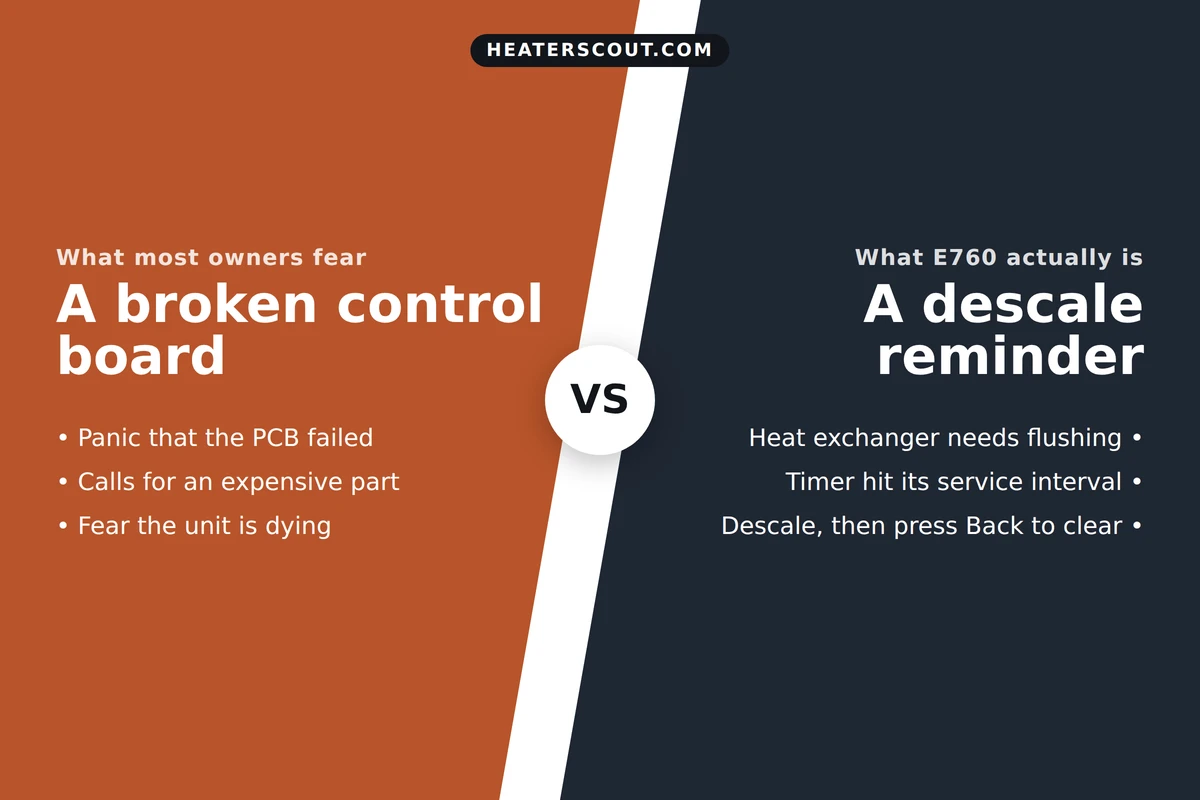
A Navien NPE that puts E760 on the front panel is not failing. It is nagging. The control board counts the hours the burner runs, and once that counter crosses a preset service interval it posts E760 to tell you the heat exchanger is due for a flush. No sensor tripped, no part died. The unit is asking for the annual descale that keeps a tankless heater efficient. That is the whole story, and it changes how you should react: this is a maintenance prompt, not a repair emergency.
What E760 really means
Ignore the guesswork online that calls E760 a 'communication error' between the front panel and the PCB. Navien's own manuals list E760 as the flushing and service alarm. It is a scheduled-maintenance reminder tied to run hours, not a board or wiring fault. Treat it as a request to descale, not a reason to order parts.
Why is my Navien still making hot water if E760 is showing?
Because nothing is actually broken. E760 is an alarm, not a lockout. On most NPE units the burner keeps running and the display keeps flashing the reminder. That is by design: Navien wants you to service the unit soon, but it does not want to leave you without hot water over a maintenance prompt. The exception is a heavily scaled exchanger that has already started tripping real overheat or exhaust faults on top of the E760. If the unit is cutting out, you are past due and the flush is overdue, not optional.
Which situation are you in
How you handle E760 depends on your setup and your comfort level. Three common cases cover almost everyone who sees this code.
You have isolation valves
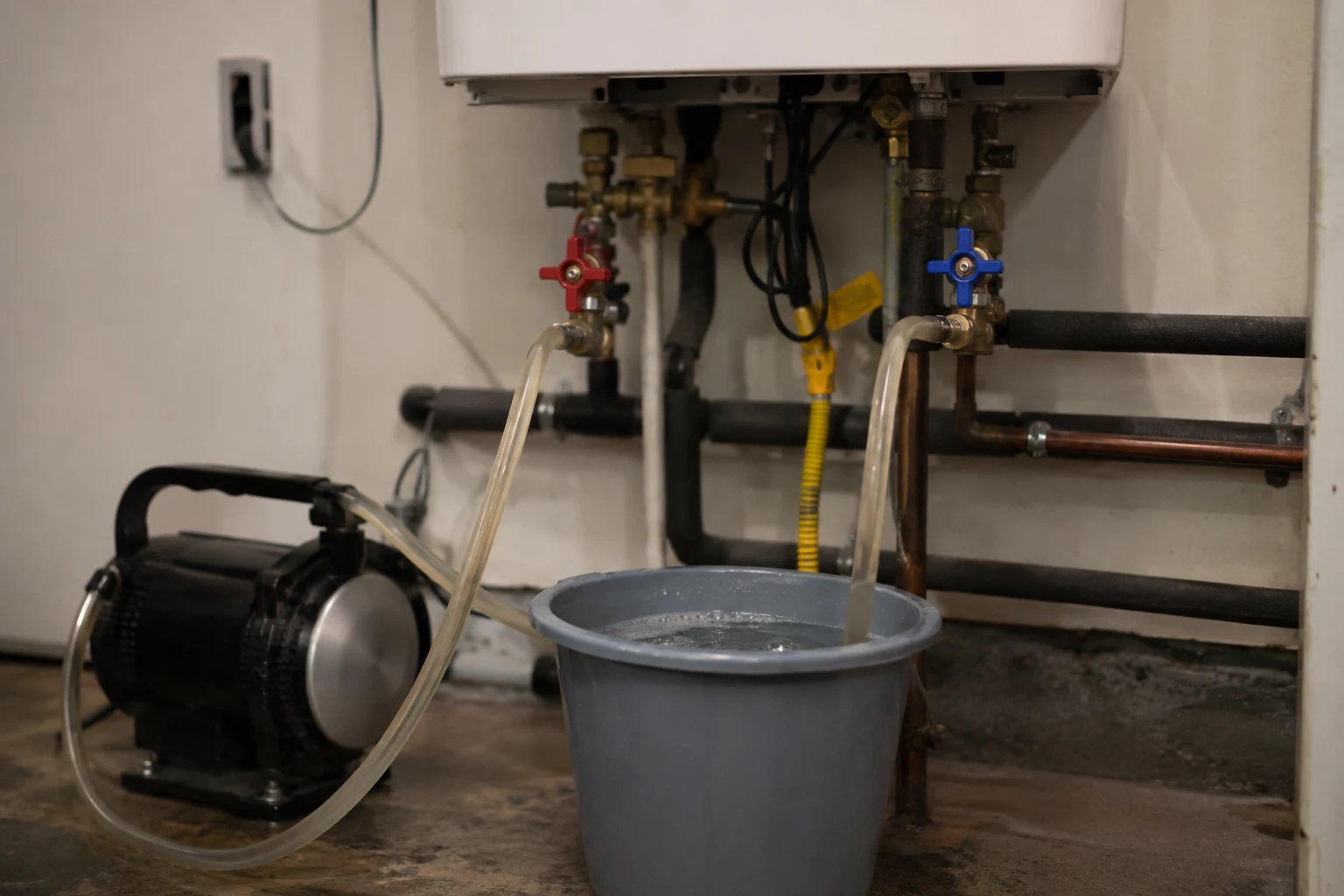
If the installer fitted service valves under the unit, you can flush it yourself in about an hour with a pump, two hoses, and a gallon of vinegar. Descale, then press Back to reset. This is the cheapest path and the one Navien assumes you will take on schedule.
No isolation valves
Without service valves you cannot easily circulate a descaler. You will either have a plumber add isolation valves during the service, which is worth doing once, or pay for a full professional flush. Either way the code clears the same way afterward, with the Back button.
E760 keeps returning fast
If the code comes back weeks after a flush, the timer is fine, your water is the problem. Very hard water scales the exchanger quickly. Add a softener or a scale filter on the cold feed so you are not chasing E760 every couple of months.
The descale-and-reset checklist
Work top to bottom. Shut down safely, circulate a descaler, rinse, then reset. Do not press Back until the flush is done, or you are only silencing the alarm.
- Turn off the gas supply to the unit and let the heat exchanger cool.
- Close the hot and cold isolation valves that feed the house so you circulate only through the heater.
- Connect a submersible pump and two hoses to the service (purge) ports, drawing from a bucket.
- Open the service valves and circulate white vinegar or a commercial descaler for 45 to 60 minutes.
- Drain the descaler, close the service ports, and reopen the house isolation valves.
- Run clean water through for several minutes to rinse any vinegar from the waterways.
- Restore gas and power, open a hot tap, and confirm the unit fires and heats normally.
- Press the Back button once on the front panel to acknowledge E760 and reset the service timer.
Navien code E760
The flushing and service alarm. Navien's control board tracks cumulative operating hours, and when that counter reaches the programmed service interval the unit displays E760 to prompt a heat-exchanger flush. It is a maintenance reminder, not a component fault, and it clears with the Back button once the descale is done. It is distinct from the low-number fault codes (E003 ignition, E016 overheat, and the rest), which indicate actual failures and usually lock the unit out.
Why the board tracks hours instead of measuring scale
It is worth understanding why E760 fires on a timer rather than reading an actual scale sensor. There is no cheap, reliable way to measure deposit thickness inside a sealed heat exchanger while the unit runs. What Navien can measure easily is time: how many hours the burner has fired since the last reset. So the board uses run hours as a proxy for how much scale has probably built up, and it sets the trigger point conservatively, well before a typical hard-water exchanger would be in trouble. That is why the code can appear even when your exchanger turns out fairly clean on soft water. The timer is not wrong, it is just cautious. The upside of a time-based reminder is that it is predictable: E760 lands on roughly the same schedule every year, so you can plan the flush instead of waiting for a hard fault to strand you without hot water on a cold morning.
Reading the code before you touch anything
Before you go get the pump, confirm the unit is genuinely showing E760 and not a different code that looks similar on a scratched panel. E760 sits by itself in the number space, far above the low E00x and E0xx fault codes. If the panel is actually flashing something like E016 or E030 alongside it, you have a real fault stacked on top of the maintenance reminder, and the flush alone will not clear that one. In that case, descale first because it often helps, then diagnose the remaining fault by its own number. When E760 is the only thing on the display and the unit is still heating water, you are squarely in descale-and-reset territory and the checklist above is all you need.
Why scale is worth flushing out
Scale is calcium and magnesium that drops out of hot water and plates onto the inside of the heat exchanger. A tankless unit is especially sensitive to it because the water runs through narrow copper or stainless passages that the burner heats fast. A thin scale layer acts like insulation between the flame and the water, so the burner has to work harder and run hotter to hit the setpoint. That shows up as higher exhaust temperatures, lower efficiency, and eventually real fault codes when a sensor sees numbers it does not like. E760 is Navien trying to get you to flush before any of that happens. The interval is deliberately set on the conservative side.
What the flush is doing chemically
White vinegar is dilute acetic acid, and a commercial tankless descaler is a stronger food-safe acid. Circulating it dissolves the calcium carbonate scale back into solution, which the pump then carries out into the bucket. That is why you circulate for the better part of an hour rather than just filling and draining: the acid needs contact time to eat through the deposit. The rinse afterward matters too. You do not want vinegar sitting in the waterways or reaching a hot tap, so run clean water through until it comes out with no smell. On soft water the exchanger may come out nearly clean, which is a sign your interval could stretch a little. On hard water you will see the vinegar turn cloudy, which is the scale you just removed before it could choke the unit.
Keeping E760 on a once-a-year rhythm
The goal is to make E760 boring: it shows up about once a year, you flush, you press Back, done. Two things keep it on that rhythm. First, water treatment. If you are on hard well or municipal water, a whole-house softener or a scale-inhibiting cartridge on the cold feed slows how fast the exchanger scales, which keeps flushes quick and stretches the interval. Second, do the flush when the code asks, not months later. A unit that is flushed on time comes apart easily and the vinegar clears it in one pass. A unit that has been ignored for two or three cycles can be packed hard enough that a single flush will not fully clear it, and now you are into a plumber's visit instead of a Saturday chore. E760 is the cheapest maintenance signal a tankless heater gives you. Answer it, and the expensive fault codes tend to stay away.
Frequently asked
Is Navien error code E760 dangerous?
No. E760 is the friendliest code Navien throws. It is a service alarm, not a failure. The control board keeps a running timer of operating hours, and when that timer crosses the preset service interval the unit posts E760 to remind you the heat exchanger is due for a flush. On most Navien NPE units the heater keeps making hot water while the code is showing, because nothing is actually broken. The risk is only in ignoring it. Scale that keeps building narrows the waterways, drives up the exhaust temperature, and eventually trips real faults like overheat or high exhaust temperature. So E760 is not an emergency, but it is not something to keep dismissing for another year either.
Can I reset Navien code E760 myself?
Yes, and the reset is simple: press the Back button on the front panel once. That acknowledges the alarm and clears it from the display. The important part is what you do before you press it. E760 is asking for a descale, so the honest sequence is to flush the heat exchanger first, then press Back to reset the service timer. If you press Back without descaling, the code goes away but the scale is still in there, and the timer will bring E760 back on schedule. Reset only after you have actually done the maintenance, or you are just snoozing an alarm on a unit that keeps building deposits.
How do I flush a Navien tankless to clear E760?
You need the isolation (service) valves that sit under the unit, a submersible pump, two hoses, a five-gallon bucket, and about a gallon of white vinegar or a commercial descaler. Turn off the gas and let the unit cool. Close the hot and cold isolation valves to the house so you are only circulating through the heater. Connect the pump and hoses to the service ports, open the service valves, and circulate the vinegar solution through the heat exchanger for 45 to 60 minutes. Then drain the vinegar, close the service ports, reopen the isolation valves, and run clean water through to rinse. Restore gas and power, run a hot tap to confirm normal operation, and press Back to clear E760.
How often does Navien E760 come back?
It is tied to run hours, not the calendar, so the interval depends on how hard the unit works and how hard your water is. On a typical home with moderately hard water, E760 tends to reappear somewhere around every 12 months, which lines up with Navien's recommended annual flush. On very hard water, or in a busy household running a lot of hot water, the timer can trip closer to every six to nine months. If E760 keeps coming back only a few weeks after a flush, that is not the timer being aggressive, that is a sign your water is scaling the exchanger fast and you should look at a whole-house softener or a dedicated scale filter on the cold feed.
Do I have to call Navien or a plumber for E760?
Not necessarily. A descale is within reach of a homeowner who is comfortable with hoses, a pump, and shutting off gas and water, especially if the installer already fitted isolation valves. The parts cost is small: a flush kit with pump and hoses runs about $60 to $130, and you reuse it every year. If your unit has no isolation valves, or you are not comfortable working around the gas line, a professional flush usually runs $150 to $300 and the tech will reset the code as part of the job. Navien technical support (1-800-519-8794) can also walk you through the reset and confirm your model's flush procedure.
Will descaling actually clear E760, and does the code prove there is scale?
Descaling is exactly what E760 is asking for, and pressing Back after the flush resets the service timer that raised the alarm. One nuance worth knowing: E760 is triggered by accumulated hours, not by a sensor that measures scale directly. So the code appears on schedule whether the exchanger is heavily scaled or nearly clean. That is fine. The interval is set conservatively so you flush before scale becomes a problem, not after. Do the flush, reset the code, and you have both cleared the alarm and done the maintenance it was prompting. If you are on soft water and the exchanger comes out clean, that is a good outcome, not a wasted trip.
What is the difference between E760 and a real Navien fault code?
The numbering tells you a lot. Navien's genuine fault codes are the lower E-numbers: E003 is ignition failure, E016 is overheating, E030 and E047 are exhaust and flame problems, and so on. Those point at gas, venting, sensors, or the board, and they usually stop the unit from running. E760 sits off on its own as a maintenance alarm. It does not mean a component failed, it means a maintenance timer elapsed. If you are unsure which family your code belongs to, the tell is behavior: a real fault typically locks the unit out and it will not heat, while E760 usually lets the heater keep working and simply nags you to service it. Treat the low-number faults as diagnose-and-repair, and E760 as descale-and-reset.