A Navien that locks out on E515 is not complaining about your water, your gas, or your venting. It is complaining about its own brain. The main control board runs a constant self-check on its internal circuit, the resistances, transistors, and relays that switch the fan, the igniter, and the gas valve. When one of those readings falls outside what the board expects, it flags an abnormal PCB and shuts the unit down on purpose. The code points straight at the board, which scares people into buying one. Hold off. A $200 board is the last thing this fault usually needs.
What E515 is actually reporting
Navien's service literature is blunt about it. Per the NCB-180 service manual, a 515 error means an error occurred in the internal circuit of the PCB, giving resistance, transistor, or relay faults as examples. On newer units it shows as 515-09, where 515 is the fault family and the suffix logs which internal check tripped. Some techs describe the trigger as an IGBT or relay reading out of range, or the board's own monitoring device flagging the control as abnormal. The practical takeaway is the same either way: the board does not trust a signal inside itself, so it refuses to fire. That self-distrust can come from a genuinely bad board, but far more often it comes from something feeding the board a bad signal, a loose plug, a weak ground, or dirty power. The board is the messenger, not always the culprit.
The fix, cheapest first
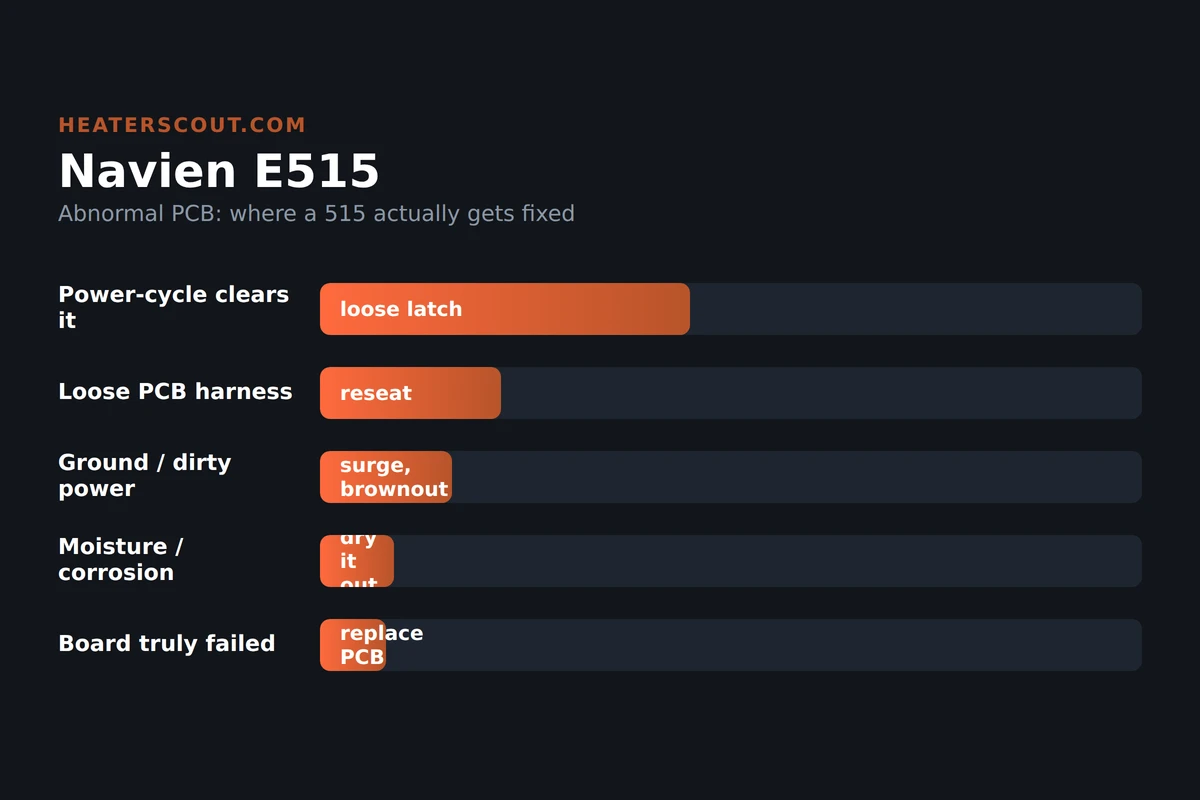
Work from free to expensive. A power-cycle costs nothing and clears a large share of 515 events outright. Only after the free and cheap checks fail do you talk about a board.
| Code meaning | Abnormal PCB (main control board internal fault) |
| Shown as | E515 or 515-09 on newer units |
| Board fault type | Resistance, transistor, relay, or IGBT out of range |
| Most likely real cause | Loose harness, bad ground, or dirty power |
| Reset method | Full 5-minute power-down at breaker or outlet |
| What to inspect | PCB harness, ground, igniter, fan, dual venturi, 3-way valve |
| OEM control board | About $200 to $320 for the part alone |
| Pro repair range | About $450 to $800 diagnose and board swap |
| Surge protection | $30 to a few hundred installed, if power is dirty |
| Navien support | 1-800-519-8794 (read the full code with suffix) |
| Difficulty | DIY reset and reseat, licensed tech for board or gas |
Which path fits your situation
How a 515 shows up tells you where to aim. A code that appears once and never returns is a different animal from one that fires every morning.
One-time 515 after a storm or flicker
A single 515 that clears on a power-cycle and never comes back was almost certainly a surge or a brownout that rattled the board. No parts needed. If your area has flickery power, add a surge protector so the next spike does not do worse than a lockout.
Intermittent 515, works then quits
A 515 that appears randomly and clears on its own points at a loose harness or a marginal ground, not a dead board. Vibration and heat cycling back a connector out over time. Reseat every plug on the board and check the ground before you spend a dollar on parts.
Hard 515 that returns instantly
A 515 that comes back the moment you restore power, with clean harnesses and a good ground, is the case where the board may genuinely be failing. This is the one that justifies an OEM board, and it is a licensed tech's job to confirm and swap it.
515 with moisture in the cabinet
If you find water or heavy condensation inside the unit, corrosion is the likely trigger. Fix the source of the water first, dry and clean the board, and only then decide if a corroded board needs replacing. A new board in a wet cabinet fails again fast.
Diagnostic order when the reset does not hold
If a full power-down and a harness reseat both fail, stop guessing and work the list in order. Navien's own guidance is to inspect the board along with the parts it drives before condemning it.
Verify the power feeding the unit
Check that the outlet or circuit delivers a stable, correct voltage. A brownout, an undersized shared circuit, or a big motor load dipping the line at startup can trip a 515 without a thing being wrong inside the board. A voltage meter at the unit while a nearby load starts tells you if the power is the problem.
Inspect the parts the board drives
Per Navien, look over the PCB's monitoring device, the igniter, the fan, the dual venturi, and the 3-way valve. A shorted or seized component the board switches can drag a relay or transistor reading out of range and present as an abnormal PCB. Confirm each part and its connector is sound.
Rule out ground and electrical noise
A weak or missing ground lets noise reach the board and corrupt its self-checks. Reseat the ground at the board and chassis, confirm continuity back to the panel, and keep the unit off circuits that share heavy inductive loads.
Check for moisture and corrosion one more time
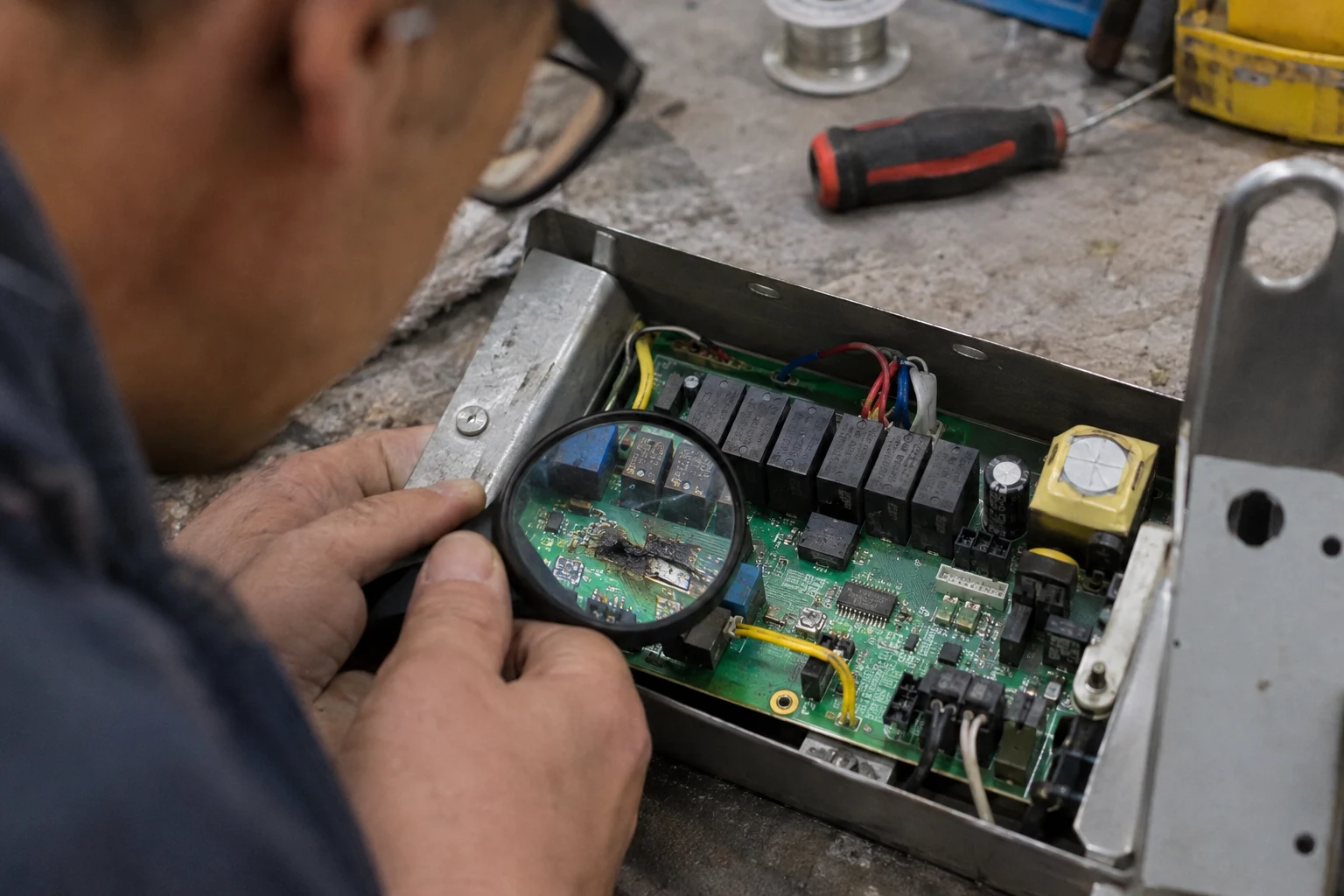
Condensation inside a sealed combustion cabinet, or a slow leak dripping onto the board, corrodes pins and bridges traces. A green or crusty connector produces the same fault as a bad component. Dry, clean, and reseat before you buy anything.
Replace the control board last
Only after power, driven parts, ground, and moisture all check clean and 515 still returns do you fit an OEM Navien board matched to your model and serial range. Then set the DIP switches or settings for your gas type and altitude so the new board runs your unit correctly.
Where the homeowner line sits
The reset and the visual checks are fair game for a careful homeowner. Powering the unit down, opening the cover, reseating plugs, and looking for corrosion or water is a screwdriver and a flashlight, no gas and no live testing. The line you do not cross is anything with the unit powered, anything on the gas side, and the board swap itself. Measuring live voltage, condemning driven components, and replacing and reprogramming a control board are licensed-tech work, both for safety and because a new board set up wrong runs the burner wrong. Never bypass a control circuit to force a unit past a 515. That fault exists so the board does not run the gas valve and igniter off signals it cannot trust.
Should I add a surge protector after an E515?
If the fault traced back to a storm, a flicker, or a brownout, yes. Sensitive tankless control boards do not like voltage spikes or sags. A dedicated or whole-house surge protector is cheap insurance against the next event doing permanent damage instead of a clearable lockout. It will not fix a board that already failed, but it protects the replacement.
Keeping E515 from coming back
A control board lives longer on clean, stable power in a dry cabinet. If your unit sees frequent 515s, the highest-value moves are protecting the power and sealing out moisture, not swapping boards. Put the heater on a properly grounded circuit that is not shared with heavy motor loads, add surge protection if your power is flickery, and keep the cabinet dry by fixing any leak or condensation source promptly. Roll a connector check into the annual service: have the tech reseat the board harnesses and eyeball the plugs for early corrosion while the unit is already open for a descale. The board that never gets fed a bad signal is the board that never throws a 515.
Frequently asked
Can I reset Navien error code E515 myself?
Yes, and a full power-down is the first thing to try. E515 is a latched fault, which means the board holds it until you clear it, not until the condition passes. Turn the unit off at its power switch, then kill the breaker or unplug the unit at the wall outlet and leave it dead for a full five minutes. Thirty seconds is enough to reboot most electronics, but Navien techs use five minutes so the board's capacitors fully discharge and the internal watchdog resets clean. Restore power and run a hot tap. If 515 stays gone, you caught a one-time glitch, often a brownout or a voltage spike that rattled the board. If it comes right back, the reset did its job of proving the fault is real, and you move on to the harness and ground checks. The reset never repairs a board, it only clears the flag.
What does the -09 mean in 515-09 on my Navien?
Newer Navien units show a two-part code, a main number and a sub-number, like 515-09. The 515 is the fault family, an abnormal PCB. The -09 is Navien's sub-index that points the tech at which internal check tripped, logged in the error history menu. You do not need to decode the suffix to act on it, because the response is the same across the 515 group: power-cycle, then inspect the board's connections, ground, and power quality before you condemn the board. If you call Navien support at 1-800-519-8794, read them the full code including the suffix, because it helps them narrow the diagnosis and tell you whether your serial range has a known board revision or bulletin.
Does E515 mean I have to replace the control board?
Usually not. The code names the PCB because the board is reporting a problem with itself, but a board that can still light up, run its display, and post an accurate error code is often not the actual failure. In the field, most 515 events trace back to something feeding the board: a loose or corroded wiring harness, a poor ground, or dirty power from a surge or a brownout. Those mimic an internal board fault because they scramble the signals the board is checking. Replace the board only after a power-cycle, a full harness reseat, a ground check, and a look for moisture all come up clean and the code still returns. Swapping a $200-plus board first is the expensive way to find out the real problem was a $0 loose plug.
How much does it cost to fix Navien code E515?
It ranges from nothing to several hundred dollars depending on where the fault lands. A power-cycle that holds costs you nothing. Reseating a loose harness or cleaning a corroded ground is free beyond your time. If the board genuinely failed, an OEM Navien PCB runs roughly $200 to $320 for the part alone depending on model, and you want the exact board for your serial range, not a generic one. Add a licensed tech to diagnose and swap it and the total usually lands around $450 to $800 once you count the trip, labor, and reprogramming the DIP switches or settings to match your gas type and altitude. A whole-house or dedicated surge protector, worth adding if dirty power caused the fault, is another $30 to a few hundred installed.
Will descaling clear error code E515?
No. Descaling flushes scale out of the heat exchanger's water side, and 515 is a control-board fault on the electronics side. The two do not touch. If your unit is also throwing flow or temperature codes, descaling may help those, but it will not move a 515. Keep descaling on its annual schedule for the health of the unit, then handle 515 as an electrical problem: power-cycle, check the board's connections, the ground, and the quality of the power feeding it.
Why does Navien E515 keep coming back?
A 515 that returns after a reset is telling you the trigger is still present. The repeat offenders, in order: a harness connector on the board that is loose, corroded, or backed out just enough to drop a signal intermittently. A weak or missing ground, which lets electrical noise reach the board and fail its internal checks. Dirty power, meaning surges, brownouts, or a shared circuit with a big motor load that dips the voltage every time it starts. Moisture or condensation inside the cabinet corroding a trace or a pin. And last, a board that has actually degraded. Chase them in that order. If you replace the board and 515 comes back within weeks, the board was never the problem, the power or ground feeding it is.
Is Navien error code E515 dangerous?
The code itself is a protection, not a hazard. When the control board cannot trust its own internal circuit, it shuts the unit down rather than run the burner, the fan, and the gas valve off readings it does not trust. That lockout is the safe outcome. The danger would be forcing the unit to run past a control fault, which you should never do. You lose hot water, which is an inconvenience, not a risk. If you ever smell gas, see scorching or melted connectors on the board, or find water pooled inside the cabinet, stop and get a licensed tech out, because those point at a problem bigger than a reset will fix.