Your Navien tankless unit stops making hot water, the display reads E397, and pressing the tap only gives you cold. That code points at one small part: the thermistor on the hot water outlet, the sensor that tells the control board how warm the water leaving the heat exchanger actually is. When the board reads that sensor as electrically open or shorted, it stops trusting the number, locks out the burner, and shows E397 rather than risk scalding water at the tap. Most of the time this traces to a loose plug or a chafed wire, not a dead unit.
Clear it once before you open anything
A single reset is worth trying, because a connector that jostled loose during a service call or a vibration event will read as open until you reseat it, and a reset with a good connection makes the code vanish for good. If E397 comes straight back, you have learned something useful: the fault is real and physical, not a one-time glitch. Do the reset first so you are not chasing a ghost.
What the board is actually measuring
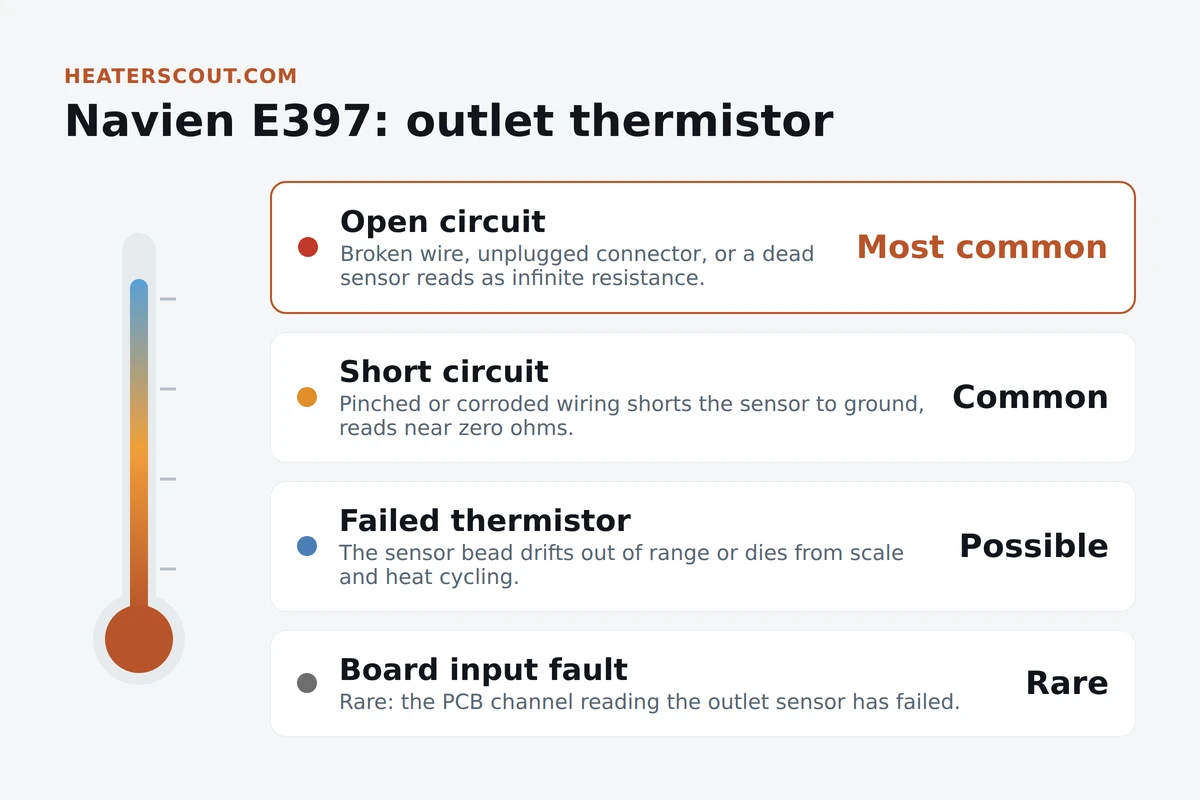
To read the diagnosis correctly it helps to know what a thermistor is and why the board cares so much about this one. Two conditions trip E397, and they sit at opposite ends of the electrical scale. Knowing which one you have narrows the hunt before you ever pick up a meter.
Open circuit (reads infinite)
- A connector fell off or was never fully seated after a service.
- A wire in the thermistor harness broke or pulled out of its pin.
- The sensor element itself died and no longer conducts.
- Fix path: reseat the plug first, then ohm the sensor if it stays open.
Short circuit (reads near zero)
- Two conductors touch where insulation chafed against a metal edge.
- Corrosion or condensate bridges the pins inside a connector.
- A pinched harness shorts intermittently when the unit heats or vibrates.
- Fix path: inspect the harness for damage, clean or replace the connector.
Track the fault down in order
Work from cheapest and most common to rare and expensive. Kill power at the breaker before you open the cover, and treat everything inside as if it can bite, because the controls run on 120 volts and the appliance burns gas. Each step below either clears the code or hands you off to the next.
1. Kill power and open the front cover
Switch off the dedicated breaker for the water heater and confirm the display is dark before you remove the front panel. The outlet thermistor sits on the hot water outlet pipe, after the heat exchanger, usually a small sensor body clipped or threaded to the pipe with a two-wire lead running back to the control board.
2. Reseat the thermistor connector
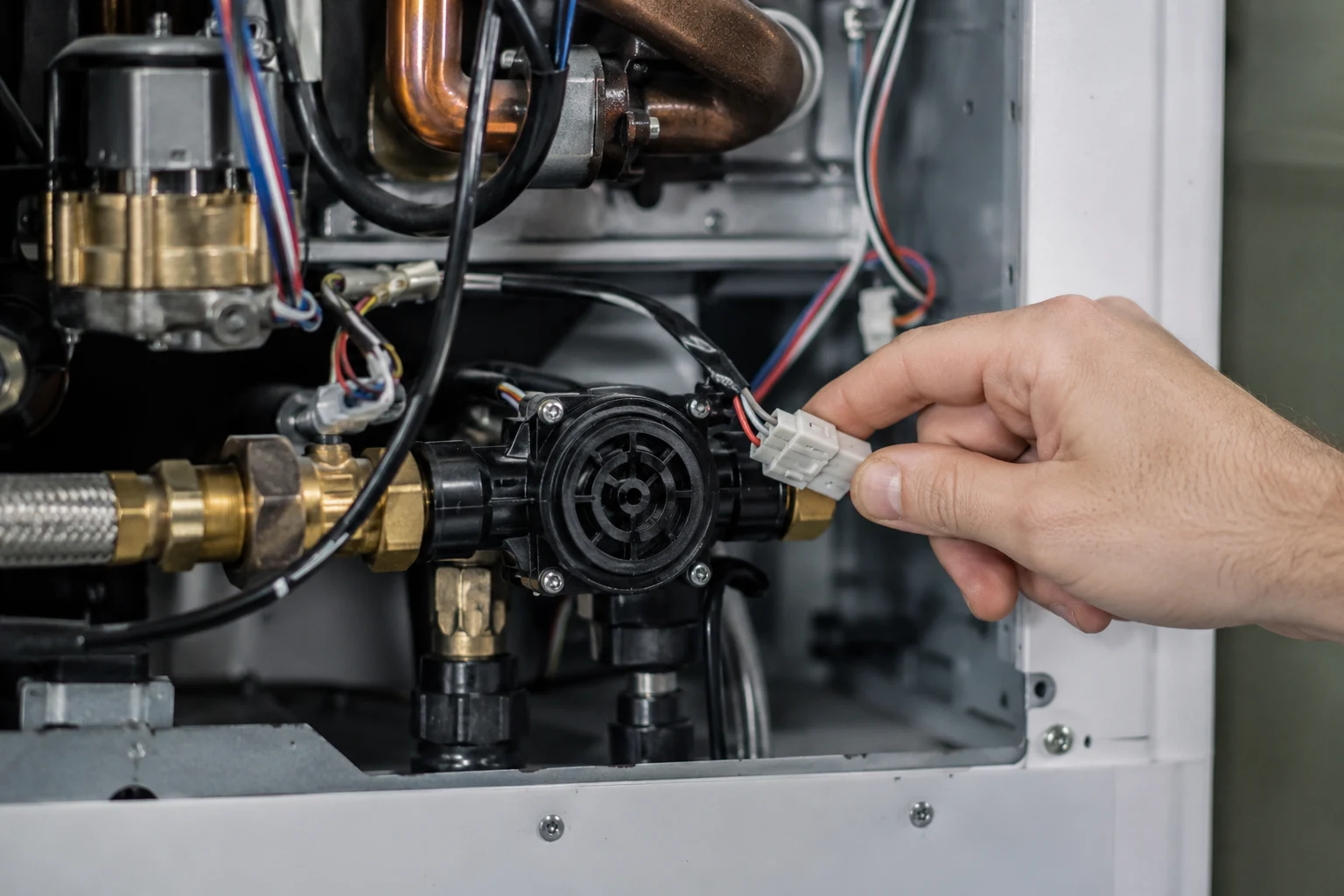
Find where the outlet thermistor lead plugs into the board or an inline connector. Unplug it, look for green corrosion or a spread pin, and firmly plug it back in until it clicks. A surprising share of E397 calls end right here, at a plug that vibrated loose or was left half-seated after a prior service.
3. Inspect the harness for damage
Follow the two wires from the sensor to the board. Look for a spot where the insulation is chafed against a metal edge, melted near a hot surface, or pinched under the cover. A short shows up as bare copper touching metal or the two conductors touching each other. Repair or reroute any damage you find and secure the harness clear of edges and heat.
4. Ohm the thermistor against spec
This is where it becomes a tech job. With power off and the sensor unplugged, measure resistance across the thermistor leads with a multimeter and compare it to the temperature-versus-resistance table in the service manual for your model. A reading of open (OL) or near zero confirms a dead sensor. A reading wildly off the table for the current pipe temperature means it has drifted and should be replaced.
5. Replace the sensor, then suspect the board
If the thermistor tests bad, swap in the correct Navien outlet thermistor for your model and clear the code. If a known-good sensor and clean wiring still throw E397, the input channel on the control board that reads this sensor may have failed, which is a rare last resort and a call to Navien support or a service tech.
Never bypass the sensor
Do not jumper, bypass, or fake out the outlet thermistor to force the burner to fire. That sensor is one of the board's overheat guards. Without a real outlet temperature the control cannot tell 120-degree water from 180-degree water, and defeating it removes a scald protection that E397 exists to enforce. If you cannot resolve the fault with a reseat and a visual check, stop and call a licensed tech or Navien support rather than working around the lockout.
DIY-safe versus licensed-tech territory
The line here is not arbitrary. Reseating a plug with the power off is low risk. Metering a live-adjacent sensor circuit, tracing a harness short, or condemning a control board all sit inside a gas appliance and call for someone who does this for a living. Here is where each task falls.
| Task | DIY-safe | Licensed tech |
|---|---|---|
| Clear the code with Reset or a power cycle | Yes | - |
| Open the cover and reseat the thermistor connector | Yes, power off | - |
| Visually inspect the harness for chafe or short | Yes, power off | - |
| Ohm the thermistor against the manual's table | No | Yes |
| Repair or replace the sensor wiring harness | No | Yes |
| Replace the outlet thermistor | Handy owner, cautiously | Preferred |
| Diagnose or replace a failed board input | No | Yes |
Parts and rough cost
The economics of E397 swing on how far the fault runs. A reseated plug is free. A sensor swap is a modest part and a short labor call. Tracing an intermittent short or replacing a board input is where the bill climbs, because the time is in the hunt, not the part.
The outlet thermistor itself usually runs about $25 to $60 from a Navien parts supplier, and it is model specific, so match it to your unit rather than grabbing a generic sensor. A service call to diagnose and replace it commonly lands between $150 and $350 in labor in most US markets, depending on your area and whether the tech has to chase an intermittent fault. If the trail ends at the control board, the part alone is several hundred dollars, at which point the age of the unit and its warranty status start to matter to the repair-or-replace decision.
Keep it from coming back
Most E397 repeats trace to wiring that was never fully secured or a sensor slowly cooked by a neglected unit. After any repair, make sure the harness is routed clear of hot surfaces and sharp edges and that every connector is fully seated and clicked. Descaling on schedule does not fix a sensor fault, but a unit that gets its annual flush and clean filter runs cooler and cycles less harshly, which is exactly the abuse that ages a thermistor. If your water is hard, a scale filter or softener upstream buys the whole machine, sensors included, a longer life. When E397 returns despite a clean reseat and a good sensor, stop guessing and get a meter on it.
Frequently asked
What does error code E397 mean on a Navien tankless water heater?
E397 tells you the control board has lost a trustworthy reading from the hot water outlet thermistor. The thermistor is a small temperature sensor clipped to the outlet pipe after the heat exchanger, and the board watches it constantly to hold your set temperature and to catch an overheat. When that sensor reads as an open circuit, meaning the resistance has gone to infinity because a wire broke or a plug fell off, or as a short circuit, meaning the resistance has dropped near zero because two conductors touched, the board can no longer believe the outlet temperature. It refuses to run rather than risk sending scalding or wildly swinging water to your taps, and it flashes E397. Most published Navien code lists show E397 as an outlet thermistor fault, though a few third-party charts blur it together with the neighboring outlet-sensor codes, so if your manual labels it slightly differently, trust the manual for your exact model.
Can I reset code E397 myself?
You can clear the display, and it is worth trying once. Press and hold the Reset or Back button on the front panel for three to five seconds, or cut power at the breaker for a full minute and restore it. If a connector had simply worked loose and you reseated it, the code stays gone and you are done. What a reset cannot do is fix a broken wire, a corroded pin, or a dead sensor. If E397 comes right back, or comes back the next time you draw hot water, the reset only confirmed that something in the outlet thermistor circuit is genuinely faulty and needs a repair, not just a power cycle.
Is it safe to keep using the heater with E397 showing?
No, and the unit will not really let you. When E397 is active the burner is locked out, so you get cold water rather than a safety hazard. The reason the board is so strict is that the outlet thermistor is one of its overheat guards. Without a believable outlet temperature reading, the control has no way to know if the water leaving the exchanger is 120 degrees or 180, so it shuts down instead of guessing. Do not try to jumper or bypass the sensor to force the unit to fire. That defeats a scald protection the code exists to enforce.
How much does it cost to fix Navien E397?
If the fix is a reseated connector or a repinned wire, it costs nothing but your time. A replacement outlet thermistor from a Navien parts supplier typically runs about $25 to $60 for the sensor itself, depending on model and where you buy it. A licensed plumber or Navien service tech will usually charge a one to two hour minimum, so figure $150 to $350 in labor on top of the part for a diagnosis and swap in most US markets. The wide range is real: a wiring repair at the connector is quick, while tracing an intermittent short inside a harness or replacing a board input takes longer and costs more.
Will descaling clear code E397?
Usually not. Descaling flushes mineral scale out of the heat exchanger and matters enormously for flow and efficiency codes, but E397 is an electrical reading on a sensor circuit, not a flow or scale problem. That said, there is one indirect link. Heavy scale and the heat cycling that comes with a neglected unit can cook a thermistor over time until it drifts or fails, so a machine that throws E397 has often been skipping its annual descale too. Flush it as part of good maintenance, but do not expect the vinegar or descaler pump to bring the sensor circuit back to life.
Why does E397 keep coming back after I reset it?
A code that returns is telling you the fault is still physically present. The three usual reasons, in order, are a connector that looks seated but has a spread or corroded pin so the contact is intermittent, a wire in the thermistor harness that is chafed or pinched against a metal edge and shorts when the unit vibrates or heats up, and a thermistor whose internal bead has finally died. Intermittent returns that track with hot water draws point at wiring that moves or heats. A code that is present the instant you power up points more at a dead sensor or a hard short. If reseating and a visual check do not hold, the next step is ohming the sensor, which is a meter job for a tech.
Do I need a licensed technician, or is this a DIY job?
It depends on how far the trail goes and how comfortable you are inside a live gas appliance. Opening the front cover, finding the outlet thermistor on the hot outlet pipe, and reseating its connector is within reach for a careful homeowner who has killed power first. Beyond that, measuring the thermistor resistance with a multimeter against the spec in the service manual, tracing a harness short, or replacing the sensor or a board input is licensed-tech territory, especially since you are working around gas and 120-volt controls. If the reseat does not fix it, calling a Navien service tech or Navien support at 1-800-519-8794 is the sane move rather than deeper probing.