Navien lets you wire up to 16 tankless heaters together in a cascade so they share one big hot-water load, and those units talk to each other over a communication cable. Error code E361 is what one board throws when that conversation goes quiet. On Navien's error-code references it reads as an abnormality in cascade communication. In plain terms, a unit that expected to hear its neighbors stopped hearing them, dropped out of the bank, and lit the display. The fix is usually a cable or a connector, not a torn-apart heater.
First, make sure E361 is really the code you have
There is a naming snag worth clearing up before you spend money. A handful of homeowner troubleshooting pages online list E361 as an inlet water thermistor fault. That does not line up with Navien's own lists, where the cold-water inlet thermistor fault on NPE units is E421, a separate code for an open or shorted sensor. E361 sits in the cascade-communication family. So if your heater is a single standalone unit with nothing else wired to it, an E361 reading is odd, and you should confirm it against the error table printed in your specific model's installation manual before chasing a cascade cable that does not exist. Sources genuinely disagree here, and I would rather you check than trust a random blog. If you do run a cascade or Ready-Link bank, E361 as a communication fault fits, and everything below applies.
How the fault shows up
The pattern is telling. E361 tends to appear when units are powered up in the wrong order, when a cable gets bumped during service, or right after someone adds or swaps a unit in the bank. It rarely shows up in the middle of a quiet night with nothing touched. Read that as a hint: the fault is almost always something physical in the link, not a random board failure.
Which unit is complaining
In a cascade, each heater has its own display. Find the unit actually showing E361. It is the board that lost contact, and its neighbors on the cable are where you look next.
The Ready-Link cable and RJ45 plugs
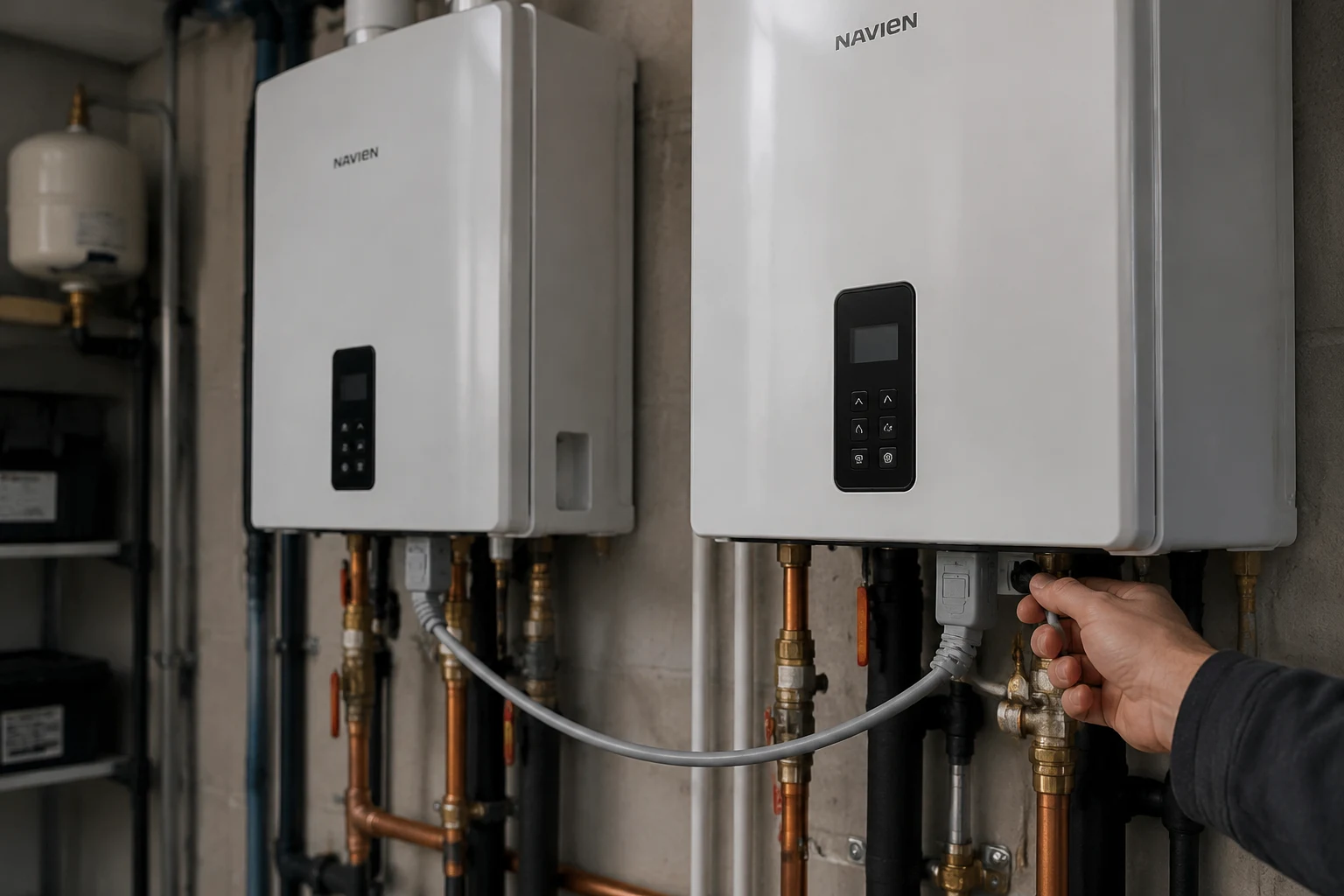
Follow the communication cable from the flagged unit to the next. Look for a plug backed halfway out of the port, a snapped RJ45 locking tab, a pinched run behind a unit, or a cable dressed right against a high-voltage line where it can pick up noise.
Master and slave settings
Confirm one unit is set as master and the addresses or dip switches on the others match the install. A setting that got bumped during a service visit will drop a unit off the bank and read as a communication fault.
Board firmware match
If a board was replaced or a unit was added recently, the PCB firmware versions across the bank need to be compatible. Mismatched boards will not hold a cascade link no matter how good the cable is.
Who is most likely to hit this
E361 is not a code the average single-heater household ever sees. It belongs to installs that gang units together, and the likely cause shifts depending on which kind of install you have.
A recently serviced cascade
Someone opened up the bank last week to descale or swap a part, and a communication plug did not click all the way back in. Reseat every RJ45 and the code usually clears.
A newly expanded bank
A unit was just added to grow capacity. Suspect firmware mismatch or an address that was never set. New board, old boards, and they refuse to talk until versions and settings line up.
A multi-unit building system
A bank feeding domestic hot water across a building. Here a dropped unit at peak demand is a real problem, so E361 gets urgent fast. Cable routing near high-voltage runs is a frequent culprit in these rooms.
A single standalone heater
If a lone unit with no cascade shows E361, stop and verify the code against your manual. It may be a misread, a display glitch, or a different code entirely. Do not buy a cable for a bank you do not have.
Clear it and confirm the fix
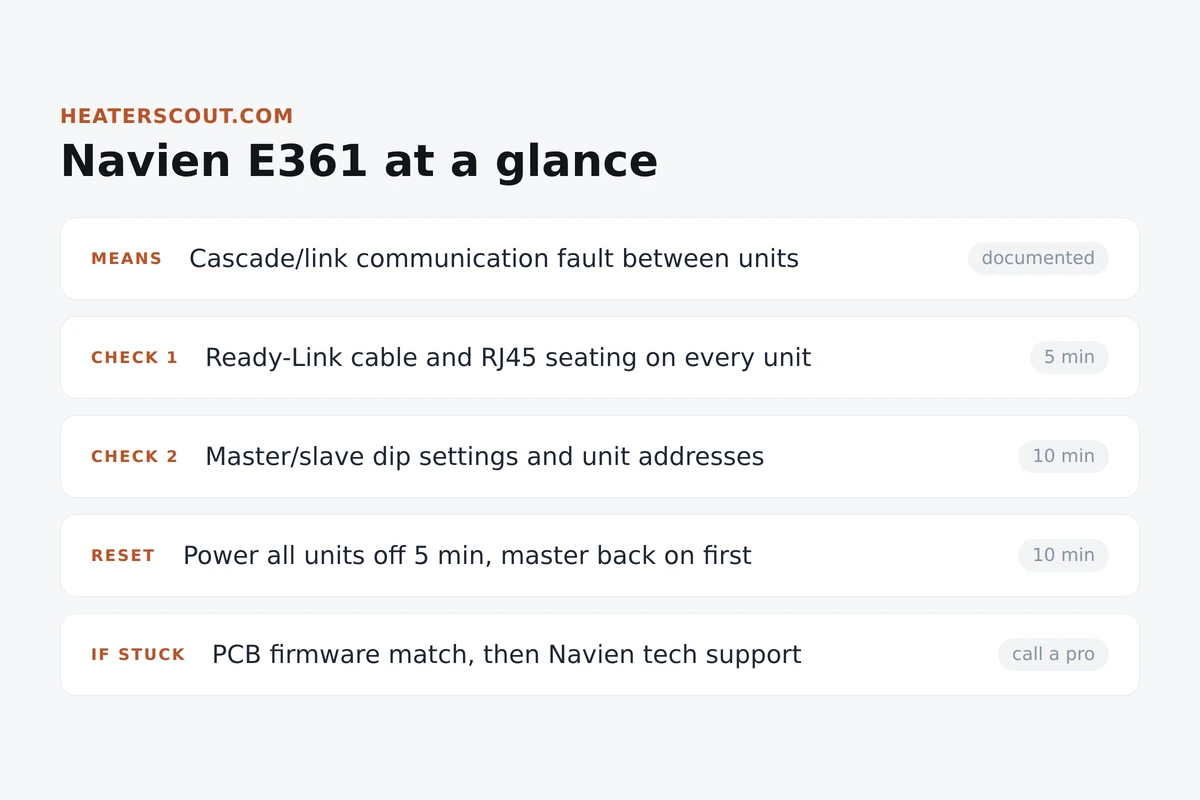
The reset is the same power-cycle discipline that fixes half of all cascade gremlins, done in the right order. Do not just cycle the one unit that is complaining. The whole bank needs to come back up in sequence so the master re-establishes the link before the others try to join.
If that holds, you are done, and it was a connector or a power-up order problem. If E361 comes back, the next question is whether this is still a job for you or a job for a Navien tech.
What you can safely do versus what needs a pro
The dividing line is clean. Anything on the communication side with the units powered down is fair game for a homeowner. Anything involving a control board, a firmware update, or the gas and high-voltage terminals belongs to a licensed tech. Here is how that splits.
Safe to do yourself
- Power-cycle the whole bank in the correct order, master first.
- Unplug and re-seat every RJ45 communication connector.
- Swap in a known-good CAT5e or Navien Ready-Link cable.
- Check that no cable is pinched or run against high-voltage wiring.
- Confirm master and slave dip or address settings match the install.
Call a licensed tech
- Diagnosing a suspected control board after the cable checks out.
- Any PCB firmware update or version-match across the bank.
- Replacing a communication board or main control board.
- A repeating E361 in a light commercial system on a schedule.
- Anything that means opening gas or high-voltage terminal blocks.
Keeping E361 from coming back
Prevention here is mostly about respecting the cable. Route the Ready-Link communication line away from high-voltage runs so it does not pick up electrical noise, and dress it so nothing gets pinched when a unit is pushed back against the wall. Use a proper CAT5e or higher cable with intact RJ45 tabs, not a tired patch cord with a cracked connector. When you add or replace a unit, check that the new board's firmware is compatible with the rest of the bank before you close it up. And when anyone services the system, power the units back on in order, master first, so the cascade rebuilds itself cleanly.
Descaling still matters for the health of each unit, and it heads off a long list of other Navien codes tied to scale and flow. It just will not touch E361, because this fault lives in the wiring and the boards rather than the water path. Keep the two maintenance jobs separate in your head: descale for the water side, cable and board care for the communication side.
Frequently asked
What does error code E361 mean on a Navien tankless water heater?
On Navien's published error-code references, E361 reads as an abnormality in cascade communication. That means the control board on one unit stopped hearing the other units it is linked to over the Ready-Link cable. Navien lets you gang up to 16 tankless heaters together in a cascade so they share the hot-water load, and those units talk to each other over a communication cable. When that conversation drops, the board that noticed the silence throws E361 and usually drops out of the cascade. Worth a caveat: a few homeowner-facing pages online tie E361 to an inlet water thermistor. That is almost certainly a mix-up with E421, which is the documented cold-water inlet thermistor code on NPE units. If your unit is a single standalone heater with no second unit wired to it, treat any E361 reading with suspicion and confirm it against the error list printed in your own model's manual.
Can I reset code E361 myself?
Yes, the reset is homeowner-safe. Kill power to every unit in the cascade at the breakers, not just the one showing the fault. Wait five full minutes so the boards fully discharge, then power the master unit back on first and bring the others up one at a time. On many NPE and NPE-2 units you can also hold the reset and diagnostic buttons together for about five seconds to clear a stubborn stored code. A reset clears the display, but if the cable or a connector is actually bad, E361 comes right back the next time the units try to talk. The reset is a test, not a repair. If it holds, the fault was a glitch. If it returns, you have a real wiring or board problem to chase.
How much does it cost to fix Navien E361?
If the cause is a loose or damaged Ready-Link cable, the part is cheap. A CAT5e patch cable with RJ45 ends runs $5 to $15, and Navien's own communication cable kit is roughly $20 to $40. Reseating connectors costs nothing. If a licensed tech comes out to diagnose, expect a service call in the $120 to $250 range for the first hour in most US markets. The number climbs if the fault turns out to be a control board. A Navien PCB is a $250 to $500 part, and with labor a board replacement on a cascade unit often lands between $500 and $900. Most E361 calls do not reach that. The common outcome is a bad cable, a half-seated RJ45 plug, or a firmware mismatch between boards, none of which cost much to correct.
Why does E361 keep coming back after I reset it?
A code that returns is telling you the communication path is still broken. Walk the whole chain. A Ready-Link cable pinched behind a unit, run next to a high-voltage line, or crimped with a marginal connector will pass a visual check and still drop packets under load. RJ45 tabs snap off and let a plug back halfway out of the port. If someone recently swapped a board or added a unit, the PCB firmware versions may not match, and mismatched boards refuse to hold a cascade link. Dip-switch or address settings that got bumped during service will also cause a repeating E361. If the cable is verified good, connectors are solid, and settings are correct, the fault is inside a board and needs a Navien tech.
Is E361 dangerous?
It is not a combustion or gas-safety fault the way an ignition or flame-rod code is, so there is no immediate hazard from the code itself. The risk is comfort and reliability. When a unit drops out of the cascade, the remaining units carry the whole demand, and on a big draw you run out of hot water or get temperature swings. In a light commercial setup that shares domestic hot water across a building, a dropped unit during peak demand is a real service problem. So E361 will not hurt anyone, but it should not sit unresolved either, because it means your redundancy is gone and one unit is now doing the work of several.
Will descaling clear code E361?
No. Descaling flushes mineral scale out of the heat exchanger and fixes flow and efficiency problems, not communication faults. E361 lives in the wiring and the control boards, not in the water path. If you descale and the code is still there, that is expected. Keep the annual descale on your maintenance list because it prevents a whole family of other Navien codes, but for E361 the fix is at the Ready-Link cable and the boards. Do not let a plumber talk you into a descale as the answer to this specific code.
Do I need a licensed tech for E361, or is this a DIY job?
The first round is DIY. Reseating cables, swapping a suspect communication cable, power cycling the cascade in the right order, and checking that no connector backed out are all safe with the units powered down. You are not touching gas or high-voltage terminals to do any of that. Where you should stop and call a licensed tech is when the code survives a good cable and correct settings, or when you suspect a control board or a firmware mismatch. Board diagnosis and replacement on a cascade system, and any firmware update, is Navien-tech territory. Doing it wrong can knock the whole bank offline, so that is the line.