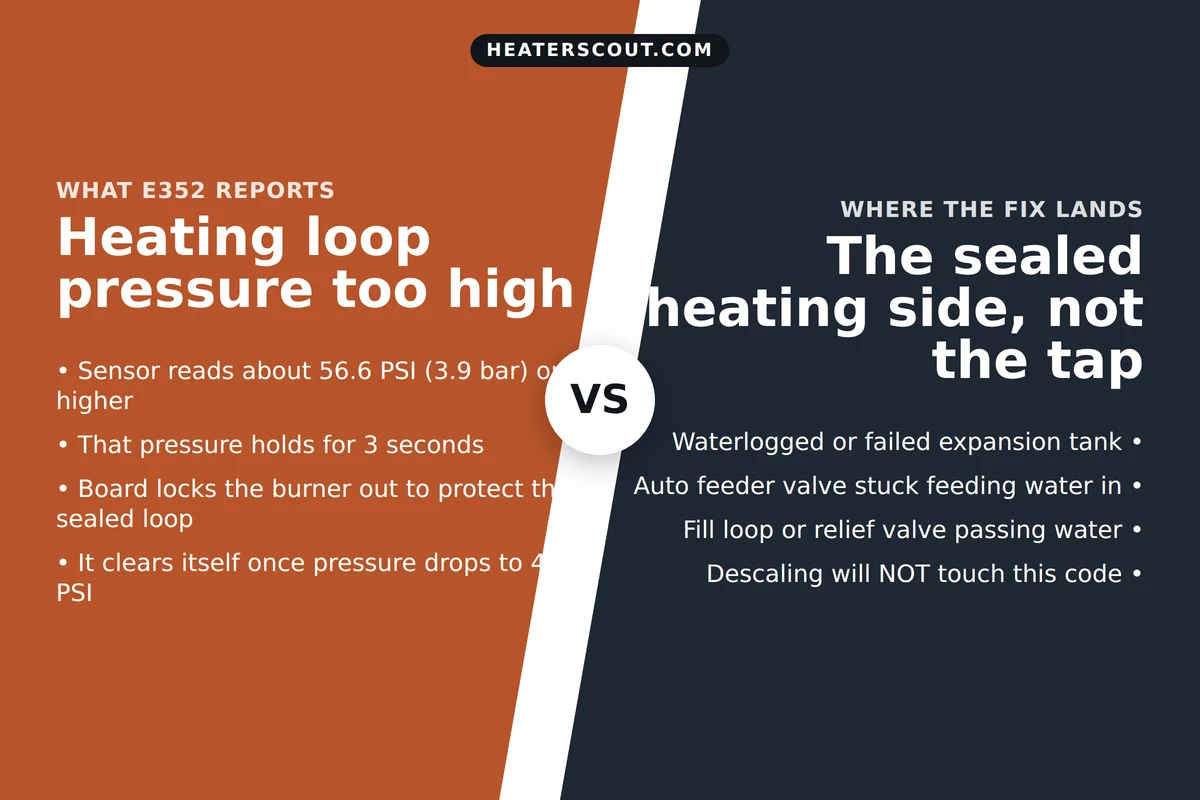
A Navien NCB that flashes E352 is not complaining about your shower pressure or a scaled heat exchanger. It is telling you the sealed heating loop inside the boiler has climbed to around 56.6 PSI or higher, roughly four times where a cold heating system should sit, and held there for three seconds. The board reads that from a single water pressure sensor and shuts the burner down to protect the loop. The fault is almost always a waterlogged expansion tank or a feed valve letting water in, not the board that a repair invoice tries to sell you.
The short version
E352 is high water pressure on the closed heating loop of a Navien combi. The pressure sensor read about 56.6 PSI (3.9 bar) or more for three seconds. It is not a cascade or communication error, whatever some code lists say. It clears itself once the loop drops to 43.5 PSI. Bleed the pressure down, then find what pushed it up: expansion tank, feeder valve, or fill loop. The sensor is the last suspect, not the first.
What the sensor is actually watching
A Navien NCB is a combi unit, which means it does two jobs from one box. On the domestic side it heats your tap water on demand, running at whatever street pressure your house has, usually 40 to 60 PSI. On the heating side it runs a separate, sealed loop through your radiators or floor coils, and that loop is a closed system that should sit around 12 to 15 PSI when cold and rise only to the low 20s once hot. E352 lives entirely on that heating side. One water pressure sensor reports the loop pressure to the control board, and the board has a hard ceiling: if the reading hits roughly 56.6 PSI (3.9 bar) and stays there for three seconds, it declares E352 and stops. Fifty-six PSI in a loop built for fifteen is not a nuisance reading. Something is forcing water in or leaving expansion nowhere to go.
The reset that is not really a reset
E352 is a self-cancelling code. The board watches the same sensor on the way down, and the moment the loop pressure falls to 43.5 PSI or lower, it drops the fault on its own. So the honest reset is not a button, it is bleeding the excess pressure out of the loop. If you want to force the latched code off the display to watch what the unit does next, cut power at the switch or breaker for about 30 seconds and restore it. That keeps your settings and clears the current fault. But if the pressure is still high when the board wakes up, E352 returns before your coffee is done.
E351 is not E352, and the difference matters
These two codes sit next to each other on the list and describe opposite problems, so it is worth being precise. E351 is an abnormal auto feeder valve fault. The automatic make-up valve that tops the loop up with water stays open longer than about five minutes while feeding, which usually means the loop is struggling to hold pressure, water is escaping somewhere, or the feeder itself is faulty. That is a low or falling pressure story. E352 is the reverse: pressure too high, the loop reading around 56.6 PSI. If you walk up to the boiler and read the wrong code, you will chase the wrong direction, hunting for a leak when the real problem is a waterlogged tank pushing pressure up. Confirm the exact code on the display first. E351 sends you looking for where water leaves; E352 sends you looking for what forces water in.
Key takeaways
- E352 is high water pressure on the sealed heating loop of a Navien NCB combi, not a communication or cascade fault.
- It trips at about 56.6 PSI held for three seconds and clears itself at 43.5 PSI or lower.
- A cold heating loop should read 12 to 15 PSI; fifty-plus means something is over-pressurizing it.
- The usual causes, most likely first: waterlogged expansion tank, a feed or fill valve passing water, then a wet or drifting sensor.
- E351 is the opposite code (feeder stuck open, low pressure). Read the display carefully before you troubleshoot.
- Descaling does nothing for E352, and the control board is almost never the cause.
Why the expansion tank is the first place to look
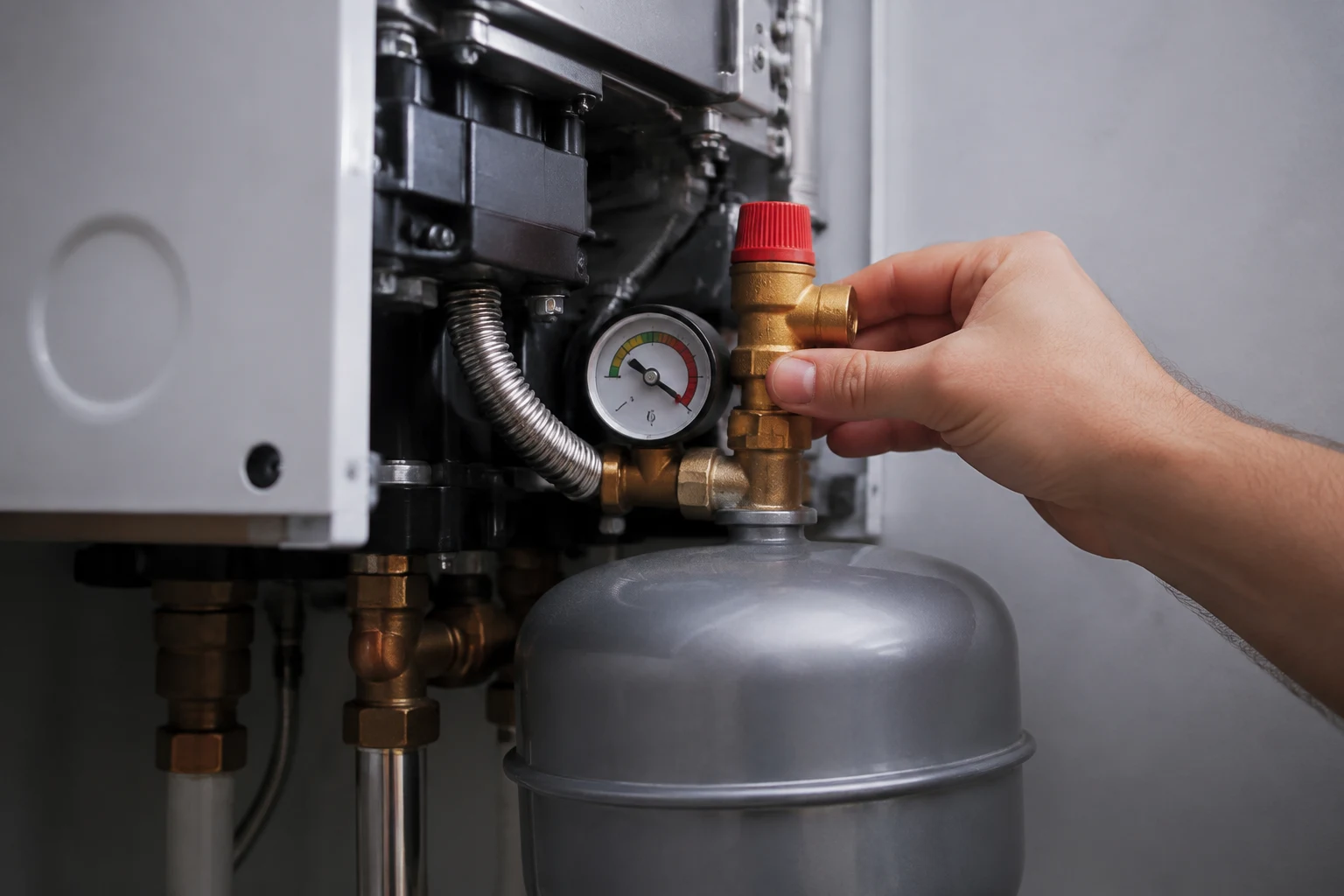
Water expands when it heats. A sealed heating loop deals with that by pushing the extra volume into an expansion tank, a small vessel with a rubber bladder and an air cushion on the other side. When the bladder fails, the tank fills with water and the air cushion disappears. Now the loop has nowhere to put the expansion, so every time the boiler fires and the water warms, pressure spikes. You can bleed it back to 15 PSI, and within a heating cycle it climbs past 50 again and re-trips E352. That is the classic signature: a code that returns fast after you relieve the pressure. Tapping the tank tells you a lot. A good tank rings hollow on the air side and sounds dull where the water is. A waterlogged tank is dull top to bottom. Some tanks can be re-charged with a bicycle pump if the bladder is intact, but a ruptured bladder means replacement, a $40 to $90 part.
When a feed valve is the culprit
If the expansion tank is healthy and the loop still climbs, follow the water in. A sealed system is topped up either automatically, through an auto feeder valve, or manually, through a fill loop with a couple of isolation valves. Both are supposed to be closed once the loop is at pressure. When one passes, it feeds your house's street pressure into a loop that should never see it. Street water can run 50 to 70 PSI, so a feeder that will not seat can drive the loop straight past the E352 ceiling. The test is simple: close the fill loop completely, bleed the system back to 15 PSI, and watch. If it holds, the feed valve was the leak. If it climbs anyway with the fill isolated, you are back to the expansion tank or a genuinely over-charged system. Do not leave a fill loop cracked open as a habit; that is how slow over-pressure problems hide for months.
Where the homeowner line sits
A careful homeowner can do the front half of this. Reading the loop gauge, bleeding pressure down through a radiator valve, tapping the expansion tank to judge whether it is waterlogged, and re-charging a tank that still has a good bladder are all within reach with basic tools. None of that touches the gas train or combustion. The place to hand it off is the sealed loop hardware. Replacing an expansion tank, rebuilding or swapping an auto feeder valve, or changing the water pressure sensor all mean draining part of the closed system and re-pressurizing it correctly, which is a heating tech's job on a combi boiler. The sensor should read 0.3 to 2.8 volts in normal operation, and a tech will confirm that before condemning it. Never cap a weeping pressure relief valve to stop a drip. That valve is the loop's last protection, and if it is passing, the pressure problem is real and needs solving, not silencing.
Keeping E352 from coming back
E352 rarely appears out of nowhere on a healthy system. It shows up when the expansion tank has aged out, when a fill valve was left cracked after a top-up, or when nobody has looked at the loop pressure in years. Make the loop gauge part of your routine: glance at it cold, and if it is drifting up over weeks, you have early warning before a lockout on the coldest morning. Have the expansion tank checked at your annual boiler service, since a bladder has a finite life and a failed one is the single most common driver of this code. Keep the manual fill loop fully closed between top-ups. A Navien combi that gets a yearly look-over and holds a steady 15 PSI cold rarely surprises anyone with a pressure code.
Frequently asked
Can I reset Navien error code E352 myself?
Yes, and often you do not even need a button. E352 is a self-cancelling fault: the moment the heating loop pressure falls to 43.5 PSI or lower, the board drops the code on its own. So the real reset is bleeding the excess pressure, not clearing a memory. If you want to force the latched code off to watch what happens next, cut power to the boiler at its switch or breaker for about 30 seconds, then restore it. That drops the current fault and keeps your temperature settings. But a power cycle is not a repair. If the loop is still over-pressurized because the expansion tank is waterlogged or the auto feeder is stuck feeding, E352 comes right back the next time the board reads the sensor. Use the reset to confirm your pressure fix held, not as the fix itself.
What does E352 mean on a Navien NCB boiler?
E352 is a high water pressure error on the sealed heating loop of a Navien combi unit. The water pressure sensor watches the pressure in the closed heating side, and when it reads roughly 56.6 PSI (3.9 bar) or higher and that reading holds for 3 seconds, the board reports E352 and stops firing the heat. A cold heating loop should sit around 12 to 15 PSI. Fifty-plus is far above where a sealed system should ever run, so the code is the boiler refusing to keep heating a loop that is dangerously over-pressurized. Note that some third-party lists wrongly describe E352 as a cascade or Ready-Link communication error. Navien's own NCB service manual is clear that E352 is high water pressure. If your unit is a single NCB combi, treat it as a pressure problem.
What is the difference between Navien E351 and E352?
They are opposite ends of the same water-pressure story, so it is easy to confuse them. E351 is an abnormal auto feeder valve fault: the automatic make-up valve that tops the heating loop up with water stays open longer than about five minutes while feeding, which usually points to low or falling loop pressure the boiler cannot satisfy. E352 is the reverse, high water pressure, the loop reading around 56.6 PSI or more. If you are chasing E351 you are looking for water escaping the loop or a feeder that cannot build pressure. If you are chasing E352 you are looking for something pushing pressure too high, like a waterlogged expansion tank or a feeder or fill loop letting water in when it should be closed. Confirm which code is actually showing before you start, because the fixes point in different directions.
How much does it cost to fix Navien E352?
It depends on what is driving the pressure up. The cheapest outcomes cost nothing but your time: bleeding the loop down to 12 to 15 PSI, or re-charging a waterlogged expansion tank with a bike pump if the tank bladder is still good. A replacement expansion tank for a boiler loop typically runs about $40 to $90 for the part. An auto feeder or fill-loop valve that is stuck passing water is a heating tech repair, commonly $150 to $350 with labor. The Navien water pressure sensor itself is an inexpensive part, often in the $40 to $80 range, and swapping it is a tech-level job on a combi boiler because it sits in the sealed loop. A full diagnostic visit lands around $150 to $300 in most metros. The board is rarely the cause of E352, so nobody should be selling you one before the pressure and the tank are checked.
Will descaling clear Navien E352?
No. Descaling flushes a vinegar or descaling solution through the domestic hot water heat exchanger to strip mineral scale from the waterways, and it is worth doing on schedule. But E352 is a pressure fault on the sealed heating loop, which is a closed system that a normal descale never even touches. Scale in the tap-water exchanger has nothing to do with how much pressure sits in the heating side. A descale will not release a waterlogged expansion tank, will not reseat a stuck feeder valve, and will not lower a loop that is running at 55 PSI. If your unit is throwing E352, put the descaling aside and go straight to the loop pressure gauge and the expansion tank.
Why does Navien E352 keep coming back?
A code that returns after you bled the pressure down means something is still pushing water into the loop or robbing it of room to expand. The most common repeat offender is a waterlogged expansion tank: the rubber bladder has failed, the air side is full of water, and the loop has no cushion, so pressure spikes every time the boiler heats and the water expands. You bleed it, it climbs again within a day. The second suspect is an auto feeder or manual fill valve that is not fully closing, quietly feeding street pressure (often 50 to 70 PSI) into a loop that should sit at 15. Third is a wet or drifting pressure sensor reading high when the loop is actually fine. Check the tank first, then the feed valves, then the sensor voltage, which should read 0.3 to 2.8 volts in normal operation.
Is Navien error code E352 dangerous?
The code is a safety response, not the danger itself. A sealed heating loop running at 56 PSI is well above its design range, and the board shutting the burner down is the boiler protecting the loop, the relief valve, and you from a system that is over-pressurized. What you should watch for is water dripping from the pressure relief valve, which is the loop dumping excess pressure and a sign the problem is real and active. Do not cap or plug a weeping relief valve to stop the drip, because that valve is the last line of defense on a sealed system. E352 is low risk to diagnose since it lives on the water and electronics side, not the gas side. If you smell gas or see scorching anywhere, stop and call a licensed tech. Otherwise, the safe move is to relieve the pressure and find why it climbed.