A Navien that flashes E351 is not the same machine most people picture when they think tankless. This code shows up on Navien's NCB combi boilers, the ones that both heat your home and make your hot water, and it points at the heating side, not the taps. Behind that side is a sealed loop of water that has to hold pressure, usually 12 to 15 PSI cold. When that pressure drops too low the board tries to refill the loop through an auto feeder valve, and if the refill fails to hold after about five minutes it latches E351. Worth saying up front: the dispatch note for this code called it a cascade communication error between linked units. That is wrong. The Navien NCB service manual labels E351 an abnormal auto feeder valve, a low heating-pressure fault. This article follows the manual.
Before you open anything, look at the pressure
E351 is a pressure story, so the first move is to read the pressure, not to grab a screwdriver. The boiler shows heating-loop pressure on the front panel, and many installs also have a small gauge on the unit or the nearby piping. A healthy NCB loop reads about 12 to 15 PSI cold and climbs toward 19 to 22 PSI once it warms. If the number is sitting near or below 10, the code makes sense and you have somewhere to start. Kill power at the breaker before you go past looking.
- Read the heating pressure on the front panel or gauge. Below about 10 PSI cold explains the code.
- Find the cold water isolation valve feeding the boiler and confirm it is fully open, not partly shut or iced.
- Look at the auto feeder lever: parallel to the pipe is open, perpendicular is closed.
- Scan the heating piping, PRV, and air vents for drips, white mineral crust, or damp spots.
- Press the schrader valve on the expansion tank; water instead of air means it is waterlogged.
- If pressure is low, use the manual fill to bring the cold loop to about 12 PSI, then power up and watch.
Key takeaways
- E351 on a Navien NCB combi boiler means abnormal auto feeder valve: the heating loop lost pressure and the refill did not hold. It is not a cascade communication error.
- Normal heating-loop pressure is about 12 to 15 PSI cold, rising to 19 to 22 PSI hot. Below roughly 10 PSI the unit shuts down.
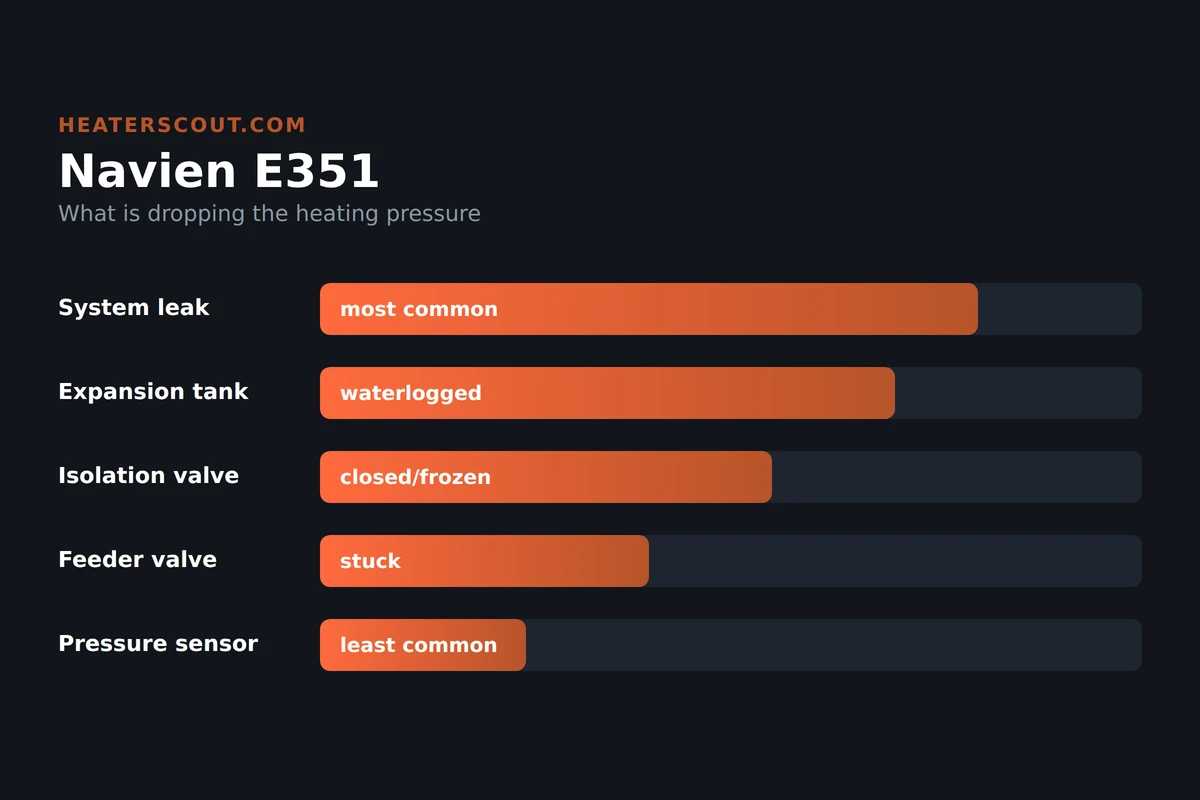
- Most-likely causes in order: a system leak, a waterlogged expansion tank, a closed or frozen isolation valve, a stuck feeder valve, then the pressure sensor.
- E351 is low pressure; E352 is the opposite, high pressure at 56.6 PSI or above. Do not confuse the two.
- Refilling to 12 PSI and power cycling clears the code, but if pressure bleeds down again you have a leak or a bad expansion tank, which is a pro fix.
E351 and E352 are opposite problems
The single most useful thing to get straight is that E351 and its neighbor E352 are mirror images. One means the loop is too low, the other means it is too high, and they send you in opposite directions. Chase a leak when the real fault is an overfeeding valve and you will waste an afternoon.
| E351 | E352 | |
|---|---|---|
| What it means | Abnormal auto feeder valve | High water level / pressure |
| Direction | Heating pressure too LOW | Heating pressure too HIGH |
| Trigger | Feeder open over 5 min, pressure not recovered | Loop at 56.6 PSI or higher for 3 seconds |
| Clears when | Pressure restored, then power cycle | Pressure falls to about 43.5 PSI or lower |
| Usual causes | Leak, waterlogged expansion tank, closed valve | Feeder stuck open, bad sensor, cross-leaking exchanger |
| First check | Refill loop to ~12 PSI cold, find the leak | Bleed pressure down, inspect feeder and sensor |
Fill cold, not hot
Fill the heating loop to about 12 PSI while it is cold, never while it is hot. Water expands as it heats, so a loop set to 12 PSI cold will climb to roughly 19 to 22 PSI on its own once the burner runs. Fill a hot loop to 15 and it can overshoot into E352 territory when it cools and cycles.
What the auto feeder valve actually is
The name on the code trips people up, so it helps to define the part before you go blaming it. The definition below is the manual's, cleaned up into plain terms.
Navien E351 (abnormal auto feeder valve)
A low heating-pressure fault on NCB combi boilers. The unit heats your home through a sealed water loop that must hold pressure. When the water pressure sensor reads the loop too low, the board stops the burner and opens an auto feeder valve to top the loop up from the cold water supply. If that valve stays open longer than about five minutes and pressure still has not recovered, the board latches E351. It means the loop is losing water, or the feeder cannot supply it, not necessarily that the valve itself is broken. Distinct from E352, which is high pressure, and E353, a water-pressure-sensor fault.
Working the causes in order
Start with the free and obvious, then move to the parts. The order below is roughly how often each one is the real culprit.
The isolation valve. The auto feeder can only refill the loop if cold water can reach it. A cold water isolation valve that is partly closed, or frozen shut on a January morning, starves the feeder, and the board reads the failed refill as E351. Confirm the valve is fully open first. In a hard freeze, a valve or line near an exterior wall can ice up and thaw by afternoon, which is why some E351 faults appear and vanish with the weather.
A system leak. If the loop keeps dropping no matter how many times you refill it, water is escaping. Walk the heating piping, the pressure relief valve, the air vents, and the pump for drips, damp insulation, or the white mineral crust that dried leaks leave behind. A pinhole that loses a few ounces a day is enough to trip E351 over a week. Some leaks are inside a wall or under a floor and take a pro with the right eyes to find.
The expansion tank. Navien field data puts a large share of repeat E351 cases here. The expansion tank holds a cushion of air behind a rubber bladder so the loop can absorb the volume change as water heats and cools. When the bladder fails, the tank fills with water and loses its cushion, so pressure swings hard and can dip below the E351 threshold. Press the schrader valve on the tank: air means it is likely fine, a squirt of water means the bladder is shot and the tank needs replacing.
The feeder valve and the sensor. Only after the loop, the isolation valve, and the expansion tank check out do you suspect the auto feeder valve sticking or the pressure sensor misreading. The sensor is the least common cause here, which is why it sits at the bottom of the list. Swapping a sensor because the code has its name on it, before checking pressure, is the classic wrong turn.
Where the homeowner line sits
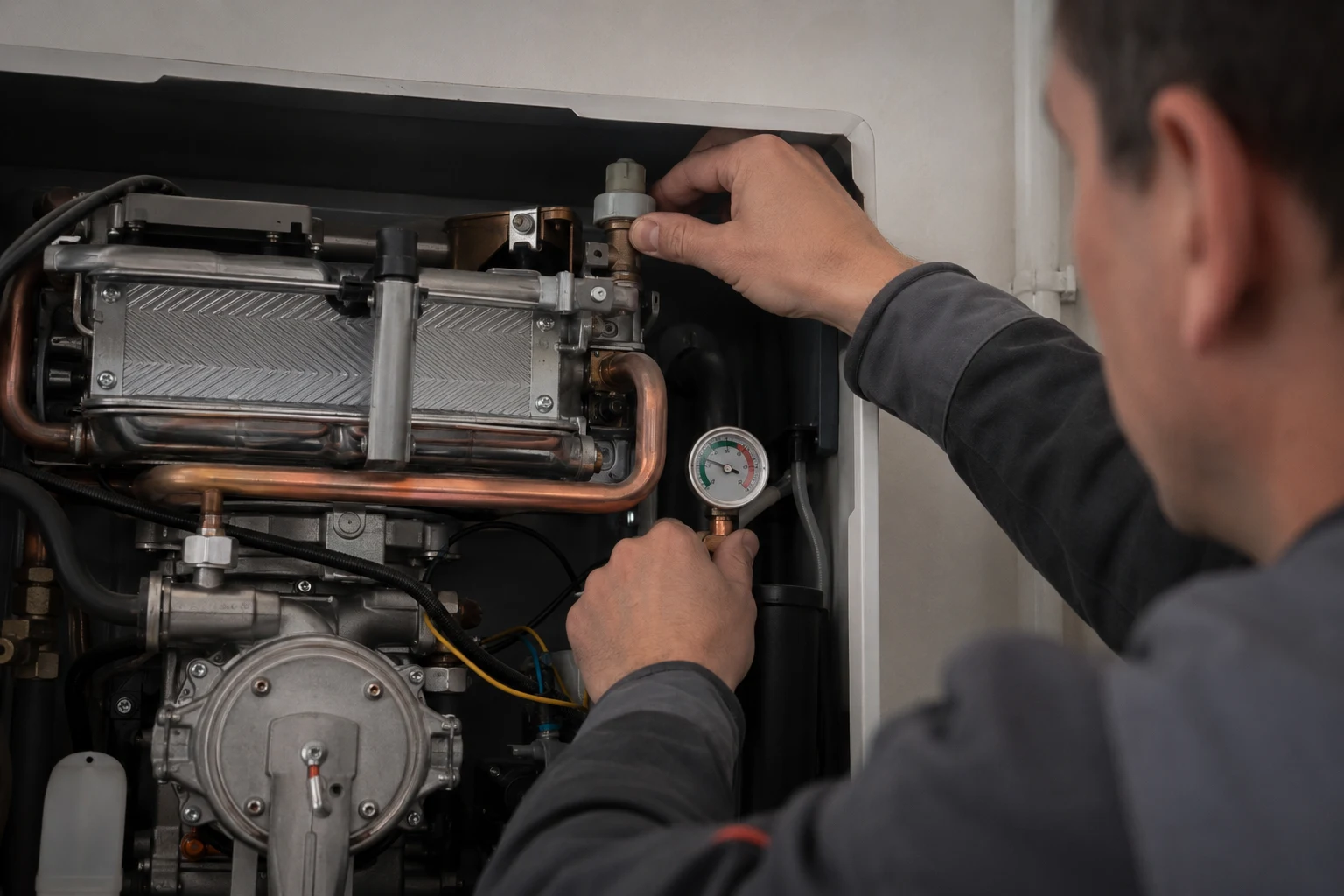
Reading the pressure, opening a stuck isolation valve, and refilling the heating loop to 12 PSI cold are fair game for a careful homeowner. So is pressing the expansion tank's schrader valve to see if it is waterlogged and eyeballing the piping for obvious drips. None of that touches the gas train, which keeps the first round of E351 work on the DIY-friendly side. The place to hand it off is when the loop will not hold pressure after a refill. Finding a hidden leak, replacing an expansion tank correctly, diagnosing a cross-leaking heat exchanger, or condemning a pressure sensor against the model service sheet is a licensed tech's job. Never jumper or defeat the pressure sensor to force the unit to fire. That sensor is what stops the heat exchanger from running on a starved loop.
Keeping E351 from coming back
An NCB that gets a yearly look-over rarely surprises you with E351. At service, have the tech verify the cold heating pressure sits near 12 PSI, check the expansion tank's charge, and scan the loop and relief valve for the start of a weep. Insulate any isolation valve or line that runs near an exterior wall so a cold snap cannot freeze it shut. Descaling the domestic hot water side on schedule keeps that half of the boiler healthy even though it does nothing for the heating loop directly. The pattern to watch for is a pressure that needs topping up more than about once a year. A loop that holds pressure on its own is a loop that is not leaking, and that is the whole battle with this code.
Frequently asked
What does Navien error code E351 mean?
On a Navien NCB combi boiler, E351 reads "abnormal auto feeder valve." The unit heats your home through a sealed loop of water that is separate from the hot water at your taps. That loop has to hold pressure, roughly 12 to 15 PSI cold. When the pressure sensor sees the loop drop too low, the board stops the burner and opens an auto feeder valve to top the loop back up from your cold water supply. If that valve stays open more than five minutes and the pressure still has not recovered, the board decides the refill is failing and latches E351. So the real message is not that the valve itself is broken. It is that the heating loop is losing water or pressure faster than the feeder can replace it, or the feeder cannot supply water at all. This code shows up on NCB models like the NCB-180, NCB-210E, and NCB-240E, which have that heating loop. A DHW-only tankless does not throw it.
Is E351 the same as E352 on a Navien?
No, they are opposite faults, and mixing them up sends you the wrong direction. E351 is low heating pressure: the loop dropped low and the feeder could not bring it back, so the code means too little water or pressure. E352 is the reverse, high water level. Per the manual E352 latches when the heating loop sits at 56.6 PSI or higher for three seconds, and it auto-cancels once pressure falls to about 43.5 PSI or lower. High pressure usually means the auto feeder valve is stuck open and overfilling, or the pressure sensor is misreading, or a plate heat exchanger is cross-leaking hot water into the loop. E353 is a related water-pressure-sensor fault. If you are chasing E351 you are looking for a leak or a valve that will not feed; if E352, you are looking for something adding too much water. Read the code carefully before you start.
Can I reset Navien error code E351 myself?
You can clear the latched code, but clearing is not fixing. First look at the heating pressure gauge or the pressure readout on the front panel. If it is low, the honest fix is to restore pressure, not just reset. Check that the cold water isolation valve feeding the boiler is fully open, then use the manual fill to bring the cold loop to about 12 PSI. After the pressure is where it belongs, cycle power: turn the unit off at the panel, shut its breaker for about 30 seconds, then restore power. That drops the latched E351 so you can watch whether it comes back. If the loop bleeds down again over hours or days, you have a leak or a waterlogged expansion tank, and no amount of resetting will hold. Reset is how you confirm a repair, not the repair.
Why does Navien E351 keep coming back?
A code that returns after you refilled the loop means the water is going somewhere. The usual causes, most likely first: a slow leak in the heating piping, a fitting, the pressure relief valve, or an air vent that weeps; a waterlogged expansion tank that can no longer cushion the loop, so pressure swings and drops; a heat exchanger leaking internally; or an isolation valve only partly open or icing up in winter. Navien field techs put a large share of repeat E351 cases on the expansion tank. If you refill to 12 PSI cold and the loop holds steady, you fixed it. If it drifts down again, chase the leak or the tank before you touch anything electronic.
How much does it cost to fix Navien E351?
It depends entirely on what is dropping the pressure. If it is a closed isolation valve or a loop that just needed refilling, the fix is free beyond your time. A replacement expansion tank for a combi boiler runs roughly $40 to $120 for the part, and a pro visit to diagnose the leak and swap it typically lands around $200 to $450 once you count the trip and labor. A stuck auto feeder valve or a water pressure sensor is a mid-range part, often $80 to $250 installed. Finding and repairing a hidden leak in the heating piping is the wild card, since the labor to locate it drives the bill more than the part. The most expensive outcome, a leaking heat exchanger, can run several hundred dollars or more. That is exactly why you verify pressure, the isolation valve, and the expansion tank before anyone opens the heat exchanger.
Is Navien error code E351 dangerous?
The code itself is a protective shutdown, not a hazard. By stopping the burner when heating-loop pressure is too low, the board keeps the heat exchanger from running dry or hot-spotting, which is the thing you want to avoid. So E351 locking the unit out is the safety system doing its job. The risk is not the code, it is ignoring the leak behind it. Water escaping a heating loop can rot framing, feed mold, or drip onto electrical parts over time. Never jumper or defeat the pressure sensor to force the unit to run, because then you are firing a loop that may be starved of water.
Will descaling clear Navien E351?
No. Descaling flushes vinegar or a descaling solution through the domestic hot water side to strip mineral scale off the waterways, and it is worth doing on schedule. But E351 lives on the heating loop, which is a separate sealed circuit, and the code is about pressure, not scale. A descale does nothing for a leak, a waterlogged expansion tank, or a closed isolation valve. That said, a unit that has gone years without a flush has usually gone years without any service, so while a tech is on site for E351 it is a fair time to descale the DHW side and check the inlet filter. Just do not expect the descale to touch the code.
What is normal heating pressure on a Navien NCB, and where do I read it?
A Navien NCB heating loop should sit around 12 to 15 PSI when the system is cold and rise to roughly 19 to 22 PSI once it heats up and the water expands. Below about 10 PSI the unit shuts down to protect itself, which is the zone where E351 appears. You read it either on the boiler's front panel, which displays heating pressure, or on a small pressure gauge on the unit or nearby piping. Fill the loop to about 12 PSI while it is cold, not hot, because the number will climb on its own as the system warms. Overfilling a cold loop past 15 PSI can push you toward the opposite fault, E352, once it heats and the pressure rises.