A Navien tankless throwing E110 has caught a blocked flue and shut the burner off on purpose. The control board watches a small fan and an air-pressure sensor track the flow of combustion air in through the intake and out through the exhaust. When that pressure stops matching what the fan is doing, the board reads it as an exhaust or intake blockage, locks the burner out, and posts E110 so you do not keep firing gas into a choked pipe. Nine times out of ten the cause is sitting outside: a vent terminal packed with snow, ice, or a nest. The fix starts at the pipe mouth, not the circuit board.
| Code | E110 (shown as E-110; sub-codes 110-01, 110-02, 110-03) |
| Navien's label | Exhaust / intake blockage, abnormal air pressure |
| What trips it | Air-pressure sensor reading disagrees with fan speed |
| 110-01 | Fault seen during the fan self-check at startup |
| 110-02 | Fault seen during a hot water call |
| 110-03 | Fault seen during a space-heating call (combi models) |
| Top cause | Blocked or frozen exterior vent terminal |
| Homeowner fix | Clear the terminal, clean the filter, check condensate |
| Pro fix | Vent rework, air sensor / pressure switch, fan |
| Difficulty | DIY-friendly if it is just a blocked vent |
Work the air path in order
E110 is a flow problem, so troubleshoot the way the air moves: from the outside terminal, through the vent and condensate path, to the intake filter, and only then to the sensor and fan inside the cabinet. Start at the cheap, common, homeowner-safe end and stop the moment the code clears. Do not open the unit until everything outside checks out.
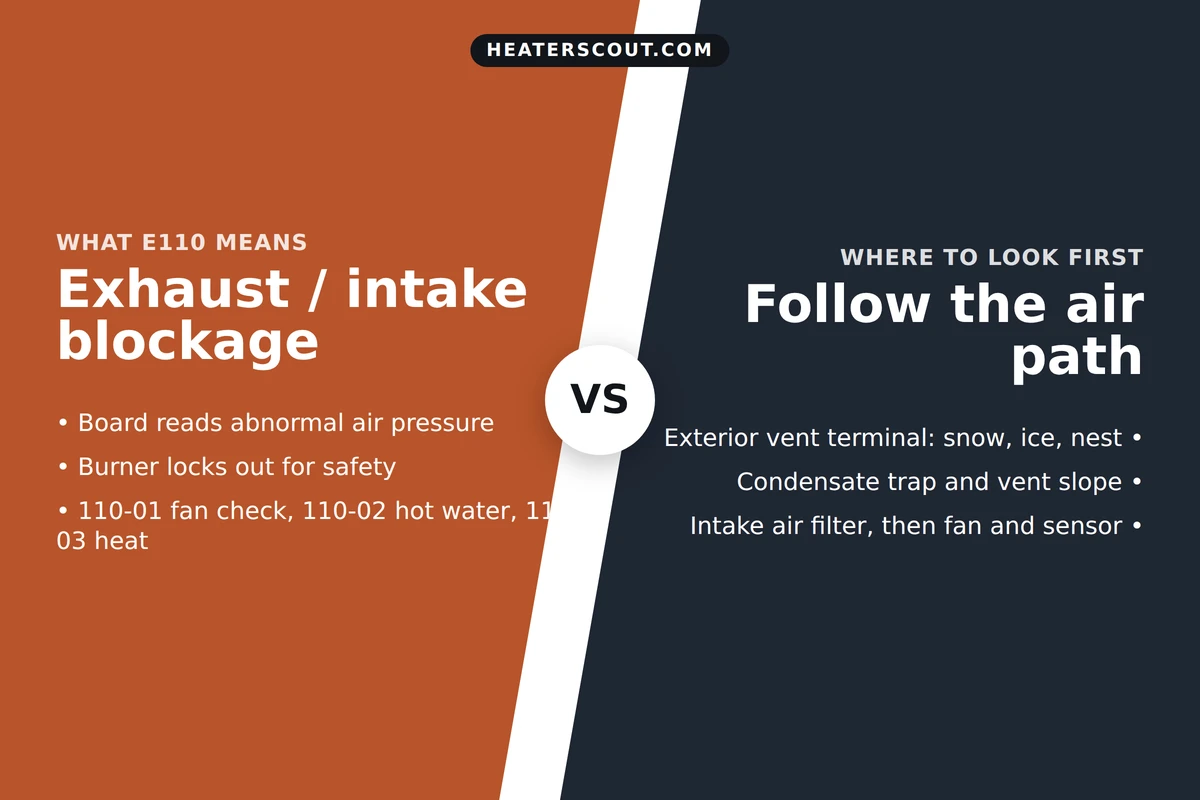
Exhaust / intake blockage (E110)
A safety lockout Navien uses when the air-pressure sensor reports flow that does not match the combustion fan's speed. On a condensing tankless, fresh air comes in and exhaust goes out through sealed plastic vent pipe, and the board expects a specific pressure signature for a given fan RPM. A blocked intake, a blocked or frozen exhaust, water pooling in a sagging vent, a plugged condensate trap, or a drifting pressure sensor all break that signature. Rather than keep burning gas against a choked flue, the board shuts the burner down and posts E110.
What actually causes it, most likely first
Across Navien's NPE and NPN lines the meaning is the same, but the likely cause shifts with your climate and install. In winter, frozen terminals and frozen condensate dominate. In older installs, a sagging vent or a loose joint shows up. On the NPE-180A specifically, some reports tie E110 to ignition trouble tangled up with a blocked intake, so if the outside is spotless and the code sticks, do not assume the vent is the only suspect. The ordered list below is what techs check, top to bottom.
Blocked or frozen exterior terminal
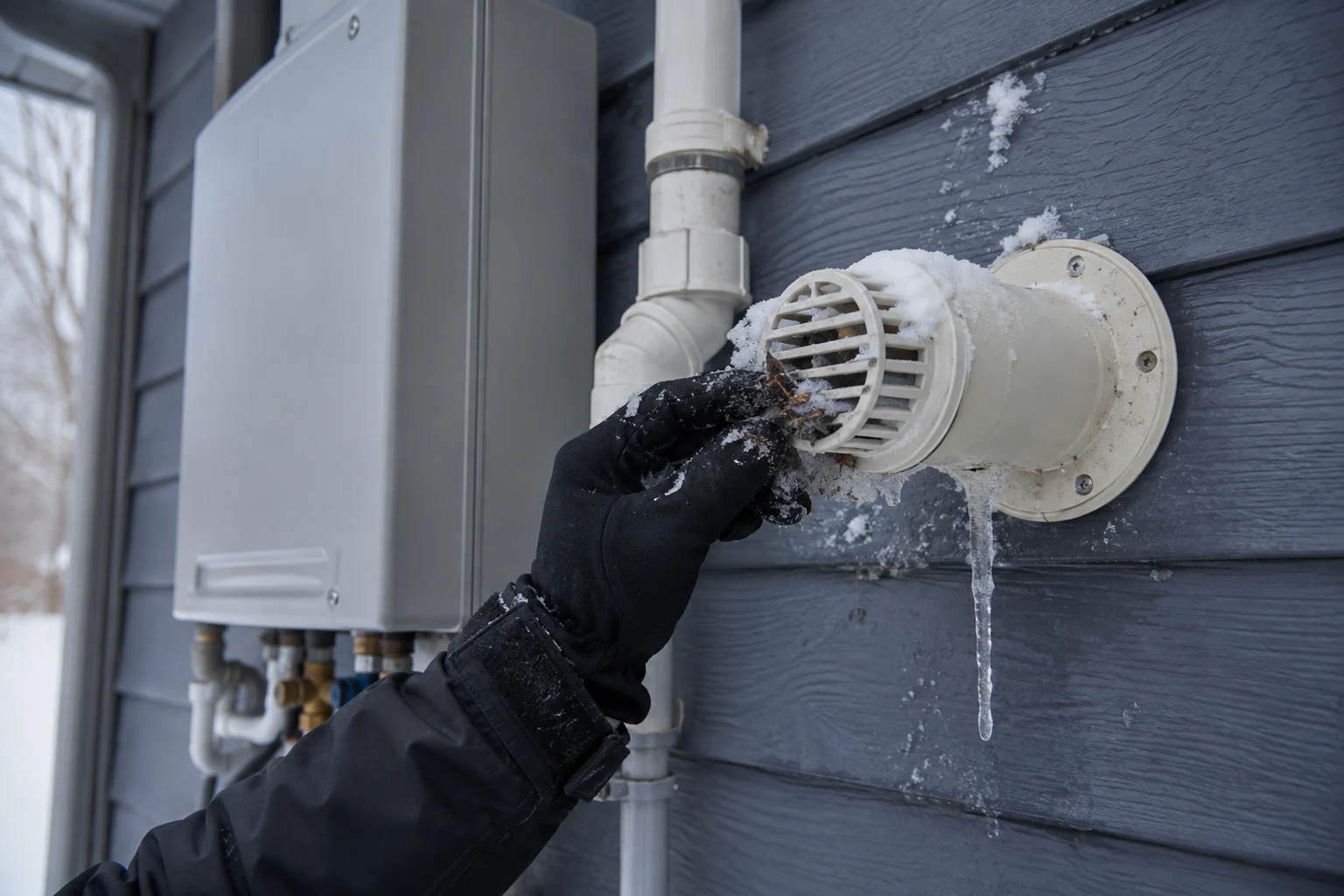
Snow, ice, leaves, a bird or wasp nest, or a cover choking the intake or exhaust pipe mouth. Peaks in winter and after storms. This is the first thing to rule out and the one you can fix yourself.
Condensate trouble
The acidic condensate the unit makes has to drain. A clogged trap, or a condensate line that freezes in an unheated space, backs water up and unbalances vent pressure. Common cause of an E110 that returns every cold night.
Vent slope, sag, or a loose joint
Vent pipe that sags or slopes the wrong way pools condensate and chokes flow. A joint that pulled partway loose leaks only under fan pressure, so it reads as a blockage. Needs a tech to re-slope, re-support, or re-seal.
Dirty filter, sensor, or fan
A clogged intake air filter is a quick clean. A drifting air-pressure sensor or pressure switch throws false E110s and needs testing. A failing combustion fan is the expensive end. All but the filter are pro territory.
What you can do versus what needs a licensed tech
The line is simple: anything outside the sealed cabinet and downstream of the terminal is homeowner-safe. Anything that means opening the unit, cutting into vent pipe, or touching the gas and electrical guts is a licensed job. E110 sits right on that line, because the common cause is outside and cheap, but the stubborn cause is inside and needs test gear.
Homeowner-safe
- Clear snow, ice, leaves, and nests from the exterior vent and intake terminals
- Rinse or replace the intake air filter at the unit
- Check and clear the condensate trap and drain line; thaw a frozen line gently
- Confirm the terminals are spaced right and not recirculating exhaust
- Power cycle and clear the lockout with the front-panel reset, then read the error history
- Keep a working CO detector near the unit at all times
Call a licensed tech
- Opening the cabinet to inspect the fan, sensor, or burner
- Re-sloping, re-supporting, or re-sealing vent pipe
- Testing and replacing the air-pressure sensor or pressure switch
- Replacing the combustion or inducer fan assembly
- Any E110 that returns within a minute or two of a clean reset
- Ignition-linked E110 on models like the NPE-180A
How to reset E110 without chasing your tail
The reset is the last step, not the first. Once the air path is clear, press the back or reset button on the front panel and wait a few seconds for the unit to relight, or cut power at the breaker for 30 seconds and restore it. Then pull up the error history in the panel so you have a record of whether E110 fires again. A reset that holds means you found it. A reset that drops back into E110 within a minute or two means the blockage is still present or the fault is inside, and that is your signal to stop and get a pro. Resetting past a real blockage is the one thing the lockout exists to prevent.
Keep it from coming back
Most repeat E110s are preventable. In cold climates, walk out and clear the exterior terminals after every snow or ice storm, and keep them clear through a long freeze. Make sure the condensate line stays above freezing, heat-trace it if it runs through an unheated space, and insulate any exposed vent pipe so exhaust moisture does not ice up. Clean the intake air filter as part of your annual descale and service so it never gets to the point of choking flow. A terminal mesh guard keeps out bugs, lint, and small nests. Get the vent run checked for correct slope and solid support at the same visit. Do those and E110 stays what it should be: a rare warning, not a winter routine.
Frequently asked
Can I reset Navien E110 myself?
You can clear the lockout, but only after you deal with what caused it. E110 is a safety shutdown for blocked air flow, so the reset just tells the board to try again. Press the back or reset button on the front panel and wait a few seconds, or cut power at the breaker for 30 seconds and restore it. If you reset without clearing the vent, the unit fires, sees the same air-pressure fault, and locks right back out. Walk the air path first: check the exterior vent and intake terminal outside, clean the intake filter, and confirm the condensate line is draining. Then reset. If it clears and stays clear, you are done. If E110 comes back within a minute or two, stop resetting and get it diagnosed, because repeated relight attempts against a blocked flue are exactly what the lockout is protecting you from.
What does E110 mean on a Navien tankless?
It means the control board detected abnormal air pressure in the combustion air path, which Navien labels as an exhaust or intake blockage. A condensing tankless pulls fresh air in and pushes exhaust out through PVC or polypropylene pipe, and a small fan plus an air-pressure sensor watch that flow. When the sensor sees pressure that does not match the fan speed, the board assumes something is choking the intake or the exhaust and shuts the burner off before combustion goes bad. The two-digit suffix tells you when it tripped: 110-01 during the fan self-check at startup, 110-02 during a hot water call, and 110-03 during a space-heating call on combi models. The cause is the same across suffixes, the timing is what differs.
Why does Navien E110 keep coming back?
A recurring E110 almost always means the blockage is still there or the vent has a hidden problem. The usual repeat offenders: an exhaust terminal that ices over again every cold night, a condensate trap that keeps clogging, or a vent run that sags and pools water so the flow chokes intermittently. It can also be a sagging or partially disconnected vent joint that only leaks under fan pressure, or a pressure switch and air sensor that are drifting and throwing false faults. If clearing the terminal fixes it for a day and it returns, the vent or the sensor needs a real look. Chasing it with resets wastes the safety margin the lockout gives you.
Is Navien error E110 dangerous?
The code itself is the safe outcome. The board caught a blocked flue and stopped the burner before you could get incomplete combustion, so E110 is the protection working. The danger is ignoring it or defeating it. A truly blocked exhaust on a gas appliance can spill combustion products, and that is a carbon monoxide risk, which is why you keep a working CO detector near any gas unit and why you never wire around the fault or run the heater on repeated resets. Clear the cause, confirm the vent is open and sealed, then restore heat. If you cannot find the blockage or the code returns fast, treat it as a call-a-pro situation, not a nuisance.
How much does it cost to fix Navien E110?
If it is a blocked exterior terminal, a clogged intake filter, or a plugged condensate trap, it costs nothing but 15 to 30 minutes of your time. Those are the common causes and they need no parts. A service call to diagnose and clear it typically runs about $100 to $250 depending on your area. If the vent has to be re-sloped, re-supported, or re-sealed, add labor and a few dollars of pipe and fittings. Parts get pricier if the fault is electrical: an air-pressure sensor or pressure switch is a modest part but takes a tech to test and replace, and an inducer or combustion fan assembly is the expensive end, often a few hundred dollars for the part plus labor. Most E110 calls end at the cheap end because most are just a blocked vent.
Will clearing the vent fix E110, or do I need a tech?
Clearing the vent fixes the majority of E110 cases, because a blocked or frozen exterior terminal is the number one cause. Go outside, find the intake and exhaust terminations, and clear snow, ice, leaves, a bird or wasp nest, or anything crushing or covering the pipe. Check that the two terminations are not so close that exhaust recirculates into the intake. Clean the intake air filter at the unit if your model has one. That is the homeowner-safe list. What needs a licensed tech: opening the cabinet, re-working vent pipe that sags or slopes wrong, testing and replacing the air-pressure sensor or pressure switch, and anything involving the fan. If the outside terminal is clear and the code persists, the problem moved inside and you want a pro.
Does cold weather cause Navien E110?
Yes, winter is prime season for E110. Two cold-weather failures trigger it. First, the exhaust terminal ices over: a condensing unit throws warm, wet exhaust, and on a hard freeze that moisture builds a rime of ice around the pipe mouth until it chokes flow. Second, condensate freezes. The unit makes acidic condensate that has to drain, and if the condensate line or trap runs through an unheated space and freezes, water backs up and unbalances the vent pressure. In cold climates you keep the exterior terminals clear after storms, make sure the condensate line stays above freezing or is heat-traced, and insulate exposed vent pipe. If you find ice, thaw it gently with warm water or a heat gun on low, never an open flame, and clear all of it before you reset.