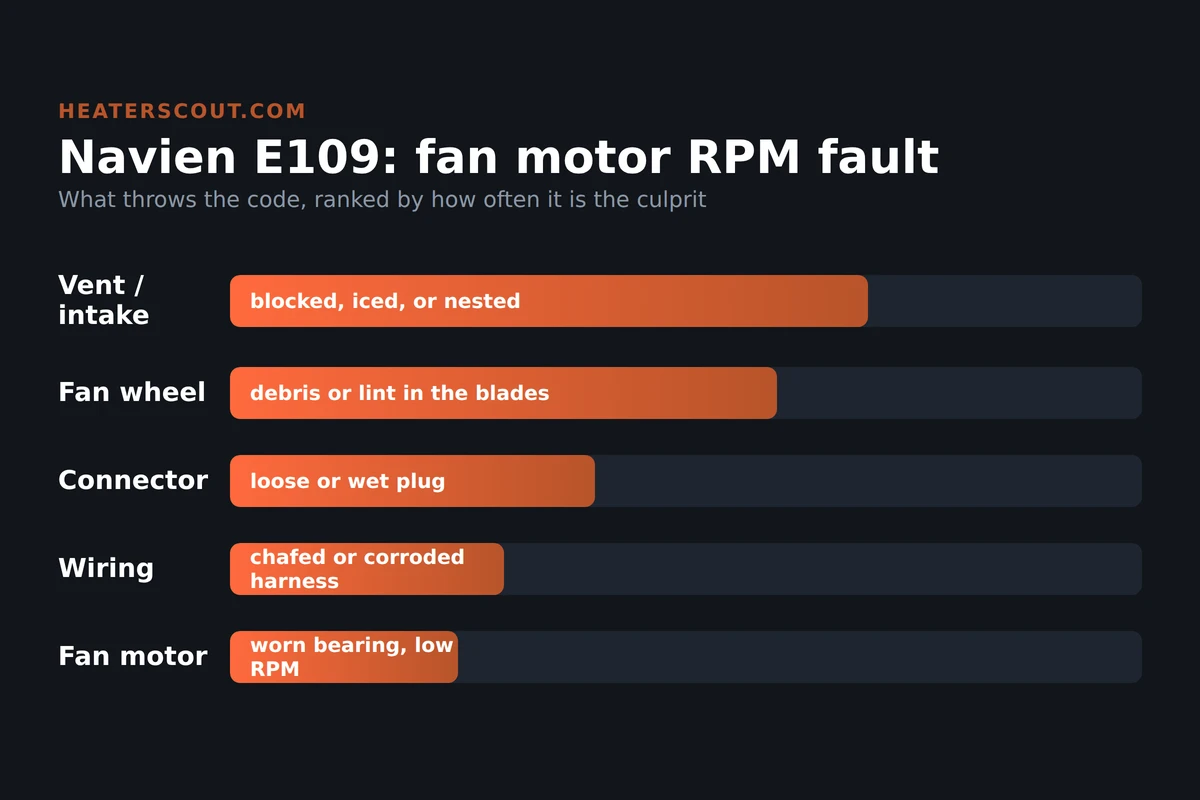
Navien throws E109 when the fan will not spin the way the control board tells it to. The board commands the blower to a target RPM, reads the speed back from a sensor on the motor, and if the two do not match, too slow, too fast, or unstable, it locks the burner out and shows E109. Most of the time the fan is fine and something is fighting it: a vent packed with ice or lint, a filter caked with dust, or a connector that shook loose. A worn fan motor is real but it is near the bottom of the list, not the top. Start with airflow before you spend a dollar on a part.
First moves before you call anyone
E109 is a fan speed fault, so everything you check is on the air side of the unit, not the water side. Work through these in order. The first three are free and clear the majority of E109 calls. Kill power at the breaker before you open any panel, and let a hot unit cool so you are not reaching past a live combustion chamber.
- Power-cycle the unit first: off at the control, off at the breaker for 30 to 60 seconds, then back on. A one-time fan glitch clears here.
- Pull and clean the intake air filter. On wall-vented and cabinet units it clogs with household dust and lint, which drags the fan below its commanded speed.
- Go outside and inspect the intake and exhaust vent terminations. Clear snow, ice, leaves, lint from a nearby dryer vent, insulation, or a bird or wasp nest.
- Look for sagging vent pipe holding condensate, or a screen or cap someone added. Both choke airflow and confuse the fan RPM.
- Open the front and check the fan connector. Push it fully home. If it is wet, power the unit off, dry it completely, and find where the water is getting in.
- Inspect the fan wiring harness for chafing, melted insulation, or green corrosion at either end, at the motor and at the control board.
- Restore power and run hot water for a full cycle. If E109 stays gone, you found it. If it returns, the fault is deeper and needs a tech.
That sequence is deliberate. The reset rules out a fluke, the filter and vent handle the two most common physical causes, and the connector and harness catch the electrical faults you can see without a meter. Only after all of that comes low fan voltage or a dead motor, and those need test gear.
If I cleaned the filter and vent and E109 still comes back, what is left?
The parts you cannot inspect by eye. A tech will measure the fan supply voltage at the control board connector against Navien's spec. On the NCB service data the fan feed reads roughly DC 127 to 184 volts on the black-to-red pins, about 15 volts on black-to-yellow, and 0 to 7.5 volts on black-to-orange as the speed signal varies. If those voltages are in range but the fan still runs slow or will not hold speed, the fan motor itself is worn and gets replaced. If the voltage is missing or out of range, the fault is upstream in the wiring or the PCB fan driver.
What the code actually reports
Understanding what the board is measuring makes the whole troubleshooting order make sense. The fan is not just an exhaust blower. It sets the combustion air, and Navien ties the gas rate to the fan speed through the venturi. So the board watches fan RPM closely, and any mismatch means the air to gas ratio is off, which is why it refuses to fire.
Navien E109, fan motor RPM fault
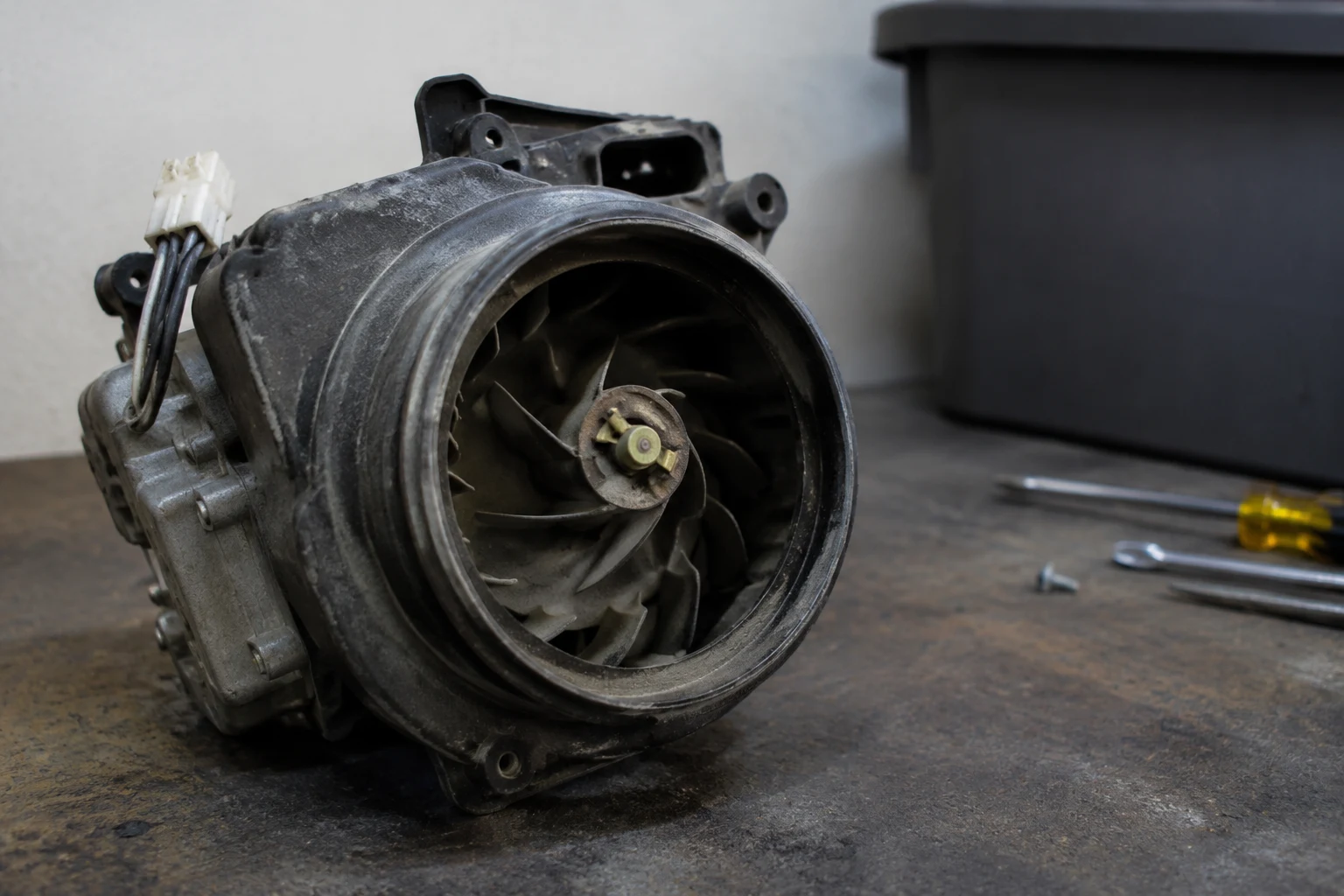
The control board commands the blower fan to a specific speed and reads the actual RPM back from a hall-effect sensor on the motor. E109 (shown as E-109 or 109 in the error history) fires when the measured speed does not match the commanded speed for the required time, whether the fan runs too slow, too fast, or will not stabilize. Because the fan sets combustion air, a speed error means the air to gas mix cannot be trusted, so the unit locks the burner out. The trigger is usually mechanical resistance, a blocked vent or a fouled fan wheel, before it is a failed motor.
That last sentence is the whole reason the code has a reputation for false alarms. A perfectly good fan reads a wrong RPM the moment something makes it work harder than the board expects. Ice at the vent cap, a dryer venting lint next to the intake, a filter no one has cleaned in two years. The motor never failed, but the RPM missed its target under load, so E109 fires.
Homeowner fixes vs. what needs a pro
The split is clean once you know the code is about airflow and fan speed. Anything you can reach and see, filter, vent, connector, is fair game. Anything that needs a meter, involves line voltage inside the combustion cabinet, or means swapping the fan or board, is a licensed job.
| Task | Who | What is involved | Rough US cost |
|---|---|---|---|
| Power-cycle / clear the code | Homeowner | Off at control, off at breaker 30-60 sec, back on | Free |
| Clean the intake air filter | Homeowner | Pull the filter, vacuum or rinse dust and lint, refit | Free |
| Clear the vent terminations | Homeowner | Remove ice, snow, leaves, lint, or a nest from intake and exhaust | Free |
| Reseat / dry the fan connector | Homeowner | Push the plug fully home, dry any moisture, trace the leak | Free |
| Measure fan voltage at the PCB | Licensed tech | Meter the fan feed against Navien's DC spec at the board | Included in a service call, ~90-180 |
| Replace the fan motor / blower | Licensed tech | Swap the OEM blower assembly, verify RPM and combustion | ~350-650 installed |
| Correct an over-length vent run | Licensed tech | Re-run vent to Navien's max equivalent length and elbow limit | ~200-600 depending on run |
| Replace the control board | Licensed tech | Last resort if the fan driver on the PCB is dead | 500+ for the board alone |
One note on model lines. E109 means the same thing across the Navien tankless NPE and NPN families and the NCB combi boilers: a fan RPM mismatch. The service data and the exact fan voltage figures differ a little by model, and some older NR and NP units label the same fault under a different number, so if you are cross-referencing an older manual, confirm the code table for your specific unit rather than assuming the number carries over. The troubleshooting order, vent and filter first, motor last, holds on all of them.
Keeping E109 from coming back
Almost every recurring E109 traces to something that was never a one-time event. The vent that iced over will ice again next cold snap. The intake that pulls lint from a dryer vent two feet away will keep pulling it. So prevention is really about the install and a yearly look.
Keep the intake and exhaust terminations clear year-round, and in freezing climates check them after storms, because a concentric vent cap can glaze over with ice and choke the fan. Move or shield the intake if it sits downwind of a dryer vent or in a dusty spot. Clean or replace the intake air filter as part of annual service, the same visit where the tech descales the water side, so the fan is not fighting a clogged filter. And if E109 first appeared right after an install or a vent modification, have the vent length and elbow count checked against Navien's table, because an over-length run is a permanent cause that no cleaning will fix. Get the airflow right and the fan spins to speed on command, which is all the board is asking for.
Frequently asked
Can I reset Navien error code E109 myself?
Yes, you can clear it, and you should try. Turn the unit off at the front control, then kill power at the wall switch or the breaker feeding the heater. Wait 30 to 60 seconds so the control board fully powers down, then restore power and turn the unit back on. If the fan was briefly confused by a gust down the vent or a one-time hiccup, the code stays gone. But a reset only clears the memory. It does nothing about a fan wheel packed with lint or a vent choked with snow. If E109 comes back within a cycle or two, stop resetting and start looking. On Navien the code also logs in the error history, so a tech can pull it later even after you clear the display.
How much does it cost to fix Navien E109?
It depends entirely on which cause you hit. Clearing a blocked intake filter or brushing lint out of the fan wheel costs nothing but 20 minutes. Reseating or drying a fan connector is also free. If the fan motor itself is worn and has to be replaced, the OEM blower assembly for an NPE or NCB runs roughly 180 to 350 dollars for the part, and a plumber or HVAC tech typically charges 150 to 300 dollars in labor, so figure 350 to 650 dollars installed for most jobs. A control board, if the fan driver on the PCB is the real fault, is the expensive outcome and can push past 500 dollars for the board alone. Get the vent and fan ruled out first before anyone quotes you a board.
Will descaling clear error code E109?
No. Descaling flushes scale out of the heat exchanger and helps flow and combustion codes, but E109 is a fan speed fault on the air side of the unit. Vinegar in the water loop never touches the blower, the venturi, or the vent. If your last service was a descale and E109 showed up afterward, the cause is more likely something the tech disturbed near the fan, a connector left loose or a vent cap not reseated, than the descale itself. Keep the two systems separate in your head: water side gets descaled, air side gets the fan and vent checked.
Is Navien E109 dangerous?
The code itself is a safety response, not a hazard. Navien locks the burner out when the fan will not hold its commanded speed, because a fan that spins too slow or too fast throws off the air to gas ratio and can cause incomplete combustion. By shutting down, the unit refuses to fire with a bad air supply. So E109 leaves you with cold water, not carbon monoxide. The thing to respect is the reason behind it. If the vent is blocked or the fan is failing, you do not want to defeat the lockout or keep power-cycling to force it to run. Fix the airflow, and the fan does its job again.
Why does E109 keep coming back after I reset it?
Because the reset never addressed the actual problem. E109 is the board telling you the fan did not spin the way it was told to, and that is almost always a physical restriction or a failing part. A recurring E109 points to a vent that keeps icing or getting blocked, a fan wheel loaded with debris that drags it down, a connector that vibrates loose, or a motor bearing on its way out so the fan runs slow under load. Each power cycle just resets the counter until the fan misses speed again. When a Navien code returns after a reset, the unit needs parts and a real inspection, not another reset.
Do I need a licensed tech, or can I handle E109 as a DIY?
You can safely do the first-look items: clear and clean the intake air filter, inspect the intake and exhaust vents for snow, ice, leaves, lint, or a bird nest, and check that the fan connector is seated and dry. Those clear a large share of E109 calls. Where you stop is opening the sealed combustion chamber, measuring the fan supply voltage at the PCB, or replacing the fan motor or control board. Those steps involve line voltage, gas, and combustion setup, so they belong to a licensed plumber or Navien-trained HVAC tech. If the vent and connector look clean and E109 still returns, that is your line to call a pro.
Does a long or improperly installed vent run cause E109?
It can, and it is a common finding on newer installs. Every Navien has a maximum equivalent vent length and a limit on the number of elbows, because each foot of pipe and each turn adds resistance the fan has to push against. If the vent is run longer than spec, undersized, or crammed with too many elbows, the fan cannot move the required air at its commanded speed and the RPM reads wrong, throwing E109 under load even though nothing is broken. Sagging vent pipe that pools condensate, or a screen or cap the installer added, does the same. If E109 started right after an install or a vent change, have the vent run measured against Navien's table before you buy any parts.