Navien E047 stops the unit because the exhaust thermostat, the little thermistor that watches how hot the flue gas is, sent back a reading the control board would not accept. Across the Navien NPE and NPN condensing lines the code means one thing: abnormal operation of the exhaust thermostat, open or shorted. Here is the part worth getting straight before you spend a dollar. E047 is not the air pressure sensor. On Navien, air-pressure faults post as E110 or E127. E047 lives on the exhaust-temperature side, and it fires for one of two reasons that need completely different fixes: an electrical fault at the sensor, or the exhaust actually running too hot.
| Code | E047 (shown as E.047 on some panels) |
| Official meaning | Abnormal operation of the exhaust thermostat / exhaust thermistor |
| Affected units | Navien NPE and NPN condensing tankless (NPE-180/210/240 A and S, and siblings) |
| Sensor watched | Exhaust (flue) thermistor, open or shorted signal |
| Not this code | Air pressure sensor is E110 / E127, not E047 |
| Homeowner can do | Power-cycle reset, check outdoor vent terminals, check condensate drain |
| Needs a licensed tech | Opening the cabinet, testing thermistor resistance, PCB diagnosis |
| Typical fix cost | $0 if vent-clearing works; $150 to $350 for a sensor swap |
What the exhaust thermistor actually does
A condensing tankless pulls almost all the heat out of the combustion gas before it leaves the unit. That is why the exhaust is cool enough to run through PVC and why there is a condensate drain. The exhaust thermistor sits in the flue path and reports that leaving-gas temperature to the board as a resistance value. A healthy heat exchanger hands most of its heat to the water, so the flue gas leaves relatively cool and the thermistor reads a normal, expected resistance. The board trusts that sensor to catch two problems: a sensor or wire that has failed, and an exhaust that has climbed too hot because heat is escaping instead of going into the water.
When the resistance the board reads falls outside its acceptable window, E047 latches and the burner shuts off. Out of range in the open direction (very high or infinite resistance) usually means a broken connection: a wire off its pin, a corroded terminal, a plug that vibrated loose. Out of range in the shorted direction (near zero) points at a failed thermistor or a pinched, chafed wire touching ground. Both look identical on the display. That is why the fix is a process of elimination, not a guess.
Is E047 the same as an air pressure sensor error on my Navien?
No. E047 is the exhaust thermostat (flue temperature sensor). Navien reports air-pressure faults under E110 (abnormal air pressure) and E127 (APS open or short). If you are troubleshooting an air pressure sensor you want those codes. E047 sends you to the exhaust thermistor, its wiring, the vent, and the heat exchanger. Some third-party lists blur the two because both sit on the combustion side, so cross-check against the Navien NPE service manual, which lists E047 as the exhaust thermostat.
Work the causes in order
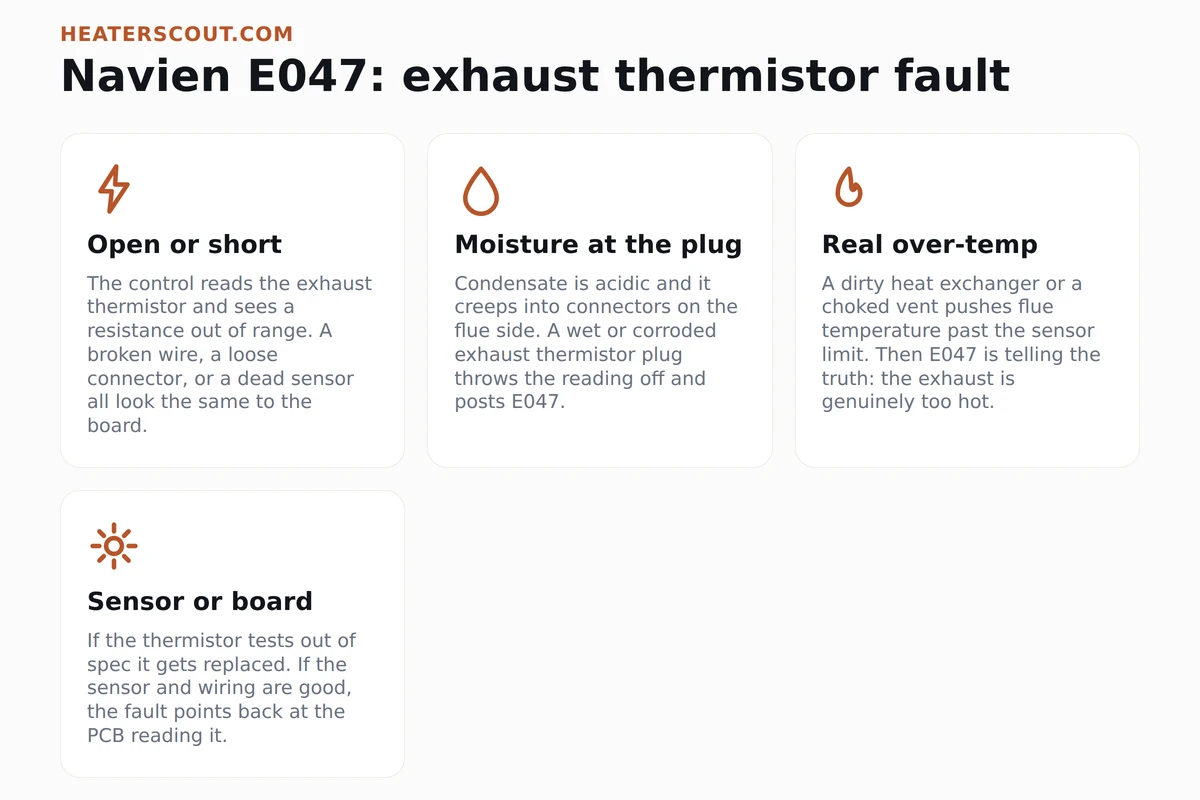
The fault splits into an electrical branch and a real-over-temp branch, and you cannot tell which from the display alone. Rule out the free, outside-the-cabinet causes first, then the sensor and its wiring, then the combustion side, and treat the board as the last suspect. That order keeps you from paying for a $400 part when the problem was a bird nest in the vent cap.
Blocked or restricted vent terminal
Start outside. If the intake or exhaust termination is choked by a nest, leaves, snow, insulation blown into the pipe, or a nearby dryer vent dumping lint into it, the unit cannot move combustion gas cleanly and flue temperature can climb. This is the one genuine cause a homeowner can safely fix. Clear the terminals, confirm both pipes are open, then reset.
Water or corrosion in the exhaust thermistor connector
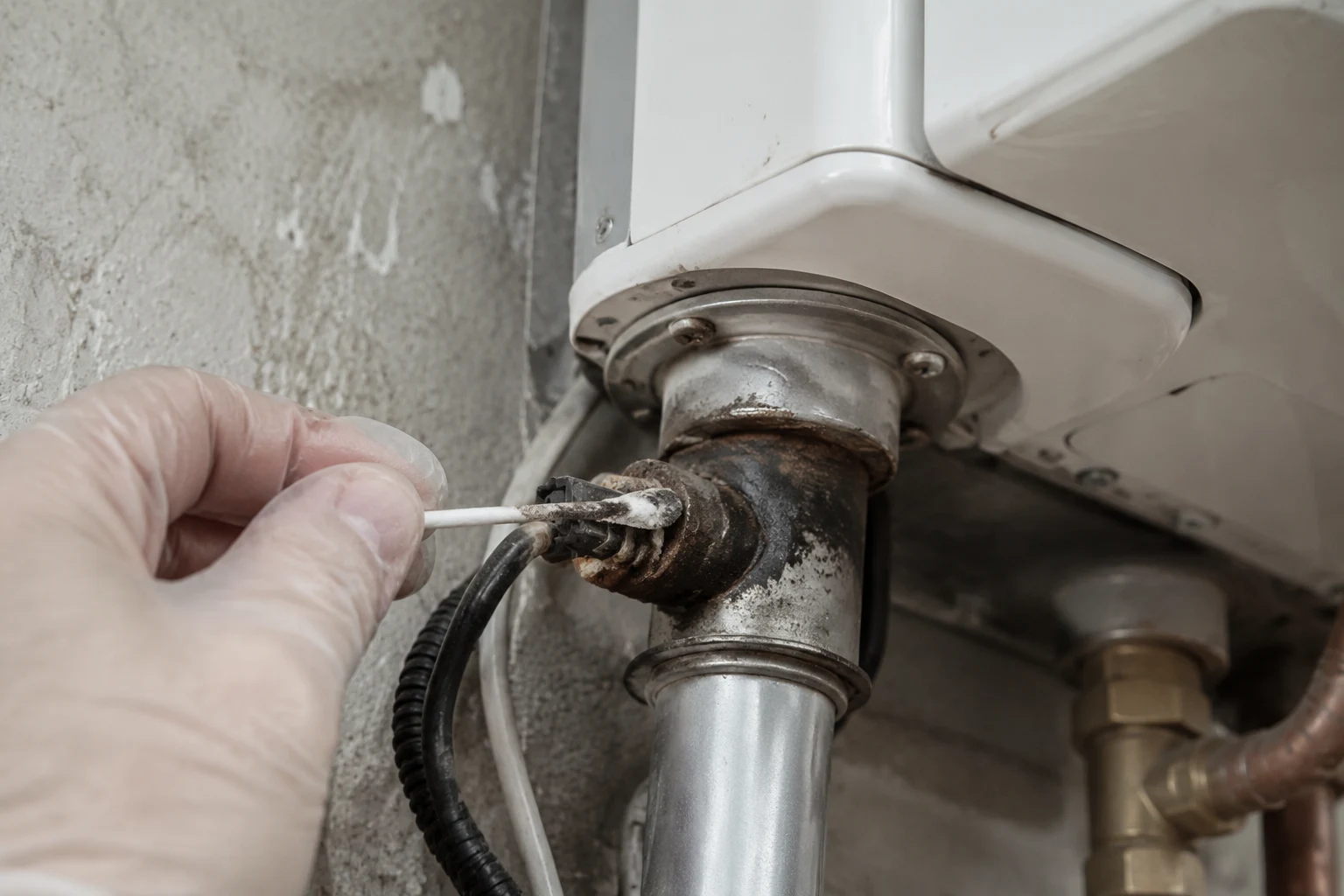
Condensate on a condensing unit is mildly acidic. Over years it wicks into connectors and corrodes pins. A wet or green-crusted exhaust thermistor plug reads erratically and posts E047. A tech unplugs the connector, inspects for moisture and corrosion, dries and reseats it, or replaces the pigtail.
Exhaust thermistor open or shorted
With the connector clean, the sensor itself is tested. In the unit's DIAGNOSTIC mode the tech reads the thermistor's resistance (the K value) and compares it to the expected value at that temperature. Infinite resistance means an open sensor or wire; near-zero means a short. An out-of-spec thermistor gets replaced.
Dirty heat exchanger driving a real over-temp
If the sensor and wiring test good but the unit still trips under load, the exhaust may honestly be too hot. Scale or soot on the heat exchanger keeps heat from crossing into the water, so more of it leaves the flue. A descale plus a combustion check brings flue temperature back down. Confirm gas pressure while the cabinet is open.
Control board (PCB) fault
Last suspect, not first. If the thermistor reads correctly, the wiring is sound, the vent is clear, and combustion is normal, but E047 still posts, the board's ability to read the sensor is in question. A PCB is the expensive outcome, so it is condemned only after everything cheaper checks out.
Clearing the code and reading the history
Clearing E047 is simple: switch the unit off at the panel, kill the dedicated breaker for 30 to 60 seconds, and power back up. Before you do, walk outside and look at the vent terminals, and check that the condensate drain is running and not backed up. Those two checks are the whole of what a homeowner should do inside the cabinet, which is to say nothing, because these are sealed condensing appliances and the exhaust sensor is not a reach-in part.
What a reset does not do is tell you whether the fault was a one-time spike or a pattern. A tech pulls the error history from the control and reads how often E047 has posted and under what conditions. If your unit dropped E047 once and has run clean since, you probably had a momentary condition. If it keeps latching every few cycles, stop resetting and get it diagnosed.
Who should do what
The split here is sharp. The vent terminals and the condensate drain are outside or at the base of the unit and safe to inspect. Everything past the front cover, the exhaust thermistor, its connector, the heat exchanger, the gas train, the board, is inside a sealed combustion appliance and belongs to a licensed tech.
Clear the vent and reset
Check the outdoor intake and exhaust terminations for a nest, leaves, snow, lint, or a dryer vent blowing into them. Confirm the condensate drain runs clear. Power-cycle at the breaker. If E047 does not return, you are done.
Test the exhaust thermistor
If E047 returns, the fault is inside. A tech unplugs and inspects the connector for moisture and corrosion, then reads the thermistor's resistance in DIAGNOSTIC mode against the expected K value and replaces the sensor if it is out of spec.
Chase a real over-temp
Sensor and wiring good but it still trips under load? The exhaust is genuinely too hot. That means descaling the heat exchanger and a combustion check before anyone talks about a board.
Do not keep resetting
If E047 keeps coming back, leave the unit off. Repeatedly clearing a genuine over-temp defeats the protection the sensor exists to provide. Get it diagnosed rather than forcing hot water out of it.
Before the tech arrives
You can shorten the visit and sometimes skip it. Run this quick list, and note anything you find so you can hand the tech a picture of when and how E047 shows up.
- Note whether E047 appears at startup or only under hot-water demand.
- Go outside and check both vent terminals for a nest, leaves, snow, lint, or a dryer vent aimed at them.
- Confirm the condensate drain line is running clear and not backed up or frozen.
- Power-cycle: unit off, dedicated breaker off 30 to 60 seconds, back on. See if E047 returns.
- Track how often it comes back: once and gone, or every few cycles.
- Recall the last descale or service. A unit overdue for maintenance points toward the over-temp branch.
- Do not open the cabinet or probe the exhaust sensor yourself.
Keeping E047 from coming back
Two habits cover most of what causes this code. First, keep the vent terminations clear and correctly placed. A termination too close to a dryer vent, a bush that grew over it, or a spot that drifts full of snow will choke the exhaust and push flue temperature up. Walk out and look at them a couple of times a year. Second, stay on top of descaling. On hard water a yearly flush keeps the heat exchanger clean so heat goes into the water instead of out the flue. Combine that with a look at the condensate path, since acidic condensate is what corrodes the connectors that throw an open-circuit E047 in the first place.
If your unit is well past its last service and E047 shows up, the maintenance was probably overdue anyway. A full service, descale, condensate check, connector inspection, and combustion check, resolves the common causes in one visit. Chase the vent and the reset yourself, then let a licensed tech read the sensor. That order gets you from a dark display back to hot water without paying for a board you did not need.
Frequently asked
What does Navien error code E047 mean?
E047 means the control board sees an abnormal signal from the exhaust thermostat, the small thermistor that watches how hot the flue gas is leaving the unit. The board expects that sensor's resistance to sit inside a defined range. When the reading falls outside that window, either open (infinite resistance, like a broken wire) or shorted (near zero), the unit posts E047 and stops firing. Two very different situations produce the same code. The common one is an electrical fault: a corroded connector, a chafed wire, moisture in the plug, or a thermistor that has drifted out of spec. The less common but more serious one is a genuine over-temperature, where the exhaust really is too hot because a dirty heat exchanger or a blocked vent is cooking the flue. The Navien NPE service manual lists E047 as abnormal operation of the exhaust thermostat and points you to check the sensor, its wiring, and the diagnostic resistance value.
Can I reset Navien E047 myself?
You can clear it, and clearing it is the right first move. Turn the unit off at the front panel, cut power at the dedicated breaker for 30 to 60 seconds, and power back up. That drops the latched fault. Before you restore power, check the two things a homeowner can safely reach: the outdoor vent terminals and the condensate path. Make sure the intake and exhaust terminations are not blocked by a nest, leaves, snow, lint, or a dryer vent blowing into them, and that the condensate drain runs clear. If E047 comes back within a cycle or two, the fault is inside the cabinet at the thermistor, its connector, or the board, and that is a licensed-tech job. Probing the exhaust sensor in a sealed condensing unit is not homeowner work.
How much does it cost to fix Navien E047?
If the outdoor vent was blocked and clearing it plus a reset fixes it, your cost is nothing but your time. When a technician has to come out, expect a diagnostic or service-call fee of roughly $100 to $200 in most US markets. The exhaust thermistor itself is inexpensive, generally $20 to $60, so a straightforward sensor replacement often lands around $150 to $350 installed. If a scaled heat exchanger is driving the over-temp, you are looking at a full descale, which runs $150 to $400. A control board (PCB) is the expensive outcome, commonly $300 to $600 for the part plus labor. Rule out the cheap causes first: vent, condensate, then sensor, before anyone quotes you a board.
Is Navien E047 dangerous?
The code itself is a safety response, and the unit shutting down is the safe outcome. E047 watches exhaust temperature for a reason: if flue gas leaves too hot, it can damage the venting, the sealing, and eventually the appliance. When the fault is purely electrical, a loose plug or a dead sensor, there is no immediate hazard beyond having no hot water. When the fault is a real over-temperature, do not keep resetting and running the unit to force hot water out of it. Repeatedly clearing a genuine over-temp condition defeats the protection the sensor provides. If E047 keeps returning, leave the unit off and get it looked at.
Why does Navien E047 keep coming back?
A code that returns right after a reset is almost never a fluke. The usual repeat offenders are a marginal connector on the exhaust thermistor that makes and breaks contact as the unit heats and cools, moisture wicking into that connector from acidic condensate, a thermistor aged out of spec, and a slowly fouling heat exchanger that lets flue temperature creep up until it trips the limit again. Because the same E047 covers both an electrical fault and a true over-temp, a tech confirms which one you have by reading the sensor's resistance in DIAGNOSTIC mode against the expected K value. An out-of-range reading condemns the sensor or its wiring. An in-range reading that still trips points at the combustion or heat-exchanger side, or the board.
Will descaling clear Navien E047?
Only if a scaled heat exchanger is what is driving the exhaust temperature up. Descaling flushes mineral buildup out of the heat exchanger so heat transfers into the water the way it should instead of pushing extra heat out the flue. If hard water has coated the exchanger and flue temperatures have crept up over time, an annual descale can bring exhaust temperature back into range and keep a healthy thermistor from tripping. But descaling does nothing for a corroded connector, a broken wire, a failed sensor, or a bad board. Those are the more common causes of E047. So descaling is worth doing as regular maintenance and it can be part of the fix, but do not assume it is the fix. Confirm the sensor and wiring first, then descale if the over-temp path is the real story.
Does E047 mean my Navien air pressure sensor is bad?
No, and this trips people up. E047 on Navien is the exhaust thermostat, the flue temperature sensor, not the air pressure sensor. Air-pressure problems show up under different codes: E110 for an abnormal air pressure reading and E127 for an open or shorted APS. If you are chasing an APS problem you want those codes, not E047. It is easy to conflate them because both live on the combustion side, but the fix path is different. E047 sends you to the exhaust thermistor, its connector, the vent, and the heat exchanger. If a source tells you E047 is the APS, cross-check the Navien NPE service manual, which lists E047 as the exhaust thermostat.