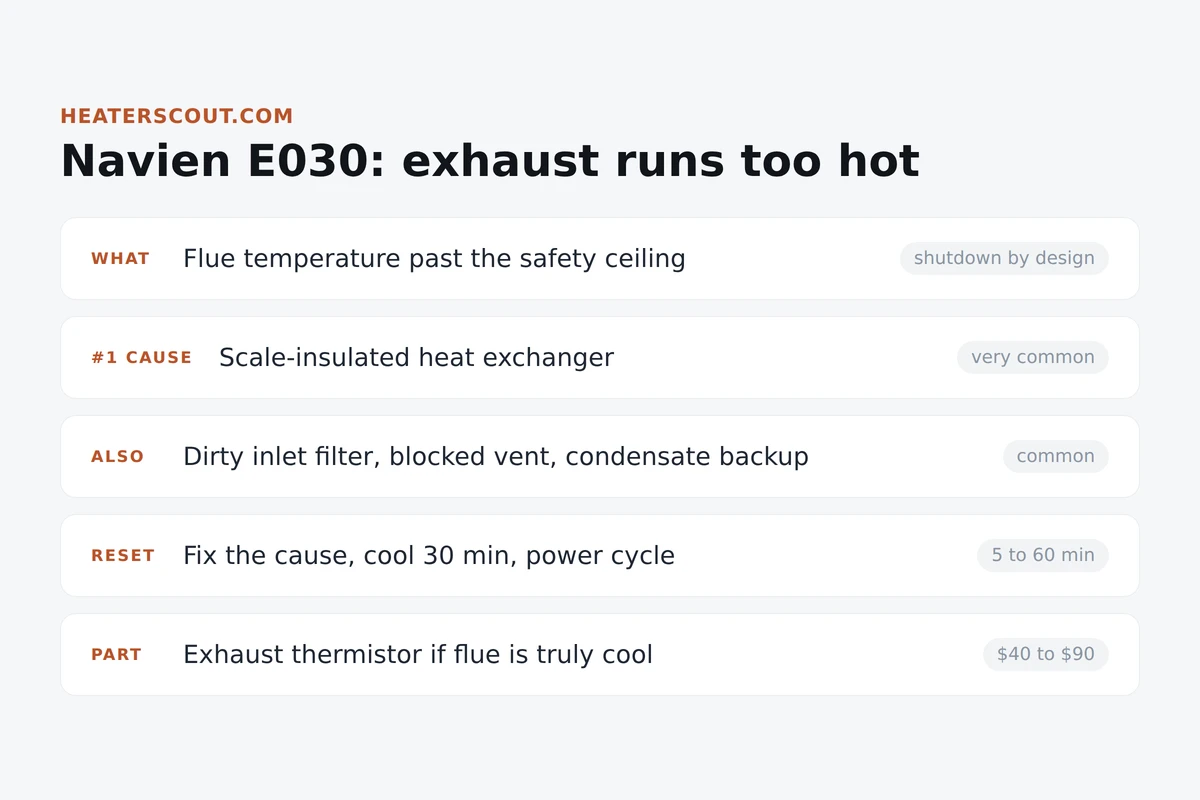
On a Navien tankless, E030 means the exhaust is running hotter than the unit allows, and the control shut the burner off before the flue could scorch anything. On the NPE service manual that limit is about 230F (110C) held for more than 10 seconds. The code is almost never a broken part. It is heat that should be going into your water going up the flue instead, and nine times out of ten that traces to a heat exchanger crusted with scale. Clean the inlet filter, descale, check the vent, and the flue temperature drops back where it belongs.
Do these in order before you call anyone
Work from cheapest and safest to most involved. Most E030 units clear at the descale step. Do the fix first, then the reset, because a bare power cycle without touching the cause just trips the code again on the next long draw.
Read this before you reset again
E030 is a safety shutdown, not a nuisance code. Do not sit there resetting it to force hot water. Repeatedly clearing combustion-side codes (E003, E004, E012, E030) runs a unit that is telling you it cannot shed its heat safely. If you smell exhaust in the room or the vent feels hot, shut the unit down and call a pro.
What the control board is actually reporting
Every condensing tankless watches its own exhaust with a thermistor mounted in the flue path. That sensor has a job beyond efficiency: it is a safety limit. When the number it reads climbs past the ceiling for that model and stays there, the board assumes something is sending combustion heat where it should not go and it cuts the burner. That is E030.
Navien E030 (abnormal exhaust temperature)
The exhaust thermistor detected a flue temperature above the unit's safety limit, held long enough to count as a fault. On the NPE line that limit is around 230F (110C) for more than 10 seconds. The board shuts the burner off to protect the vent and heat exchanger. It is a designed shutdown reporting that heat is escaping up the flue instead of transferring into the water, most often because scale has insulated the heat exchanger.
Why the flue runs hot: fix the cause, not the symptom
The two columns below sort E030 into what you can safely handle and what needs a licensed technician. The homeowner side covers the majority of real-world cases. The pro side is where the burner, gas supply, and sealed exhaust path live, and those are not DIY territory.
Homeowner-safe checks
- Clean the inlet water strainer
- Descale and flush the heat exchanger through the service valves
- Confirm the outdoor vent terminal is clear of nest, lint, snow, or debris
- Clear a visible clogged condensate trap or line
- Cool the unit 30 minutes, then power cycle to reset
Leave these to a licensed tech
- Test or replace the exhaust thermistor ($40 to $90 part)
- Read the K value in diagnostic mode and check wiring
- Verify gas pressure and combustion, correct overfiring
- Check DIP-switch settings for the model and altitude
- Diagnose a scaled or damaged heat exchanger ($1,000 to $4,100 installed)
When it is the heat exchanger versus the sensor
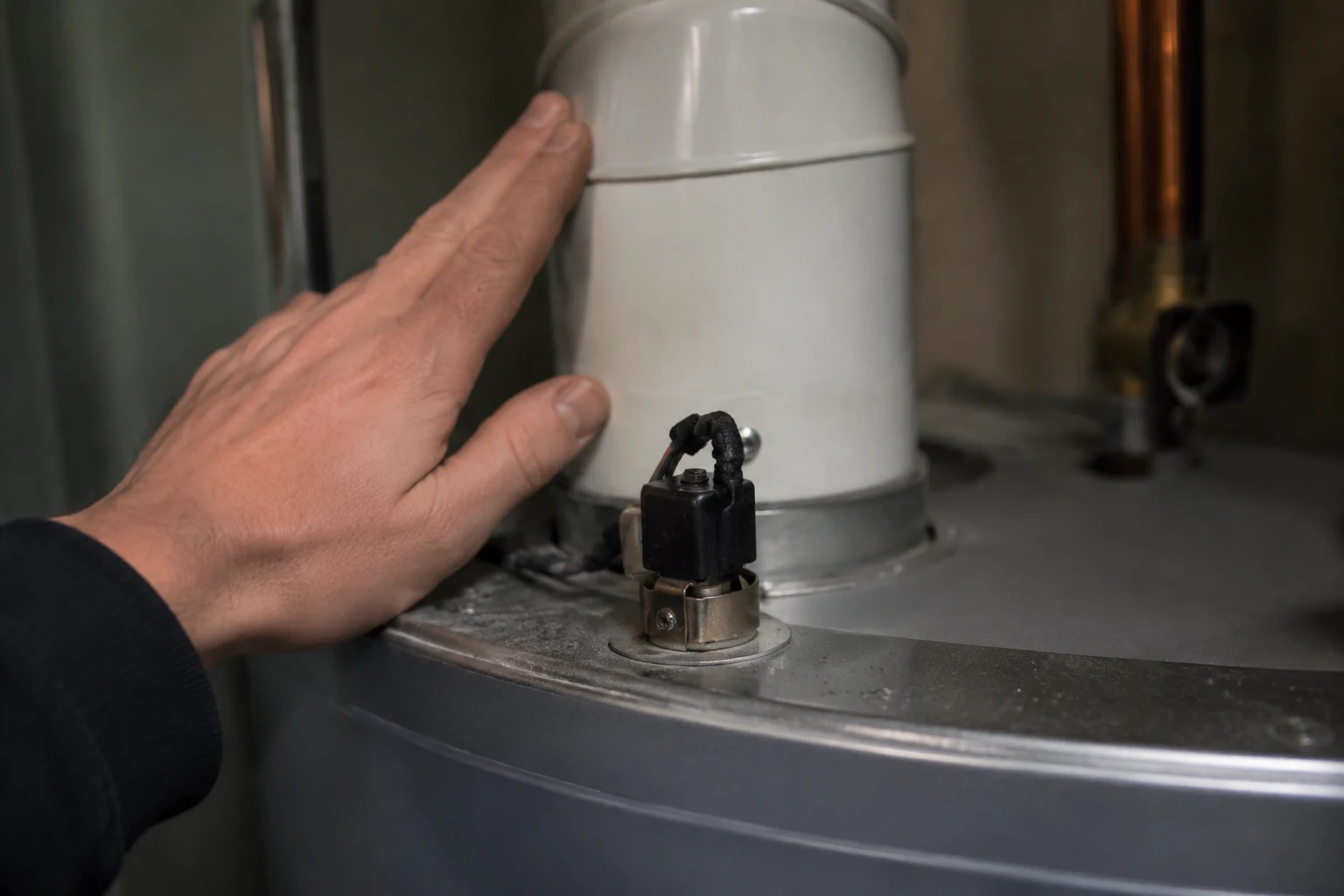
Here is the fork that decides your bill. If the flue really is hot, the problem is upstream: scale, low flow, a restricted vent, or condensate backing up. Descale first, because scale is the most common and the cheapest to rule out. If the code keeps coming back within a day after a clean descale, the exhaust vent or condensate path is the next suspect, then combustion tuning.
If the flue is cool to the touch but E030 still trips, you are looking at the exhaust thermistor itself reading high or a shorted connection. That is a cheap part but a job for someone who can open the unit and confirm the reading in diagnostic mode. Do not assume the sensor is bad until the descale and vent checks are done, because a genuine overheat looks identical from the front panel and swapping a good sensor fixes nothing.
Keeping E030 from coming back
E030 is a maintenance code more than a failure code. The single best defense is an annual descale flush, and a shorter interval if your water is hard and you have no softener. Scale is slow and cumulative, so the flue creeps hotter over a couple of years until it finally trips on a long draw. Descaling on schedule keeps the heat crossing into the water where it belongs.
Two other habits pay off. Rinse the inlet water strainer when you descale so flow stays full through the heat exchanger. And once a year, look at the vent terminal outside and the condensate line: Navien and Noritz both want horizontal vent runs pitched back toward the unit so condensate drips back through the heat exchanger and out the trap, not pooling in a low spot. A vent that sags or a condensate trap that dries out and plugs will send you an E030 long before the heat exchanger itself is to blame. Fix the water and the venting, and the exhaust temperature takes care of itself.
Frequently asked
Can I reset Navien error code E030 myself?
Yes, the reset itself is a homeowner job, but do the fix before the reset or the code comes right back. Turn the unit off at the power switch or the wall outlet, leave it off for at least 30 minutes so the flue and heat exchanger cool down, then power it back on. Some owners also hold the power button or use the reset on the front panel. The cooldown matters more than the button: E030 latches on an overheat, and the control will not let the burner fire again until the exhaust thermistor reads a normal temperature. If you reset and the flue is still running hot because the heat exchanger is scaled, the unit trips again on the next long draw. So clean the inlet filter and, if the code repeats, flush the heat exchanger first, then reset.
Will descaling clear Navien E030?
In most repeat cases, yes, because a scale-coated heat exchanger is the number-one cause of E030. When mineral scale insulates the copper or stainless passages, combustion heat cannot cross into the water, so it goes up the flue instead and the exhaust temperature climbs past the trip point. Flushing the heat exchanger with a descaler through the service valves for 45 to 60 minutes strips that scale and lets heat transfer back into the water, which pulls the flue temperature down. If your water is hard and you have never descaled, this is the first real fix to try. If E030 shows up right after a fresh descale, look elsewhere: vent blockage, condensate backup, or a failing exhaust thermistor.
How much does it cost to fix Navien E030?
It ranges from nothing to a few thousand dollars depending on the cause. Cleaning the inlet filter is free. A descale flush is about $150 to $300 if a plumber does it, or the cost of a flush kit and a jug of descaler if you do it yourself, roughly $50 to $130. An exhaust thermistor is a $40 to $90 part plus an hour of labor. Clearing a blocked vent or fixing a condensate line is a service-call charge, commonly $150 to $400. The worst case is a heat exchanger that has been cooked or badly scaled, where a replacement runs $1,000 to $4,100 installed. Because E030 is usually a maintenance problem caught late, most owners land in the descale-and-reset range rather than the parts-replacement range.
Is Navien error code E030 dangerous?
The code exists to keep you safe, so seeing it is not the emergency. E030 is a designed shutdown: an overheating flue is a real hazard, and the exhaust limit trips the burner off before anything melts, scorches the vent, or damages the heat exchanger. The danger is ignoring it and resetting over and over to force hot water. Repeatedly clearing combustion-side codes like E003, E004, E012, and E030 pushes a unit that is telling you it cannot get rid of its heat safely. Treat it as a hard stop, find out why the flue is hot, and fix that. If you smell exhaust in the room or the vent feels hot to the touch, shut the unit off and call a pro.
Why does Navien E030 keep coming back?
Because a reset does not remove scale, clear a vent, or drain a plugged condensate line. If the code returns within a day or after every long shower, the flue is still running hot for a physical reason. The usual repeat offender is a heat exchanger scaled from hard water that never got descaled. Next is a partially blocked exhaust vent, a sagging vent section holding condensate, or a clogged condensate trap that backs water into the unit. Less often it is overfiring from a gas or combustion setting, or an exhaust thermistor drifting high. Chasing the reset instead of the cause is why owners see E030 five times in a week. Descale, inspect the vent and condensate path, then check the thermistor reading in diagnostic mode.
Do I need a plumber to fix E030, or can I do it myself?
Split it by task. A homeowner can safely clean the inlet water filter, run a descale flush through the service valves, check that the vent terminal outside is not blocked by snow, lint, a nest, or debris, and clear a visible condensate line. Those cover the most common causes. Leave the rest to a licensed tech: opening the sealed combustion chamber, testing or replacing the exhaust thermistor, reading gas pressure, adjusting combustion or DIP-switch settings, and diagnosing a suspected heat-exchanger failure. Anything involving the burner, gas supply, or the sealed exhaust path is not a DIY job. If your descale and vent check do not stop E030, that is the line where you call a Navien-trained technician.
Does E030 mean the same thing on every Navien model?
The meaning is the same, abnormal exhaust temperature, but the exact trip point and thermistor wording differ by model line. The NPE service literature describes the exhaust limit shutting the unit down when the flue exceeds about 230F (110C) for more than 10 seconds. Some condensing and NPB-series guides cite a lower ceiling. Do not fixate on the number. What matters is that the flue got hotter than that model allows and the control shut down. The fix path is the same across the line: clean the inlet filter, descale the heat exchanger, inspect vent and condensate, then check the exhaust thermistor. If your manual lists a different threshold than another source, trust the manual for your specific model.