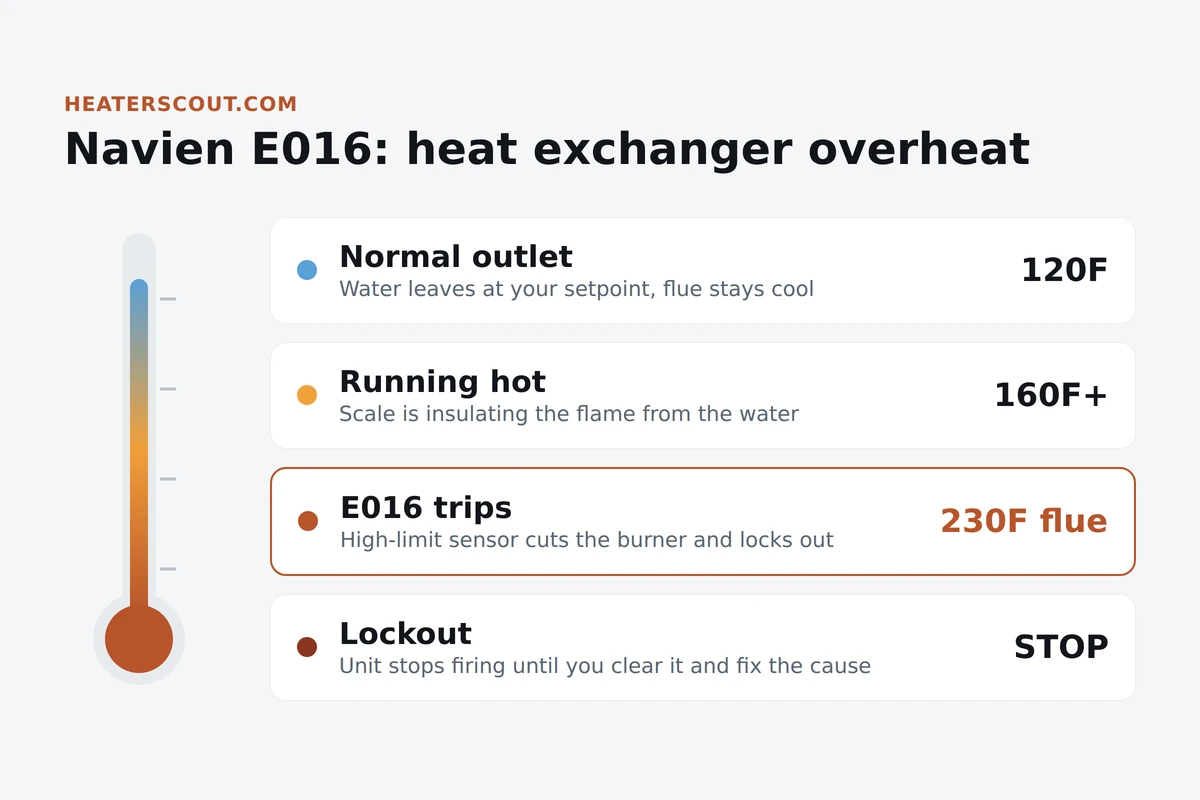
A Navien tankless throwing E016 has decided its own heat exchanger is running too hot and has shut the burner off to protect itself. The board is reading a temperature it does not like, either flue gas past roughly 230 degrees Fahrenheit on the NPE and NPN condensing units or outlet water hotter than allowed on other lines, and it locks out rather than keep firing. On a unit that has never been descaled, this is not bad luck. It is the scale finally getting thick enough to cook the metal, and Navien techs will tell you it is a predictable event, not a defect. The good news is that the most common cause is also the one you can fix in an afternoon.
Reading what the board is actually telling you
E016 is an overheat lockout. The heat exchanger is the coil of metal tubing the burner heats and the water flows through. When everything works, the flame's heat passes into the water, the water leaves at your setpoint, and the flue gas stays cool. E016 means that handoff broke down. The metal and the flue gas run hotter than the water is carrying away, a limit sensor sees the excess, and it cuts the burner before the metal takes damage. Your job is to find why the heat stopped flowing into the water, and the causes stack up in a predictable order.
1. Scale in the heat exchanger
This is the top cause by a wide margin. Hardened calcium and lime plate the inside of the exchanger tubing and act as insulation between the flame and the water. Heat that used to move into the water now backs up into the metal and the flue, and the limit sensor trips. Any Navien that has run a year or more on hard water without a descale is a prime suspect. Reduced flow, longer waits for hot water, and E016 showing up more often are all the scale telling on itself.
2. Low water flow or a clogged inlet filter
The exchanger needs a steady volume of water moving through it to carry heat away. Navien puts a small inlet water filter and strainer on the cold feed, and it catches grit, sediment, and flakes of scale. When it clogs, flow drops, the thinner stream cannot absorb the burner's heat, and the exchanger overheats. A partly closed service valve, a kinked line, or a whole-house filter due for a change does the same thing. This is the second thing to check because it is quick and free.
3. Air trapped in the system
Air pockets in the exchanger or the lines create hot spots the water cannot reach, so a section of metal runs dry and hot even while water flows past. This shows up most after service work or a supply shutoff let air in. Running several hot taps wide open for a few minutes to purge the air can clear an E016 that started right after the lines were opened.
4. Mixing valve, three-way valve, or sensor fault
Deeper causes send water the wrong way or misread the temperature. A stuck three-way or mixing valve can starve the exchanger of flow. A failing outlet thermistor can report a temperature that is not real, and a weak high-limit switch can trip early even when the exchanger is fine. A faulty control board can misread the whole picture. These are less common than scale and flow, and they are where a licensed tech takes over.
What you can safely do versus what needs a tech
The split here is clean, and it matters because half the fixes for E016 are genuinely homeowner work and the other half are not. Descaling and cleaning the inlet filter are maintenance tasks Navien expects owners or a handy DIYer to do. Anything that involves the gas valve, the limit sensor, the three-way valve, the control board, or opening the sealed combustion side is licensed-tech territory. Do the safe things first. They fix most E016 cases, and if the code survives a good descale and a clean filter, you have narrowed the problem down for whoever comes to look at it.
Homeowner-safe fixes
- Power the unit off for about 30 minutes, then restart, to clear the lockout and let the sensor cool.
- Shut the isolation valves, pull and rinse the cold inlet water filter and strainer, then reseat it.
- Descale the heat exchanger with a flush kit and white vinegar or a descaler for 45 to 60 minutes.
- Purge trapped air by running several hot taps wide open for a few minutes after any line work.
- Check the error history in the menu so you know if E016 is a one-off or a repeat pattern.
Call a licensed tech
- Testing or replacing the high-limit or exhaust limit sensor that trips the overheat.
- Diagnosing a stuck three-way or mixing valve that starves the exchanger of flow.
- Checking the outlet thermistor and the control board for false high readings.
- Inspecting the heat exchanger for warping or pinhole leaks after repeated overheats.
- Replacing the heat exchanger if a flush cannot restore it, which is the expensive outcome.
Before you tear into a descale, one quick reset tells you whether you are chasing a lockout or a hard fault. Clear the code and see how fast it returns. That timing is a clue: instant is a sensor or valve, minutes to hours of heavy use is scale or flow.
Should I just keep resetting E016 until my plumber can come?
No. Clearing the code once to confirm the unit still runs is fine, but repeatedly resetting an overheating heat exchanger and forcing it to keep firing is how a fixable scale problem turns into a warped exchanger with pinhole leaks. The lockout is protecting the metal. If E016 comes right back after a reset and you have not descaled, shut the unit off and run hot water from another source or wait for service rather than cycling it over and over.
The fix, in order
Work these in sequence and stop at the step that clears the code. Most owners never get past the descale. You need a flush kit, a small pump with two hoses and a bucket, plus two to four gallons of white vinegar or a tankless descaler. Your Navien has two service valves with hose bibs for exactly this, so no plumbing is cut. Kill the power and shut the gas before you open anything.
- Power the unit off and let it sit about 30 minutes so the heat exchanger and the limit sensor cool. Then restart and run a hot tap to confirm E016 returns and is not a stale code.
- Shut the hot and cold isolation valves and close the gas. Open the small drain caps to relieve pressure into a bucket, keeping a towel handy for the water that follows.
- Unscrew the cold-side inlet water filter and strainer. Rinse the screen clean of grit and scale flakes, check it is not torn, and thread it back in. A clogged screen alone can cause E016.
- Connect the flush pump and hoses to the two service-valve hose bibs. Open the service valves to the pump and close the ones to the house so you are circulating only through the heat exchanger.
- Fill the bucket with white vinegar or a descaling solution and run the pump to circulate it through the exchanger for 45 to 60 minutes. The vinegar will cloud and pick up gray scale as it works.
- Flush the vinegar out with clean water for several minutes, remove the pump and hoses, and reinstall the inlet filter. Close the drain caps and reopen the house-side service valves.
- Reopen the gas, restore power, and run hot water. Purge any trapped air by running several hot taps wide open for a few minutes. Watch for E016 to stay cleared under a real hot-water draw.
- If E016 survives a clean filter and a full descale, stop here and call a tech. The remaining causes, the limit sensor, the three-way valve, the thermistor, and the board, need instruments and are not owner work.
Never bypass the overheat sensor
Do not defeat or bypass the high-limit sensor to stop E016 from tripping. That sensor is the only thing standing between an overheating heat exchanger and real damage, warped metal, pinhole leaks, or scalding water at the tap. If the unit keeps overheating after a proper descale and a clean filter, the answer is to fix the cause, a stuck valve, a bad sensor, or a scaled exchanger that needs replacing, not to silence the alarm. Repeatedly forcing an overheating unit to fire is how a 150 dollar flush becomes a several-thousand-dollar heat exchanger.
Keeping E016 from coming back
E016 shows up from time plus hard water, so prevention is a rhythm, not a one-time act. A yearly descale keeps scale from ever getting thick enough to insulate the exchanger, and cleaning that little inlet filter at the same time keeps flow up. If your water is hard enough that you descale more than once a year to stay ahead of E016, a water softener upstream of the heater is the real fix. It softens the water before it touches the exchanger and can roughly double how long the unit goes between service.
| DIY descale supplies | Under 50 dollars for a flush pump kit and a few gallons of white vinegar. Reusable pump, so the recurring cost is just the vinegar. |
| Professional descale and flush | About 120 to 450 dollars depending on your area. Often bundled with an annual maintenance visit that runs under 200 dollars. |
| Inlet filter screen | A few dollars if yours is torn and needs replacing. Cleaning the existing screen is free. |
| Heat exchanger replacement | Roughly 1,000 to over 4,000 dollars installed. The part alone is about 300 to 900 dollars. This is the outcome you descale to avoid. |
| Water softener upstream | The most effective long-term prevention on hard water. Softens water before it reaches the exchanger. |
If you take one thing from E016, let it be the timing. It almost always shows up on a unit that skipped its descales. Clear it, flush it, then put the next descale on the calendar before scale returns to the same trip point.
Frequently asked
What does Navien error code E016 mean?
E016 is Navien's abnormal high temperature fault, which means the heat exchanger got too hot. On the NPE and NPN condensing units the exhaust or flue limit sensor fires when the flue gas passes roughly 230 degrees Fahrenheit, about 110 Celsius, for more than ten seconds. On other model lines the outlet water thermistor reports water leaving hotter than the board allows. Either way the board reads an overheat and shuts the burner off. It is a safety lockout, not a glitch. Something is making the heat exchanger run hotter than designed, and nine times out of ten that something is scale.
Can I reset code E016 myself?
You can clear the lockout, yes. Turn the unit off at the power switch or pull its plug, wait, then power it back on and run hot water to see if E016 returns. Navien's own guidance is to shut the unit down for about 30 minutes before restarting so the heat exchanger and the limit sensor cool fully. A short 30 second cycle sometimes clears the code too, but the longer wait is safer because a still-hot sensor can re-trip immediately. Clearing the code is the easy part. If you reset it and do nothing else, E016 comes right back the next time the unit fires hard, because the reset does not touch the scale or clogged filter that caused it.
Will descaling clear code E016?
In most cases, yes, and it is the single most effective fix. Scale, hardened calcium and lime from your water, coats the inside of the heat exchanger and acts like insulation. The flame heats the metal, the metal cannot dump that heat into the water fast enough, so the metal and flue gas run hot and the limit sensor trips. Flushing the exchanger with a descaler or plain white vinegar for about 45 to 60 minutes dissolves the buildup and lets heat transfer normally again. Owners on repair forums report E016 clearing after a single one-hour vinegar flush. If your unit has never been descaled and throws E016, descaling is almost certainly the fix.
How much does it cost to fix Navien E016?
If scale is the cause, a professional descale and flush runs about 120 to 450 dollars depending on your area, and a DIY flush with a pump, a bucket, and a jug of vinegar costs under 50 dollars in supplies. A new inlet filter screen, if yours is torn, is a few dollars. It gets expensive only if the overheating already damaged the heat exchanger. A Navien exchanger kit alone is roughly 300 to 900 dollars, and with labor the full job lands from about 1,000 to over 4,000 dollars depending on the model and access. That gap is exactly why you descale before scale gets bad enough to cook the exchanger.
Why does E016 keep coming back?
Because the underlying cause was not fixed, only the code was cleared. The usual repeat offender is hard water. You descale once, the unit runs fine, then scale rebuilds and E016 returns on its old schedule. Hard water areas can scale an exchanger enough to overheat in a single year. The fix is a maintenance rhythm plus, ideally, a water softener upstream of the heater so the water hitting the exchanger is soft. Other repeat causes are a filter that keeps clogging, a mixing or three-way valve sending water the wrong way, or a high-limit sensor that trips early. If E016 returns within weeks of a good descale, stop resetting and get the valve, sensor, and board checked.
Is Navien error code E016 dangerous?
The code itself is the safety system doing its job. The high-limit sensor exists to catch an overheating heat exchanger and shut the burner down before the metal is damaged or scalding water reaches a tap. The danger is in ignoring it. Bypassing or repeatedly resetting an overheating unit without fixing the cause lets the exchanger keep cooking, which can warp the metal, open pinhole leaks, and ruin an exchanger a timely flush would have saved. Treat E016 as a stop sign, not a nuisance.
What is the difference between E016 on an NPE and other Navien models?
The overheat idea is the same across the line but the exact sensor that trips can differ, and the sources are not perfectly consistent. On the condensing NPE and NPN units, most manuals tie E016 to the exhaust or flue limit sensor catching flue gas over about 230 Fahrenheit. Other Navien documentation describes E016 as high outlet water temperature read by the water thermistor. Both trace back to the same problem, a heat exchanger that cannot shed its heat, and the same first fixes apply: check the inlet filter, descale, then have a tech check the limit switch, the three-way valve, and the board. Always match the fix to your model's service manual, not a generic list.