Navien E012 is the code you get when the burner already lit. The unit sparks, the flame catches, hot water starts flowing, and then partway through the cycle the flame sensor stops seeing a flame and the board shuts everything down. That timing is the whole story. You are not chasing a unit that will not start, you are chasing a flame that will not stay lit, and the two problems point in different directions.
Navien E012 (flame loss)
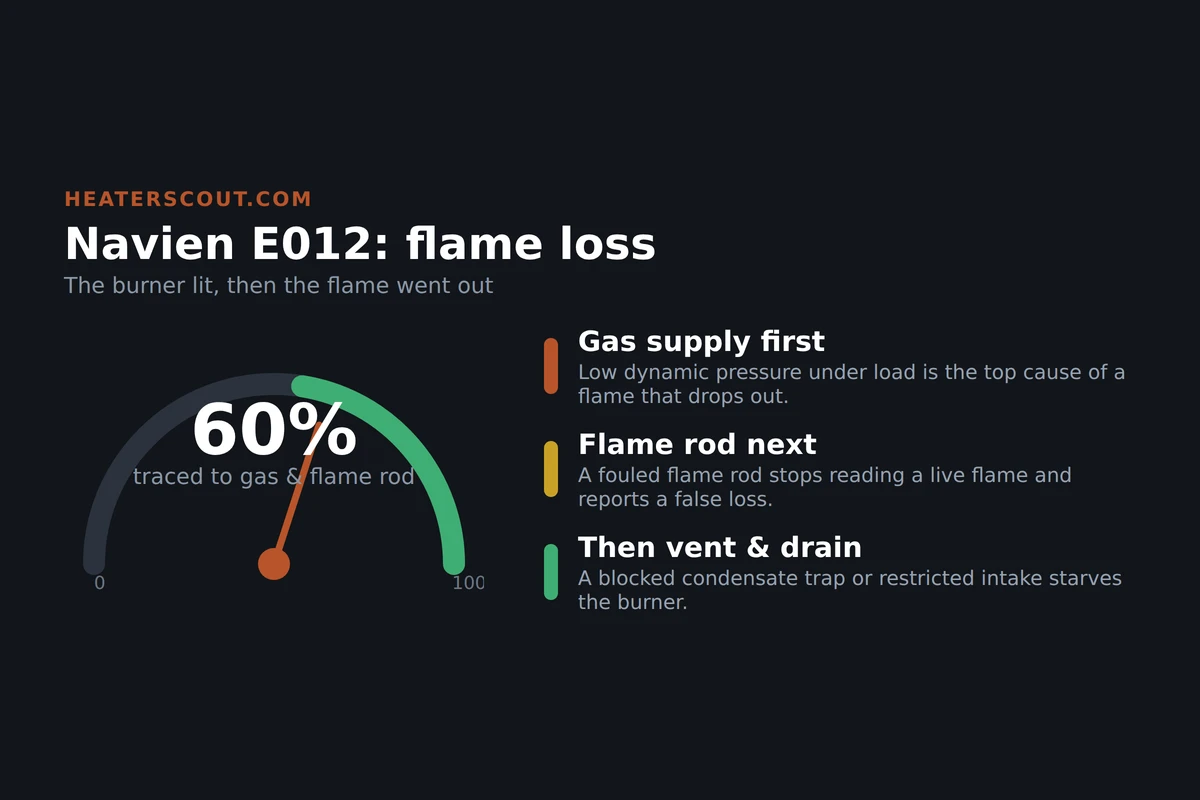
A flame-loss lockout. The burner ignited and ran, then the flame rod stopped detecting the flame's ionization current mid-cycle, so the control board closed the gas valve and posted E012 rather than let unburned gas continue. The code names a symptom, a flame that dropped out, not a single failed part. The cause is usually on the gas side or the flame rod, with venting and condensate close behind.
Flame loss versus ignition failure
It is worth being precise, because Navien uses separate codes for separate moments. An ignition-failure code means the lighting sequence ran and the flame rod never saw a flame at all, so the burner never established. E012 is later in the sequence: the flame was there, the unit was heating, and then it was gone. If your unit dies the instant it tries to fire, that is a different problem. E012 shows up seconds or minutes into a good run, which is why gas-pressure sag under load is such a common culprit. The unit had enough gas to light and not enough to keep burning once demand climbed.
Field reports back this up. Techs who work on the NCB and NPE lines describe E012 that appears after five to fifteen minutes of runtime, or the moment a second gas appliance switches on, as the classic signature of a shared or undersized gas line. The line reads fine at rest and sags the moment combined demand rises past what it can deliver.
It quits after a few minutes of hot water
Runs fine, then E012 mid-shower or when the furnace or range fires. That is low dynamic gas pressure under load. A manometer reading while the burner runs flat out tells the tale. Homeowner-safe part: confirm the gas is fully on and no valve is half-closed.
It fails intermittently, no clear pattern
Random flame loss with no load trigger often means a fouled flame rod. The oxide film insulates the probe so it misreads a live flame as gone. Cleaning restores it, but the rod sits inside the combustion area, so it is a cover-off, gas-off job.
It started after cold weather or a while unused
A frozen or blocked condensate trap, or a vent packed with ice, leaves, or a nest, backs pressure up and destabilizes the flame. You can inspect the outside vent and the accessible condensate drain yourself before assuming a part failed.
What you can safely do, and what you cannot
The split on E012 is sharp. A handful of checks are genuinely safe to do without opening the unit or touching a gas fitting. Everything past that involves gas pressure, the gas valve, or the sealed combustion chamber, and that is licensed work. Trying to shortcut it around live gas is where people get hurt.
Safe for a homeowner
- Confirm the gas is on and other gas appliances work normally.
- Check that the main gas shutoff and the service valves are fully open, handle in line with the pipe.
- Inspect the outside vent termination for ice, leaves, snow, or a nest.
- Pour a little water into the condensate drain outlet and confirm it flows away, no gurgle, no standing water.
- Power-cycle the unit off for about five minutes, then back on.
Call a licensed technician
- Measuring dynamic gas pressure with a manometer while the burner runs at full load.
- Removing the front cover to reach and clean the flame rod.
- Resizing or re-routing an undersized gas line shared with other appliances.
- Testing or replacing the gas valve, igniter, or control board.
- Anything inside the combustion chamber or on a gas fitting.
The causes, ranked by how often they show up
Sources agree on the short list, and they agree on the order. Gas supply and pressure lead, the flame rod is next, then venting and condensate, with the gas valve and the control board as the last resorts. The percentages below reflect how often each turns out to be the culprit in the field, not a hard measurement, so treat them as a priority order rather than statistics.
| Cause | Why it drops the flame | Who fixes it | Rough US cost |
|---|---|---|---|
| Low gas pressure under load | Line sags below the minimum firing pressure when the burner draws full demand or another appliance shares the supply. Flame weakens and the rod loses it. | Technician (manometer, gas work) | $150–$400+ |
| Dirty or failed flame rod | Oxide film insulates the probe so it misreads a live flame as gone. A false loss. | Technician (cover off, gas off) | $150–$300 |
| Blocked condensate trap or drain | Backed-up or frozen condensate floods the secondary heat exchanger and destabilizes combustion. | Homeowner can inspect; tech to clear | $0–$250 |
| Restricted intake or exhaust vent | Ice, debris, a nest, or recirculated exhaust starves the burner of clean air. | Homeowner can inspect exterior | $0–$300 |
| Faulty gas valve | Valve delivers unstable gas flow, so the flame flickers and drops. | Technician | $300–$600 |
| Control board (PCB) | Board misreads the flame signal or mis-sequences the valve. Rare, ruled out last. | Technician | $400–$600+ |
The order to work it, step by step
Do the safe checks first, in order, and reset once between them. If E012 clears and the unit runs a full cycle after any step, you found it. Stop there. If it keeps coming back after the homeowner-safe steps, that is your cue to hand it to a licensed installer rather than keep cycling the display.
Why gas pressure is the usual answer
When the safe checks do not clear it, gas pressure is the most common finding, and it is the reason DIY ends here. A Navien NPE unit wants at least 3.5 inches of water column at the inlet, and it needs the line to hold roughly 7 to 10 inches while the burner is firing at full capacity. That word, while, is the trap. A line can read perfectly at rest and collapse the moment the burner pulls its full BTU load, especially if it is undersized for the run length or shared with a furnace and a range that fire at the same time.
That is exactly the E012 that shows up mid-shower, or the instant the heat kicks on. The flame is fine until combined demand drags the pressure below the minimum, then the flame goes weak, the rod loses it, and the board locks out. Diagnosing it means putting a manometer on the line and reading the pressure under load, and correcting it means resizing the gas line. Both are licensed gas work, not a reset.
The flame rod, and why it is not a wipe-and-go job
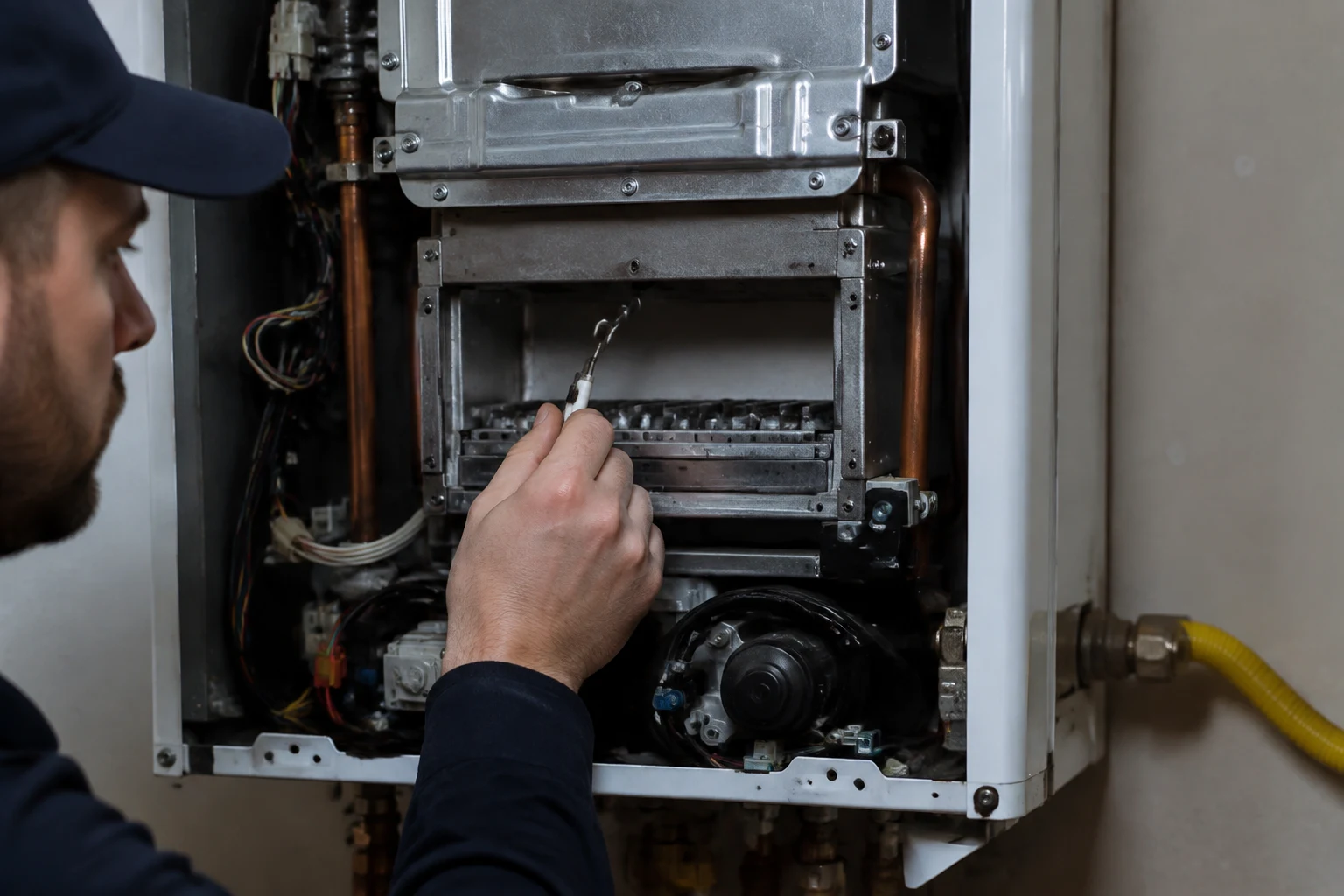
The flame rod is a small electrode that proves a flame is present by reading the tiny ionization current a flame conducts, a process called flame rectification. Over time it picks up an oxide film from combustion, and that film insulates it so it stops sensing the current even while the burner is lit. The board reads no flame, and you get a false E012. Cleaning it is genuinely simple, 0000-grade steel wool on the probe, a clean mounting surface, and tight screws for a good ground. The reason it is still a technician task is location: the rod sits inside the combustion area behind the front cover, and reaching it means shutting off the gas and opening a sealed portion of the unit. Navien and most installers are blunt about not opening the combustion chamber yourself.
Venting, condensate, and the quiet triggers
A restricted vent starves the burner of clean air, and on these condensing units the exhaust and intake terminations can catch ice, debris, or a nest. Close-coupled terminations can even recirculate exhaust back into the intake, which fouls combustion enough to drop the flame. The condensate side is the other quiet one. If the trap fills from a blocked drain, or the condensate line freezes in winter, liquid backs up into the secondary heat exchanger and obstructs airflow, and the flame becomes unstable. Both of those you can inspect from outside the sealed unit, the vent termination and the accessible condensate drain, which is why they sit in the homeowner column.
Keeping E012 from coming back
Most repeat E012 traces to things annual service catches. A yearly maintenance visit cleans the flame rod and the intake filter, flushes the heat exchanger, and checks the condensate trap before any of them destabilize the flame. If the code first appeared after adding a gas appliance or a longer line, have an installer confirm the gas line is sized for the full combined load, not just the water heater at rest. Keep the vent terminations clear through the seasons, especially of snow and ice, and make sure the condensate line cannot freeze. None of that is glamorous, but a unit that keeps its flame is a unit whose gas, air, and drain paths are all doing their job at once.
Frequently asked
What does Navien error code E012 mean?
E012 is a flame-loss error. The burner lit normally and ran for a while, then the flame sensor stopped reading a flame and the control board shut the unit down. It is different from an ignition-failure code, which means the burner never lit at all. E012 means it lit and then the flame died mid-cycle, so you are looking for what destabilized a flame that was already burning.
Can I reset a Navien E012 myself?
Yes. Switch the unit off at its disconnect or unplug it for about five minutes, then power it back on. A reset clears the lockout on the display, but it does not fix the cause. If E012 returns after a normal run, the reset only bought you time, and you need to find why the flame is dropping out.
How much does it cost to fix Navien E012?
A diagnostic and cleaning service call usually runs about $150 to $300. If a part is involved, a flame rod, gas valve, or control board, expect roughly $200 to $600 with labor depending on the component. Correcting a gas-pressure or venting problem, such as resizing a gas line or re-routing a vent, can cost more because it is licensed work.
Will cleaning the flame rod clear E012?
Often, yes, when a dirty flame rod is the cause. Combustion leaves an oxide film on the rod that insulates it, so it stops sensing the flame current and reports a false loss. Cleaning the probe with 0000-grade steel wool and re-seating it with a tight ground usually restores the signal. The catch is that reaching the rod means removing the front cover and shutting off gas, which is why most owners have a technician do it.
Why does my Navien show E012 only after running a few minutes?
That pattern points at gas pressure. The unit fires fine at first, but once the burner draws its full demand, or another gas appliance kicks on and shares the supply line, the pressure sags below what the flame needs. The flame gets weak, the rod loses it, and the unit posts E012. Measuring that dynamic pressure under load takes a manometer and a technician.
Is Navien error code E012 dangerous?
The code itself is a safety response, not a hazard. When the flame drops out, the board shuts the gas valve so raw gas cannot keep flowing. The unit is doing its job. What you should not do is keep resetting and forcing it to run, or open the sealed combustion area yourself, because the underlying cause often involves gas pressure or venting that needs proper diagnosis.
Why does E012 keep coming back after I reset it?
Because the reset never addressed the root cause. Repeated E012 after a clean reset almost always means low dynamic gas pressure, a fouled flame rod, a partially blocked vent or condensate trap, or a failing gas valve. Each reset clears the display and the unit relights, runs, and loses the flame again. That repeating loop is the signal to stop resetting and bring in a licensed installer.