A mobile home water heater looks like any other tank in the closet, so the natural move when it dies is to grab a 40 gallon unit off the shelf at the home center and swap it in. That is the one move you should not make. A true manufactured home falls under the federal HUD code, and that code requires a water heater specifically listed for manufactured housing, not a standard residential model. The difference is not a technicality. It is about where a gas burner gets its combustion air, how the unit vents, and how it is secured, and getting any of those wrong in the tight air space of a mobile home can put carbon monoxide in a hallway. This page covers what makes a heater mobile-home approved, why a standard atmospheric tank is not, how to spot the right listing, the sizes that fit, and the brands that make compliant units.
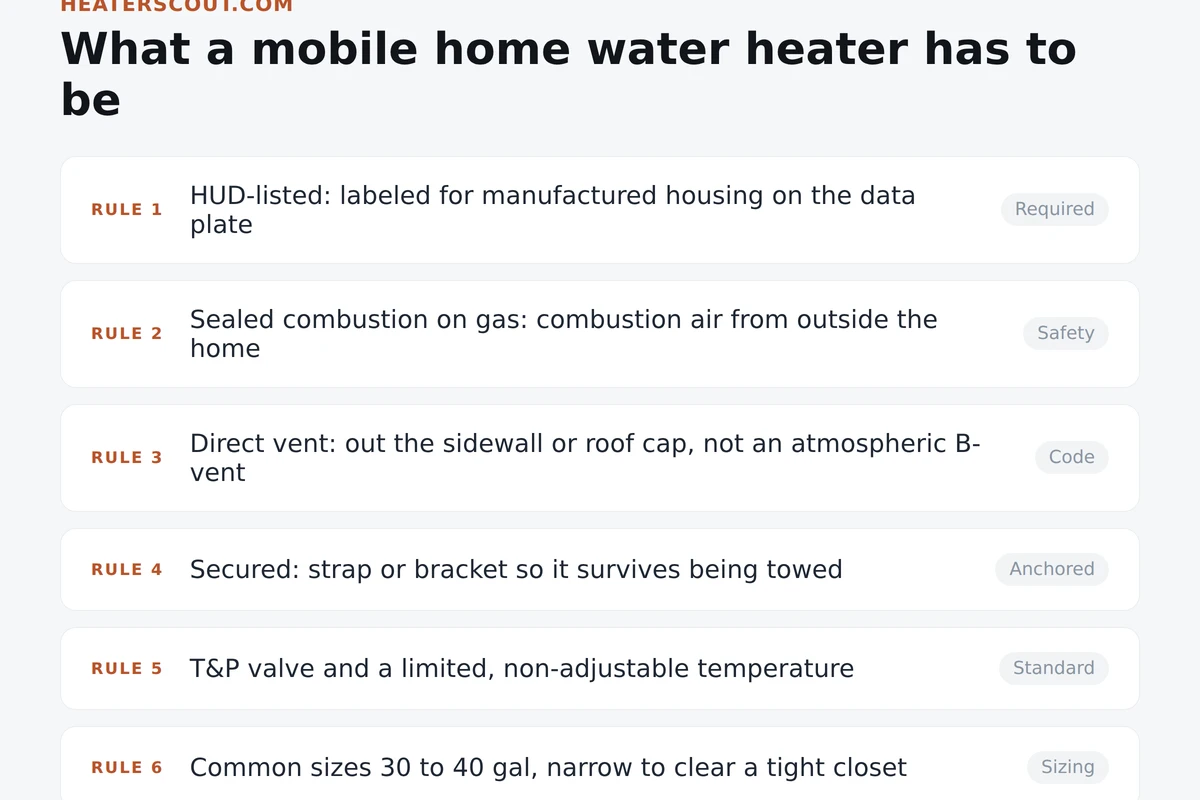
| HUD listing | Listed and labeled for manufactured housing on the data plate, not marketing copy |
| Combustion air | On gas units, sealed combustion drawing air from outside the home, not from the room |
| Venting | Direct vent out the sidewall or a manufactured-housing roof cap, not an atmospheric B-vent |
| Securing | Anchored with a strap or bracket so it survives transport, kit usually included |
| Relief valve | A temperature and pressure relief valve, with a limited non-adjustable temperature |
| Fuel | Gas units field-convertible between natural gas and propane, kit in the box |
| Size | Commonly 30 to 40 gallons, narrow enough to clear a tight closet and access door |
| Mobile home (HUD) | Standard residential | |
|---|---|---|
| Listing | Manufactured housing listed | Not HUD listed |
| Combustion air (gas) | Sealed, from outside | From the room |
| Venting (gas) | Direct vent, sidewall or roof cap | Atmospheric B-vent up the roof |
| Secured for transport | Strap or bracket, included | Not required |
| Fuel switch | Field-convertible NG or LP | Often single fuel |
| Typical size | 30 to 40 gal, narrow | 40 to 50 gal, wider |
Manufactured home or modular home? Check first
Before anything else, settle which kind of factory-built home you have, because it changes the answer completely. A manufactured home is one built after June 15, 1976 to the federal HUD code, and it carries a red HUD certification label, usually a metal tag on the exterior. A home like that needs a water heater listed for manufactured housing, full stop. A modular home, by contrast, is also built in a factory but to state and local building code rather than the HUD code, and it carries a state seal instead of a HUD tag. Modular homes generally take a standard residential water heater, the same as a site-built house.
People use mobile home, manufactured home, and modular home loosely, and that confusion is exactly what leads to the wrong tank going in. If your home has a HUD tag, treat it as a manufactured home and buy a manufactured-housing-listed heater. If it has a state seal and no HUD tag, you are likely fine with a standard unit. When you cannot find or read the tag, do not guess, because the whole combustion air and venting question hangs on this one distinction.
Where do I find the HUD tag on my home?
It is a small red metal plate, usually mounted on the exterior toward the rear of each section of the home, near the ground. Inside, a paper data plate lists the manufacturer and specs. If there is a HUD label, the home is a manufactured home and needs a manufactured-housing-listed water heater.
Why a standard tank does not belong in a mobile home
The heart of the whole rule is combustion air. A gas water heater has to burn fuel, and burning fuel needs oxygen, which the burner draws in as combustion air. A standard atmospheric gas tank pulls that air straight from the room it sits in. In a site-built house with a big volume of indoor air and plenty of natural leakage, there is enough oxygen and enough draft to carry the exhaust up the flue safely. A manufactured home is a different environment: smaller, built tighter, and with the heater often crammed into a small closet. A burner drawing room air in that space can run short of oxygen, backdraft, and spill carbon monoxide into the living area.
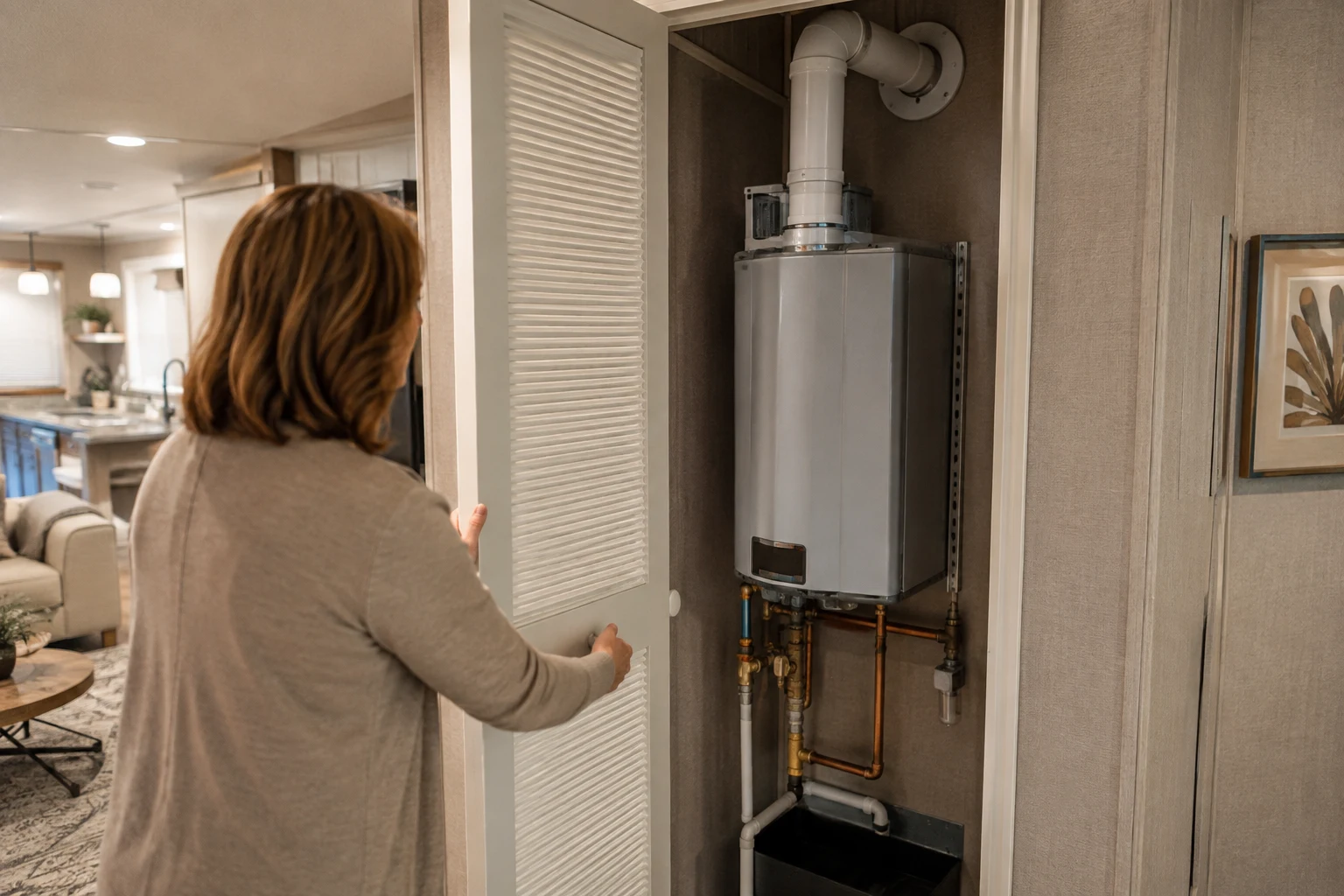
That is why HUD requires a gas water heater in a manufactured home to be sealed combustion, meaning it draws every bit of its burner air from outside the home through a dedicated intake and pushes the exhaust back out through a sealed assembly, so the flame and its gases never touch the indoor air at all. A standard tank cannot meet that requirement, and the square, unsealed intake at its base is one of the visible reasons it fails to qualify. On top of the air problem, a standard unit vents up through the roof with an atmospheric B-vent, while a mobile home uses a direct-vent path out the sidewall or through a roof cap made for manufactured housing, with termination clearances suited to the low roof profile. Swap in a standard tank and none of that lines up.
Sealed combustion (direct vent)
A gas appliance that draws all of its combustion air from outside the building through one pipe and vents its exhaust back outside through another, keeping the burning process completely isolated from indoor air. In a manufactured home, sealed combustion is what keeps a gas water heater from starving for oxygen or spilling carbon monoxide into the tight interior. It is the core reason a standard atmospheric tank, which burns using room air, is not approved for mobile home use.
Which type fits your situation
There is no single right answer, because it depends on what fuel and connections your home already has and how much of the install you want to take on. The three common paths break down like this.
A home already on gas with a vent path
Replace the sealed-combustion gas unit with another mobile-home-listed gas model. Match the fuel, natural gas or propane, confirm the field conversion is set correctly, and reuse the existing direct-vent path if it is in good shape. This keeps your low gas running cost.
A home with a 240 volt circuit
Go electric. A mobile-home-listed electric tank has no burner, so there is no combustion air or venting to deal with, which makes it the cleanest compliant swap. You still secure it and set up the relief valve, but the hardest parts of a gas install disappear.
A tight closet or a short door
Measure first, then buy. The closet width, door opening, and ceiling height decide what fits, so look at a short or narrow mobile-home-listed model. Tank diameter matters as much as height because the access door is usually the real bottleneck.
A propane park with no natural gas
Pick a mobile-home gas unit and set it up for LP using the included conversion kit, or skip the fuel question entirely and go electric if a circuit exists. Never run a natural gas orifice on propane, or the reverse, because the flame is wrong and dangerous.
How to replace a mobile home water heater the right way
The order matters, and the single most important step happens before you buy anything: confirm the home is a manufactured home and measure the space. Get those two right and the rest is a straightforward swap.
Brands that make mobile-home-approved units
You do not have to hunt far. The major US water heater makers all offer models certified for manufactured housing, and they usually put mobile home right in the product name. Rheem builds both gas and electric mobile home models: its Professional Classic and Performance gas units come in a 40 gallon, 30,000 BTU direct-vent configuration that is field-convertible between natural gas and propane, and its Performance electric line for manufactured housing comes in 30 and 40 gallon sizes carrying both the federal efficiency certification and the HUD listing.
Richmond, which is Rheem's retail-channel label, offers the same kind of 30 and 40 gallon electric mobile home tanks. American Water Heater makes a ProLine mobile home electric line, including a 30 gallon model built to fit tighter closets. Between those brands you can find a mobile-home-listed unit in either fuel and either common size at most plumbing suppliers and home centers. The important habit is the same regardless of brand: read the data plate and confirm the manufactured-housing listing before you commit, because a compact tank that merely fits the closet is not the same as one that is actually approved for it. The listing is what protects your warranty, your insurance, and the people breathing the air in the home.
Frequently asked
Can I put a regular water heater in a mobile home?
In a true manufactured home, no. Federal HUD code requires the water heater to be listed and labeled for manufactured housing, and a standard residential unit does not carry that listing. The main reason is combustion air: a conventional gas water heater pulls the air it burns from the room around it, which is fine in a roomy site-built house but a carbon monoxide risk inside the small, tightly sealed air envelope of a mobile home. A standard atmospheric tank also vents up through the roof with a B-vent, while a mobile home needs a sealed, direct-vent unit that draws air from outside and vents out the sidewall or a special roof cap. Beyond the safety problem, installing a non-approved unit can void the appliance warranty and give your insurer a reason to deny a claim. If your home is a modular home built to state code rather than the HUD code, a standard heater is usually fine, so confirm which one you have first.
How do I know if a water heater is approved for a mobile home?
Look at the data plate on the unit, not the box or the sales page. A mobile-home-approved heater says it is listed for manufactured housing or manufactured home use right on that plate, often alongside language about sealed combustion or a HUD listing. Marketing copy that just says compact or the fact that a small tank fits the closet is not proof of anything. If you are buying, ask the seller or installer for the listing and confirm it before the old unit comes out, because a swap in progress is the worst time to discover the new tank is not code. Rheem, Richmond, and American Water Heater all publish which of their models are certified for manufactured housing, and those models are usually labeled mobile home right in the product name.
What size water heater does a mobile home use?
Most mobile homes run a 30 or 40 gallon tank, which covers a one to three person household comfortably. The bigger constraint is not the number of gallons but the closet. Mobile home water heater closets are narrow and often short, and the access door is narrow too, so the tank diameter matters as much as its height. A typical 30 gallon electric unit stands about 46 to 50 inches tall and roughly 18 to 20 inches across, and short models drop to around 40 inches tall for tight spaces. Before you buy, measure the closet width, the door opening, and the ceiling height, then match a mobile-home-listed tank to those numbers rather than assuming last unit's size is available. Going up in gallons only helps if the space and the door can actually take the larger tank.
Why do mobile home water heaters need sealed combustion?
It comes down to how much air is in the building and where the burner gets it. A site-built house has a large volume of indoor air and usually enough natural leakage that a gas water heater can safely pull its combustion air from the room. A manufactured home is smaller, tighter, and often has the heater tucked in a closet, so a burner drawing room air can starve for oxygen, backdraft, and spill carbon monoxide into the living space. Sealed combustion solves that by drawing all the burner's air from outside through a dedicated pipe and pushing the exhaust back out the same sealed assembly, so the flame never touches indoor air. HUD requires this for gas units in manufactured homes, and it is why the square, unsealed base intake on a standard tank disqualifies it. An electric unit sidesteps the whole issue because it has no combustion at all.
Can I use an electric water heater in a mobile home?
Yes, and it is often the simplest compliant choice when the home already has a 240 volt circuit for it. An electric unit has no burner, so there is no combustion air requirement and no venting to run out the wall, which removes the two hardest parts of a gas swap. You still have to use a model listed for manufactured housing, secure it with a strap or bracket, and set it up with a temperature and pressure relief valve, but the install is generally cleaner than gas. Rheem, Richmond, and American Water Heater all make electric mobile home models in 30 and 40 gallon sizes that are certified for manufactured housing. The trade-off is running cost, since electric resistance heat is more expensive per gallon than natural gas in most areas, but for a mobile home without an existing gas line or vent path, electric is frequently the path of least resistance and least risk.
Do mobile home water heaters need to be strapped or secured?
Yes. A manufactured home is built to be transported, so its appliances have to be anchored well enough to survive being towed down a highway, and the water heater is no exception. Mobile-home-listed units are designed to be secured with a strap or a mounting bracket, and a strapping kit is commonly included with the unit for exactly that reason. This is separate from the seismic strapping required in earthquake states, though the goal overlaps: keep the tank from shifting, tipping, or tearing loose from its water, gas, and vent connections. When you replace the heater, reuse or replace the securing hardware rather than setting the new tank in loose, because an unsecured tank is both a code problem and a real hazard if the home is ever moved or shaken.
Does a mobile home gas water heater run on propane or natural gas?
It can run on either, and most mobile-home gas units are built to switch between the two. A large share of manufactured homes, especially those in parks or rural areas, run on propane rather than piped natural gas, so the manufacturers ship these heaters field-convertible, with the conversion kit included in the box. The unit typically comes preset for natural gas, and the installer swaps in the propane orifice and adjusts it if the home is on LP. If you are replacing a gas unit, confirm which fuel your home actually uses and make sure the new heater is set up for it, because running a natural gas orifice on propane, or the reverse, produces the wrong flame and is dangerous. When in doubt, have the fuel type verified before the heater is lit.