Marey sells two machines that look alike on a wall and behave nothing alike inside. The electric ECO line is a 240V heater with an LCD panel, no batteries, and elements that modulate to the flow; when it sulks it flashes a code like E3 on that screen. The gas Power Gas line is a flueless-or-vented burner fired by two D-cell batteries through a pulse igniter, with a summer/winter switch and, on the newer units, a digital panel that shows E1 through E8. Same brand, same 'my Marey won't make hot water' complaint, completely different fixes. This page splits the two, maps the electric faults and the gas error codes, and routes each one to the part behind it, all off the Marey manuals rather than guesswork.
| ECO110 | 11 kW · 240V · 60A double-pole · 6 AWG · ~3 GPM |
| ECO150 | 14.6 kW · 240V · 70A double-pole · 6 AWG · ~3.5 GPM |
| ECO180 | 18 kW · 240V · 2×50A · 2×8 AWG · ~4 GPM |
| ECO240 | 24 kW · 240V · 3×40A double-pole · 8 AWG · ~4.7 GPM |
| ECO270 | 27 kW · 240V · multi-circuit · ~6.5 GPM |
| Activates at | ~0.53 GPM (2 L/min) flow · inlet pressure 5-85 PSI |
The verdict
Settle one thing first: electric ECO or gas Power Gas. On an electric ECO, kill the breakers, then check both poles, the flow (it needs about 0.53 GPM to start), and read E3 as a temperature-sensor fault. On a gas Power Gas, pull and replace the two D-cell batteries first, confirm the gas valve is open and the summer/winter switch is set, then read the digital code: E2 sends you to the gas supply and E5 to ignition. A reset on either is just a breaker cycle or a battery pull, never a red button.
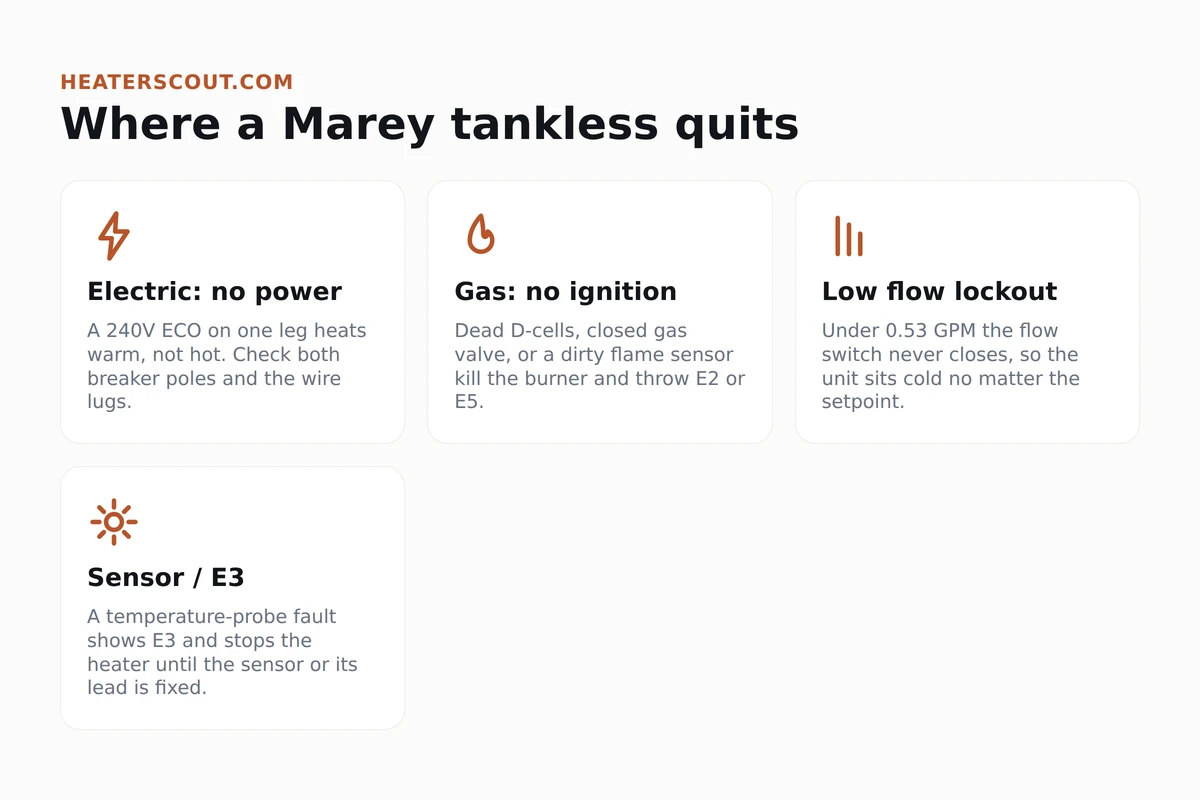
First, know which Marey you have
Every good Marey diagnosis starts by naming the machine, because the brand covers two unrelated designs. If your unit plugs into a 240V circuit through a dedicated breaker, has an LCD showing a temperature and sometimes an E code, and takes no batteries, it is an electric ECO: ECO110, ECO150, ECO180, ECO240, or ECO270. If it burns propane or natural gas, has a battery door for two D cells, and carries a summer/winter switch, it is a gas Power Gas unit in the GA family, like a GA10 or GA16. The rating label on the case confirms it. Get this right before anything else, because E3 means a temperature sensor on the electric line and a false-flame signal on the gas line, and the reset method is different for each.
Walking a Marey fault: the diagnostic order
Whatever the code, work it in the same order so you do not skip the cheap, common causes to chase an expensive rare one. The steps below apply to both families with the electric-versus-gas fork called out where it matters.
Name the machine and cut the energy
Read the label: electric ECO or gas Power Gas. On an electric ECO, turn off the dedicated breakers before you open anything, since Marey requires the breakers off before any reset or service on units that pull 45 amps and up. On a gas unit, turn the power switch off and pull the D-cell batteries.
Read and write down the code
On the electric LCD, note the E code exactly, most often E3 for a sensor fault. On the gas digital panel, note the E code and whether the buzzer is sounding. Write it down before you cycle power, because resetting clears the readout and you lose what it was telling you.
Check flow before you blame the heater
A Marey needs about 0.53 GPM, roughly two liters a minute, to close the flow switch and start heating. Clean the inlet strainer, the faucet aerator, and the showerhead. A weak trickle at a low-flow fixture can look like a dead heater when the unit simply never activated.
On gas, do batteries and gas supply next
Replace both D-cell batteries even if they read fine, confirm the gas valve is fully open and the tank is not near empty, and set the summer/winter switch for the season. Weak batteries are the single most common reason a Power Gas unit will not ignite.
On electric, verify both breaker poles and the elements
A 240V ECO running on one live pole heats warm, not hot. Confirm both poles of every dedicated breaker are on and holding, check the wire lugs are tight, and if power is solid but there is still no heat, the element or the control board is next.
Match the code to the part and reset once
Route the code to its part using the charts below, make the fix, then reset once by cycling breakers (electric) or batteries (gas). If the same code returns immediately, the cause is still there and you stop resetting and replace the part.
Electric ECO faults and what they mean
The electric line is the simpler of the two to reason about because it has no combustion. Power, flow, sensor, element. When an ECO will not make hot water, it is almost always one of those four, and the LCD narrows it down. E3 is the code owners see most: it is a temperature-sensor fault, the board losing a trustworthy reading from the outlet probe and stopping rather than heating blind. Before you buy a sensor, open the unit with the breakers off and check the probe's connector and lead, because a corroded or loose connection throws the same E3 as a dead sensor and costs nothing to reseat.
Lukewarm water with no code on an ECO is the signature of a lost breaker pole. These are 240V heaters, and if one of the two poles trips or a lug loosens, the heater runs on half its elements and can only warm the water. People assume the heater is failing when a breaker is the culprit. The other no-code complaint is water that is hot at a full-open tap but cold at a trickle, which is the flow-switch activation threshold doing its job: below about 0.53 GPM the unit will not turn on at all.
- Electric ECO shows E3 on the LCD: temperature-sensor fault. Check the probe lead and connector first, then the sensor.
- Warm-not-hot water, no code: one of the two 240V breaker poles is dead. Confirm both poles and the wire lugs.
- Cold at low flow, hot at full flow: you are below the ~0.53 GPM activation threshold. Clean strainer, aerator, showerhead.
- Breaker trips under load: undersized breaker or wire for the kW rating, or a shorted element pulling too much current.
- Reset means breakers OFF, wait, then ON. Marey requires the breakers off before any reset. No red button exists on the ECO.
Gas Power Gas error codes and the reset
The gas line adds combustion, batteries, and venting, so it has more ways to fail and a fuller code table. The newer digital-panel GA units show a two-character E code and beep when they fault. The steps below cover the reset that clears a one-time fault and the season switch that trips up a lot of owners.
The gas code table itself reads across the digital-panel GA models like this. E1 is a water-temperature probe fault, the gas equivalent of the electric E3, where the control has lost a good reading from the inlet or outlet probe. E2 is a flame fault that points at the gas supply, so it is your cue to check the valve, the tank level, and the line. E3 is a false-flame signal, the board seeing flame current when it expects none, often a wiring or sensor issue. E4 is thermostat protection. E5, the one you meet most, is an ignition or flame failure tied to batteries, gas, or a dirty sensor. E7 is a fan fault, where the control does not see the blower reach speed before or during the burn. E8 is over-heating protection, the unit cutting the burner because the water climbed past its limit.
The same E-number can mean slightly different things across Marey gas models, because the GA line has run through several control boards and manual revisions. A code like E5 shows as a temperature-thermistor fault on one sheet and an ignition failure on another. Read the number off your own panel, then confirm its meaning against the legend in your unit's manual rather than assuming a generic chart fits your board.
Which fixes are DIY and which are not
Most Marey faults land on the homeowner-friendly side if you respect the two hard safety lines. On the electric ECO, the safety line is the breaker: 45 to 100 amps of 240V is not a live-work circuit, so every check happens with both poles off, and Marey says so plainly. Reseating a sensor lead, tightening a lug, cleaning a strainer, and swapping a sensor or element are all reasonable with the power dead and a multimeter in hand. The one to hand off is a control board that reads the sensor wrong even with a known-good probe, since diagnosing that cleanly takes more than a meter.
On the gas Power Gas line, the safety line is the fuel. Batteries, the season switch, cleaning the igniter and flame sensor, and confirming an open gas valve are all owner work. But gas pressure problems, a burner that will not stay lit after a clean sensor and fresh batteries, venting faults, and any smell of gas are where you stop and call a licensed pro. An E7 fan fault and a persistent E5 after the basics both point at parts better left to someone who works on gas appliances. When you call, whether a local pro or Marey support at (855) 627-3955, have the full model and serial ready, since every part is keyed to the exact model.
Match your Marey to the fix
ECO showing E3 on the LCD
Temperature-sensor fault. Breakers off, open the case, and check the probe connector and lead for corrosion or a loose pin before buying a sensor. Reseat, retest, then replace the sensor if E3 stays. A board that misreads a good probe is the last suspect.
ECO makes warm water, no code
A dead 240V breaker pole. The heater is running on half its elements. Confirm both poles of every dedicated breaker are on and holding, and tighten the wire lugs. This is the most common cause of an ECO that 'lost its power' overnight.
Power Gas won't ignite or dies in 30s
Fresh D-cell batteries first, then confirm the gas valve is open and the tank is not empty, set the summer/winter switch, and clean the igniter and flame sensor. E2 and E5 both live here. If it still quits after the basics, the flame sensor or board is next.
No hot water at a low-flow fixture
You are below the roughly 0.53 GPM activation flow. The heater never turned on. Clean the inlet strainer, the aerator, and the showerhead to restore enough flow to close the switch, and test at a full-open tap to confirm the heater itself is fine.
Run your Marey by the same discipline every time and it stops being mysterious. Name the machine, cut the right energy source, read and write the code, check flow, then split into the electric path (poles, sensor, element) or the gas path (batteries, gas, igniter, flame sensor). The codes are just the heater telling you which of those it lost. Follow the number to the part, fix the cause rather than resetting past it, and keep the model and serial handy for the one call you cannot avoid.
Frequently asked
What does E3 mean on a Marey tankless water heater?
On the electric ECO line, E3 on the LCD is a temperature-sensor fault. The control board has lost a believable reading from the outlet temperature probe, so it stops heating and shows the code rather than guess at the water temperature. The cause is usually the sensor itself, a corroded connector, or a wire that has worked loose at the board, and less often a control board that is not reading the probe. On the gas Power Gas line the picture is different: on the digital-panel gas models E3 is a false-flame or false-fire signal, meaning the control still sees flame current when it expects none. Because the same letters mean different things across the two product families, the first thing to settle is whether you own an electric ECO or a gas Power Gas unit before you chase the code. Kill the breakers on an electric unit before opening it, and pull the batteries on a gas unit.
How do I reset a Marey tankless water heater?
There is no red reset button on a Marey the way there is on an electric tank heater. On the electric ECO line you reset by turning off the dedicated breakers at the panel, waiting a minute or two, and turning them back on. Marey is explicit that you must turn the breakers off before resetting, because an ECO150 or ECO240 pulls serious current and working on a live unit risks a shock and can damage the board. On the gas Power Gas line you reset by turning the on-unit power switch off, or by pulling the two D-cell batteries for a moment, then restoring them. Cutting the water flow and reopening it also cycles the flow switch. A reset clears a one-time fault; it does not fix a cause. If the same code returns the moment you draw hot water, the fault is real and you need to chase the part it points at.
Why is my Marey tankless not igniting or making hot water?
Start by splitting electric from gas. On a gas Power Gas unit, no ignition almost always traces to the two D-cell batteries that fire the pulse igniter: dead or weak cells and the burner never lights, so replace them first even if they seem fresh. Then confirm the gas valve is fully open, the propane tank is not empty, and the summer/winter switch is set for the season. A dirty igniter or flame sensor is the next suspect and shows as E2 or E5. On an electric ECO unit, no hot water usually means the flow is below the roughly 0.53 GPM the flow switch needs to turn the heater on, or one of the two breaker poles has tripped so the unit runs on half its elements and only warms the water. Check flow first, then both poles of every breaker, then the elements.
What flow rate does a Marey tankless need to turn on?
About 0.53 GPM, which is roughly two liters per minute, is the minimum flow that closes the flow switch and starts a Marey heating. Below that the switch never trips and the unit stays cold no matter how high the setpoint is, which is why a trickle at a bathroom faucet or a badly clogged aerator can look like a dead heater. The electric ECO line also wants an inlet water pressure in the 5 to 85 PSI band to run correctly. If you get hot water at a wide-open shower but nothing at a low-flow fixture, the heater is fine and you are simply below its activation flow. Cleaning the inlet strainer, the aerator, and the showerhead often restores enough flow to trip the switch reliably.
What breaker and wire size does a Marey electric tankless need?
It depends on the kilowatt rating, and Marey specifies a dedicated circuit for every ECO model. The ECO110 at 11 kW wants a 60-amp double-pole breaker on 6 AWG copper, drawing up to about 45.8 amps. The ECO150 at 14.6 kW steps up to a 70-amp double-pole breaker, still on 6 AWG. The larger units split the load across multiple circuits: the ECO180 at 18 kW uses two 50-amp breakers on 8 AWG, and the ECO240 at 24 kW uses three 40-amp double-pole breakers on 8 AWG. An undersized breaker nuisance-trips under load, and undersized wire is a fire hazard, so match the manual for your exact model. All of these are 240V circuits, and both poles must be live for the unit to reach full power.
What do the E codes on a Marey gas tankless mean?
On the digital-panel gas models the control shows a two-character E code and usually beeps. E1 is a water temperature probe fault. E2 is a flame fault, which points you at the gas supply, so check the valve and the tank. E3 is a false-flame signal. E4 is thermostat protection. E5 is an ignition or flame failure and is the code you see most, tied to weak batteries, a closed gas valve, or a fouled igniter or flame sensor. E7 is a fan fault, where the board does not see the blower spin up fast enough before or during the burn. E8 is over-heating protection. Read the code, note whether the burner ever tried to light, and match it to the legend on your unit, since the exact wording can shift between GA models and production years.
Why does my Marey gas tankless run for 30 seconds then shut off?
A gas Power Gas unit that lights, runs briefly, then quits and often throws E2 or E5 is the classic weak-flame-signal pattern. The burner ignites, but the flame sensor is not reading a strong enough flame current to satisfy the control, so after a few seconds of proving time the board shuts the gas off as a safety. The usual causes are a dirty or misaligned flame sensor and igniter, weak D-cell batteries that cannot hold the ignition sequence, low gas pressure, or an almost-empty propane tank. Clean the sensor and igniter gently, put in fresh batteries, and confirm full gas pressure and an open valve. If it still dies after half a minute, the flame sensor or the control board is the next call.
Where do I find the model number on a Marey water heater?
On the rating label, which on the electric ECO units sits on the side or bottom of the case and on the gas Power Gas units is on the side of the cabinet near the gas and water connections. It carries the full model number, so ECO110, ECO150, ECO180, ECO240, or ECO270 on the electric line and a GA prefix such as GA10 or GA16 on the gas line, along with the voltage or gas type and the serial number. Write down the complete model and serial before you call for parts or dial Marey support, because the sensor, flow switch, igniter, and control board are keyed to the exact model. Marey's US support line is (855) 627-3955, and having the model and serial in hand makes that call much shorter.