The kitchen tap blasts cold water fine, but flip it to hot and the stream shrinks to a trickle. That single mismatch is the best clue you will get. Cold water never passes through the water heater, so if only the hot side is weak, the restriction has to sit somewhere between the tank and the faucet. Weak on cold too? Then the heater is off the hook and the whole house shares the blame.
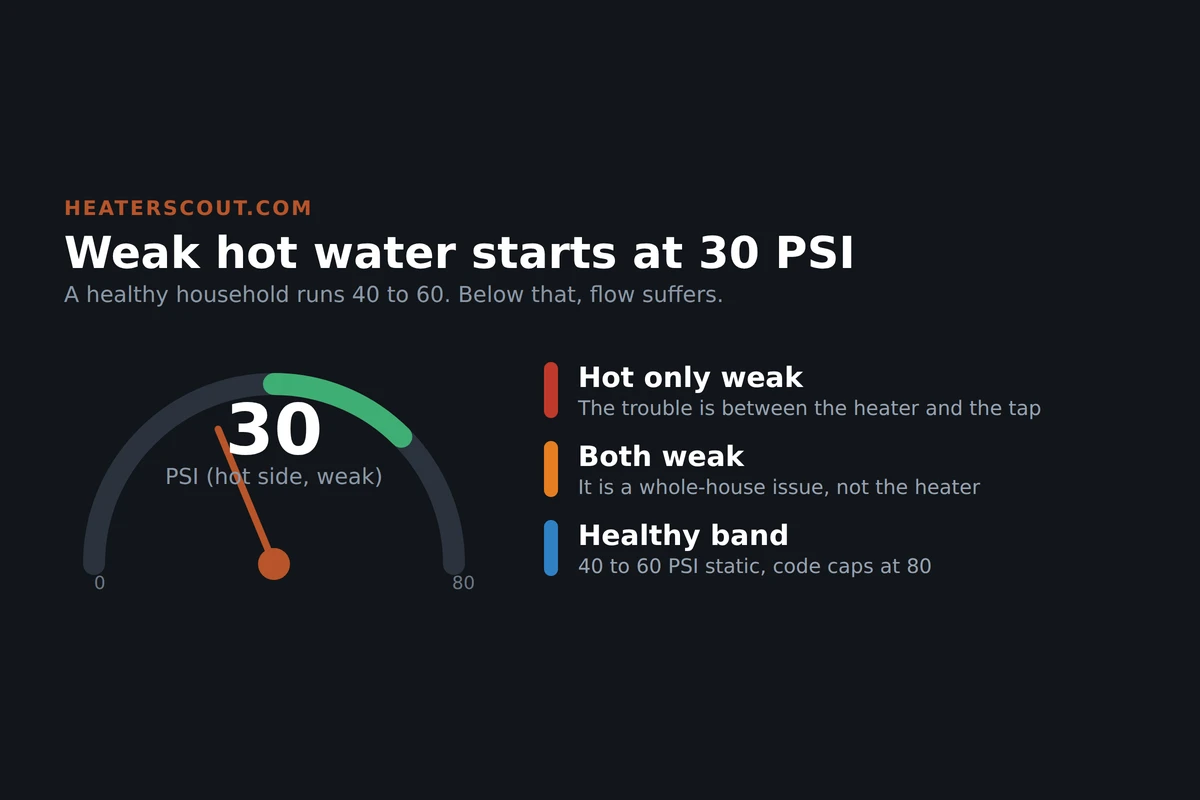
Quick answer
Compare a hot-only tap against a cold-only tap at the same fixture. If cold is strong and hot is weak, the fault is on the hot path: most often a scaled aerator or showerhead screen, a bad heat-trap nipple on the tank, sediment at the hot outlet, or a hot-side shutoff that never opened fully. Work the chain from the tap back to the tank. If both hot and cold are weak, it is a whole-house problem like a pressure-reducing valve, the main valve, or low supply, and the heater is not to blame.
Hot only, or everywhere? That answer changes the whole job
Before you unscrew anything, settle one question that splits the work in two. Turn on a fixture with separate handles, run the cold by itself, then run the hot by itself, and feel how they differ. It takes half a minute and it tells you whether you spend the afternoon at the water heater or at the main valve. Skip it and you risk flushing a tank that was never the problem.
The reason the test works comes down to geography. Cold water leaves the main and reaches the tap without ever entering the heater. Hot water detours through the tank: in the bottom, heated, out the top fitting, then off to you. Anything on that detour can pinch the flow, and nothing on it can explain weak cold. So a hot-only drop points at the heater and the hot lines. A drop on both hot and cold cannot come from the tank at all, because cold never went near it, and you look upstream at the pressure-reducing valve, the main shutoff, and the supply the whole house draws from.
Whole-house weakness is worth a word before we leave it, because people burn weekends on the wrong target. If both taps came out weak, a pressure-reducing valve slowly failing near the main is a common culprit, as is a main shutoff someone left partway closed after a repair, or genuinely low pressure off the street or a well pump that is losing its edge. None of that is the water heater. Thread a $10 gauge onto a hose bib, read the static pressure, and if it sits well under 40 psi you have your answer without ever touching the tank. From here on, this guide assumes the test came back hot-only.
What chokes the hot side, ranked by how often it is the culprit
With a hot-only result in hand, the field narrows to a short list, and the entries are not equally likely. Some are five-minute cleanups and one or two are real repairs. Ranked by how often each turns out to be the trouble in an average house, here is where hot pressure goes to die.
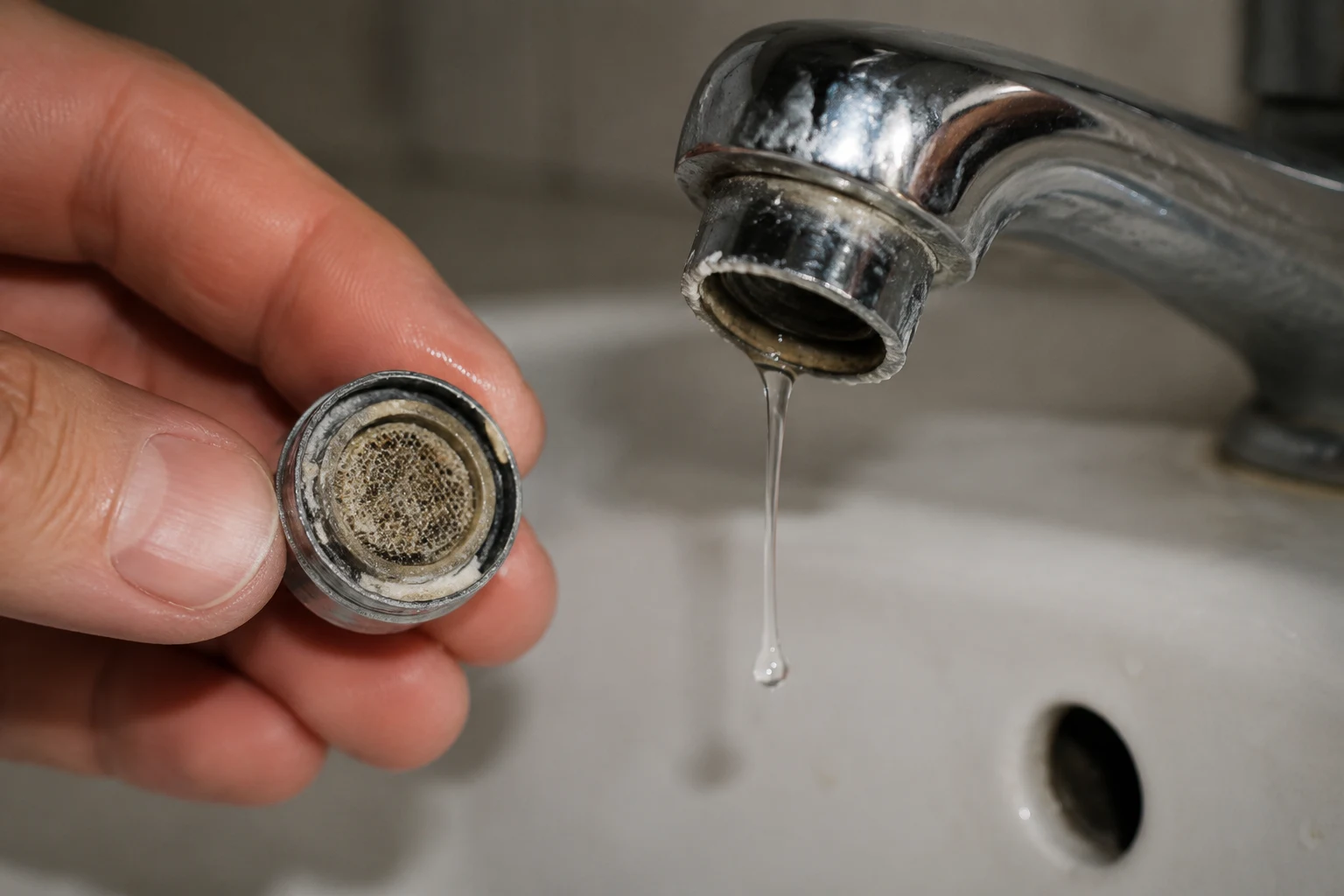
Aerators and showerhead screens top the list because they clog at the point of use, and they clog worst where you draw hot water most. The busy master shower and the kitchen sink collect mineral flakes on their screens faster than a guest bath that runs twice a month. That is also why one weak faucet with the rest of the house fine almost always means the screen at that one tap, not a heater problem. Pull the aerator, soak it in vinegar, and the fixture usually comes back to life.
Valves are the sneaky second tier. A hot-side stop under a sink, or the shutoff on top of the heater, can be backed open only halfway and starve everything downstream. Worse is an old gate valve, the kind with a round wheel handle, which can look open while its internal washer has come loose and is riding in the flow like a flap. Gate valves also seize partway and corrode, and you cannot always tell from the handle. A quarter-turn ball valve, lever inline with the pipe, is the honest replacement.
Then comes the tank itself. Heat-trap nipples on top hold a plastic flapper that sticks or crumbles, and sediment settling into the hot outlet narrows the passage the hot water leaves through. Below those, a failing pressure-balancing valve inside a single-handle shower can drop hot flow while cold stays strong, which mimics a heater problem at exactly one fixture. And in older homes the pipe itself is the restriction: galvanized steel that has rusted inward for forty years, its bore shrunk to a pencil, cannot be cleaned and has to be repiped.
Work the chain from the tap back to the tank
Guessing is slow. Testing in order is fast. Start where the water comes out and move back toward the heater, and let each step retire a chunk of the suspects so you end up pointing at one thing instead of shrugging at six. You need almost nothing: a bottle of white vinegar, a wrench, a hose for the tank, and a $10 pressure gauge. Stop the moment flow comes back.
Two of those steps reward extra care. Before you flush, always kill the power or the gas so an electric element cannot dry-fire once the water level drops below it. And when you handle the nipples, keep track of hot versus cold, because a directional heat-trap nipple installed backward will make the flow worse instead of better. If you own a tankless unit, add one check at the front of the chain: find the inlet filter screen on the cold line where it enters the heater, unthread it, and clear the sediment that collects there. A plugged inlet screen drops flow through the whole unit and mimics a tank problem.
There is an order to why this chain saves time. The fixture end is where the cheap, fast wins hide, so you clear those first and often finish there. Moving back toward the tank, each step costs a little more effort and a little more risk, which is exactly why you earn the right to open the heater only after the aerators, the localization test, and the valves have all come up clean. By the time you are unthreading nipples, you already know the trouble is at the tank rather than out at a screen, so you are not tearing into the heater on a hunch. A homeowner who works the chain in this order rarely does more than the first two steps, because most weak hot water is a screen and a soak away from fixed.
The GPM numbers, and what a clogged screen does to them
Weak is a feeling; gallons per minute is a fact. Knowing what each fixture should deliver tells you whether a tap is genuinely starved or just modest by design, and it shows how much a scaled screen is actually costing you. Federal rules cap most fixtures, so the ceilings below are the best you will get even when everything is clean.
| Showerhead (code max) | 2.5 gpm; many run 1.5 to 2.0 |
| Kitchen faucet aerator | 1.5 gpm typical |
| Bathroom faucet aerator | 1.0 to 2.2 gpm by model |
| Low-flow / eco aerator | As low as 1.0 gpm by design |
| Scaled screen effect | Can cut real flow by half or more |
| How to check a fixture | Time filling a 1-gallon jug: 60 sec = 1.0 gpm |
Put those numbers to work with a jug and a watch. A kitchen faucet rated at 1.5 gpm should fill a gallon in about 40 seconds; if it takes 80, the screen is passing half of what it should and the vinegar soak is your fix. A shower that dribbles well under its 1.5 to 2.5 gpm rating with a clean head points past the fixture to the valve or the tank. Because scale builds fastest where hot water runs most, the fixtures you lean on daily will always read low first, which is exactly why the two-tap test and this jug test together tell you whether the number is the screen, the valve, or the heater.
Check the gauge first
Read your static pressure before you decide anything is broken. Thread a $10 gauge onto a hose bib or the water heater drain and open it with no water running. Inside 40 to 60 psi with only hot weak means the fault is on the hot path and the steps above will almost always clear it. Over 80 psi is quietly wearing out fill valves and the heater, and calls for a pressure-reducing valve. Under 40 at the meter is a supply problem, and no amount of work at the tank will fix it.
Frequently asked
Why is only my hot water weak while cold runs strong?
Cold water goes straight from the main to the faucet and never enters the water heater. Hot water takes a longer road: it fills the bottom of the tank, sits, heats, and leaves through a fitting on top before it reaches you. Every part on that road is a place a restriction can hide. So when cold is fine and only hot drops off, the fault lives on that hot-only path. The usual culprits are a scaled aerator or showerhead screen, a heat-trap nipple gone bad on top of the tank, sediment plugging the hot outlet, or a hot-side shutoff that never opened all the way.
What are heat-trap nipples and why do they choke hot flow?
Heat-trap nipples are the two fittings threaded into the hot and cold ports on top of the tank. Each one holds a small plastic flapper or ball that keeps heat from rising out of the tank between draws. That plastic part swells, cracks, or catches grit, and once it sticks it throttles the hot outlet down to a dribble. It is one of the most common hidden reasons hot pressure fades, and a fresh pair of nipples usually brings full flow back for the price of two fittings and half an hour.
How do I tell whether it is the heater or the whole house?
Run a cold-only tap, then a hot-only tap at the same fixture, and feel the difference. Strong cold, weak hot points at the water heater or the hot lines. If both come out equally weak, the heater is innocent and you are looking at a whole-house cause like a partly closed main valve, a failing pressure regulator, or low supply from the street or well. That one comparison decides which way to troubleshoot before you touch a wrench.
What is a normal GPM at a shower or kitchen faucet?
Modern showerheads are capped at 2.5 gallons per minute and many run 1.5 to 2.0. A kitchen faucet aerator is usually 1.5 gpm, and bathroom aerators run 1.0 to 2.2 gpm depending on the model. When mineral flakes clog the screen, real flow can fall well below those numbers, sometimes cutting a 1.5 gpm faucet in half. Because scale builds fastest at the fixtures you use most, the busiest hot taps are usually the first to go weak.
Does a tankless water heater have anything extra that clogs?
Yes. A tankless unit has a small inlet filter screen on the cold water line where it enters the heater. That screen catches sediment and scale flakes, and when it fills up it drops the flow through the whole unit, which shows up as weak hot water everywhere. It unthreads for cleaning in a few minutes. Tankless owners on hard water should check that screen first, and also descale the heat exchanger on schedule, since scale inside the exchanger narrows the passages and cuts flow the same way sediment does in a tank.
Can sediment in the tank really lower my hot pressure?
It can. Hard-water minerals settle as sediment and scale on the tank bottom and inside the hot outlet, and year by year that buildup narrows the passage the hot water leaves through. On well water or anything above about 12 grains of hardness it stacks up fast. Flushing the tank clears the loose sediment, but heavy scale sometimes plugs the nipple and the first stretch of hot line and needs the nipple replaced too.
When is low hot water pressure a plumber's job, not mine?
When the restriction is inside the pipe or the supply. Old galvanized steel lines corrode shut from the inside over decades, and rust scale narrowing the bore cannot be cleaned out, only repiped in copper or PEX. A failing pressure regulator, a bad mixing valve, or a gauge that reads far below 40 psi at the meter are supply-side problems as well. If the cheap DIY steps do not restore flow, the trouble has moved past valves and screens, and that needs proper diagnosis.