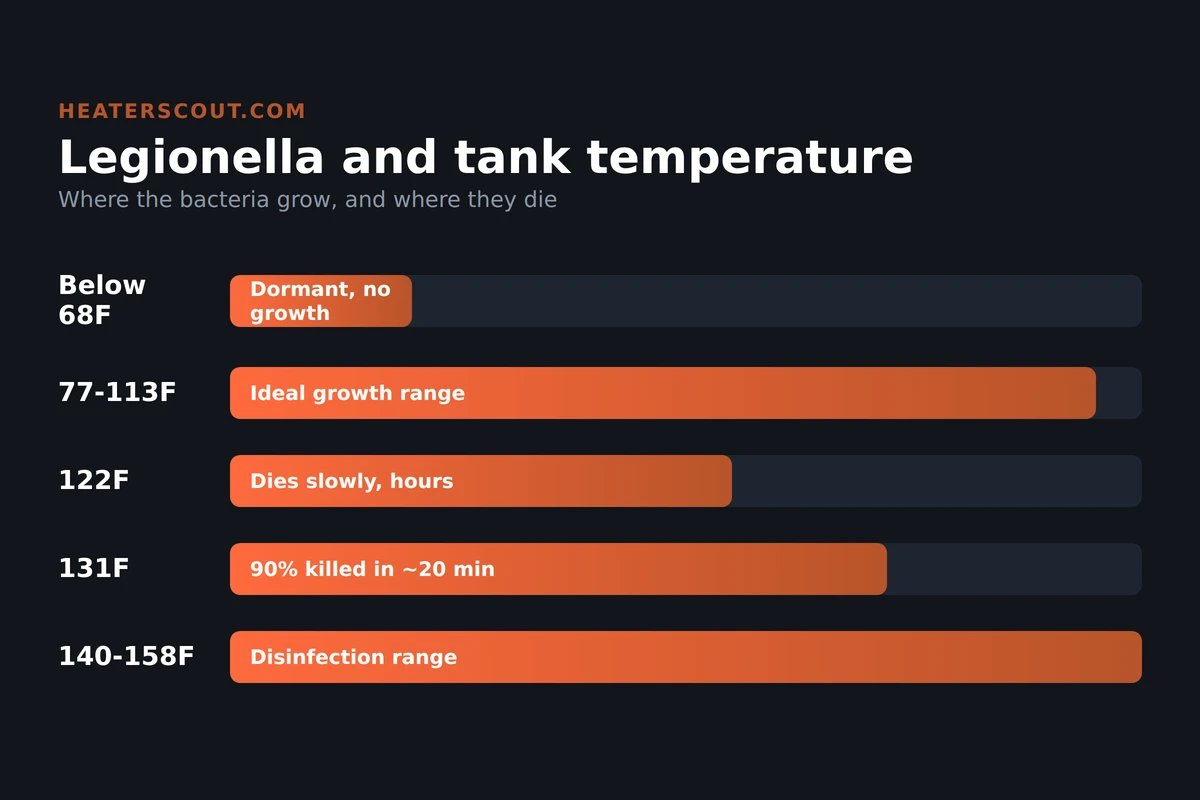
Legionella lives in the water you drink, wash in, and heat, at low harmless levels, almost everywhere. It only becomes a problem when it multiplies, and it multiplies in a narrow band of warmth. The bacteria grow fastest between roughly 77F and 113F, sit dormant below about 68F, and start dying once the water climbs past 122F. That range matters because it collides directly with a piece of common energy advice: set your water heater to 120F. That number saves energy and prevents most scalds, but it parks the coldest layers of the tank right in the zone where Legionella is happiest.
120F storage sits inside the risk zone
A water heater stored at 120F does not disinfect the tank. The Legionella growth range runs up to about 113F, and a 120F setpoint leaves cooler pockets near the bottom of the tank and out in the branch lines that drift into that range, especially in a home where hot water sits unused for days. If anyone in the household is elderly, a smoker, or immunocompromised, treat 120F storage as the risky end of the tradeoff, not the safe default.
Who actually needs to worry about this
For a busy family that runs the shower, dishwasher, and laundry every day, a 120F tank is usually fine. Water turns over fast enough that bacteria never get a foothold. The risk is not uniform. It concentrates in specific situations where water sits still and warm, and in specific people whose lungs cannot fight off an exposure. Here is where the concern is real.
The vacation home or seasonal cabin
A property that sits empty for weeks is the textbook breeding ground. The heater is often turned down to save energy, which drops the water into the 77 to 113F growth range, and nobody runs the taps, so the water sits motionless long enough for the bacteria to bloom. Sediment on the tank floor and biofilm in the lines give them a surface to colonize. The first shower after you arrive can aerosolize a large dose all at once.
An immunocompromised or elderly resident
The same water dose that a healthy adult shrugs off can put an older person, a smoker, or someone on immune-suppressing medication in the hospital with pneumonia. For these households the margin is thinner, so 120F storage is the wrong call. Store hot at 140F and temper it down at the tap, and consider running a periodic thermal disinfection cycle for extra assurance.
The large house with long pipe runs
A sprawling home with a fixture at the far end of a long branch line has water that cools into the growth range between uses and rarely gets flushed. These dead legs, sections of pipe that hold standing water no one uses, are where Legionella colonizes even when the tank itself is hot. A guest bathroom used twice a year is a small stagnant reservoir feeding a showerhead.
The microbiology, in plain numbers
Legionella is a waterborne bacterium that is everywhere in low concentrations, in lakes, rivers, and the municipal supply. It does not cause trouble at those background levels. The problem starts when a warm, still reservoir like a lukewarm water heater lets it multiply into a high-dose colony. The whole prevention strategy hinges on temperature, so the two terms below are worth pinning down before we get to the kill data.
Legionella
A genus of bacteria found naturally in fresh water and soil. Legionella pneumophila is the species behind most human illness. It thrives in warm, stagnant water between about 77F and 113F and colonizes scale, sediment, and biofilm inside tanks and pipes. It causes disease when contaminated water is aerosolized into a breathable mist, from a showerhead, a spray faucet, or a whirlpool tub, and inhaled into the lungs. It is not a threat at the low background levels present in most water supplies; the danger comes from letting it multiply in a warm reservoir.
Thermal disinfection
Deliberately raising the water heater and the plumbing to a temperature that kills Legionella, then flushing every fixture so the heated water reaches the ends of the lines. The tank is brought to at least 140F, often higher for the cycle, and each hot outlet including showers is run until it runs hot for several minutes. It is a corrective measure for a system that has been sitting cool or idle, not a substitute for storing hot in the first place.
The bacteria grow up to 113F and start dying above 122F. That leaves a gap of barely ten degrees between where Legionella thrives and where heat begins to fight it, and a 120F setpoint splits the difference on the wrong side.
How fast heat actually kills it
Killing Legionella is not a single threshold you cross. It is a curve of temperature against time. Just above the growth range the bacteria die, but slowly, over hours. The higher you go, the faster the die-off, until at scald-range temperatures the kill is near instant. That relationship is the whole reason 140F is the disinfection setpoint and 120F is not. The table below is the practical version of that curve.
| Temperature | Effect on Legionella | Time to kill |
|---|---|---|
| Below 68F (20C) | Dormant. No growth, but not killed. Survives and waits. | Indefinite survival |
| 77 to 113F (25 to 45C) | Ideal growth range. Population multiplies fastest here. | Grows, not killed |
| 113 to 122F (45 to 50C) | Growth stalls, but bacteria persist and are not reliably killed. | Survives |
| 122F (50C) | Die-off begins, but only over a long span. | Hours |
| 131F (55C) | Roughly 90 percent of the population killed. | About 20 minutes |
| 140F (60C) | The standard disinfection storage temperature. Rapid kill. | A few minutes |
| 151F (66C) | Near-complete kill. | About 2 minutes |
| 158F (70C) | Kill is essentially instant. | Seconds |
The 140F storage plus mixing valve compromise
This is where the two hazards collide. Store the tank hot enough to kill Legionella and you make the tap water hot enough to scald. A child or an older adult hits third-degree burns in about two seconds at 140F and needs roughly five minutes to burn at 120F. So the scald-safe advice, keep taps at 120F or below, is exactly the setpoint that lets Legionella grow. You cannot satisfy both hazards with a single tank temperature. The scald side of this tradeoff is its own subject, but the mechanism that resolves both is the same piece of hardware.
The fix that plumbing codes and public-health guidance converge on is to store hot and deliver tempered. Set the tank to 140F so the stored water stays hostile to the bacteria, then install a thermostatic mixing valve, also called a tempering valve, on the hot outlet. The valve blends in cold water to knock the delivery temperature down to a safe 120F at the fixtures. You get the disinfection benefit of a hot tank and the scald protection of a cool tap at once. It costs more than turning a dial, and it needs a plumber for the valve, but it is the only setup that answers both hazards honestly.
Stagnation is the real enemy, not just temperature
Temperature gets the headlines, but stagnation is what turns a low background level into a dangerous colony. Legionella needs time sitting still to multiply. A tank that stays hot but a branch line that never flows can still grow a colony at the fixture end. Dead legs, the sections of pipe leading to fixtures nobody uses, are the classic hiding spot. So is an oversized tank in a small household, where a large volume of water turns over slowly and a cool bottom layer lingers for days.
This is why reoccupying an idle building is the moment to be careful. After a house or a wing has sat empty, raise the heater to 140F or above, then run every hot fixture, showers included, for several minutes so heated water sweeps through to the ends of the lines and purges the stagnant water. Do it with the bathroom door closed and yourself out of the room while the shower runs, because that first flush is exactly the aerosol you are trying to avoid breathing. Water that does not move is water that grows things.
Two illnesses from the same water
When Legionella does infect someone, it shows up as one of two very different illnesses, and the water source gives no hint which. Legionnaires' disease is the severe form, a pneumonia that can be fatal in older adults, smokers, and immunocompromised people, and it needs antibiotics and often hospitalization. Pontiac fever is the mild form, a short flu-like episode of fever and aches with no pneumonia that usually clears on its own in a few days. The same colonized showerhead can produce either one. Because you cannot control which illness an exposure causes, the only lever you actually hold is preventing the colony from forming, and that lever is temperature and flow.
Frequently asked
What temperature kills Legionella in a water heater?
Heat starts working against Legionella above 122F, but slowly at first. At 122F the bacteria die over a span of hours, so that temperature does not disinfect a tank on any practical timescale. Climb to 131F and roughly 90 percent of the population dies in about 20 minutes. At 140F the die-off happens in minutes, and at 151F it takes about two minutes. By 158F the kill is close to instant. Storage at 140F keeps the bulk of the tank hostile to the bacteria, because the coldest layer near the bottom still sits well above the growth range. That is why the disinfection setpoint is 140F and not 120F or 125F. The gap between where the bacteria thrive and where they die is only about 30 degrees, and 120F storage falls on the wrong side of it.
Is 120F on my water heater dangerous?
It is a real tradeoff, not a clear yes or no. Energy guidance often points to 120F because it cuts standby heat loss and eliminates most tap-water scald risk. The problem is that 120F storage does not disinfect the tank. The growth range for Legionella runs from about 77F up to 113F, and a tank set to 120F holds cooler pockets near the bottom and in the plumbing runs that drift right into that band, especially in a house where hot water sits unused for days. For a healthy household with steady daily hot-water use, 120F is usually fine because water turns over fast enough that bacteria never colonize. The risk climbs in low-use homes, vacation properties, and houses with immunocompromised or elderly residents. The common compromise is to store at 140F and add a thermostatic mixing valve to deliver 120F at the taps, which gets both the disinfection and the scald protection.
What is the difference between Legionnaires' disease and Pontiac fever?
Both come from breathing in aerosolized water carrying Legionella, and both trace back to the same bacteria, but they are very different in severity. Legionnaires' disease is a serious pneumonia. It settles in the lungs, causes high fever, cough, and shortness of breath, and it can be fatal, particularly in older adults, smokers, and people with weakened immune systems. It needs antibiotic treatment and often a hospital stay. Pontiac fever is the milder form. It presents like a short bout of flu, fever, headache, and muscle aches, with no pneumonia, and it usually clears on its own within a few days without treatment. The same water source can cause either one, and which one a person gets depends partly on the dose inhaled and partly on their own health. You cannot tell from the water which form it will produce, which is why the goal is to keep the bacteria from multiplying in the first place.
Can I get Legionnaires' disease from drinking hot tap water?
Drinking contaminated water is not the main route. Legionella infects the lungs, so the danger is inhaling it as a fine mist, not swallowing it. The classic exposure is a hot shower, where the spray breaks water into a breathable aerosol, or a spray faucet, whirlpool tub, or decorative fountain. Someone with normal swallowing reflexes who drinks the water is at very low risk. The exception is people who aspirate, meaning water goes down the wrong way into the lungs, which is more common in the elderly and in people with swallowing disorders. That is why prevention focuses on the water that gets aerosolized.
How does a vacation home or empty house raise the Legionella risk?
Stagnation is the driver. Legionella needs three things to bloom: water in the growth temperature range, time sitting still, and a surface to colonize such as scale, sediment, or biofilm inside the tank and pipes. A vacation home checks every box. The heater may be turned down or off, so the water drifts into the 77 to 113F growth band. Nobody runs the taps for weeks, so the water sits motionless and the bacteria multiply undisturbed. Sediment on the tank floor and biofilm in the branch lines give them a home. When you arrive and take that first shower, you can aerosolize a large slug of colonized water at once. The fix before reoccupying a home that has sat idle is to run the heater up to 140F or higher for a period, then flush every hot fixture, showers included, for several minutes with the bathroom door open and yourself out of the room, to purge and heat-kill the stagnant water.
Does a tankless water heater have a Legionella problem?
Tankless units carry much lower Legionella risk because they store almost no water. There is no reservoir of standing water sitting in the growth range for days, which removes the main breeding condition. Water heats on demand as it flows through, and it typically comes out hot enough to be hostile to the bacteria. The risk does not vanish entirely, because the plumbing downstream still holds water. Long branch lines, dead legs, showerheads, and aerators can still harbor biofilm and let water cool into the growth range between uses. So a tankless heater removes the big tank as a reservoir but does not fix a stagnant, oversized, or dead-legged distribution system.
How often should I run a thermal disinfection cycle?
For a normal, occupied home with the tank stored at 140F, you do not need a separate disinfection routine. The storage temperature already keeps the tank hostile to the bacteria day to day. Thermal disinfection, deliberately raising the tank higher and flushing every fixture, is a corrective step for specific situations: after a house has sat empty for a stretch, when someone in the household is immunocompromised and you want extra assurance, or if a heater has been running at a low setpoint like 115F to 120F for a long time. In those cases, raise the tank to at least 140F, ideally higher for the cycle, and run each hot fixture including showers until it runs hot for several minutes so heated water reaches the ends of the lines. Water at 140F scalds in seconds, so warn everyone in the house and turn the setpoint back down or confirm the mixing valve is delivering safe temperatures before anyone showers normally.