A Kenmore water heater has one wrinkle no other brand has: there is no Kenmore factory, and there never was. Kenmore was Sears' house label, so every tank was built by somebody else and badged for Sears. That company is printed on the rating plate, and for most Kenmore gas tanks it is State Industries, now part of A.O. Smith. Sears is gone and the line is discontinued, so you order parts by the real builder's number. The first move on any dead Kenmore is not the pilot or the breaker. It is reading the plate to learn who made it, because that decides the blink-code chart and where parts come from.
Key takeaways
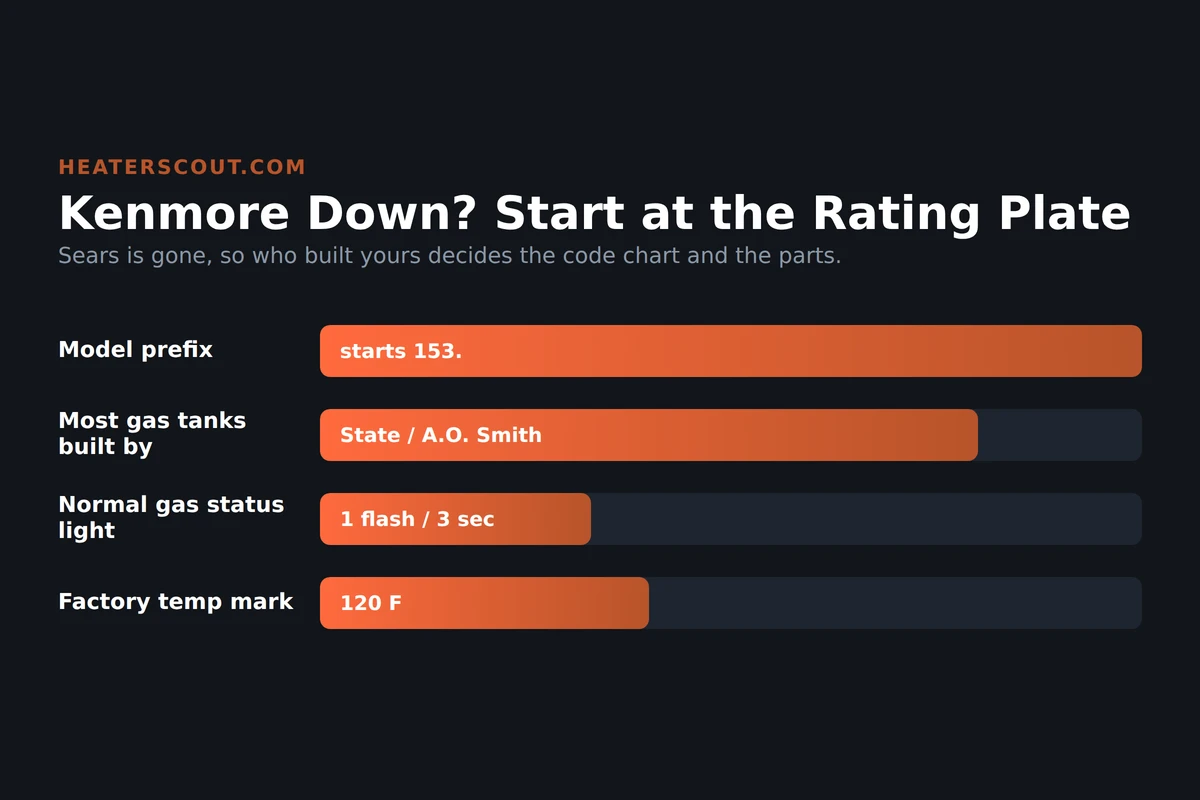
- Kenmore model numbers start with 153, the Sears source code. The real builder is on the rating plate, usually State Industries or A.O. Smith, sometimes Rheem or American.
- The line is discontinued. Order parts by the OEM cross-reference (State, A.O. Smith, Rheem), not a Kenmore part number.
- Gas: one status-light flash every three seconds is normal. Two or more is a fault code you read off the chart on your own valve.
- Electric: the red ECO reset lives on the upper thermostat. Breaker off first, reset once, and a repeat trip means a real fault.
- Set it to the 120 mark. The relief valve is never capped. A tank that weeps from its body is done.
Does any of this apply to a Kenmore tankless or hybrid heat-pump unit?
Some of it. The temperature, leak, sediment, and parts-by-OEM notes carry over, but hybrid heat-pump and tankless Kenmore units use different controls and read faults with their own digital codes rather than a status-light blink count. The hybrid ECO, for instance, opens closer to 185 degrees. This hub is about standard gas and electric storage tanks. If you have a hybrid or tankless, use its own display code and manual, but you still source parts by the maker on the plate.
Step zero: read the rating plate
Before you touch the pilot or the breaker, find the rating plate on the side of the tank and read two things: the model number, which starts with 153 on every Kenmore, and the name of the company that actually built it. The 153 is just the Sears source code and tells you nothing about repair. On most Kenmore 153 gas tanks the builder line says State Industries, which A.O. Smith bought in 2008, so you are effectively holding an A.O. Smith heater. Some came from Rheem or American, which read a little differently. Write down the model, serial, and builder, because with Sears closed you order every part under the builder's cross-reference, not a Kenmore number.
- Locate the rating plate on the side of the tank and read the builder name next to the 153 model number.
- State or A.O. Smith on the plate: use the A.O. Smith / State flash chart and part numbers.
- Rheem or American on the plate: use that maker's chart and parts instead.
- Photograph the plate. Model, serial, builder, gas or electric, and gallons drive every parts search.
- Search the OEM equivalent (thermopile, gas valve, element, thermostat), not a 'Kenmore' part.
The 153 source code
A Sears prefix, not a manufacturer. Sears stamped its own three-digit source code on rebadged products, and 153 is the code for water heaters. It tells you the unit came through Sears as a Kenmore, not who built it or which parts fit. The rating plate names the real builder next to that number, and that name, State, A.O. Smith, Rheem, or American, is the one you carry into a parts search now that the Kenmore counter is gone.
No hot water: read the light, then the reset
No hot water is the call that starts most Kenmore troubleshooting. Split it by fuel type right away. On a gas Kenmore, look at the status light on the gas control valve at the base of the tank. One flash every three seconds means it is fine, pilot lit and control healthy. A repeating pattern of two or more flashes is a fault code. On the common State and A.O. Smith built units, two flashes is a pilot that is out or a thermopile short of normal voltage, usually a weak or dirty pilot. Four flashes is over-temperature. Five is a thermostat or temperature-sensor fault. Seven is a gas control valve failure, and some show an eight-then-four pattern for a control shutdown. Match your count to the chart printed on your valve, because a Rheem-built Kenmore reads its light on a different map.
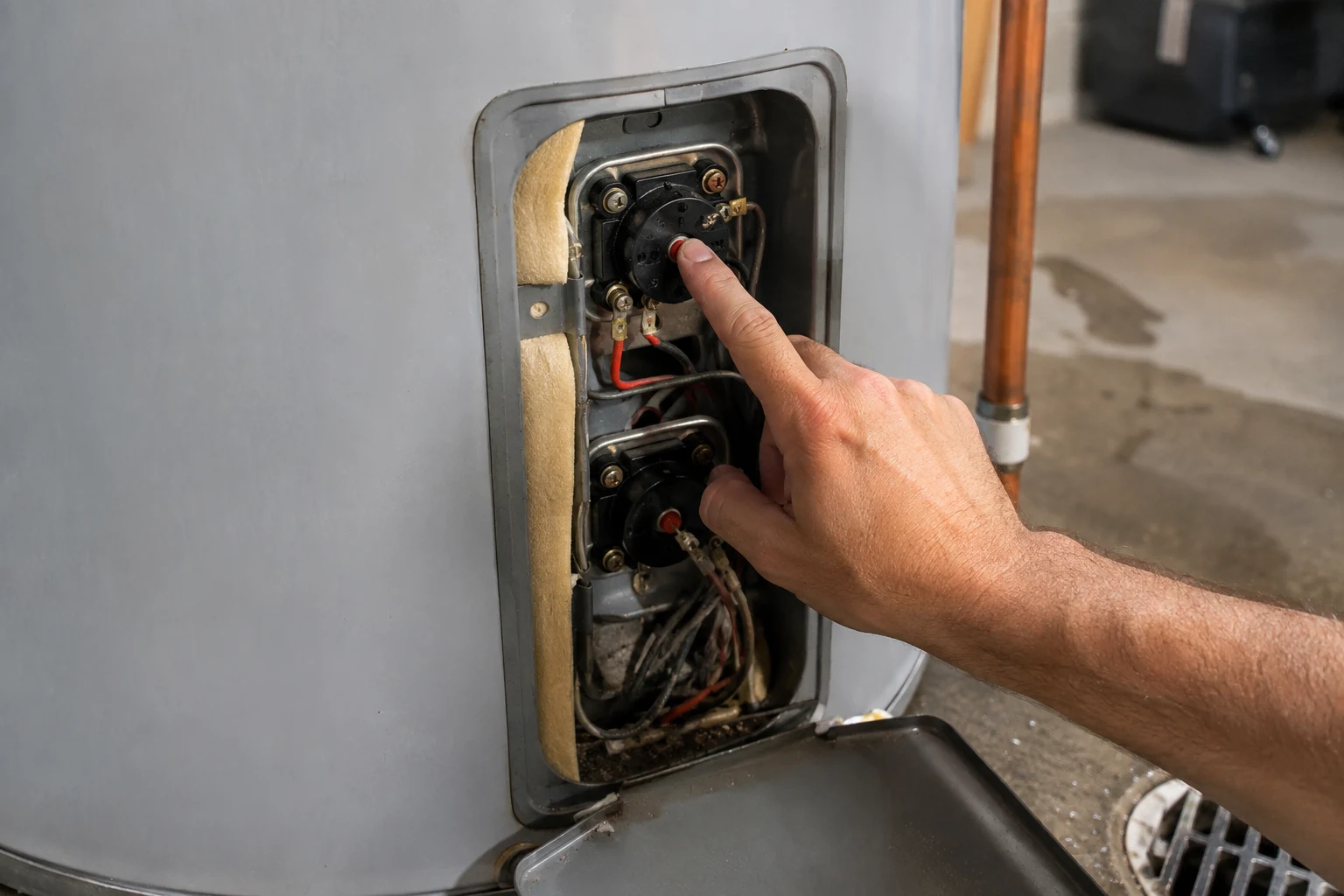
On an electric Kenmore with no hot water, the usual culprit is the ECO, the red high-temperature reset button on the upper thermostat. Before you go near it, kill the breaker, because the panel you are opening sits on 240 volts. With power off, fold back the insulation, press the red button until it clicks, then button everything up before restoring power. The ECO opens around 180 degrees, so it only trips when the water really overheated. If the reset holds, you are done. If it trips again within a day, you have a stuck thermostat or an element shorted to the tank, not a nuisance trip, and that is where you stop resetting and diagnose. A tripped ECO cuts both elements, so it usually leaves no hot water at all. Lukewarm water instead points at a single dead element.
Confirm the symptom and the fuel
No hot water at all, not enough, or too hot are three different problems. Note whether it is the whole house or one fixture, and whether the heater is gas or electric. That alone cuts the list in half.
Gas: count the status-light flashes
One flash every three seconds is normal. Count a repeating pattern and match it to the chart on your gas valve. Two flashes often means clean or relight the pilot. Four, five, seven, or eight-four are stop-and-diagnose faults.
Electric: reset the ECO once, breaker off
Kill the 240 volt breaker, open the upper panel, fold back insulation, press the red button until it clicks. If it holds, done. If it trips again within a day, stop and find the overheating cause.
Check the temperature dial before blaming a part
The 120 mark is the factory setting. Scalding water means turn it down. On electric, set both thermostats the same. Water that ignores the dial is a failing thermostat.
Then look and listen for leaks and sediment
Scan the relief valve, the fittings, and the base of the tank. Popping or rumble at the burner is sediment flashing to steam. A flush clears the noise; a wet tank body does not get fixed.
Not enough hot water, or it runs out fast
Running out is a different problem from no hot water, and the difference points at the cause. On an electric Kenmore, a burst of hot that turns lukewarm halfway through a shower is the classic sign of a dead lower heating element. The upper element heats the top of the tank for the first few gallons, then the lower element carries the rest, and when it fails you get a short run of hot followed by cold. On a gas Kenmore the same short-supply feeling usually traces to a low temperature setting, a partly clogged burner, or a thick sediment layer insulating the flame. Check the dial first.
Sediment is the quiet thief here too. Mineral scale on the tank floor steals usable volume and burner efficiency, so a 40 gallon Kenmore starts behaving like a 30, and it also drives the popping and rumble you hear as trapped water flashes to steam under the layer. A yearly drain and flush is both fix and prevention, though on a unit well past ten years the capacity loss can be permanent once the scale bakes hard.
The pilot and thermopile problem
A two-flash code, or a pilot that lights and then dies the second you release the gas knob, is almost always the thermopile. It is the sensor bundle the pilot flame heats, and its tiny voltage is what holds the main gas valve open. If the pilot flame is weak, off-color, or does not fully wrap the sensor, the voltage sags and the valve closes. Clean the pilot orifice and the sensor, then relight per the burner-door legend: knob to OFF and wait several minutes, then PILOT, hold the knob fully in, click the piezo igniter three to six times, and keep the knob pressed about a minute after it catches so the thermopile warms. If the pilot holds and you get one flash every three seconds, you are done. If a tech tests the thermopile and it reads below about 350 millivolts, replace it, a cheap part ordered under the builder's number.
Leaks, the relief valve, and the tank body
Where a Kenmore leaks decides whether it is a five-dollar fix or a new heater. A drip from the relief valve during a heating cycle can be normal thermal expansion. Open a hot faucet, and if the drip stops, that was expansion pressure with nowhere to go, and the cure is an expansion tank on the cold inlet. A relief valve that drips steadily otherwise is worn or has sediment on its seat, and it gets replaced, never capped. That valve is the tank's last safety, set to open near 210 degrees or 150 psi, and plugging it turns a water heater into a bomb. A leak at a fitting or union up top can often be resealed. The one leak nobody fixes is water weeping from the body or bottom of the tank, which means the steel corroded through. On an aging discontinued brand, a weeping tank is a replacement.
The parts reality, and the stop-and-call-a-pro line
Plenty of Kenmore work is a careful homeowner's afternoon with the breaker off and the burner-door legend open: relighting a pilot, resetting an ECO once, turning the dial down, flushing sediment. What trips people up now is sourcing, because there is no Kenmore parts counter. You read the builder off the rating plate and buy the State, A.O. Smith, or Rheem equivalent. A thermopile, thermocouple, element, thermostat, or relief valve is all standard under those names. The stop-and-call line is where a fault keeps coming back or the failure is the tank itself. A four-flash over-temp or an electric ECO that trips a second time both mean the water is genuinely overheating, and chasing that with repeated resets wears out a safety device while ignoring a real hazard. A seven-flash or eight-four gas valve fault, any gas smell, and a weeping tank body are hard stops.
- A gas smell near the heater. Leave, then call the gas utility. Do not flip switches or light anything.
- A four-flash over-temp code, or an electric ECO that trips a second time within a day.
- A seven-flash or eight-then-four gas control valve fault on the status light.
- Water weeping from the body or bottom of the tank, not just a fitting or the relief line.
- A relief valve that keeps dripping after a new valve and an added expansion tank.
- Rusty or metallic hot water that stays rusty after a full flush, on a tank past ten years.
- Any 240 volt electrical work beyond pressing the reset button with the breaker off.
Everything above that line is reasonable homeowner territory with the breaker off. Everything below it is where a licensed plumber or gas tech earns the call, because the failure mode is a burn, a flood, or a combustion problem. The tie-breaker on a gas unit is always the chart on your specific gas valve and the builder name on your specific rating plate. Read both before you turn a screw or place a parts order.
Frequently asked
Who actually made my Kenmore water heater, and does it still have parts?
Kenmore was never a factory. It was Sears' house brand, so the heaters were built by other manufacturers and badged Kenmore. Your model number starts with 153, the Sears source code, and the real builder is printed on the rating plate. For most Kenmore 153 gas tanks that builder is State Industries, which A.O. Smith bought in 2008, so many Kenmore units are A.O. Smith heaters under a different label. Some were made by Rheem or American Water Heaters. Sears closed most stores around 2018 and the line is discontinued, so there is no Kenmore parts counter. You order by the real builder: note the OEM name, model, and serial, and cross-reference the State, A.O. Smith, or Rheem part. A gas valve, thermopile, element, or thermostat is still available under the maker's number even though the Kenmore badge is dead.
What do the flashes on my Kenmore gas water heater status light mean?
The light on the gas valve at the base of the tank blinks a diagnostic code, and the count is what you read. One flash about every three seconds is the good signal: pilot lit, control healthy, no action needed. Trouble is a repeating pattern of two or more. On the common State and A.O. Smith built units, two flashes means the pilot is out or the thermopile is short of voltage, usually a weak or dirty pilot. Four flashes is over-temperature. Five points at a thermostat or temperature-sensor fault. Seven is a gas control valve failure, and some units show an eight-then-four pattern for a control shutdown. The exact chart depends on who built your heater, so read the label on your own gas valve and match your blink pattern to it, not to a count off the internet.
Where is the reset button on a Kenmore electric water heater and can I press it?
It is the red button on the upper thermostat, the ECO or high-temperature cutoff, behind the upper access panel and insulation. One rule beats its location: shut the breaker off first, because those terminals carry 240 volts. With power off, press the red button until it clicks, put the insulation and cover back, then restore power. The ECO opens when tank water passes about 180 degrees, so it only trips because the water genuinely overheated. A reset that holds is fine. A reset that trips again within a day means a real fault, usually a stuck thermostat or an element shorted to the tank, so stop resetting and diagnose. A tripped ECO cuts both elements, so it usually leaves no hot water at all; some warm water instead points at a single dead element.
What temperature should I set my Kenmore water heater to?
Leave it at the 120 degree mark for most homes. The gas dial carries a 120 mark, and the factory sets it there because 120 is hot enough for showers and dishes and low enough that a slip at the tap does not scald on contact. Every degree past 120 shortens the time hot water takes to burn skin, a real hazard with kids or older adults. If your water runs scalding, check the dial before blaming a part. On a gas Kenmore the dial is on the control valve. On an electric one there are two thermostats, upper and lower, and both have to be set the same with a small flat screwdriver, breaker off. Water that runs hotter than the dial says, or will not turn down, is a failing thermostat, and on gas it can show as a four-flash over-temperature code.
My Kenmore water heater is leaking, is it dangerous and what do I do?
Where it leaks decides everything. A drip from the relief valve during a heating cycle can be normal thermal expansion. Open a hot faucet, and if the drip stops, that was expansion pressure and the house wants an expansion tank. A valve that drips steadily otherwise is worn or has sediment on its seat and gets replaced, never capped. It is the tank's last defense against rupture, set to open near 210 degrees or 150 psi, and blocking it is how a heater becomes a bomb. A leak at a fitting or union up top can often be resealed. The leak you cannot fix is water weeping from the body or bottom of the tank, which means the steel corroded through and no patch holds. On a Kenmore that old, and most are old now, that is a new unit. Keep a drip pan with a drain under the heater so a slow leak goes somewhere safe.
Is it worth repairing a Kenmore water heater or should I just replace it?
Age plus the type of failure. A residential tank typically lasts 8 to 12 years, and since the line has been discontinued for years, most surviving units are at or past that window. Small parts are still worth doing on a tank with life left: a thermopile, thermocouple, gas valve, single element, thermostat, or worn relief valve are all normal repairs, bought under the real builder's number, State, A.O. Smith, or Rheem, not Kenmore. The replace-it signs are clear. Water weeping from the body means the steel rusted through and cannot be sealed. Rusty hot water that stays rusty after a full flush, a repeatedly tripping ECO or four-flash over-temp on a ten-year-old tank, and heavy sediment that keeps causing noise all point the same way. When a big part like the gas valve fails on a tank that old, the repair money is usually better spent toward a new heater with a fresh warranty.