You are kneeling in front of an old Sears Kenmore water heater, model number 153-something, watching a little status light throw a pattern of flashes, and you cannot find a Kenmore flash chart anywhere because Sears is gone and there was never a Kenmore factory to publish one. Here is the thing that untangles it. Kenmore was a Sears house brand, a badge on the tank, not the company that welded it. Somebody else built your heater, that builder's name is printed on the rating plate, and that builder decides which flash chart your status light actually follows. So the very first job is not counting flashes. It is reading the plate to learn who made the thing.
The 153. model prefix
The 153 in front of your Kenmore model number, like 153.336930 or 153.331350, is a Sears source code. Sears stamped a three-digit prefix on every product it sold to record which supplier built it, and 153 was the code assigned to its water heaters. The prefix confirms the unit was sold under the Kenmore name by Sears. It does not name the factory on its own. The actual manufacturer, the company that engineered and assembled the heater, is printed separately on the rating plate on the side of the tank. Most Kenmore 153. gas tanks were built by State Industries, which belongs to the A.O. Smith family, though some came from Rheem and a few from American Water Heaters.
The model number tells you who to call for parts, not who to blame. There is no Kenmore factory, so the 153. prefix and the maker on the rating plate are how you find the builder whose equivalent part actually fits.
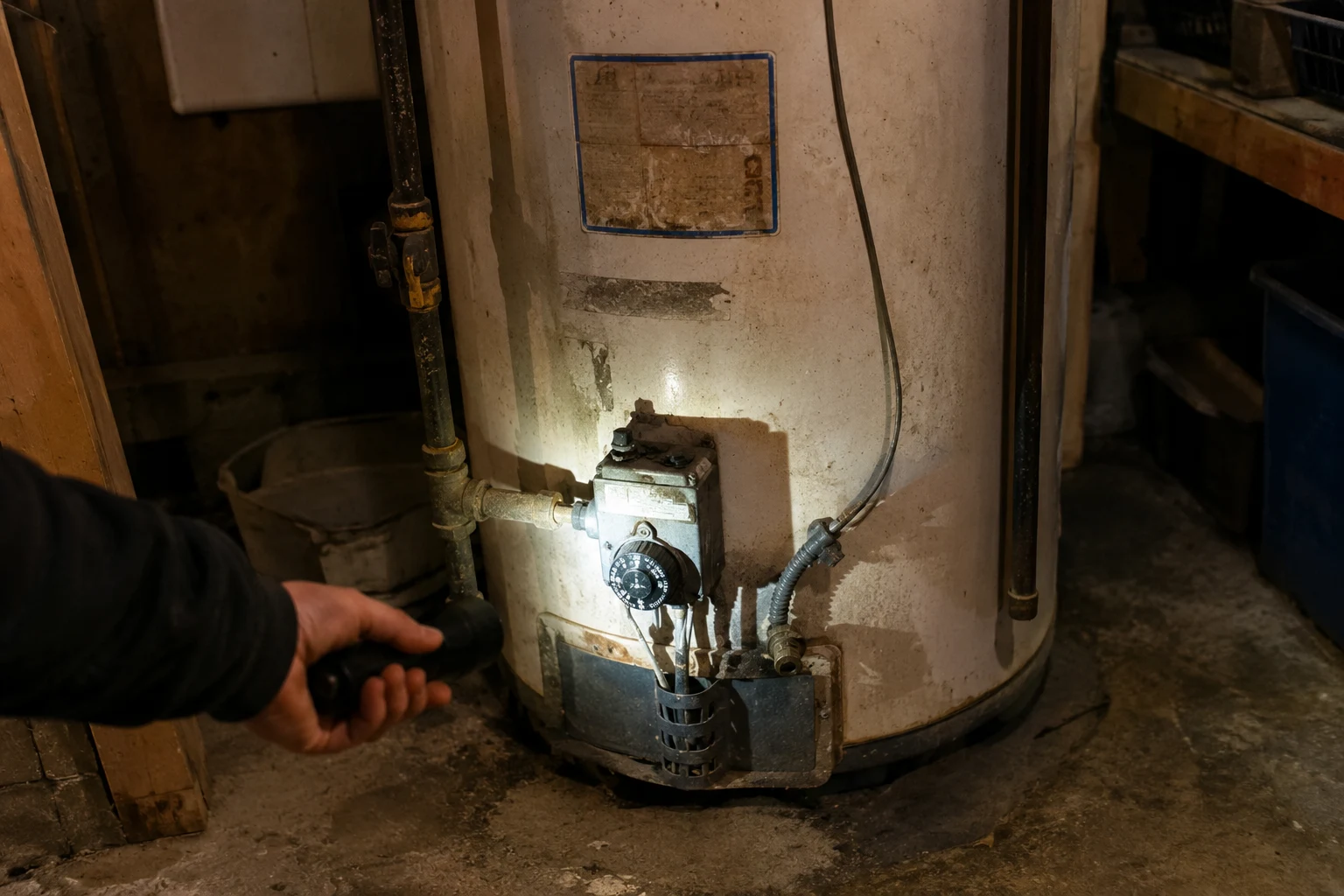
Read the rating plate first: who built yours
Before you match a single flash to a fix, find the rating plate on the side of the tank near the top and read the manufacturer name. That name, not the Kenmore badge, decides which chart applies. Most Kenmore 153. gas tanks came off a State Industries line and use the A.O. Smith and Honeywell-Resideo gas control valve, so they read the shared A.O. Smith flash chart. A smaller share were built by Rheem and read the Rheem chart instead, and a few came from American Water Heaters, another A.O. Smith brand, which follow the A.O. Smith chart. The table below is your decoder: find the builder, learn how to spot it on the plate, and see which chart your status light speaks.
| Built by | How to tell | Status-light chart |
|---|---|---|
| State Industries (A.O. Smith family) | Rating plate reads State Industries, State Water Heaters, or A.O. Smith; the most common case for a 153. gas tank; Honeywell or Resideo gas control valve at the base | Shared A.O. Smith chart: 1 normal, 2 thermopile, 4 over-temp, 5 sensor, 7 gas valve |
| Rheem | Rating plate reads Rheem (or Rheem Manufacturing); gas valve wears the Rheem-style status light and legend; model still carries the 153. Sears prefix | Rheem chart: same counts on the practical codes, but confirm against the Rheem legend on the door |
| American Water Heaters (A.O. Smith family) | Rating plate reads American or American Water Heaters; also an A.O. Smith brand; less common on Kenmore tanks than State | A.O. Smith chart: reads the same as the State built units, 1 normal and 2, 4, 5, 7 as faults |
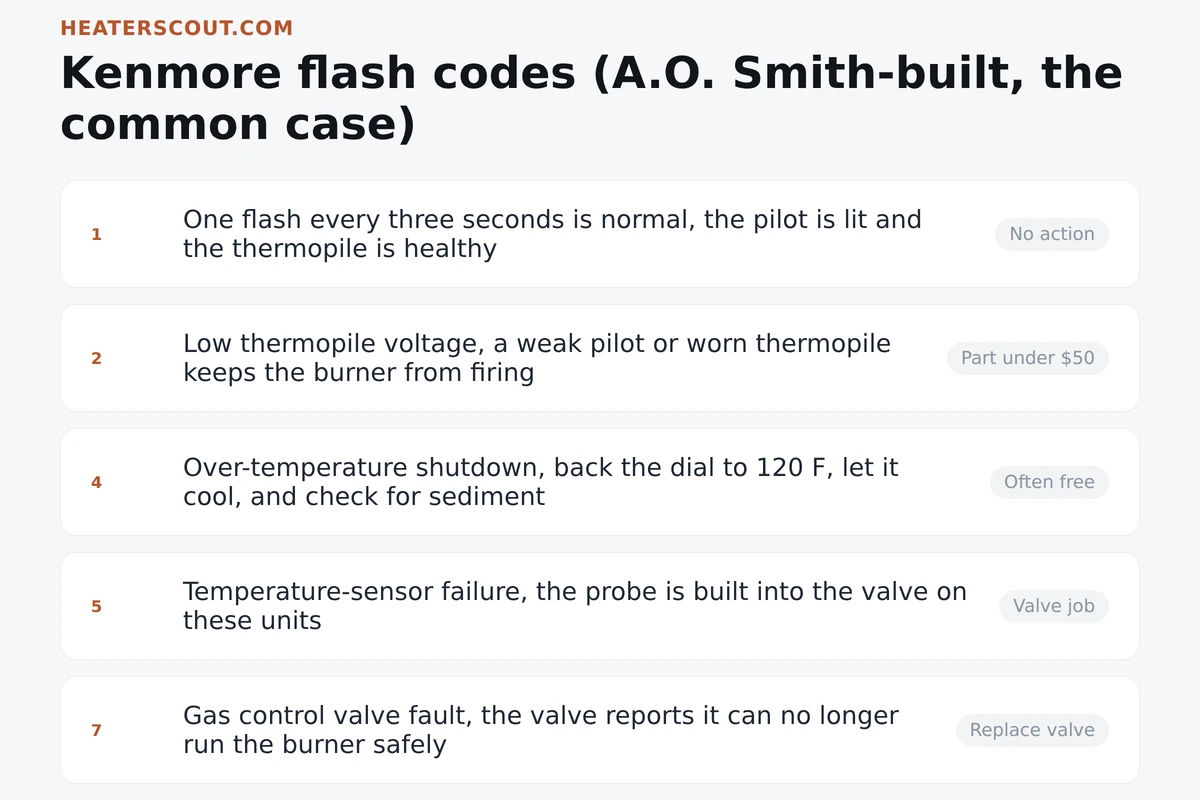
The A.O. Smith flash chart, the common case
Assume your rating plate says State or A.O. Smith, which covers most Kenmore 153. gas tanks. The green status light low on the gas control valve is a diagnostic display, and the count in each burst is the code. One flash every three seconds is normal. The Kenmore manual says it plainly: a single slow blink means the pilot is lit and the thermopile is healthy, and it is not a fault however much it looks like a warning light. Everything above one flash is a fault, and each count routes to its own fix. Two flashes is low thermopile voltage, the friendly one: a weak or sooty pilot or a worn thermopile drops the voltage below the valve's holding point, so clean and reseat the pilot and leads, and if a meter reads low, swap the thermopile for under fifty dollars. Four flashes is an over-temperature shutdown: back the dial down to about 120 degrees, let the water cool, and check the tank bottom for sediment acting like an insulating blanket over the burner, because that code often clears for free. Five flashes is a temperature-sensor failure, and on these units the sensor is built into the gas control valve, so a genuine five usually ends in a valve job. Seven flashes is a gas control valve fault, the valve reporting an internal failure it cannot run the burner past, and that means replacing the valve assembly. The reset is the same for the soft faults and worth doing exactly once: turn the gas control knob to OFF, wait about five minutes, relight the pilot following the instructions on the burner door, and turn the knob back to your setting. Once, not on repeat, because resetting a four-flash over-temp or a seven-flash valve code over and over is chasing a safety trip in circles.
State / A.O. Smith-built Kenmore
The common case. Rating plate reads State, State Water Heaters, or A.O. Smith, with a Honeywell or Resideo gas control valve. Read the flash chart straight off the A.O. Smith logic: 1 normal, 2 thermopile, 4 over-temp, 5 sensor, 7 valve. For parts, cross-reference your full 153. model and serial to the A.O. Smith or State equivalent thermopile or gas control valve at a plumbing supply house or the A.O. Smith parts line.
Rheem-built Kenmore
Less common but real. Rating plate reads Rheem even though the model still carries the 153. Sears prefix. The status light reads the Rheem way, so match the count against the Rheem legend printed on the burner door rather than the A.O. Smith chart. Order parts as the Rheem equivalent, using your model and serial, from a Rheem dealer or supply house.
American-built Kenmore
A few Kenmore tanks came from American Water Heaters, another A.O. Smith brand. The plate reads American or American Water Heaters. It follows the same A.O. Smith flash chart as the State built units, so 1 is normal and 2, 4, 5, and 7 map the same way. Get parts as the American or A.O. Smith equivalent, cross-referenced from your 153. model and serial.
Why the builder decides everything here
With a living brand you would call the factory, read their chart, and buy their part. Kenmore took that ladder away when Sears closed. The badge on the tank points at a company that no longer sells water heaters, so the only reliable path runs through the actual builder named on the rating plate. That is not a technicality. It changes which flash chart you trust, which legend on the burner door is authoritative, and which part number fits. A State built Kenmore and a Rheem built Kenmore can wear the identical Sears 153. prefix and still read their status lights differently, because the gas control valve underneath is different hardware. Miss the builder and you can count flashes perfectly and still buy a valve that does not fit your tank.
So keep the order straight every time. Read the rating plate and find the builder. Match the flash count to that builder's chart, confirming against the legend printed on your own burner door, which always wins over any generic table if the two disagree. Then, when you need a part, cross-reference your full 153. model number and serial to the builder's current equivalent, whether that is A.O. Smith and State or Rheem, rather than hunting for a Kenmore listing that no longer exists. Do that and an orphaned Sears heater troubleshoots as cleanly as any name still on the shelf.
Frequently asked
Who made my Kenmore water heater?
Not Kenmore. Kenmore was Sears' house brand, and Sears is bankrupt, so there is no Kenmore factory and never really was one. Your heater was built by an outside manufacturer whose name is printed on the rating plate stuck to the side of the tank. Most Kenmore gas tanks with a model number starting 153. were built by State Industries, which is part of the A.O. Smith family. Some were built by Rheem, and a few by American Water Heaters, also an A.O. Smith brand. Read the rating plate for the actual maker, because that name is who you cross-reference for parts and which flash chart your status light follows.
What does the 153 model number mean?
The 153 in front of your model number, like 153.336930, is a Sears source code. Sears put a three-digit prefix on every product to record which supplier built it, and 153 was the code for its water heaters. It tells you the unit was sold by Sears under the Kenmore name. It does not tell you the factory by itself. To find the real builder you read the rating plate, which names the actual manufacturer, usually State Industries, sometimes Rheem or American. Write down the full model and serial before you shop for parts, because those numbers cross-reference to the builder's equivalent part, not to a Kenmore catalog that no longer exists.
Is a blinking status light on my Kenmore normal?
Usually yes. On the common A.O. Smith and State built Kenmore, one flash every three seconds is the normal heartbeat. It means the pilot is lit and the thermopile is healthy, and the Kenmore manual says so in plain language. A single slow blink is not a warning no matter how much it looks like one. What signals a fault is a burst of more than one flash with a pause after it: two, four, five, or seven quick flashes. Count the flashes in one burst, wait for the roughly three-second pause, and confirm the same count on the next burst before you decide anything is wrong.
What does 2 flashes mean on a Kenmore water heater?
On an A.O. Smith or State built Kenmore, two flashes is low thermopile voltage. The thermopile is the small bundle of thermocouples the pilot flame heats to generate the voltage that runs the gas valve. When the pilot burns weak or sooty, or the thermopile is worn, the voltage sags below the valve's holding point and the burner will not fire. It is the friendliest code on the chart. Check that the pilot burns a strong steady blue and wraps the thermopile tip, clean and reseat the leads at the valve, and if a meter reads low the thermopile part usually runs under fifty dollars and is homeowner work with a screwdriver and a wrench.
How do I reset a Kenmore water heater?
On a gas Kenmore the reset is the gas control knob, not a red button. Turn the knob to OFF, wait about five minutes so the valve and water settle, then relight the pilot following the lighting instructions printed on the burner door and turn the knob back to your temperature setting. Do that once, not over and over. A clean reset clears a one-time fault. It does not fix a cause. If the same flash count comes right back, the fault is real and repeating, and hammering the reset on a four-flash over-temperature or a seven-flash valve code is the wrong move because those are safety conditions. The red ECO button lives on electric models, behind the upper access panel.
Where do I get parts for a Kenmore water heater now that Sears is gone?
You cross-reference to the actual builder, because there is no Kenmore parts counter anymore. Read the rating plate to find who made the heater. If it says State Industries, American, or A.O. Smith, order the A.O. Smith or State equivalent thermopile, gas control valve, or thermocouple using your full model and serial number. If it says Rheem, order the Rheem equivalent. A plumbing supply house or the builder's own parts line can match a Kenmore 153. model to the current part number. Do not search for a Kenmore branded part, because those listings dried up when Sears closed. Match the builder, not the badge.
Are Kenmore flash codes the same as A.O. Smith?
For the majority of Kenmore gas tanks, yes, because most were built by State Industries, which is part of the A.O. Smith family and uses the same Honeywell-Resideo gas control valve. Same valve means the same flash logic: one flash normal, two low thermopile, four over-temperature, five temperature sensor, seven gas control valve. So an A.O. Smith flash chart applies directly to a State built Kenmore. The exception is a Kenmore built by Rheem, which reads its status light the Rheem way instead. That is why you check the rating plate first. The legend printed on your own burner door is the final authority for your exact heater.