Strip away the endless-hot-water ad copy and a tankless water heater is a math problem. It costs more to buy and install, uses less energy to run, and lasts longer, and whether those trade in your favor depends almost entirely on two numbers: how much hot water your household actually uses, and how many years you plan to stay in the house. The Department of Energy says a tankless is 24 to 34 percent more efficient for a low-use home and lasts past 20 years against a tank's 10 to 15. Those are real advantages. They are also slow to pay back a 2,500-to-6,000-dollar install. This page runs the honest cost-benefit, names the households where it clearly wins, and names the ones where a plain tank is the smarter buy.
The verdict
A tankless is worth it if you use a low-to-moderate amount of hot water, plan to stay in the home 10 or more years, and can install it without a major electrical or gas upgrade. Then the 24 to 34 percent DOE efficiency gain, the 20-plus-year lifespan, and the avoided second tank replacement outrun the higher upfront cost. It is not worth it for high simultaneous demand, for a cheap-electricity home that would need a 1,500-to-4,000-dollar panel upgrade, or for anyone selling within a few years. In those cases a good storage tank or a heat pump water heater wins on money.
Couple or small family staying put, gas already run
Low-to-moderate hot water use lands you in the 24 to 34 percent DOE efficiency band, and a decade-plus in the home lets the savings plus the longer life clear the install premium. An existing gas line keeps the install near the bottom of the cost range.
Big family, several showers at once
You can make it work, but only with a unit sized for your real peak, 5-plus GPM and more in a cold climate. That means a larger gas unit or two units, which pushes cost up. Sized right it is fine; sized cheap it disappoints on the first busy morning.
Selling soon, or electric-only with a full panel
Move in a few years and you never bank the payback. Force a 1,500-to-4,000-dollar panel upgrade for an electric whole-house unit and the savings vanish. A storage tank or heat pump water heater is the better spend here.
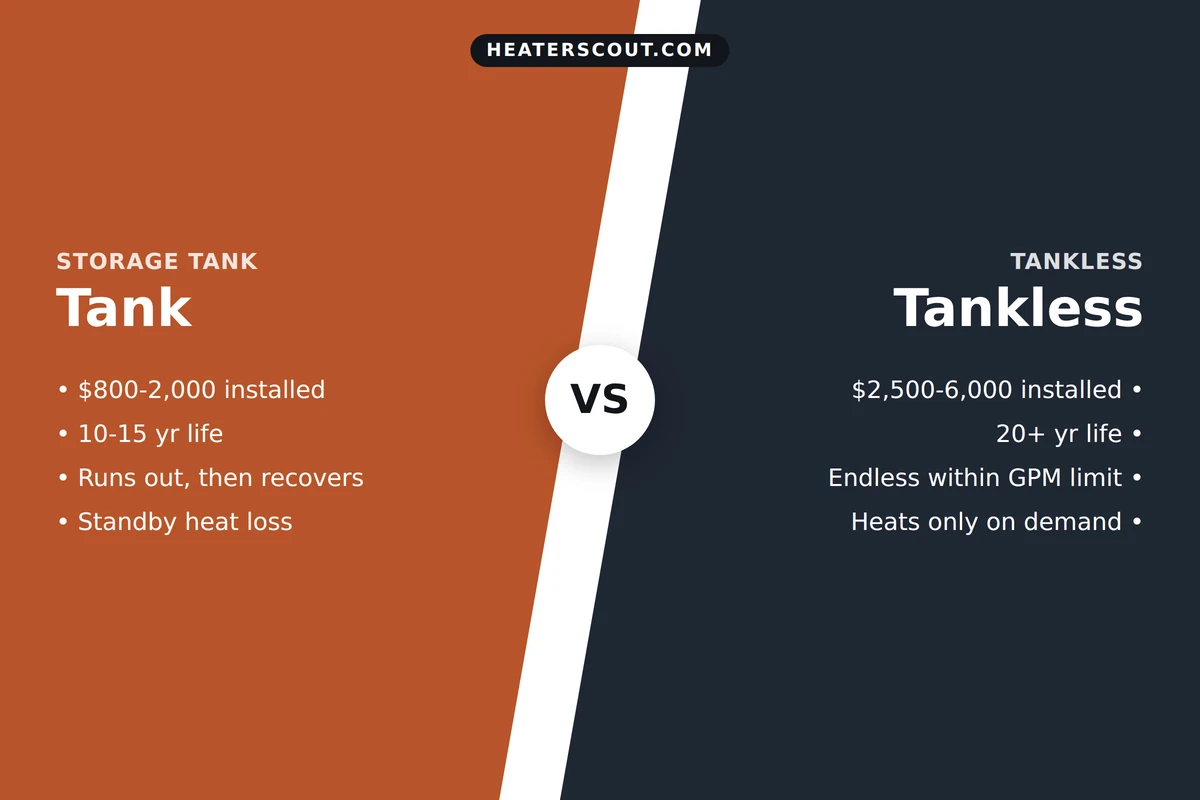
The upfront gap is real, and it is the whole argument
Everything about this decision starts with the install premium, so be clear-eyed about it. A storage tank runs roughly 800 to 2,000 dollars installed for a like-for-like swap, because the plumber drains the old one, disconnects water, gas or power, sets the new tank, and reconnects, usually in a couple of hours. A tankless runs about 2,500 to 6,000 dollars installed, and it climbs from there when the job needs more than a straight swap. The unit itself is only part of it. Gas tankless often needs the gas line upsized to carry its high burst BTU load, plus new stainless or PVC venting sized for the unit, plus a condensate drain on a condensing model. Each of those adds hundreds to over a thousand dollars.
Electric whole-house tankless has its own version of the same trap. On paper the box is cheaper, but a whole-house electric unit commonly demands 100 to 150 amps of dedicated capacity and heavy copper wire. On a home with a 100- or 150-amp service, that can force a panel upgrade in the 1,500-to-4,000-dollar range before the heater does a thing. So the true question is never the sticker price of the appliance. It is the delivered, installed cost in your specific house, gas line and panel included. That number is what the energy savings have to pay back.
| Storage tank | Tankless | |
|---|---|---|
| Installed cost | $800-2,000 | $2,500-6,000+ |
| Typical lifespan (DOE) | 10-15 years | 20+ years |
| Efficiency vs standard tank (DOE) | baseline | 24-34% low use, 8-14% heavy |
| Gas savings, family of 4 (ENERGY STAR) | - | ~$95/yr, ~$1,800 lifetime |
| Hot water | Runs out, then recovers | Endless within GPM limit |
| Standby heat loss | Yes, keeps water hot 24/7 | None, heats on demand |
| Maintenance | Flush sediment | Descale yearly, more in hard water |
Where the savings actually come from
A tank keeps 40 or 50 gallons hot every hour of every day, whether you use it or not, and it bleeds heat through its walls the whole time. That bleed is standby loss, and it is the single biggest thing a tankless eliminates. A tankless sits cold until a tap opens, then fires to heat water as it flows. Kill the standby loss and you get the DOE's headline number: 24 to 34 percent more efficient than a storage tank for a home using 41 gallons of hot water a day or less. The reason low-use homes see the biggest gain is simple. When you draw little water, standby loss is a large share of your total energy, so removing it moves the needle hard. Heavy users who pull around 86 gallons a day still gain, but only 8 to 14 percent, because most of their energy already goes into water they actually use.
In dollars, ENERGY STAR figures a certified gas tankless saves a family of four about 95 dollars a year, and up to roughly 124 dollars for a condensing unit, versus a standard gas storage tank. Over the unit's life that is around 1,800 dollars. Useful, not life-changing, and worth naming plainly so the decision rests on facts rather than a vague sense that tankless equals cheap. Ninety-five dollars a year against a 2,000-to-4,000-dollar install premium is why the energy line alone takes 10 to 20 years to pay back, and why the lifespan and the avoided second tank matter so much to the real answer.
Lifespan is the quiet half of the value
The efficiency number gets the headlines, but the lifespan is where a lot of the real value hides. DOE puts a tankless past 20 years and a storage tank at 10 to 15. Play that out. Over the life of one tankless you would normally buy and install two tanks. Somewhere around year 12 to 15, the tank owner is writing another 800-to-2,000-dollar check while the tankless keeps running. Fold that avoided replacement into the math and the payback picture improves well beyond what the fuel savings alone suggest. This is the piece that turns a marginal energy case into a decent overall case for someone staying in the house.
The catch is that the 20-year number assumes maintenance. Scale from hard water is the leading killer of tankless units. Minerals plate the heat exchanger, choke flow, drop efficiency, and if ignored long enough shorten the life that was supposed to be the selling point. So budget a yearly descale, and every six to eight months if your water is hard, either yourself with a pump and vinegar or a solution, or as a service call. Setting the temperature to 120 to 125 degrees rather than 140 also slows scale. A tank is not maintenance-free either, sediment needs flushing, but a neglected tankless loses its lifespan edge faster than owners expect, and that edge is a big part of why you paid more.
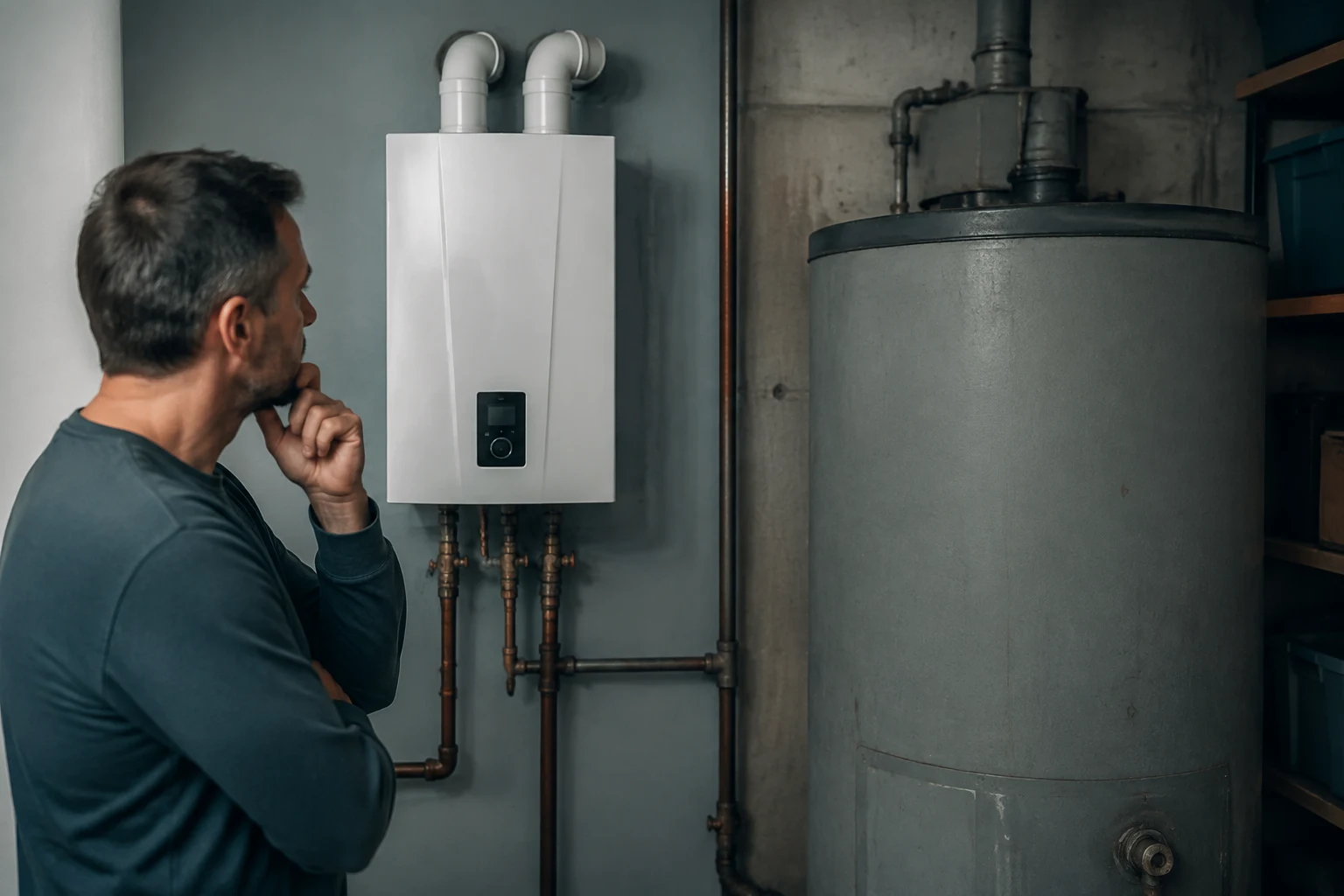
Endless hot water, and the flow ceiling nobody mentions
The endless-hot-water claim is true in one dimension and misleading in another. It is endless in time: a tankless will run a single shower until the water bill scares you, because it heats on the fly instead of draining a stored 50 gallons. No more the fourth person getting a cold rinse. What it is not is endless in volume. Every unit has a ceiling on gallons per minute it can raise to temperature, and open more taps than that ceiling and every fixture goes lukewarm at once. A shower pulls 2 to 3 GPM, so two together want 4 to 5. In a cold climate the incoming water might be 40 to 50 degrees, forcing a bigger temperature rise that shrinks the deliverable flow, so a busy northern home can need a unit rated for 9 to 11 GPM to hit the same peak a southern home covers with less.
This is exactly where the high-simultaneous-demand household has to think hard. A big family running two showers, a dishwasher, and a load of laundry at 7 a.m. is asking for more flow than one modest unit delivers. The fix is to size up, a large gas unit or even two units in parallel, and that pushes the install cost past the point where the energy savings pay back comfortably. It still works, and plenty of big homes run tankless happily. But sized to peak demand, not to the box price, and go in knowing the endless promise has an asterisk that reads within your flow rating.
Worth it if
- You use a low-to-moderate amount of hot water, landing in the 24-34% DOE efficiency band.
- You plan to stay 10-plus years, long enough to bank savings and skip a second tank.
- Gas is already run, keeping the install near the low end of the range.
- You will actually descale it yearly, so it reaches its 20-plus-year life.
- You value endless duration and the reclaimed floor space of a wall unit.
Skip it if
- Your household runs several showers and appliances at once without sizing up.
- You are electric-only and would need a 1,500-to-4,000-dollar panel upgrade.
- You will move within a few years and never earn back the premium.
- Your water is very hard and you will not keep up with descaling.
- A heat pump water heater would electrify the house on your existing panel.
The honest bottom line
A tankless water heater is worth it for a low-to-moderate-use household that plans to stay in the home a decade or more and can install it without a costly gas or electrical upgrade. In that lane the DOE efficiency gain, the ENERGY STAR savings, the 20-plus-year life, and the tank you never have to replace twice all line up, and endless hot water in a smaller footprint is a genuine daily upgrade. It is a poor buy when the fit is wrong: heavy simultaneous demand you refuse to size for, cheap electricity with a panel that needs upgrading, or a short stay that never lets the payback arrive. If you are electrifying and worry about the panel, price a heat pump water heater in the same breath, because it often beats electric tankless on both install and running cost.
Run your own two numbers before you sign anything. Pull your rough daily hot-water use and how long you plan to stay, then get an installed quote that spells out gas-line, venting, and panel work for your actual house. If the delivered cost is near the low end and you are staying put, the case is easy. If the quote balloons on upgrades or you are listing the house next spring, the plain tank is not the boring choice, it is the correct one.
Will a tankless water heater lower my water bill?
Not really, and it can nudge it up. A tankless saves energy, not water. Because hot water is instant and endless, some households take longer showers, and a cold-water-sandwich quirk can waste a little water at the tap while temperature settles. The savings live on the gas or electric side, not the water side.
Is a tankless worth it for a single person or a small condo?
Often yes on efficiency percentage, since low use sits squarely in the 24-to-34-percent DOE band, but the small absolute dollar savings make the payback slow. For one person a point-of-use electric unit or a right-sized small tank can be the better value unless you specifically want the space savings and endless duration.
Frequently asked
Is a tankless water heater actually worth the extra money?
For the right household, yes. The Department of Energy puts the efficiency gain at 24 to 34 percent for homes that use 41 gallons of hot water a day or less, and the unit lasts more than 20 years against a storage tank's 10 to 15. ENERGY STAR figures a certified gas tankless saves a family of four about 95 dollars a year, roughly 1,800 dollars over the unit's life. The catch is the upfront gap. A tank runs roughly 800 to 2,000 dollars installed and a tankless 2,500 to 6,000 or more, and the direct energy savings alone often take 10 to 20 years to close that gap. So it is worth it when you plan to stay put long enough to bank the savings and the extra decade of service life, and it is a weaker deal if you move every few years or force a big electrical or gas upgrade to make it fit.
How much does a tankless water heater actually save per year?
Less than the marketing implies, but real. ENERGY STAR pegs the gas savings for a family of four at about 95 dollars a year compared with a standard gas storage tank, and up to roughly 124 dollars for a condensing model depending on your rates and how much hot water you draw. The savings come from killing standby loss, the heat a tank bleeds off keeping 50 gallons hot around the clock even when nobody is home. A tankless only fires when a tap opens. The DOE's 24 to 34 percent efficiency figure is largest for low-use homes because standby loss is a bigger slice of their total. Heavy users who draw around 86 gallons a day still see a smaller 8 to 14 percent gain, since more of their energy goes to actually heating water they use rather than to standby.
How long does a tankless water heater last compared to a tank?
The Department of Energy puts tankless units at more than 20 years and storage tanks at 10 to 15. That extra decade is a real part of the value math, because over the life of one tankless you would typically buy and install two tanks. The longer life is not automatic, though. Scale from hard water is the main thing that shortens a tankless life, so the 20-year number assumes you descale it, once a year in normal water and every six to eight months in hard water. Skip that and mineral buildup narrows the heat exchanger, drops efficiency, and can cut years off the unit. A tank has its own maintenance, flushing sediment, but a neglected tankless loses its lifespan edge faster than most owners expect.
When is a tankless water heater NOT worth it?
Three cases. First, high simultaneous demand: if your household routinely runs two or three showers plus a dishwasher at once, you need a unit sized for 5 or more gallons a minute, and in a cold climate where inlet water is 40 to 50 degrees that can climb to 9 to 11 GPM, pushing you into a large gas unit or two units. Second, cheap electricity with a weak panel: a whole-house electric tankless can pull 100 to 150 amps and force a 1,500 to 4,000 dollar panel upgrade, which erases the savings. Third, short stays: if you will sell in a few years, you never live long enough to earn back the install premium, and buyers rarely pay it back at resale. In those cases a good storage tank, or a heat pump water heater, is the smarter money.
What is the payback period on a tankless water heater?
On direct energy savings alone, roughly 10 to 15 years for a gas tankless and 12 to 20 years for an electric one, using typical rates. That looks slow next to the marketing, and if you only counted the fuel line it often is. The honest version folds in the rest: a tankless lasts more than 20 years to a tank's 10 to 15, so somewhere around year 12 to 15 you skip the cost of a second tank the tankless owner never has to buy. Count that avoided replacement, plus the space you get back and the endless hot water, and the deal tips favorable for anyone staying in the home a decade or more. The payback is genuinely bad if you needed a panel or gas-line upgrade to install it, since that adds thousands to the front end that energy savings claw back very slowly.
Does a tankless water heater really give endless hot water?
Endless in duration, capped in volume. A tankless will run a single hot shower for as long as you want, because it heats water as it flows rather than draining a stored supply, so it never runs cold the way a tank does after the fourth back-to-back shower. The limit is flow, not time. Each unit has a maximum gallons-per-minute it can raise to temperature, and if you open more taps than that ceiling allows, every fixture drops in temperature or pressure at once. A shower wants 2 to 3 GPM, so two at once wants 4 to 5, and cold incoming water in winter shrinks the deliverable flow further. Size the unit to your real peak demand and the hot water is effectively endless. Undersize it and endless becomes lukewarm.
Is a gas or electric tankless the better value?
For a whole house, gas usually wins on value where a gas line already exists, because a single gas unit can deliver the 6 to 11 GPM a busy home needs and the ENERGY STAR savings figures are built around gas. Electric whole-house tankless looks cheaper on the box, but the install is where it bites: it commonly needs 100 to 150 amps of dedicated capacity, so a home on a 100- or 150-amp panel may face a 1,500 to 4,000 dollar service upgrade before the heater even turns on. Electric shines for point-of-use, a single bathroom or a remote sink far from the main heater, where the load is small and no panel upgrade is needed. If you are electrifying the whole house and worried about panel capacity, a heat pump water heater is often the better move than electric tankless.