A Rheem ProTerra flashing A102 is not telling you the heat pump died. It is telling you one thermistor, the ambient air sensor near the intake, gave the control board a reading it could not trust, so the unit quietly switched to its electric elements and kept making hot water. That is the pattern across every hybrid brand: a bad temperature sensor rarely leaves you cold, it leaves you running on the expensive backup while a small alphanumeric code sits on the display. Read the code, figure out which sensor it names, and most of the time the fix is a connector you reseat with the power off.
What these sensors do, and why a hybrid has so many
A plain electric tank has two temperature controls and nothing else to sense. A hybrid heat pump water heater is really a small air conditioner bolted to a tank, and an air conditioner needs to watch temperatures at several points to run its refrigerant loop safely. That is why the code list is longer. Each thermistor answers one question for the control board.
- Ambient sensor: how warm is the room air the heat pump is pulling from? Below about 40 to 45 degrees the unit won't run the compressor efficiently.
- Upper and lower tank sensors: how hot is the water at the top and bottom of the tank? This is how the board decides when to heat and which element to fire.
- Evaporator (coil) sensor: is the outdoor-style coil frosting or working normally? Guards against ice buildup.
- Suction sensor: refrigerant temperature returning to the compressor, watched to protect the compressor.
- Discharge sensor: refrigerant temperature leaving the compressor, watched for overheating.
When any one of those reads out of range, shorted, or open, the board cannot safely run the heat pump, so it does the conservative thing and hands heating to the resistance elements. You still get hot water. You just lose the roughly three-to-one efficiency of the heat pump until the sensor is right again. That electric-only fallback is the single most important thing to understand, because it is why a sensor fault hides in your power bill instead of your shower.
The cross-brand sensor code map
The exact display differs by brand. Rheem gives you an A-code, A.O. Smith spells out the sensor name with a short/open/AD error, and Bradford White labels its thermistors T2 through T5 in a service menu. The underlying meaning is the same set of sensors. Here is how they line up.
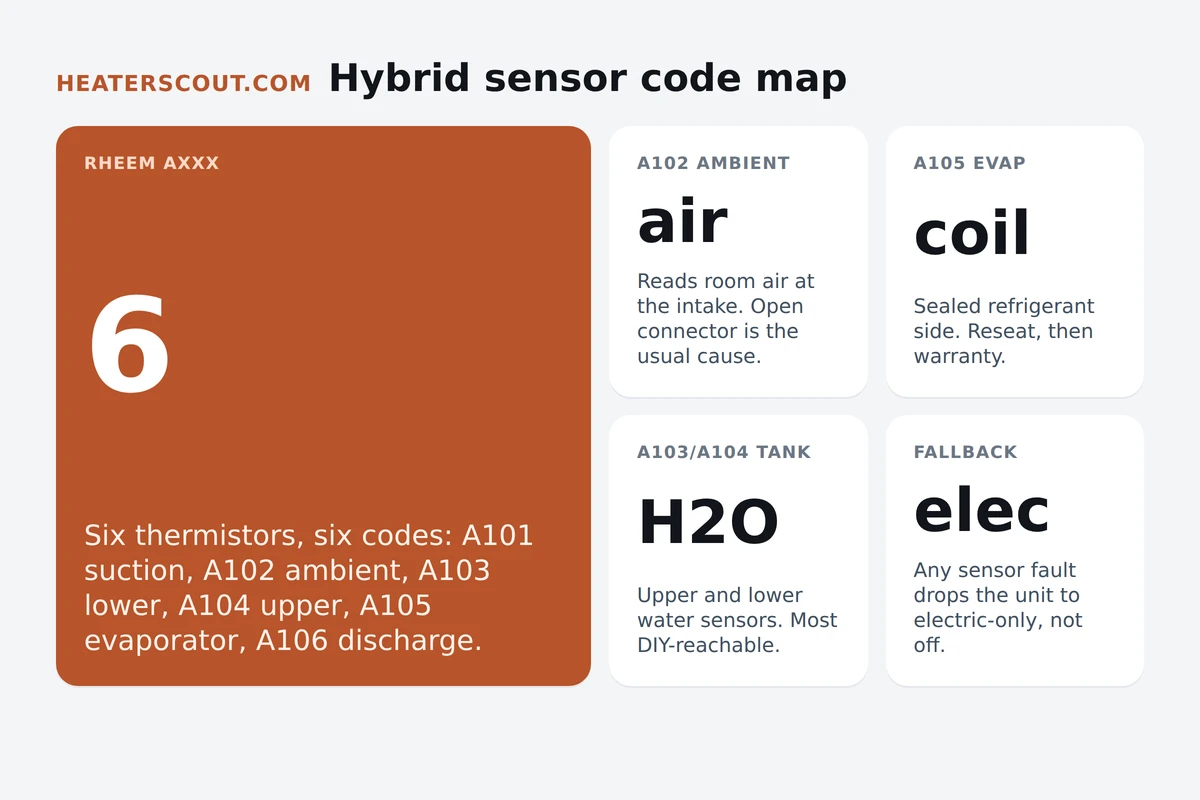
Rheem ProTerra / Performance (A-codes)
- A101 — Suction temp sensor failure (sealed side, pro)
- A102 — Ambient temp sensor failure (room air intake)
- A103 — Lower tank heater temp sensor failure
- A104 — Upper tank heater temp sensor failure
- A105 — Evaporator temp sensor failure (coil, sealed side)
- A106 — Discharge temp sensor failure (sealed side, pro)
A.O. Smith Voltex + Bradford White AeroTherm
- Voltex: Ambient / Upper / Lower / Discharge / Coil 'Temp Sensor Short or Open or AD Error'
- Voltex manual action: call a qualified tech to service
- AeroTherm T2 — tank / water temperature thermistor
- AeroTherm T3a / T3b / T5 — evaporator and coil sensors
- AeroTherm T4 — ambient / air sensor
- AeroTherm: service mode shows each sensor's live temp
A word of caution on exact wording. These codes are current for 2026 model lines, but Rheem in particular has shipped several control-board generations, and the letter-number scheme and even which sensor a code names can shift with firmware. Always confirm the code you see against the chart printed in your own unit's Use and Care manual or on the label inside the top cover. If a generic table and your manual disagree, the manual for the appliance in front of you wins.
Reseat before you replace
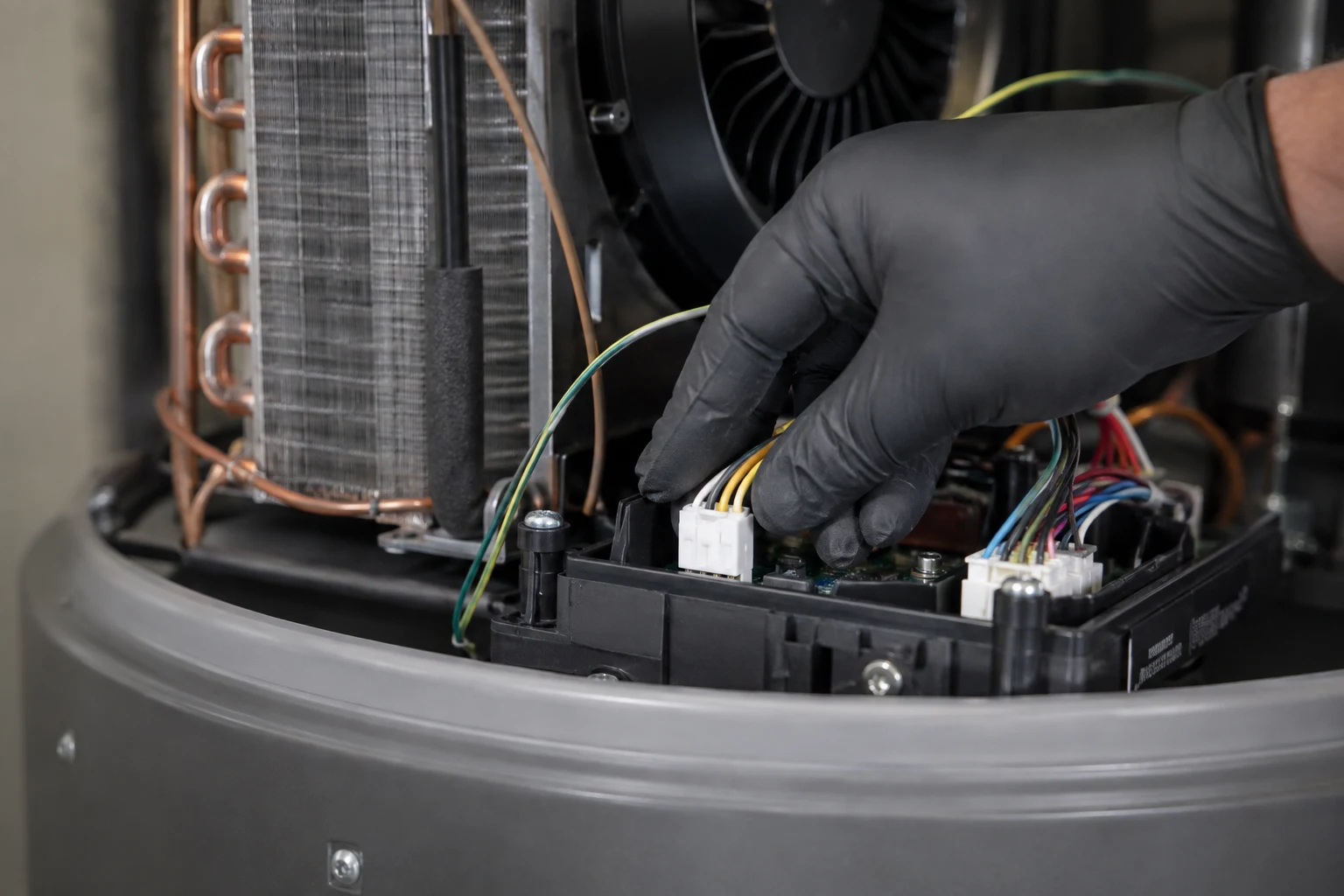
The most common cause of a sensor code across all three brands is not a failed thermistor. It is a connector that is loose, was never fully seated at the factory, or worked apart from vibration and thermal cycling. Sensors get a slim two-wire plug into the control board, and those plugs are easy to knock half-off during any prior service. So the diagnosis order is always the same: reseat first, meter second, replace third.
Reseat path (start here, free)
- Kill power at the breaker and confirm it is off
- Remove the top cover / electrical bay panel
- Find the sensor named by the code and trace its wire to the board
- Unplug it, look for corrosion or spread pins, plug it back firmly
- Restore power, let the board re-read, watch if the code clears
Replace path (if reseat fails)
- Power off, unplug the suspect sensor
- Meter the thermistor: ~10,000 ohms at room temp is healthy
- OL / infinite = open sensor; near zero = shorted sensor
- Order the matching sensor or harness by model number
- Sealed-side sensor? Stop and call warranty / a pro
Quick answer
A hybrid water heater sensor code names one temperature thermistor and means the control board got a bad reading from it, so the unit switched to electric-element heating and kept making hot water. Reseat that sensor's connector with the power off first. If the code returns, meter the thermistor: about 10,000 ohms at 77 degrees is healthy, while an infinite or near-zero reading means replace it. Tank and ambient sensors are DIY-reachable; suction, discharge, and evaporator sensors sit on the sealed refrigerant loop and are pro or warranty work.
Testing the thermistor without guessing
The multimeter test is what separates a real sensor failure from a wiring problem, and it takes two minutes. With the power off and the sensor unplugged from the board, set the meter to ohms on the 20k or auto range and touch both sensor pins. These are negative-temperature-coefficient parts, which is the key to reading them: resistance goes down as they get warmer. At a normal room temperature near 77 degrees a 10k thermistor sits close to 10,000 ohms. Cup the sensor tip in your hand and the number should fall as it picks up your body heat. If it does, the sensor is alive and your fault is in the plug or the board. If it reads OL and never moves, the element inside is open and the sensor is dead. If it reads near zero, it is shorted. Both dead states get a new sensor.
Bradford White makes this easier than a bare meter. The AeroTherm control has a service mode that displays each thermistor's live temperature, T2 through T5, so you can see at a glance which sensor is reporting something impossible, like a coil at 200 degrees or a room at minus 40, and go straight to that one. When a sensor reads a plausible temperature in service mode but the unit still flags a fault, suspect the wiring path between the sensor and the board rather than the sensor.
Where the DIY line really sits
Location decides difficulty far more than brand does. The ambient sensor and the upper and lower tank sensors sit in the dry electrical bay under the top cover. Reseating their connectors or swapping a thermistor is reasonable homeowner work with the power off. The suction, discharge, and evaporator or coil sensors are a different story. They are strapped or bonded onto the sealed refrigerant system, and while you can still reseat their connectors, replacing one can mean touching the sealed loop, which is licensed EPA refrigerant work. That is exactly why A.O. Smith's Voltex manual tells you to call a qualified person for its sensor faults rather than walking you through a swap.
This is also where warranty pays off. Rheem, A.O. Smith, and Bradford White hybrids carry long tank and heat-pump coverage, and sealed-system parts are frequently covered even when labor is not. Before you spend on a refrigerant-side sensor or a control board, pull the model and serial off the rating label and check coverage. A covered evaporator sensor turns a service call into labor only, and it keeps an unqualified hand out of a sealed system that is expensive to get wrong. Read the code, name the sensor, reseat it, meter it, and only then decide whether the next call is to the parts counter or to warranty.
Frequently asked
What does an A102 code mean on my Rheem hybrid water heater?
A102 is an ambient temperature sensor fault. That thermistor sits near the air intake and tells the control board how warm the room is, which is how the heat pump decides whether it can pull heat from the air efficiently. When the board sees an out-of-range reading or an open circuit, it flags A102 and switches the unit to electric-element heating so you still get hot water. The most common cause is not a dead sensor at all, it is the connector working loose or never being fully seated at the top-deck wiring, so the first move is to kill power, pull the top cover, find the ambient sensor plug, and reseat it firmly. If the code clears, you are done. If it comes back, meter the thermistor: a healthy 10k sensor reads about 10,000 ohms at room temperature. An infinite or zero reading means the sensor is bad and gets replaced.
Can I reset a sensor fault code myself?
Usually yes, and it costs nothing to try. Cut power at the breaker for two to three minutes, then restore it, which forces the control board to re-read every sensor on startup. If the fault was a one-time glitch or a connector that was marginal, the code clears and the heat pump comes back. What a power cycle does not do is fix a genuinely failed thermistor or a truly loose plug. If the same code returns within a day, the sensor or its connection is the real problem, and resetting on a loop just keeps the unit running on electric elements at higher cost. Reset once to confirm a repair worked, not as the repair. On Bradford White AeroTherm units the service menu lets you watch each sensor's live temperature, which is a better clue than blind resetting.
Will my water heater still make hot water with a sensor fault?
In almost every case, yes. Hybrid heat pump water heaters are built to fall back to their electric resistance elements when the heat pump can't be trusted, and a bad temperature sensor is exactly that situation. The board shuts down the compressor and fan, throws the sensor code, and runs the same upper and lower elements a plain electric tank uses. You keep hot water, you just lose the efficiency, because elements draw roughly three times the electricity per gallon that the heat pump does. That is why a sensor fault feels invisible until the power bill jumps. If you have no hot water at all, the problem is something else, a tripped element ECO, a blown breaker, or a wiring fault, not a lone sensor.
How do I test a heat pump water heater temperature sensor with a multimeter?
Cut power first, always, then unplug the sensor from the control board so you are reading the thermistor alone. Set a multimeter to ohms, the 20k or auto range. Touch the probes to the two sensor pins. A typical 10k NTC thermistor reads close to 10,000 ohms at 77 degrees, and the number drops as the sensor warms because these are negative-coefficient parts. Warm the tip in your hand and you should watch the resistance fall. A reading of OL or infinite means the sensor is open and dead. A reading near zero means it is shorted. Either extreme means replace it. A stable, sensible reading that tracks temperature means the sensor is fine and your fault is in the wiring or the board. Compare against the resistance-versus-temperature chart in your unit's service literature for the exact numbers.
Which sensor faults are DIY and which need a pro?
Split them by where the sensor lives. The tank sensors, upper and lower on Rheem, T2 on Bradford White, and the ambient air sensor, sit in the dry electrical bay under the top cover. Reseating those connectors or swapping the thermistor is homeowner work if you are comfortable pulling a cover with the power off. The refrigerant-side sensors, suction, discharge, and evaporator or coil, are strapped onto the sealed heat pump system. You can still reseat their connectors, but the sensor itself is bonded into the sealed loop, and A.O. Smith's own manual tells you to call a qualified tech for those. Anything that turns into opening the refrigerant circuit is licensed EPA work, not DIY, and it is where the sealed-system warranty matters most.
Why does the same sensor code keep coming back after I reset it?
A code that returns is telling you the fault is real and not a glitch. Three things cause a repeat. First, a connector that looks seated but has a corroded or spread pin, so it makes contact when you push it and loses it with vibration, reseat it hard and inspect the pins. Second, a thermistor that has actually drifted or failed, which the multimeter test will show as an out-of-range or open reading. Third, and less often, a control board input that is damaged, which you confirm by proving the sensor reads correctly at the plug but the board still flags it. Chase them in that order, cheapest first. Repeated resetting without fixing the cause just leaves the unit stuck on electric elements.
How much does it cost to fix a hybrid water heater sensor?
The sensor itself is cheap. A replacement thermistor or a sensor harness for a Rheem, A.O. Smith, or Bradford White hybrid typically runs from about 20 to 80 dollars as a part. If the connector was just loose, the fix is free. Where cost climbs is labor and access. A tank or ambient sensor a homeowner reaches is a short job. A refrigerant-side sensor that a licensed tech has to reach, or a control board replacement if the board input is the real fault, pushes a service call into the 150 to 400 dollar range with labor. Before paying for parts, check the warranty against the rating label, because these units carry long tank and heat-pump coverage, and sealed-system parts are often covered even when labor is not.