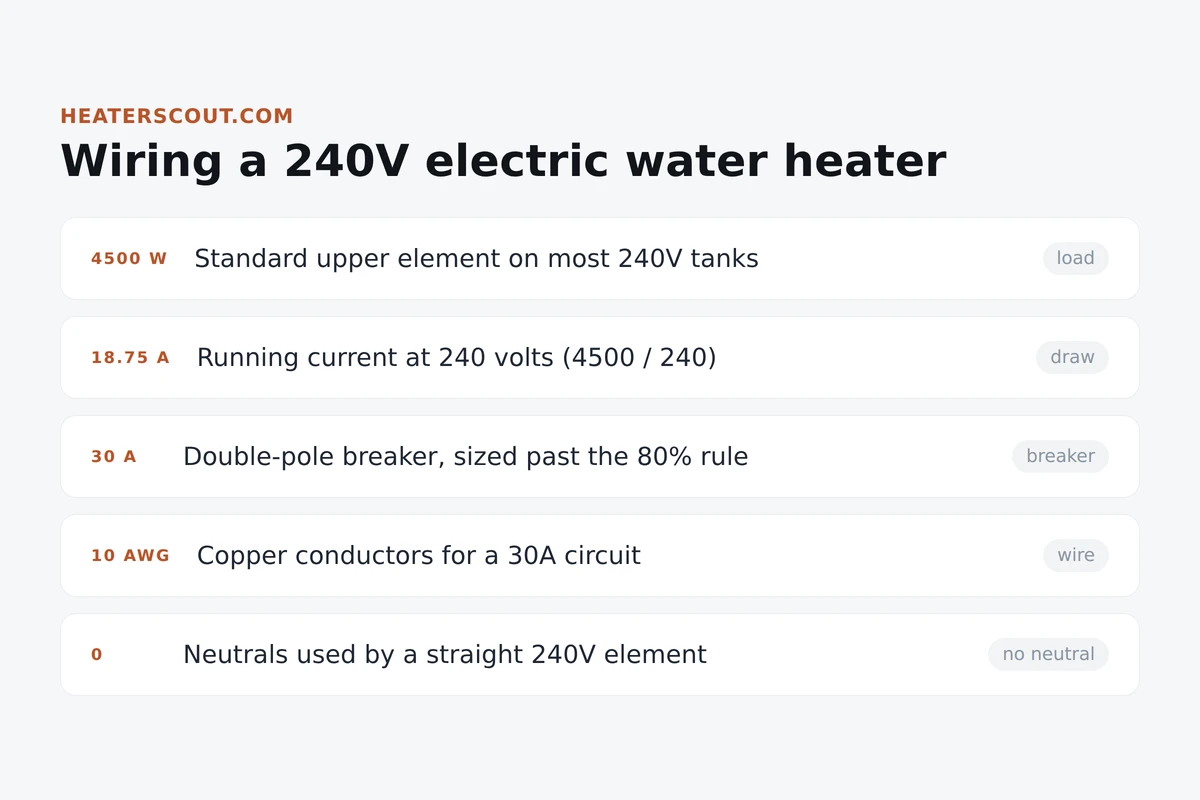
A 4500-watt element on a 240-volt circuit pulls 18.75 amps, and that one number decides almost everything else about the wiring: the breaker, the conductor size, whether you need a neutral, and how close the disconnect has to sit. Get the amperage math right and the rest of the job is landing three wires in a box on top of the tank. Get it wrong and you are looking at nuisance trips, cooked insulation, or a heater that dry-fires an element the first time you refill it. This is 240-volt work in a wet room, so read the rating plate, pull the breaker, and test dead before you touch a lead.
Before you open a single knockout
Wiring a water heater is not the place to improvise. The load is continuous, the voltage is 240, and the box sits in a damp utility closet where a loose ground matters. Everything below assumes the circuit is off at the panel and you have verified it dead with a meter at the heater leads, not just flipped a breaker you think is the right one. Line these up first, because a half-wired heater with the panel open is not a state you want to walk away from.
- The rating plate read and photographed. Note the wattage of each element and the voltage. A 4500W/240V element draws 18.75 amps and sets your breaker and wire size.
- The correct breaker on hand: a 30-amp DOUBLE-pole (two-pole) breaker for a standard 4500-watt tank, matched to your panel brand. Two single-pole breakers with a handle tie is not the same thing.
- 10 AWG copper conductors, or 10/2 with ground cable if you are pulling NM. Never aluminum on a water heater without listed connectors and anti-oxidant, and never a size smaller than the breaker allows.
- A flexible whip or listed cable clamp for the top knockout, plus wire nuts rated for the conductor size and heat.
- A non-contact tester and a multimeter to confirm the circuit is dead at the leads before you strip anything.
- A local disconnect if the panel is not within sight of the heater. NEC 422.31(B) wants a means to kill power within sight, not more than 50 feet away.
- Black or red tape to re-identify a white conductor as a hot leg at both ends if you run 10/2 cable.
- Your local code and permit sorted. Water heater electrical is inspected in most jurisdictions, and this is a call-a-pro job if any of the above is unfamiliar.
Breaker and wire by element wattage
The whole table below comes from one rule. A water heater is a continuous load, so NEC 422.13 treats the branch circuit as continuous: the running current cannot exceed 80 percent of the breaker, which is the same as saying the circuit is rated at 125 percent of the load. Take the element wattage, divide by 240 to get amps, multiply by 1.25, and round the breaker up to the next standard size. Then match the copper to that breaker. A 4500-watt element is 18.75 amps, times 1.25 is 23.4 amps, rounded up to a 30-amp breaker on 10 AWG. Here is how the common element sizes land.
| Element | Running amps (W / 240) | 125% for sizing | Breaker (double-pole) | Copper wire |
|---|---|---|---|---|
| 3800 W | 15.8 A | 19.8 A | 20 A | 12 AWG |
| 4500 W | 18.75 A | 23.4 A | 30 A | 10 AWG |
| 5500 W | 22.9 A | 28.6 A | 30 A | 10 AWG |
| 5500 W (simultaneous, rare) | 45.8 A (both fire) | 57.3 A | 60 A | 6 AWG |
Two things about that table. First, the 4500-watt row is the default on nearly every Rheem and A.O. Smith residential tank you will meet, so 30 amps and 10 AWG is the answer you reach for unless the plate says otherwise. Second, the last row is the exception that proves the rule. Standard dual-element tanks are non-simultaneous, so only one element ever fires and you size for one element. A simultaneous tank runs both at once, doubles the load, and needs a 60-amp circuit on 6 AWG. Those are uncommon in homes, and the rating plate calls it out in plain language, so you are not left guessing.
Why there is no neutral, and where the ground lands
The single biggest point of confusion on a 240-volt heater is the missing white wire. People expect three current-carrying conductors plus a ground because that is what a dryer or a range uses. A straight resistance-element water heater is simpler than that. The element is a load wired across two hot legs, and it never touches a neutral.
Straight 240V (two-hot, no-neutral) wiring
A resistance heating element connected across L1 and L2, the two hot legs of a 240-volt circuit. Each leg is 120 volts to ground and 240 volts to the other leg. Both legs carry current and both are hot; the element has no connection to the grounded neutral conductor, so a standard element heater needs only two hots and an equipment ground. A neutral shows up only on hybrid heat-pump units or models with a 120-volt control board, which the rating plate will state. Compare this with a double-pole breaker, the two-handle breaker that switches both hot legs at once so the element is fully de-energized when it trips or is turned off.
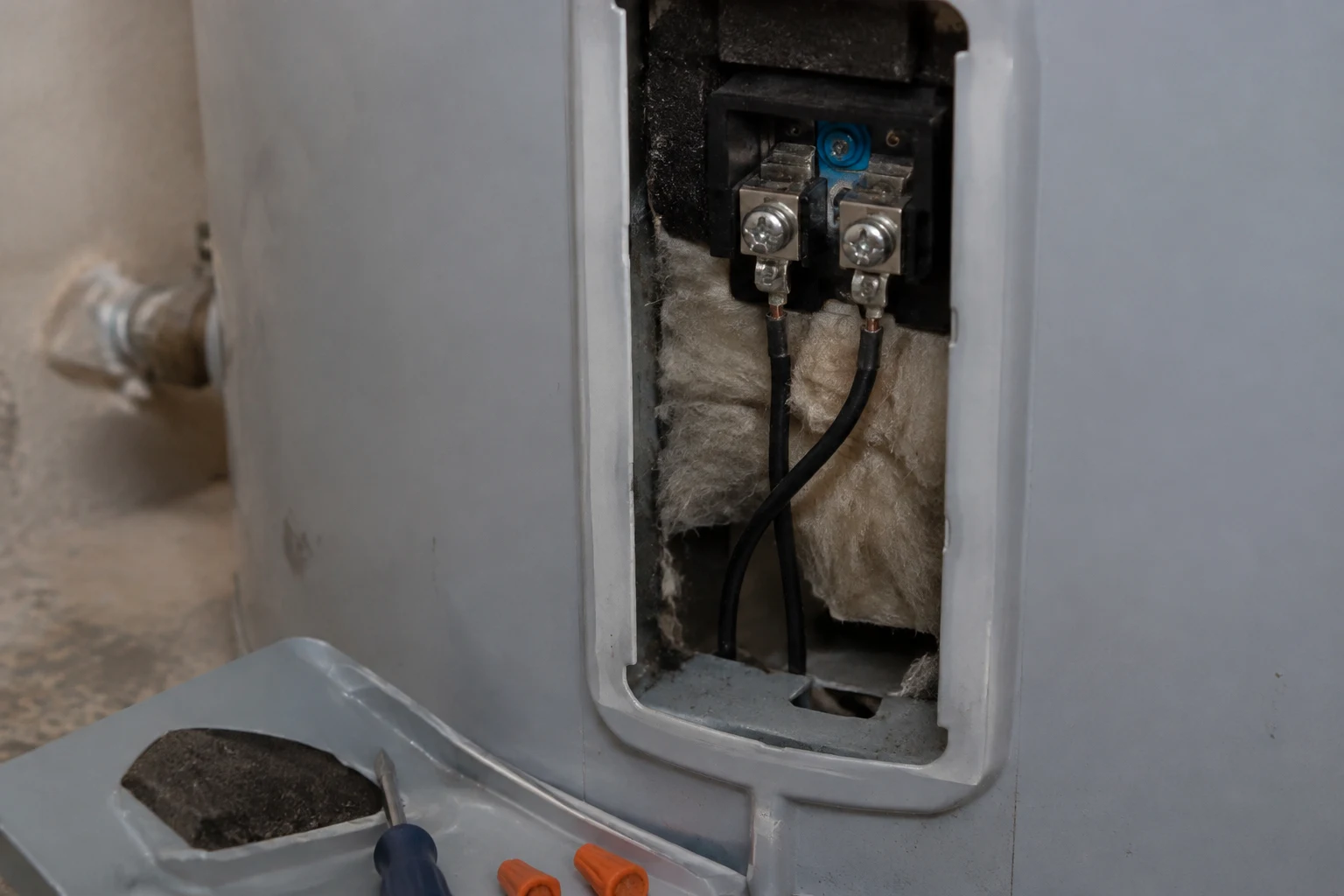
So inside the top junction box you are landing three conductors, not four. The two hots, typically black and red, connect to the two heater leads with wire nuts. Polarity does not matter across a resistance element, so either hot can land on either lead. The bare or green equipment ground goes under the green grounding screw, bonding the tank and box to the panel ground so a fault trips the breaker instead of energizing the tank shell. If you pulled 10/2 cable, the white conductor becomes your second hot leg, and you re-identify it with a wrap of black or red tape at both ends so the next person does not read it as a neutral. The whole connection is fed through a flexible whip or a clamped cable into the threaded knockout on top, with a little slack left so the elements can be pulled for service without fighting the wire.
Dual-element tanks add one wrinkle inside the tank, but it does not change the feed. The upper thermostat takes the incoming power first, runs the upper element until the top of the tank is hot, then hands power down to the lower thermostat and lower element. Because they are non-simultaneous, the two elements never draw at the same time, and the branch circuit still only ever sees one 4500-watt load. Your wiring to the box is identical whether the tank is single or dual element.
Wiring faults and the symptom each one shows
Most water heater electrical problems are not mysterious. They are one of a handful of wiring mistakes, and each throws a specific symptom. If you just wired a heater and something is off, walk this list before you blame the tank.
Hot leg and ground reversed, or a hot on the ground screw
A hot conductor landed on the green grounding screw instead of a heater lead energizes the tank shell and the ground system. Symptom: the breaker trips instantly on power-up, or worse, you get a shock off the tank or nearby metal and the breaker holds. Kill power immediately, confirm the two hots go to the two heater leads and the ground goes only to the green screw.
No equipment ground, or ground not bonded
The ground was left off, cut short, or never landed under the green screw. Symptom: the heater runs fine, so nothing looks wrong, right up until an element shorts to the tank. Then instead of tripping the breaker, the fault sits on the tank shell waiting to shock someone. This is the quiet, dangerous one. There must be a continuous bonded ground back to the panel.
Undersized wire or breaker
10 AWG on a 30-amp circuit is the floor for a 4500-watt element. Symptom of undersized conductor: the cable and the connections run hot, insulation smells or discolors, and terminations loosen over time. Symptom of an undersized breaker, like a 20-amp on an 18.75-amp load: nuisance trips, usually when the cold tank calls for a long heating cycle. Fix by matching the breaker and wire to the load.
Loose wire nut or terminal
A connection that is not tight enough arcs and heats under the 18.75-amp load. Symptom: intermittent heating, a heater that works then quits, scorched or melted wire nuts, and sometimes a faint burning smell at the top box. Re-strip, re-land, and torque every connection; heat cycling loosens marginal connections that tested fine cold.
Single-pole breaker or only one hot leg live
The heater is fed 120 volts instead of 240 because one leg is dead, a single-pole breaker was used, or a hot came loose. Symptom: the water gets barely warm or heats painfully slowly, since the element sees a quarter of its rated power at half voltage. Confirm 240 volts leg-to-leg and a true double-pole breaker feeding both hots.
Notice that two of these faults, the missing ground and the loose connection, do not stop the heater from making hot water. That is exactly why a water heater is a call-a-pro job when any part of the wiring is unfamiliar. A tank that heats fine can still be sitting on an ungrounded fault or a connection that is slowly cooking itself, and neither shows up until it fails in a way you do not want to be standing next to.
Frequently asked
What size breaker and wire does a 4500-watt electric water heater need?
A 30-amp double-pole breaker fed with 10 AWG copper. Here is the math the code makes you do. A 4500-watt element on a 240-volt circuit draws 4500 divided by 240, which is 18.75 amps. A water heater is a continuous load, so NEC 422.13 and 210.19 say the branch circuit must be rated at 125 percent of that, or looked at the other way, the running load cannot exceed 80 percent of the breaker. Eighteen point seventy-five amps at 125 percent is 23.4 amps, so you round up to the next standard breaker, which is 30 amps. A 30-amp circuit calls for 10 AWG copper. Do not fit a 20-amp breaker to save a wire size; 18.75 amps is already 94 percent of a 20-amp breaker, well over the 80 percent ceiling, and it will nuisance-trip or overheat.
Does an electric water heater need a neutral wire?
A straight 240-volt element heater does not. The element is a simple resistance load wired across two hot legs, L1 and L2, each 120 volts to ground and 240 volts to each other. Both legs are hot, both are current-carrying, and the element does not reference the neutral at all, so there is no white wire landing on it. What the heater does need is an equipment grounding conductor, the bare or green wire, bonded to the green ground screw in the junction box. So a typical feed is two hots and a ground, often run as 10/2 with ground cable where the white conductor is re-identified as a hot leg with black or red tape at both ends. The exception is a heat-pump hybrid or a unit with a 120-volt control board or electronics, which may bring a neutral for the low-voltage side. Read the rating plate.
Which wires are hot and where does the ground go?
Inside the top junction box you land three conductors. The two hot legs, usually black and red, connect to the two heater leads with wire nuts; polarity does not matter between L1 and L2 on a 240-volt resistance element, so either hot can go to either lead. The equipment ground, bare copper or green, lands under the green grounding screw on the bracket or tank, never on a heater lead. If you pulled 10/2 cable where the second conductor is white, re-identify it as a hot with black or red tape at both ends so nobody mistakes it for a neutral later.
What is a non-simultaneous dual-element water heater and why does it matter for wiring?
Most residential tanks have two 4500-watt elements, upper and lower, but they are wired non-simultaneously, meaning only one fires at a time. The upper thermostat runs the show. On a cold tank it powers the upper element until the top is hot, then hands power down to the lower thermostat and lower element for the rest of the tank. Because they never run together, the peak load is one 4500-watt element, 18.75 amps, not two. That is why a 9000-watt nameplate still sits happily on a 30-amp, 10 AWG circuit. Simultaneous-operation tanks, where both elements can run at once and the load doubles, are rare in homes and the rating plate calls them out plainly.
Do I need a disconnect for an electric water heater?
You need a way to disconnect and lock out the circuit that is within sight of the water heater, per NEC 422.31(B) for appliances rated over 300 volt-amps. On most installs the breaker itself satisfies this only if it is within sight, meaning visible and not more than 50 feet away. If the panel is around a corner, in another room, or in a finished basement away from the utility closet, you install a local disconnect: a small non-fused pull-out or a lockable breaker-lockout at the panel. The point is that anyone servicing the elements can positively kill power and see that it stays off. This is not optional and it is a common inspection failure on DIY jobs.
Can I use 12 AWG or a 20-amp breaker if my heater is smaller?
Only if the math works out, and it rarely does on a full-size tank. 12 AWG copper is good for a 20-amp circuit. A 20-amp breaker at 80 percent allows 16 amps of continuous load. A 3800-watt element at 240 volts draws about 15.8 amps, which just squeaks under 16, so a small 3800-watt tank can legitimately run on a 20-amp, 12 AWG circuit. But the common 4500-watt element draws 18.75 amps, over the 16-amp ceiling, so it must be on 30-amp, 10 AWG. When in doubt, size to the largest element on the rating plate, do the 125 percent calculation, and round the breaker up to the next standard size. Undersizing to save on wire is how insulation cooks and breakers nuisance-trip.
Should I hard-wire the heater or use a flexible whip?
Both are code-compliant; the flexible whip is what most installers reach for. A whip is a short length of flexible conduit, often 18 to 24 inches, run from a junction box or the local disconnect into the threaded knockout on top of the tank. It absorbs thermal movement and lets you disconnect the tank without cutting cable. Hard-wired NM straight into the top box is fine too where local code allows, with a proper cable clamp at the knockout. Either way the conductors land in the top junction box, the ground bonds to the green screw, and you leave a little slack so the next person can pull the elements without a fight.