Water is spreading across the floor under the tank, or you are walking out the door for two weeks and do not want it heating an empty house. Either way the first move is the same idea done two different ways: stop the heat, and if there is a leak, stop the water. Which control you touch depends on whether the heater is electric or gas.
Quick answer
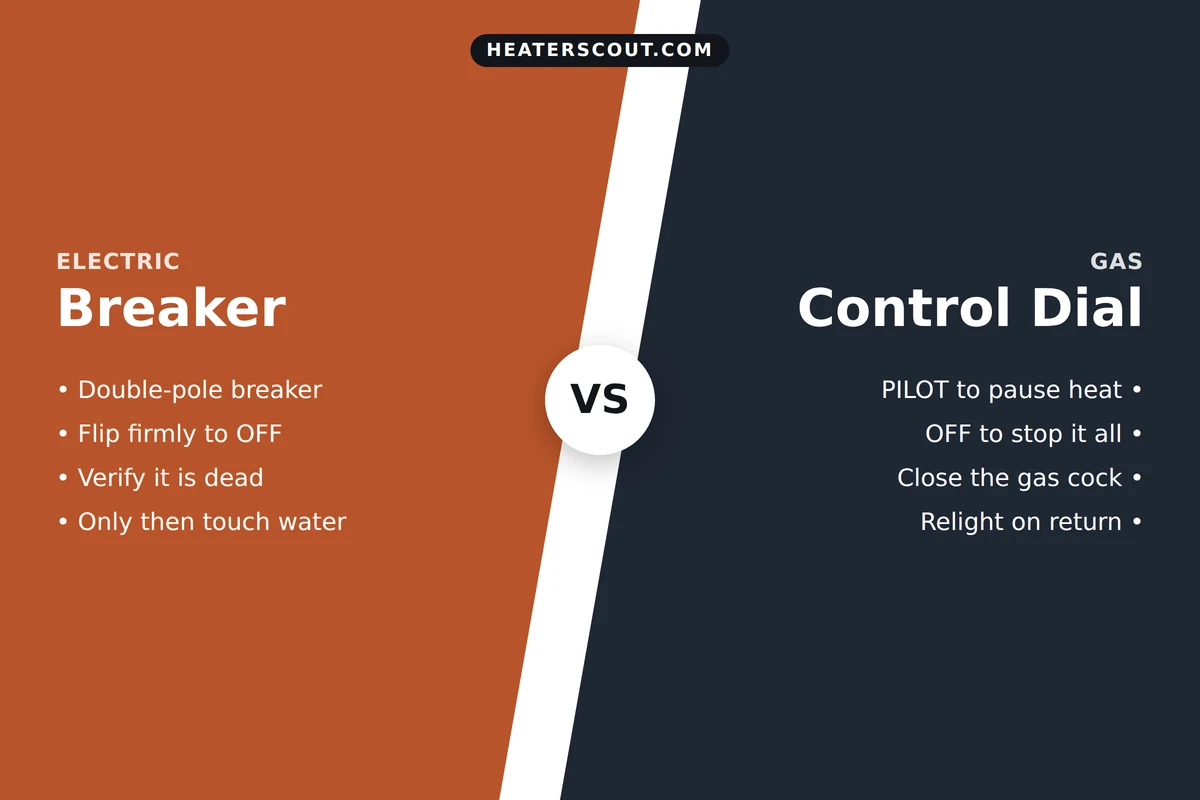
Electric: flip the double-pole (two-slot) breaker labeled water heater to OFF. Gas: turn the control dial on the front from ON to OFF, or to Pilot if you only want to pause heating. If it is leaking, also close the cold-water shutoff valve on the pipe entering the top of the tank.
The two switches nobody separates in their head
Almost every mistake people make shutting off a water heater comes from treating it as one action. It is two. There is the heat source, which is the breaker on an electric tank or the gas control on a gas tank, and there is the water supply, which is the cold-water valve on the pipe feeding the top of the tank. They do completely different things, and the situation you are in decides which ones you touch.
Cutting the heat stops the tank from making the problem worse. Cutting the water stops the tank from refilling. A leaking tank needs both, because you want it to stop heating and stop taking on more water to spill. A vacation needs only the heat off, because there is nothing to spill and you want the tank to stay full so it does not sit dry. A repair usually needs the heat off first, then the water off so you can drain the thing down. Get the order right and nothing dramatic happens. Get it wrong and you either flood a room or cook an element.
Dry-fire kills electric elements
Never leave an electric element powered while the tank is drained or air has gotten into it. An exposed element dry-fires and burns out in seconds. Power off first, drain second, always.
That dry-fire warning is worth sitting with for a second, because it is the single most expensive slip in this whole job. An electric element is a metal rod that glows hot only because water is pulling heat away from it. Drop the water level below the element while the breaker is still on and the rod has nowhere to send its heat. It overheats and fails in under a minute, sometimes with a pop. That is why every drain-down sequence in this guide starts with the breaker, not the hose. On a gas tank the burner sits underneath the tank rather than inside the water, so it is more forgiving, but the habit of heat-off-first is the same one that keeps you out of trouble on both.
Which control for which problem
Shutting a heater down is really two separate switches: the heat source and the water supply. You rarely need both. This is what to touch for the situation you are actually in.
| Situation | Heat source | Cold-water inlet |
|---|---|---|
| Tank leaking onto the floor | Off | Close it |
| Vacation, 1 to 3 weeks | Pilot or breaker off | Leave open |
| Replacing element or thermostat | Breaker off | Close it, then drain |
| Replacing a gas valve or anode | Off, then gas valve | Close it, then drain |
| Smell of gas near the unit | Gas valve at the wall | Leave, ventilate, call the gas company |
Electric water heater, step by step
An electric tank has no dial and no flame. All of its power comes through one circuit, so the whole shutdown lives in the breaker panel. The catch is that a water heater runs on 240 volts through a double-pole breaker, and a single flick is not always a clean off. Push it firmly and confirm with a tester rather than trusting the position of the switch.
If your panel is a mess of unlabeled breakers, there is a quick way to find the right one. Have someone watch the tank while you flip candidates, or listen for the faint tick of the thermostat dropping out. When in doubt, the water heater is almost always one of the few double-pole 30-amp breakers, sharing that description only with the range and the dryer, both of which are easy to rule out. Once you have found it, write on the panel door in pencil so you never hunt for it again.
Gas water heater, step by step
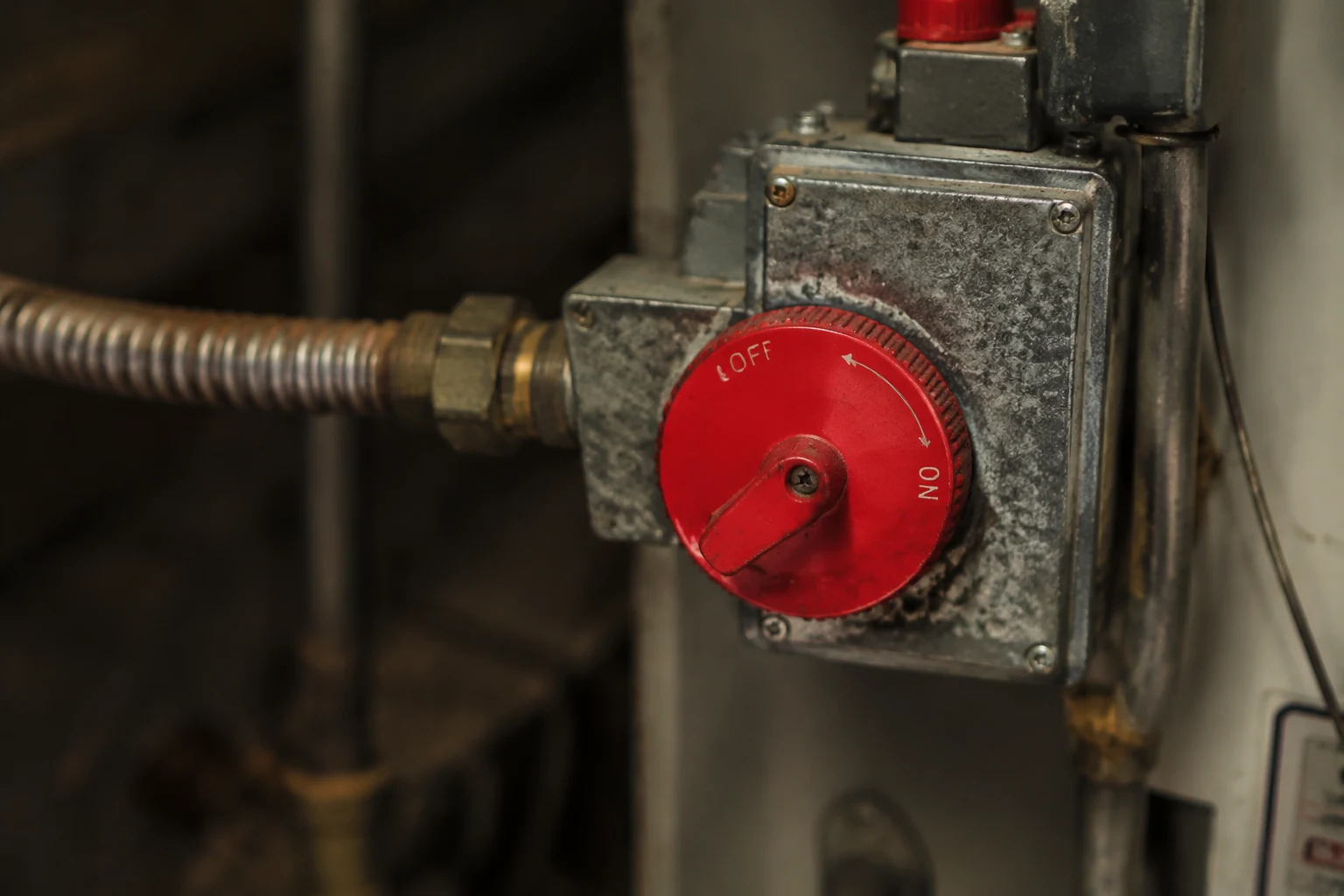
A gas tank gives you a middle setting an electric one does not: Pilot. That single extra position is the reason gas shutdowns are usually gentler. You can stop the tank heating without killing the pilot flame, which means no relight dance when you come home. Save the full Off for leaks and real repair work, where you want everything dead.
Newer gas heaters have swapped the old knob for a sealed electronic control with a little status light and a piezo igniter button, but the logic is identical. The dial still reads ON, PILOT, and OFF, and the same rule holds: Pilot to pause, Off to stop everything. On these units the pilot is lit by pressing and holding the button while you click the igniter, so if you turn all the way to Off you are signing up for that little sequence when you return. That is the whole case for leaving it on Pilot whenever you safely can.
The leak that will not wait
Every rule above assumes you have a minute to think. A tank actively pouring water onto the floor does not give you that minute, so it gets its own drill. The order flips: water first, because that is what is doing the damage, then heat, because the tank is now going to sit still while you deal with the mess.
Reach for the cold-water inlet valve on top of the tank and close it fully. If that valve is seized or missing, go one level up to the main shutoff for the house, usually near where the water line enters or by the meter. With the supply cut, the tank can only leak the water already inside it, and the flood stops getting worse. Then cut the heat the normal way, breaker for electric or dial to Off for gas, so the heater is not trying to warm a tank that is emptying itself. Only after both are done do you worry about mopping up, moving boxes off the floor, or figuring out whether the leak is the drain valve, a fitting, or the tank itself rusting through.
Vacation: off or just down?
Leaving town raises a question people overthink. Should the water heater be fully off, or is there a smarter middle setting? For a normal trip of a week or two, you do not want it fully off and you certainly do not want it drained. You want it idling.
On a gas tank that idle is the Pilot position, which stops the burner from cycling but keeps the pilot lit so the tank is ready to fire the moment you turn it back to ON. On an electric tank there is no idle, so you simply flip the breaker off; the tank sits full and cold, which is completely fine. Many modern heaters also have a dedicated Vacation mode, marked VAC on the dial or in the app, that holds the water at a low temperature around 50 to 60 degrees rather than a full 120. That is enough to keep the tank from freezing or growing anything, while spending almost no energy.
The one time you go further and actually drain the tank is when the house will sit unheated in freezing weather for a long stretch. A full tank in a below-freezing house can freeze, expand, and split. In that case you cut the heat, close the cold inlet, and drain the tank down completely so there is no water left to freeze. For any trip where the house stays above freezing, draining is more work and more wear than it is worth.
Before you walk away, and when you come back
A quick pass now saves a cold shower or a scorched element later. Run down this list before you leave the tank, and again in reverse when you bring it back to life.
- Heat source is off or on Pilot, and you noted the original setting.
- Cold-water inlet is closed only if there is a leak or a drain planned.
- No hot tap is left running that could keep siphoning the tank.
- On return: restore power or gas before you expect hot water, not after.
- Give it 30 to 60 minutes to recover, then test a hot tap before you trust it.
Coming back from a full Off
If you shut a gas dial fully to OFF, the pilot went out with it. Bringing it back means the relight sequence printed on the tank: dial to Pilot, hold the button, light or press the igniter, keep holding about a minute, then release and turn to ON.
Frequently asked
Should I turn off the water or the power first?
If the tank is leaking, close the cold-water inlet valve first to stop the flood, then cut power or gas. If you are only doing a repair or leaving for vacation, cut power or gas first; the water can stay on.
Do I have to drain the tank when I turn it off for vacation?
No. For a normal trip you leave the tank full and just set a gas dial to Pilot or Vacation, or flip the breaker on an electric unit. Only drain the tank if the house will sit unheated below freezing or you are storing the heater.
What does the Pilot setting do versus Off on a gas water heater?
Pilot keeps the small standing pilot flame burning but stops the main burner, so the tank stops heating without the pilot going out. Off shuts everything including the pilot, so you will have to relight it when you come back.
Can I turn off an electric water heater at the switch instead of the breaker?
Only if it has a dedicated disconnect switch or unplugged cord, which most hardwired 240-volt tanks do not. The reliable cutoff is the double-pole breaker in the panel labeled water heater.
Is it safe to leave the water heater off for weeks?
Yes. A tank sitting cold and full is fine for weeks. On return, restore power or gas, let it come up to temperature for 30 to 60 minutes, and run a hot tap to confirm before you rely on it.
Shut it off but the trouble did not stop?
A tank that keeps leaking after the water is off, or trips its breaker the moment you restore power, has a deeper fault. Browse the electric and gas troubleshooting guides to find it.