Quick answer
A water heater element is a resistor, so you test it with a multimeter on ohms. A healthy element reads a steady number in the low teens: about 12.8 Ω for a 4500W/240V element, 16.5 Ω for 3500W, or 10.5 Ω for 5500W. The math is R = V²/W with the rated 240V. A reading of OL or infinity means the element is burned open. A near-zero reading, or any continuity between a terminal and the tank, means it is shorted or grounded. Cut power at the breaker first — 240V can kill.
What your ohms reading means at a glance
Probe both element terminals and read the needle. A dead-short 0Ω sits far left, a burned-open OL far right, and a healthy element lands in the accent band right of center.
Separate check: any continuity from a terminal to the bare tank means the element is shorted to ground. A good element reads OL to the tank.
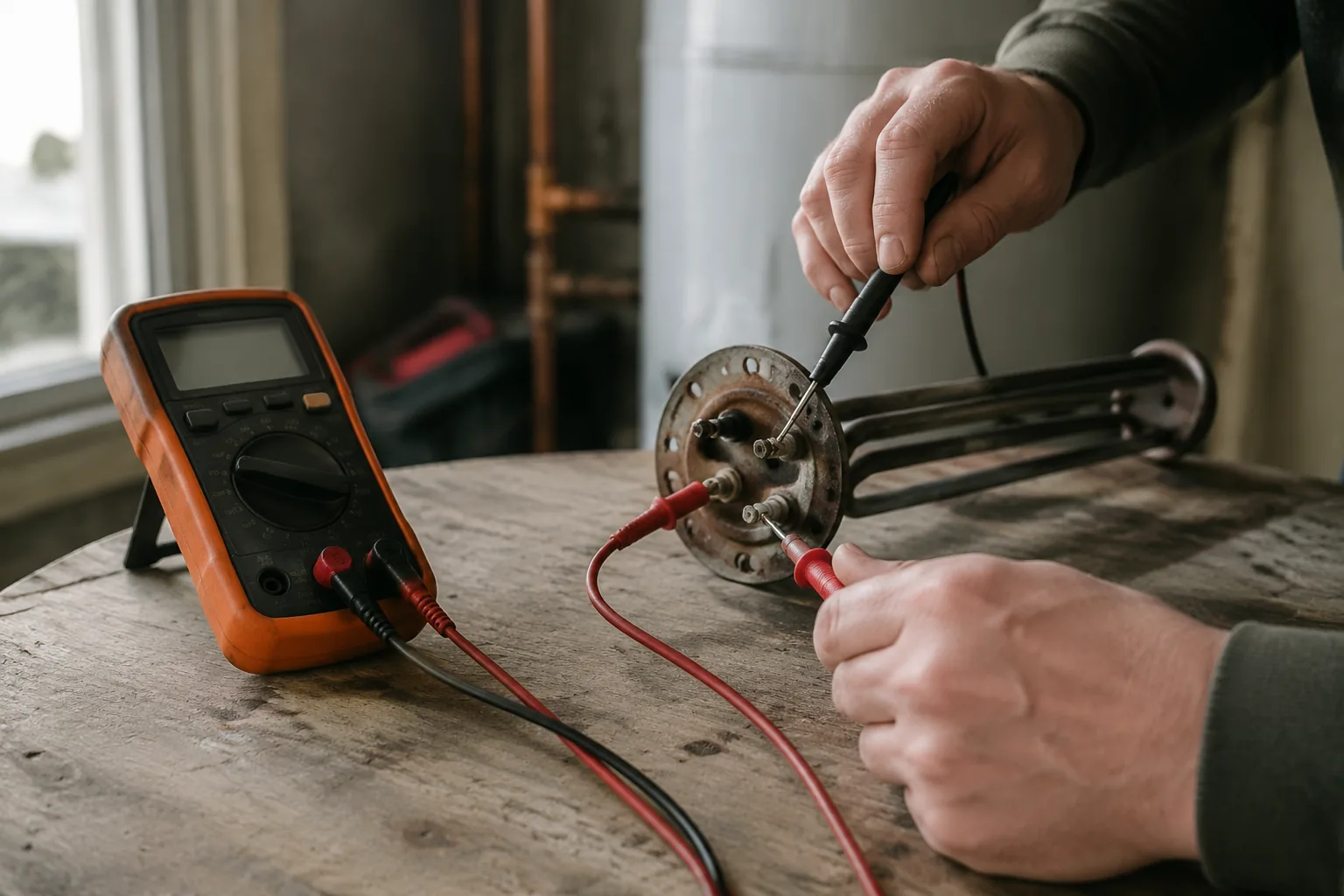
A burned-out heating element is the single most common reason an electric tank runs out of hot water, and it costs about two minutes to prove with a $15 meter. You are not guessing at symptoms. An element either passes current in a tight, predictable range or it does not, and the multimeter tells you which in one reading.
Why an element reads the number it does
A tank heating element is nothing more exotic than a coil of resistance wire sealed in a metal sheath. Feed it 240 volts and it turns electricity into heat. Because it is a plain resistor, its resistance is fixed by its wattage rating, and you can predict it before you ever touch the meter. The relationship is Ohm’s law rearranged for power: R = V²/W. Elements are rated at 240 volts, so you square 240, get 57,600, and divide by the wattage stamped on the element.
Run the three common sizes and you get the numbers every technician carries in their head:
| Element rating | Math (57,600 ÷ W) | Expected resistance |
|---|---|---|
| 3500W / 240V | 57,600 ÷ 3500 | about 16.5 Ω |
| 4500W / 240V | 57,600 ÷ 4500 | about 12.8 Ω |
| 5500W / 240V | 57,600 ÷ 5500 | about 10.5 Ω |
So a healthy element lands somewhere in the rough band of 10 to 16 ohms, tighter once you know the wattage. If your reading sits within about 10 percent of the target for its rating, the element is fine and the fault is elsewhere — usually the thermostat, the reset, or wiring. If the number is wildly off, you found the problem.
Before you touch anything
The wiring behind that access panel carries 240 volts, enough to stop your heart. Turning the tank “off” at a wall switch is not enough. Flip the double-pole breaker in the panel, then confirm zero volts at the element terminals with a tester before a screwdriver goes near them. Do not skip the verification step.
How to test the element, step by step
You need a multimeter (any cheap one with an ohms setting), a screwdriver, and a non-contact or contact voltage tester. Work in this order and do not shortcut the power-off checks.
Kill the 240V breaker
Go to the electrical panel and switch the water heater’s double-pole breaker to OFF. It is a single wide breaker or two tied together; both legs must drop. A wall switch or the thermostat dial does not de-energize the element.
Open the access panel and fold back the insulation
Remove the screws on the metal cover over the element, then peel back the fiberglass insulation and the plastic terminal cover behind it. Most tanks have two elements, upper and lower; test whichever one you suspect, or both.
Verify zero voltage
With your tester, check across the two element screws and from each screw to the tank. It must read zero. If you see any voltage, the breaker did not kill this circuit. Stop and find the right breaker.
Disconnect at least one element wire
Loosen the screw and lift one of the two wires off the element terminal. This isolates the element so the meter reads the element alone, not the rest of the circuit feeding back through it.
Set the meter to the lowest ohms range and zero the leads
Turn the dial to ohms (the Ω symbol), on the lowest range, around 200 on a manual meter. Touch the two probe tips together first: a good meter reads close to 0. That confirms the meter and tells you your own lead resistance to subtract.
Read across both element terminals
Press one probe to each of the two element screws. A healthy element shows a steady low number matching its wattage from the table, typically 10 to 16 ohms. Compare it to the expected value from the calculator below.
Check for a ground short to the tank
Leave the meter on ohms. Touch one probe to either element terminal and the other to bare metal on the tank or a mounting bolt. A good element reads OL or infinity here. Any number at all means the element is grounded and must be replaced.
Interpret the readings
Low teens across the terminals and OL to the tank means the element is good. OL across the terminals means it is burned open. Near zero across the terminals, or continuity to the tank, means it is shorted or grounded. Reconnect the wire and reinstall the panel once you have your answer.
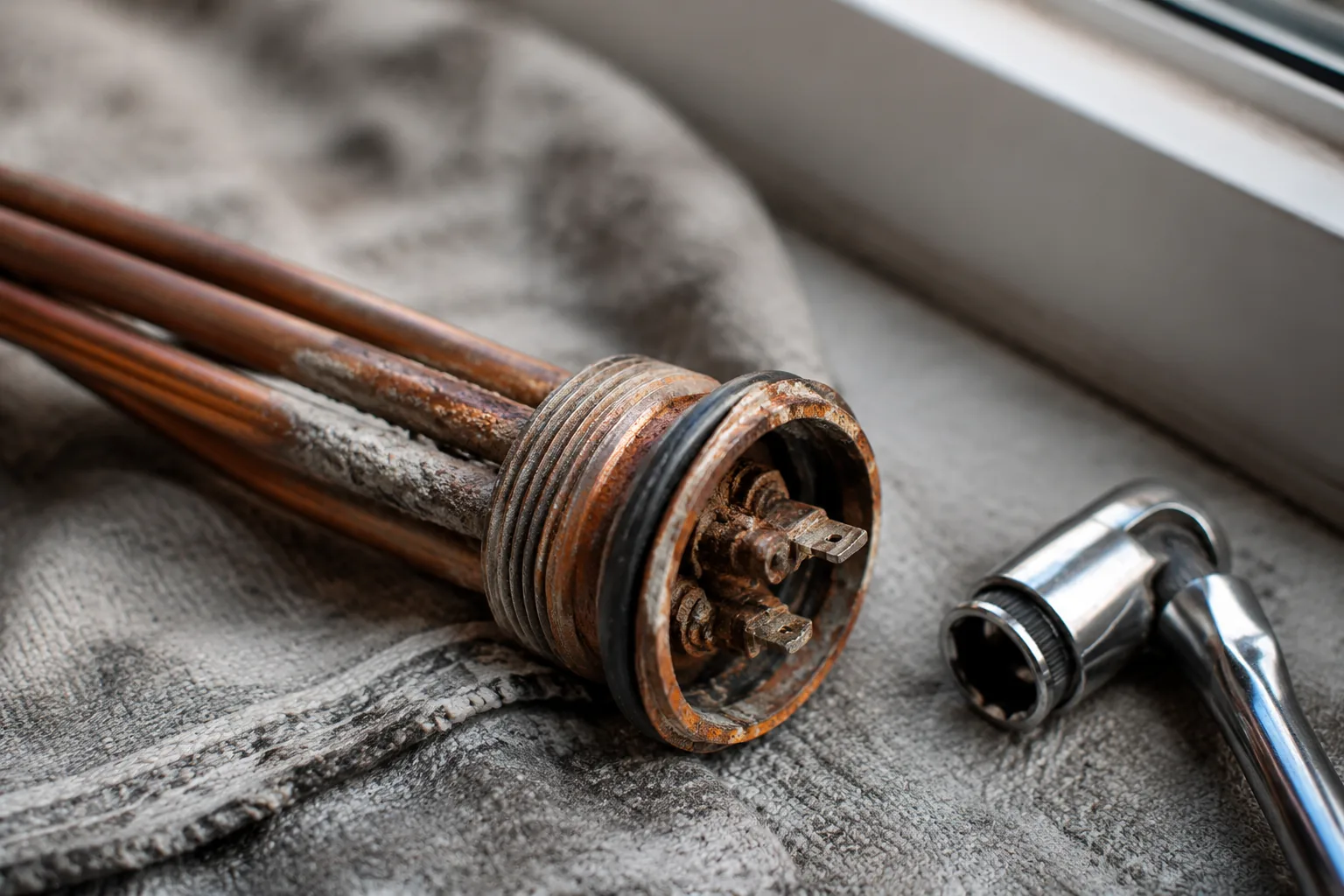
What each reading actually means
Three outcomes, three verdicts. Learn these and the meter stops being mysterious.
Low teens (good)
- Steady number near the rated target: 12.8 Ω for 4500W, 16.5 for 3500W, 10.5 for 5500W.
- OL when you probe terminal to tank.
- The element is live. Your no-hot-water fault is somewhere else — thermostat, reset button, or a broken wire.
OL / infinity (open)
- The meter never settles, showing OL, 1, or infinity across the terminals.
- The internal resistance wire has snapped or burned through, often from sediment or dry-firing an empty tank.
- No current can flow, so no heat. Replace the element.
The third outcome is the dangerous one. A reading near zero across the terminals, say under an ohm, means the coil has collapsed on itself — a dead short that will trip the breaker or cook wiring. And a short to the tank, any continuity between a terminal and the metal shell, means the coil has pierced its sheath and is energizing the tank body. That is the classic cause of a breaker that trips the instant the element calls for heat, and it is a genuine shock hazard. Either way the element is scrap.
Read the expected resistance for your element
Pick the wattage stamped on your element and your supply voltage. The tool computes the resistance you should see and explains what OL, near-zero, and continuity-to-tank readings mean against it.
Element resistance calculator
R = V²/W using the rated 240V. The healthy window is roughly 10 percent either side.
One point trips people up: the voltage picker changes the delivered wattage, not the resistance. Elements are physically rated at 240V, so an element on a 208V commercial supply still measures the same ohms — the resistance is a property of the wire, fixed. What changes is the heat output. At 208V a 4500W element delivers only about 3,380 watts, which is why the same tank recovers noticeably slower on a 208V circuit. The meter reading you compare against is always the 240V value.
If the element passes but you still have no hot water
A good element reading sends you upstream. Test the other element too, since a tank with a dead lower element gives you a short burst of warm water that runs cold fast, while a dead upper element gives you almost nothing. If both read fine, move to the thermostats and the high-limit reset: press the red reset button on the upper thermostat, and check for 240V arriving at the element terminals with power restored and the tank calling for heat. No voltage there with good elements points at a thermostat, the reset, or the wiring between them, not the elements themselves.
Frequently asked
What resistance should a water heater element read?
A healthy element reads a steady low number set by its wattage. A 4500W/240V element reads about 12.8 ohms, a 3500W about 16.5, and a 5500W about 10.5. The math is R equals 240 squared divided by the wattage. Anything within roughly 10 percent of that target is fine; readings of OL or near zero mean the element is bad.
What does an OL reading on a water heater element mean?
OL, or infinity, means the element is open. The resistance wire inside has snapped or burned through, so no current can flow and it produces no heat. This often happens after sediment buildup or after the element was dry-fired in an empty tank. An element reading OL across its terminals needs to be replaced.
How do I know if an element is shorted or grounded?
Two checks. Across the two terminals, a near-zero reading, under about one ohm, means the coil is shorted internally. Then touch one probe to a terminal and the other to the bare metal tank: a good element reads OL, but any number there means it is grounded to the shell. A grounded element is the usual cause of a breaker that trips as soon as the tank heats.
Do I have to turn off the power to test an element?
Yes, always. The element terminals carry 240 volts, which can be fatal. Switch off the double-pole breaker in the panel, not just a wall switch, then verify zero voltage at the terminals with a tester before you probe anything. An ohms test also has to be done with power off, or you will damage the meter and get a false reading.
Why does my element read the same ohms on 208 volts but heat slower?
Because resistance is a property of the element wire and does not change with supply voltage. Elements are rated at 240V, so on a 208V circuit the ohms reading is identical. What drops is the delivered wattage: a 4500W element on 208V puts out only about 3,380 watts, so the tank recovers more slowly. Always compare your reading to the 240V value.
Can I test the element without draining the tank?
Yes. The ohms test is electrical and needs only the wiring exposed, so you do not drain the tank to check an element. You only drain it if the test confirms a bad element and you are removing it. To test, kill the breaker, open the access panel, verify zero voltage, disconnect one wire, and read across the terminals.