You are in a stranger's basement, phone flashlight on, trying to price out a house, and the one number you need is nowhere on the tank in front of you. Model number, gallon rating, wattage, a wall of warnings. No line that says built on. The age is there. It is folded into the serial number, and every manufacturer folds it differently.
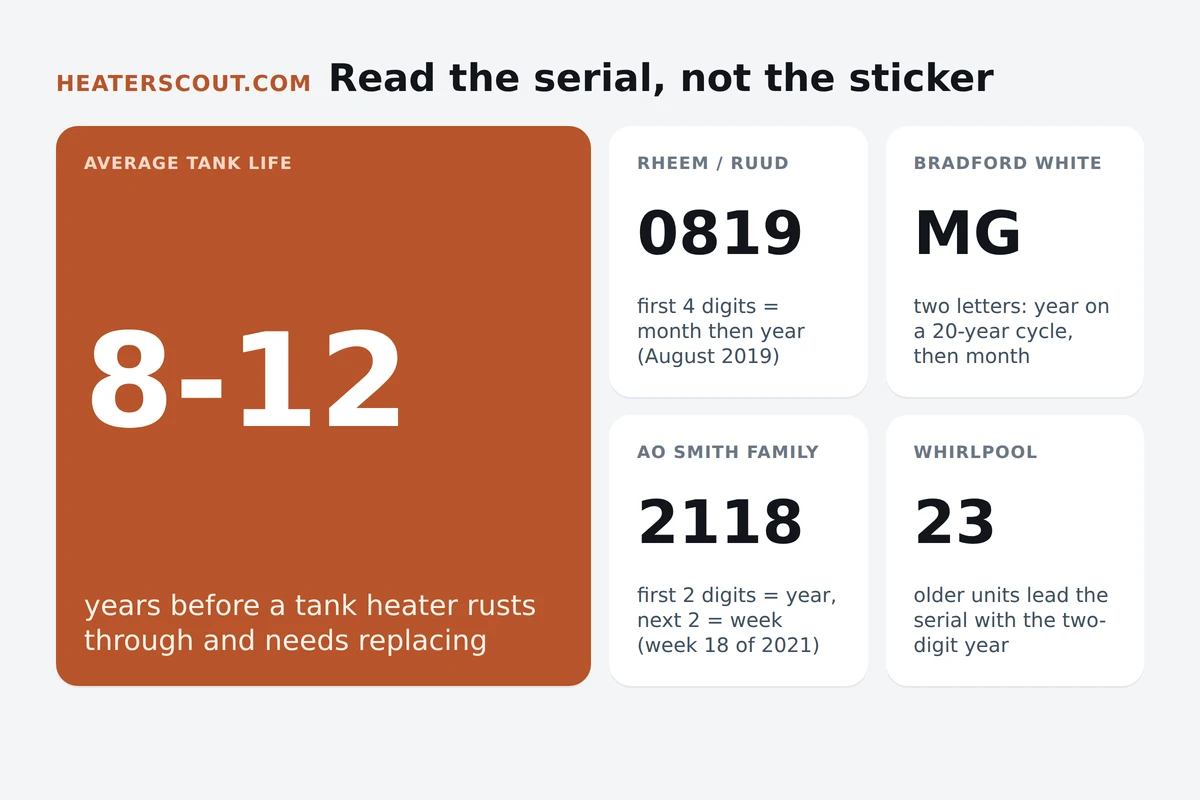
| Rheem / Ruud / Richmond | First 4 digits are month then year. 0819 is August 2019. |
| AO Smith and its lines | First 2 digits are the year, next 2 are the week. 2118 is week 18 of 2021. |
| Bradford White | Two letters: year on a 20-year cycle, then month (A-M, skip I). |
| Whirlpool / older store brands | Serial often opens with the two-digit year. 23 points to 2023. |
Find the plate before you decode anything
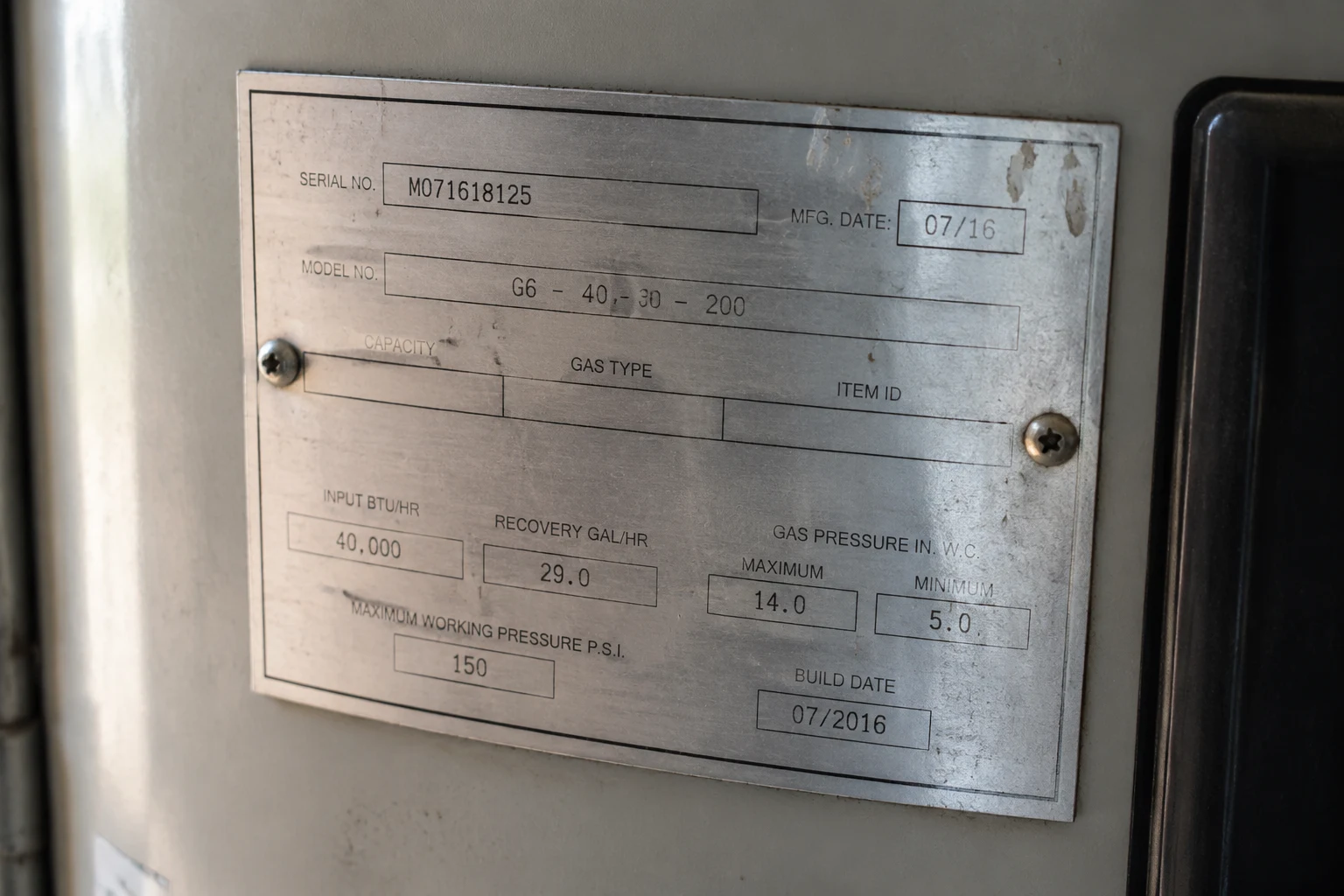
The number lives on the rating plate, which is the flat foil or stamped-metal label on the shell of the tank. On most units it sits on the upper third of the side. It lists the model, the capacity in gallons, and the input in watts or BTU, and somewhere in that block is the serial. Wipe the dust off before you read it. These labels collect a grey film that settles right over the characters you need, and a wrong guess on one digit throws the whole year off.
Now the trap. Sitting an inch from the serial is the model number, which looks almost identical and tells you nothing about age. People copy it down, run the decode, and get a date that makes no sense. Find the line marked SER, Serial, or Serial No, and copy that one, letter for letter. On a gas heater the plate is often low on the front near the gas control valve rather than up high, so crouch and look there if the upper shell is bare. Once you have the right string in hand, the decode itself takes about ten seconds. Getting the string is the part that trips people.
There is a second reason to read the model and the serial as two separate things. The model number encodes capacity, fuel type, and configuration, which is what you want when you are ordering a part or a replacement of the same footprint. The serial encodes the build date and a unique unit ID, which is what you want when you are dating the tank or checking it against a recall list. Confusing the two is the single most common mistake, and it is why so many online serial lookups come back empty. Feed a tool the model number and it has nothing to date.
Locate the rating plate
Find the foil label or metal tag on the side of the tank, usually on the upper third. On a gas unit, check low on the front near the gas control valve. Wipe off the film so every character is legible.
Copy the serial, not the model
Read the line marked SER or Serial No. Ignore the model number sitting right next to it. Write the serial down character for character, including any leading letters, because those leading characters are the whole game.
Match the brand to its scheme
The name on the front tells you which format to use. Rheem, Ruud, and Richmond lead with four date digits. AO Smith and its lines lead with year then week. Bradford White leads with two letters. Whirlpool and older store brands often lead with the two-digit year.
Convert to a real month and year
Apply the rule to get the build date. If the brand uses a repeating letter cycle, pick the most recent cycle that gives a believable age. Then subtract from today and you have the tank's age to the month.
Cross-check against the paper trail
Confirm your read against the install permit the city keeps on file, a born-on or install tag a plumber may have left, or the disclosure paperwork from a home sale. If two sources agree, you are done.
Decode it brand by brand
There is no universal rule, and that is the whole difficulty. Two tanks built the same week in different plants carry serials that look nothing alike. What helps is that most tanks come from a small number of parent companies, even when the name on the front is a store brand, so a handful of schemes covers almost everything you will meet. Find who made yours and read across the row.
| Brand | Serial format | How to read the date |
|---|---|---|
| Rheem, Ruud, Richmond, Eco, Vanguard | MMYY... (4 leading digits) | First two digits are the month, next two are the year. 0819 is August 2019. 1218 is December 2018. No lookup table. |
| AO Smith, State, Reliance, American, GE, Whirlpool and Kenmore built by them | YYWW... (newer) or letter+digits (older) | Newer plates: first two digits are the year, next two are the week. 2118 is week 18 of 2021. Older plates: a single leading letter maps to the year via a printed chart, followed by the week. |
| Bradford White | Two leading letters | First letter is the year on a repeating 20-year cycle. Second letter is the month using A through M and skipping I. Pick the cycle that puts the tank at a sane age. |
| Whirlpool and older store brands | YY... (2 leading digits) | The serial often opens with the two-digit year of manufacture. A serial starting 23 points to 2023, one starting 07 to 2007. |
Work through a Rheem example first, because it is the friendliest. Say the serial reads RHXXXX starting with 0819 after the prefix, or plainly 0819 for units without a letter prefix. Split the first four digits into 08 and 19. Month 08 is August, year 19 is 2019. Built August 2019. A serial of 1122 splits into 11 and 22, so November 2022. Ruud and Richmond, both Rheem brands, read the same way, which is why they get grouped.
AO Smith is the one that shifts over time and confuses people most. On a current plate, a serial opening 2118 reads as year 2021, week 18, which falls in early May of 2021. A serial opening 1935 reads as year 2019, week 35, late August. Older AO Smith stock used a single letter for the year instead of two digits, so a serial starting with a letter like L or M needs the year chart for that era. When the letter era leaves you guessing, the parent company support line will decode a serial on the spot, and so will the warranty lookup on the maker's site. State, Reliance, American, and the AO Smith-built store brands all follow the same current format.
Bradford White is the fussiest, so take it slow. The first letter walks a twenty-year loop, meaning the same letter can point to 1985, 2005, or 2025. You settle the ambiguity with a sanity check on age: a heater that would be forty years old is not the one humming away, so you take the most recent cycle. The second letter is the month, using A through M with the letter I skipped, so A is January, B is February, and it runs clean through to M for December once you drop I. A serial that starts MG, on a tank that is plainly recent, reads as the M-cycle year for 2025 and the G month, July. Get their published letter key if you want it exact, because the year letters do not run straight through the alphabet.
Turn the date into a decision
Dating the tank only matters if it changes what you do next. The age answers three practical questions at once. Is the next repair worth paying for. Should you be budgeting for a replacement now. Is the unit still inside its warranty window. A heater that is three years old and acting up gets fixed without much thought. A heater that is eleven years old and acting up gets replaced, because putting a new part into a shell that is about to rust through is money spent on a countdown. The anode rod and the local water hardness shift these numbers, so read the bands below as a starting frame, not a hard line.
Young and worth fixing
A tank this age is nowhere near the end of its life. Almost any fault, a burnt element, a failed thermostat, a stuck relief valve, a bad gas valve, is worth repairing. Keep up with anode-rod checks and an annual flush to protect the years you paid for, and confirm the unit is still inside its warranty window, because parts and sometimes labor may be covered. A tank under six is a repair, not a replacement, in almost every case.
The normal replacement window
This is the stretch where tanks are expected to give out, so the math tips case by case. A small fix like a thermostat still makes sense early in the range. A big one, a leaking seam or a corroded anode paired with a failed dip tube, points to replacement, especially past ten. Start pricing a new unit now so a sudden failure does not force a rushed, overpriced emergency install on a weekend.
On borrowed time, plan the swap
Past twelve, the steel shell is the risk, and no repair fixes a shell that is rusting through. Even if it heats fine today, budget for a planned replacement rather than waiting for the morning you find 40 gallons on the floor. A leaking tank at this age is almost always replace, not repair. If you are buying the house, treat a tank this old as a near-term cost baked into the offer.
Why a couple of years swings the whole call
The reason age carries this much weight comes down to how a tank dies. It does not fade out gently. The steel shell corrodes from the inside, held off only by a sacrificial anode rod that slowly dissolves in the tank's place. Once that rod is spent, the corrosion moves to the steel, and the tank rusts through and lets go. When it does, it can empty its full 40 or 50 gallons across the floor in minutes, often into a finished space below. That failure is what the age number is really warning you about, and it is why the trade replaces tanks on a schedule instead of running them to burst.
The single biggest lever you actually control is that anode rod. Pull the worn rod and drop in a fresh one every three to five years, and you keep the corrosion aimed at the rod instead of the tank, which can add years to the shell. Water hardness swings the whole window, so soft-water homes tend to land at the top of the range and hard-water homes at the bottom. A tankless unit sidesteps the problem entirely, since it has no standing shell of water to corrode, which is why it can run past twenty years with descaling. Keep these figures in your head.
No legible plate? Chase the install date
If the rating plate is faded past reading or gone, do not guess at the age. Check for an install date written in marker on the tank, a dated permit sticker on the side, or the building permit the city keeps on file for the install. Disclosure paperwork from a home purchase usually lists it, and even the age of the flue connector and shutoff valves can put you within a season or two. A dated tag a plumber left behind beats a coin flip.
Frequently asked
Where is the serial number on a water heater?
It is on the rating plate, a metal or foil label glued to the side of the tank, usually on the upper third. The same plate lists the model number, the gallon capacity, and the wattage or BTU input. On a gas heater the plate often sits low on the front, near the gas control valve. Look for the line marked SER, Serial, or Serial No. That string, not any separate line, is what carries the build date.
Is there a plain manufacture date printed on the tank?
On most tanks, no. A handful of brands stamp a build date in plain text, but the majority tuck it inside the serial number so a single string can serve as both a unique unit ID and a production date for warranty and recall tracking. That is why two heaters with no visible date can each be dated to the exact month once you know the maker's format.
How do I decode a Rheem or Ruud serial number for age?
On Rheem, Ruud, and Richmond the first four digits are the month and then the year of manufacture. A serial that opens 0819 was built in August 2019. One that opens 1122 was built in November 2022. There is no lookup table, which makes this the easiest scheme among the major brands. If the string starts with a letter, you are probably reading the model number by mistake, so double-check that you copied the SER line.
How does the AO Smith date code work?
On newer AO Smith plates, and the many lines it builds such as State, Reliance, American, GE, and store brands like Whirlpool and Kenmore, the first two digits are the year and the next two are the week of that year. A serial that opens 2118 was built in the 18th week of 2021, which lands in early May. Older AO Smith units used a single letter for the year instead, so for those you need the letter chart printed for that era, or you call the support line and read them the serial.
How does the Bradford White date code work?
Bradford White puts two letters at the front of the serial. The first letter is the year on a repeating 20-year cycle, and the second letter is the month, using A through M and skipping I so the twelve months line up. Because the year letter repeats every twenty years, the same letter can mean 1985 or 2005 or 2025, and you settle it with common sense. A tank that would be forty years old is not the one running in your basement, so you take the most recent cycle that gives a believable age.
My tank is leaking and it is over ten years old. Repair or replace?
Replace. A leak from the tank body at that age means the steel shell has corroded through, and no repair fixes a rusted shell. Weeping at a fitting or valve can sometimes be tightened or swapped, but if water is coming from the tank seam or the bottom, the unit is done. Pouring a repair bill into a ten-plus-year shell buys you weeks, not years, and the next stage is 40 or 50 gallons on the floor.
Can I still date the heater if the rating plate is faded or missing?
Yes, by chasing the paper trail instead. Many installers write the date in marker on the tank or leave a dated tag. The local building department keeps a record of the permit pulled for the install, and the paperwork from a home sale often lists it. Even the age of the surrounding fittings and the flue connector can put you within a season or two if nothing else survives.