You wanted a hot shower and got a cold one. You open the utility closet, crouch down by the base of the gas water heater, and the little blue flame that is supposed to be burning there is dark. On a tank with a standing pilot, getting it going again is a short, specific routine, and the part almost everyone botches is how long to keep the knob pressed after the flame catches. Get the order right and you will have hot water in about an hour.
Gas safety
A dead pilot may have let gas keep seeping out of the pilot orifice, so before you touch a lighter, turn the gas control dial to OFF and wait a full 5 minutes. Put your nose down near the floor by the burner. Natural gas rises and clears on its own, but propane is heavier than air and pools low, so it takes longer to disperse. If you smell gas at all, do not light anything. Open the space, let it air out, and only light once the smell is completely gone. A strong gas odor that will not clear means leave the building and call the gas company from outside.
What the gas control actually does
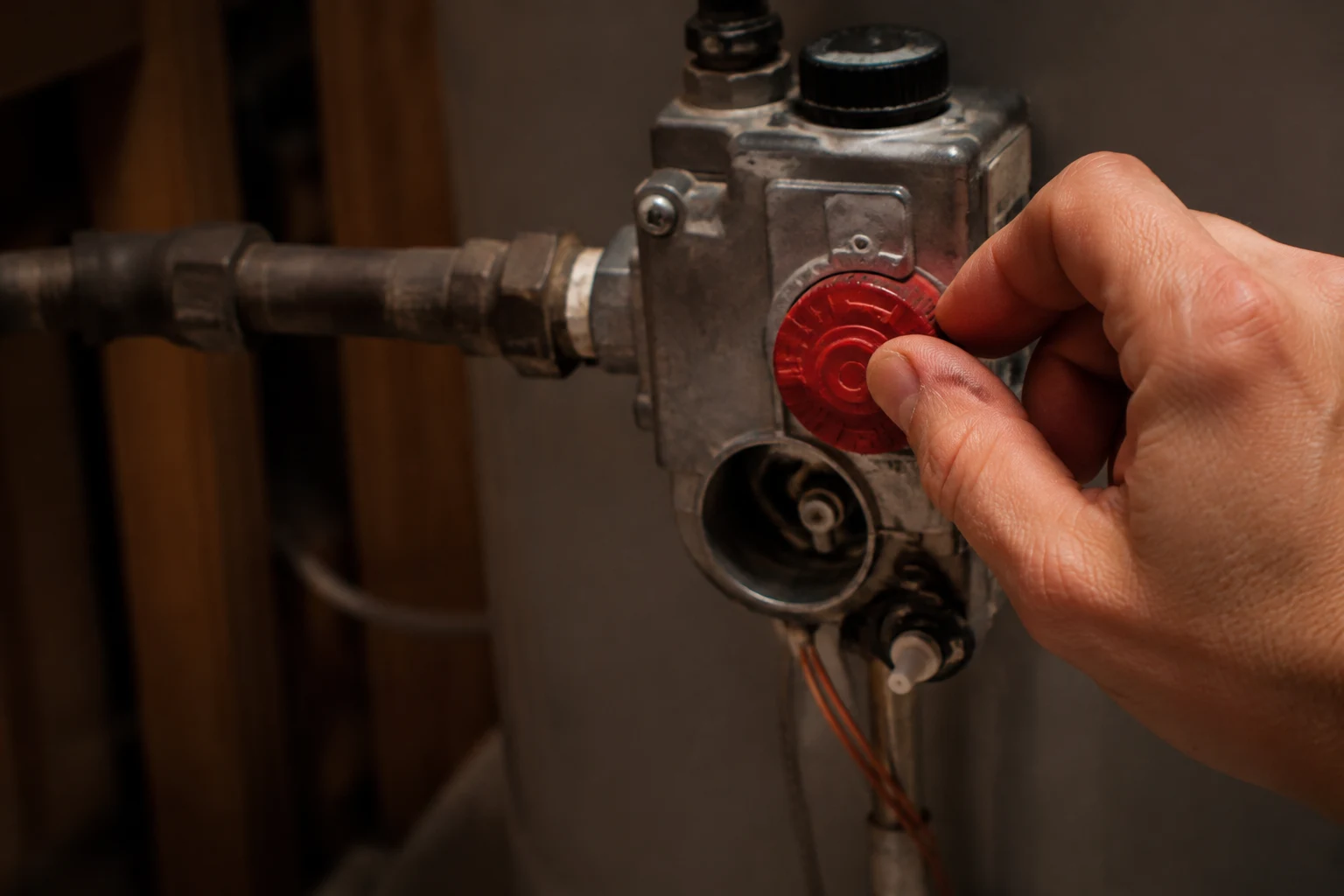
Everything about a relight happens on the round gas control box bolted to the front of the tank near the bottom. It carries one dial with three marks, ON, PILOT, and OFF, and either a push-in control knob or a separate red button that you depress during lighting. Most controls made in the last decade also have a piezo igniter, a spring-loaded button that snaps a spark across an electrode at the pilot so you never need an open flame. The valve itself is almost always a Honeywell or a Robertshaw unit, and you will find one or the other on a Rheem, an AO Smith, a Bradford White, a State, or a Whirlpool. The dance is the same across all of them, with tiny wording changes on the label.
Inside that box sits the safety that makes the hold-the-knob routine necessary. The valve refuses to send gas to the pilot unless it has proof the pilot is actually burning. That proof comes from a thermocouple, a slim metal probe whose tip sits right in the pilot flame. When the tip is hot, the junction of two dissimilar metals inside it generates a tiny voltage, on the order of 25 to 30 millivolts. That voltage energizes a small electromagnet, sometimes called the pilot solenoid, and the magnet is what physically holds the pilot gas port open. Cold tip, no voltage, port shut. Hot tip, voltage present, port held open. There are no batteries and no circuit board in that loop, just heat making electricity making a magnet pull. When you press and hold the knob during a relight, you are forcing that port open by hand for the seconds it takes the thermocouple to warm up and take over the job. That single fact explains the whole procedure and most of the ways it goes wrong.
Before you rotate a single dial, walk through a short readiness list. None of it is busywork. Each item is something that, if you skip it, tends to send you back to the closet for a second or third attempt.
- Read the instruction label on the tank first. Rheem, AO Smith, Bradford White, and State each print the exact steps and the pilot location on a sticker, and the wording differs a little by model.
- Find the sight window, the small glass or plastic port near the base that lets you watch the pilot without opening the chamber.
- Know which type you have: a piezo igniter button for a spark, or an older open-pilot access that needs a long fireplace match.
- Have a long-reach lighter or long match ready if there is no piezo, plus a flashlight so you can actually see the flame catch.
- Confirm the gas is on: the shutoff valve on the supply line handle should run parallel to the pipe, and if you are on propane, check the tank is not near empty.
- Clear anything stored against the base of the heater so you have room to hold the knob with one hand and light with the other.
The dial sequence, step by step
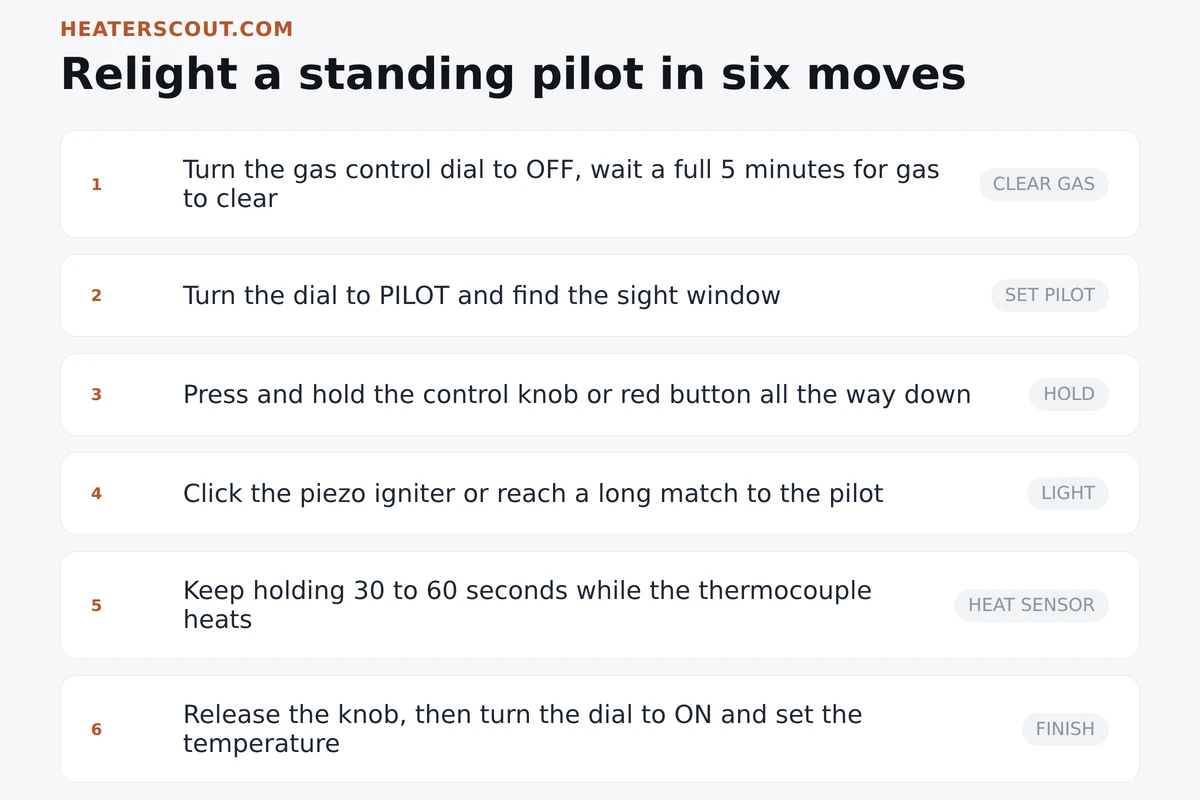
Here is the exact order. The trick is that for one stretch you do two things at once, holding the knob down with one hand while you light with the other, and then you keep holding well past the point it feels done. Work through it slowly the first time.
If the pilot dies the moment you let go, resist the urge to just keep clicking the igniter over and over. Turn the dial back to OFF, wait, and run the whole sequence again, but this time hold the knob a good 60 seconds, even 90 if you have a slow older thermocouple. Two or three honest attempts with a long, patient hold will tell you whether you have a technique problem or a hardware problem. If it still will not hold after a real 90-second hold with a healthy-looking flame, stop relighting and start diagnosing, because you are past the point where another attempt helps.
When it lights but will not stay lit
Say the pilot catches every time, you hold your minute, and it still goes dark when you release. That is a different problem from a pilot that will not catch at all, and it almost always traces to one of a handful of causes. Run these in order before you write off the heater. The list starts with the cheap and common and works toward the parts that need a wrench.
1. A weak or misaligned thermocouple
This is the single most common cause of a pilot that lights and dies. The tip has to sit inside the pilot flame, with the flame wrapping the top third of the probe. If the tip is coated in soot, bent out of the flame, or simply worn out, it cannot make its 25 to 30 millivolts and the solenoid drops out the moment you let go. A new thermocouple is a $10 to $20 part and a common fix. Clean the tip with fine sandpaper, make sure it sits in the flame, and snug the nut at the valve. If a clean, well-aimed thermocouple still fails, replace it.
2. A dirty or partly clogged pilot orifice
Watch the flame in the sight window. A healthy pilot is a small, crisp blue flame that envelops the thermocouple tip. A flame that is weak, lazy, yellow-tipped, or floating off to one side is starved, usually by a pilot orifice partly plugged with rust flakes, spider webs, or dust. A starved flame will not heat the sensor even if the thermocouple itself is fine. The orifice can be cleaned, but that means shutting off the gas and pulling the pilot assembly, which is a step past a basic relight.
3. Low or interrupted gas supply
If the flame looks small and blue but weak everywhere, the supply may be the issue. Confirm the shutoff on the gas line is fully open. On propane, check the LP tank level and the regulator, because a nearly empty tank or a frozen regulator starves every gas appliance in the house. Low line pressure will not make enough heat at the pilot to hold the valve open.
4. A kinked or blocked pilot flex-tube
A thin flex-tube carries gas from the valve to the pilot burner. If it is kinked, crushed behind the tank, or pinched during a past repair, the pilot gets a trickle instead of a proper feed and the flame runs weak. Trace the small tube from the valve to the pilot and make sure nothing is bending or crushing it.
5. A failing thermopile on a millivolt valve
Some units, especially newer sealed-combustion models and many power-vent tanks, use a thermopile instead of a plain thermocouple. A thermopile is a stack of thermocouples wired in series to make a bigger voltage, often 500 to 750 millivolts, enough to run the whole control with no external power. If a thermopile-fed unit lights, holds while you press, then dies, the thermopile may be worn or the connection corroded. That is a straightforward part swap, but it is a different part from the single thermocouple on an older standing-pilot valve.
Should I try cleaning the thermocouple myself or just replace it?
For a first pass, clean it. Turn the gas control to OFF, let the assembly cool, and gently rub the tip with fine sandpaper or an emery cloth to take off soot and oxidation, then wipe it clean and reseat it so it sits in the pilot flame. Cleaning often buys you months on a thermocouple that was just sooted up. But the part is cheap enough, around $10 to $20, that if cleaning does not fix it or the probe looks pitted and tired, replacing it outright is the better use of your time. Match the length and the thread when you buy one, and hand-tighten the nut at the valve plus a light quarter turn, since overtightening can crack the fitting.
Piezo igniters and sealed-combustion units
Newer water heaters often skip the open-flame routine. Many now use a piezo igniter, so you hold the control knob and click the red button until the pilot catches, no match needed. The newest FVIR and sealed-combustion units go further, with electronic hot-surface ignition or a striker, and a few have no standing pilot at all and light the burner on demand. On any of these, follow the printed sequence on the tank exactly, because the knob-and-igniter timing and the position of the reset can differ from the classic standing-pilot procedure. If the unit has a one-time FVIR thermal cutoff that has tripped, no amount of relighting will work until that is reset or replaced.
Frequently asked
How long do I hold the knob down when I relight a water heater pilot?
Hold it a full 30 to 60 seconds after the flame catches, and do not rush it. While you hold the knob, you are keeping the pilot gas valve open by hand. The thermocouple tip has to heat up in the flame and start generating about 25 to 30 millivolts before it can hold that valve open on its own. Let go early and the pilot drops out, which is why people relight three or four times before it finally sticks.
Why does my water heater pilot go out the second I let go of the knob?
That is the classic sign of a weak or misaligned thermocouple, or a pilot flame that is not wrapping the sensor tip. When you release the knob, the thermocouple has to hold the gas valve open by itself, and if it cannot make enough voltage the safety valve snaps shut. Hold longer first, closer to 60 seconds. If it still dies every attempt, the thermocouple is usually dirty, bent out of the flame, or worn out, and a replacement runs about $10 to $20.
Why do I have to wait 5 minutes before I light the pilot?
If the pilot went out on its own, gas may have kept trickling out of the pilot orifice for a while. Turning the dial to OFF and waiting 5 minutes lets that gas disperse so you are not putting a flame or a spark into a pocket of it. On a natural gas unit the fuel rises, but propane is heavier than air and settles near the floor, so the wait matters even more on an LP tank. Skipping it is how people get a flash burn.
Do I need a lighter, or is there a built-in igniter?
Most gas water heaters built in the last fifteen or so years have a piezo igniter, the red or black button on the gas control that clicks a spark at the pilot. If yours has one, you never need an open flame. Older Honeywell and Robertshaw standing-pilot valves with an open pilot access need a long fireplace match or a long-reach lighter held at the pilot while you hold the control knob down with your other hand.
The pilot lights but the water still is not hot. What is wrong?
A lit pilot only proves the pilot works. The main burner has to fire for the tank to heat, and that only happens once the dial is turned from PILOT to ON and the tank calls for heat. Turn the dial to ON, raise the temperature dial, and listen for the main burner to whoosh on within a few minutes. If the pilot stays lit but the burner never fires, the trouble is past the pilot, often a weak thermopile on a millivolt valve or a bad temperature control.
What is FVIR and can it stop my pilot from lighting?
FVIR stands for flammable vapor ignition resistant. Every gas water heater sold in the United States since about 2005 has this design, with a sealed combustion chamber, a flame arrestor screen at the base, and often a one-time thermal cutoff that trips if flammable vapors are drawn in. If that cutoff has tripped, or the arrestor screen is clogged with lint and dust, the pilot will not light no matter how you work the knob, and the unit needs service or a reset kit.
Pilot lights but keeps dying on you?
If you have relit it right, held a full minute, and it still will not stay lit, the fix is a diagnosis, not another relight. Read the guide on why a gas water heater pilot light won't stay lit to track down the thermocouple, orifice, gas supply, or draft behind it.