The phrase trips people up before they even start. On almost every gas tankless heater sold in the last fifteen years there is no pilot light to relight. No standing flame, no knob to hold down with a match, nothing to touch a lighter to. These units ignite electronically, sparking or glowing to life every time you open a hot tap, and when one stops making hot water the fix is to restore that ignition, not to light anything by hand. That changes the whole job. Instead of a match you are working with power, a gas valve, an error code, and sometimes a vent full of ice.
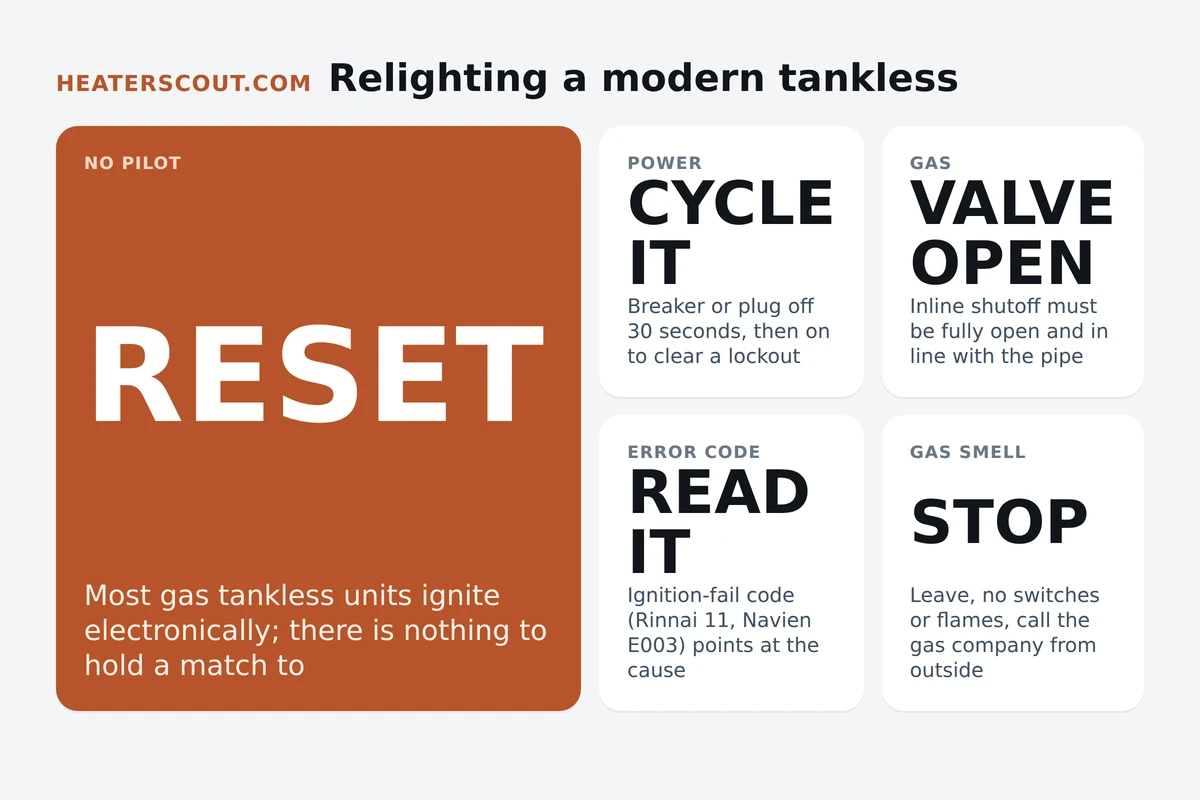
Relighting a modern tankless is a reset, not a match. The heater lights itself. Your job is to give it power, gas, and clear air, then clear the lockout so it can try again.
Read this first
If you smell gas near the heater, at any strength, this page stops applying. Do not flip a switch, do not press a button, do not use a phone inside. Get everyone out, leave the door open, and call your gas utility or 911 from a neighbor's place or the street. Do not turn the gas back on yourself after it has been shut off for a leak. A tankless that will not light can wait. A gas leak cannot.
Quick answer
On a modern gas tankless there is no pilot. To restore ignition, confirm the unit has power, open the inline gas shutoff valve all the way, and read any error code on the display. Then power cycle the unit, breaker or plug off for about thirty seconds, turn it back on, and open a hot tap so the electronic igniter fires. If it lights and holds, done. If it throws an ignition-failure code again (Rinnai 11, Navien E003), the reset did not fix the cause. Check for air in the gas line after an outage, a partly closed valve, or an iced vent, then reset once more. A code that keeps returning is a call for a tech, not another reset.
Why there is nothing to light
Walk up to a Rheem, Rinnai, Navien, Noritz, or Takagi tankless and you will not find a pilot flame burning away inside. Modern gas tankless units use electronic ignition. Depending on the model that is either a spark electrode that snaps like a gas grill or a hot surface igniter that glows orange, and a separate flame rod that confirms the burner actually lit. The sequence runs itself. You open a hot tap, a flow sensor notices water moving, the control opens the gas valve and fires the igniter, the flame rod verifies a flame, and the burner modulates to hit your set temperature. Close the tap and it all shuts down. Nothing stays lit between draws, which is half the reason these things save gas.
So when someone says their tankless went out and they want to relight it, there is no flame to relight. What they have is a unit that tried to ignite and could not, or one that lost power, or one behind a closed gas valve. If it flashes a code, that code is the fastest route to the cause. The older pilot-style units are a shrinking minority, mostly propane models for cabins and off-grid use, and they get their own section below.
The restart sequence that fixes most of them
Work these in order. Skipping around is how people replace a good igniter to fix a closed valve.
Confirm power
The unit needs electricity even though it burns gas, for the controls and the igniter. Check the display is lit. If it is dead, look at the breaker, the outlet the unit is plugged into, and any switch on the power cord. A dark panel means fix power before anything else.
Open the gas, all the way
Find the inline gas shutoff valve on the pipe feeding the heater. Full open is the handle running in line with the pipe, not across it. A valve left a quarter turn short still passes some gas but can starve the burner at high fire. Confirm the meter and any other shutoffs upstream are open too.
Read the error code
If the display shows a code, write it down before you clear it. An ignition-failure code (Rinnai 11, Navien E003 or E110, and each brand's own number) tells you the burner never lit. Other codes point at flow, vent, or sensor problems that ignition alone will not solve.
Power cycle to clear the lockout
Turn the unit off at the ON/OFF button, or cut the breaker or unplug it, wait about thirty seconds, then restore power. This clears the stored code and releases the ignition lockout so the unit will attempt to fire again. It does not repair anything, it just gives the heater another try.
Call for heat and listen
Open a hot tap somewhere in the house and hold it open. You should hear the igniter tick or click and the burner catch within a few seconds, and hot water should follow. Give it two or three tries, especially after an outage, since it can take a moment to purge air out of the burner.
If it lights on that sequence and keeps running, it was a lockout that just needed clearing. If it locks out again with the same code, the reset did its job but the underlying problem is still there. The next sections are the usual culprits behind a repeat lockout.
The checklist before you reset again
A reset that keeps failing is telling you to look harder, not to press the button faster. Run through these before the next attempt. Most repeat ignition failures are hiding in this list.
- Display is lit and the unit clearly has power, not tripped at the breaker.
- Inline gas shutoff valve is fully open, handle in line with the pipe.
- Gas is actually flowing: a stove burner or another gas appliance lights and burns steady.
- No propane tank run empty, and no other big gas appliance stealing supply at the same moment.
- After an outage, air has been purged: the burner has been given two or three tries to catch.
- Vent termination and air intake outside are clear, not iced over, blocked by snow, leaves, or a nest.
- The heater is not frozen after a long cold-weather power loss.
- The exact error code is written down so it can be looked up for your brand.
- No smell of gas anywhere near the unit. If there is, stop and leave.
After a gas outage or a fresh propane fill
This is the single most common reason a tankless will not relight, and it is not a heater fault at all. When gas service is interrupted and comes back, air gets into the supply piping. A burner cannot light on air, so the unit fires the igniter, sees no flame, and locks out. Some inline valves also close automatically during an outage, and the utility sometimes turns the meter down and expects you to relight appliances yourself.
Prove gas is present before you blame the tankless. Light a gas range burner. If it catches and burns a steady blue flame, gas and pressure are back and that branch is purged of air. Then go to the tankless, confirm its shutoff valve is fully open, power cycle it, and open a hot tap. Expect a couple of tries to pull the last of the air through its own burner. The same happens after a propane tank runs dry and gets refilled. If the stove lights clean but the tankless still refuses after several tries, that points back at the unit.
Is it safe to purge the gas line myself?
Bleeding a little trapped air by running the appliances is normal homeowner territory, and lighting a stove burner does exactly that on the kitchen branch. Opening gas fittings or working on the piping to purge a line is not. That is where a small mistake becomes a leak. If confirming gas at the stove and giving the tankless a few tries does not clear it, hand the purging to a licensed tech.
Cold weather: ice can block ignition
In winter a tankless can refuse to light for a reason that has nothing to do with gas. Condensing units especially throw moisture-laden exhaust out the vent, and in hard cold that moisture freezes at the vent termination or in the condensate drain. A plugged vent starves the burner of combustion air and blocks exhaust, and the control will not fire, or fires and drops out, then locks out with an ignition or vent-blockage code. Navien's E110 is the classic example, but every brand has an equivalent.
Go outside and look at the vent hood and the air intake. Clear snow, ice, leaves, or any nest away so they can breathe. If the unit itself froze during a long power outage, the freeze protection could not run without electricity, and you cannot force ignition on a frozen heat exchanger. Let it thaw, check for any leak or split, and only then restart. Preventing the next one means keeping the vent terminations above snow depth and the condensate line from freezing.
The older pilot-style minority
A small share of tankless units, mostly older propane models and off-grid or cabin heaters, do run a standing pilot with a manual igniter. On those you really do light a flame. Turn the gas control knob to pilot, press it in to feed the pilot, and click the piezo igniter button until the pilot catches. Hold the knob in for about sixty to ninety seconds so the thermocouple heats and learns there is a flame, then release it slowly. If the pilot holds, turn the knob to the on position and you have heat. If the pilot dies the moment you let go, the thermocouple is the usual suspect. Wait roughly ten minutes between tries so any unburned gas clears, and always follow the lighting label printed on your specific unit, because knob positions and hold times vary.
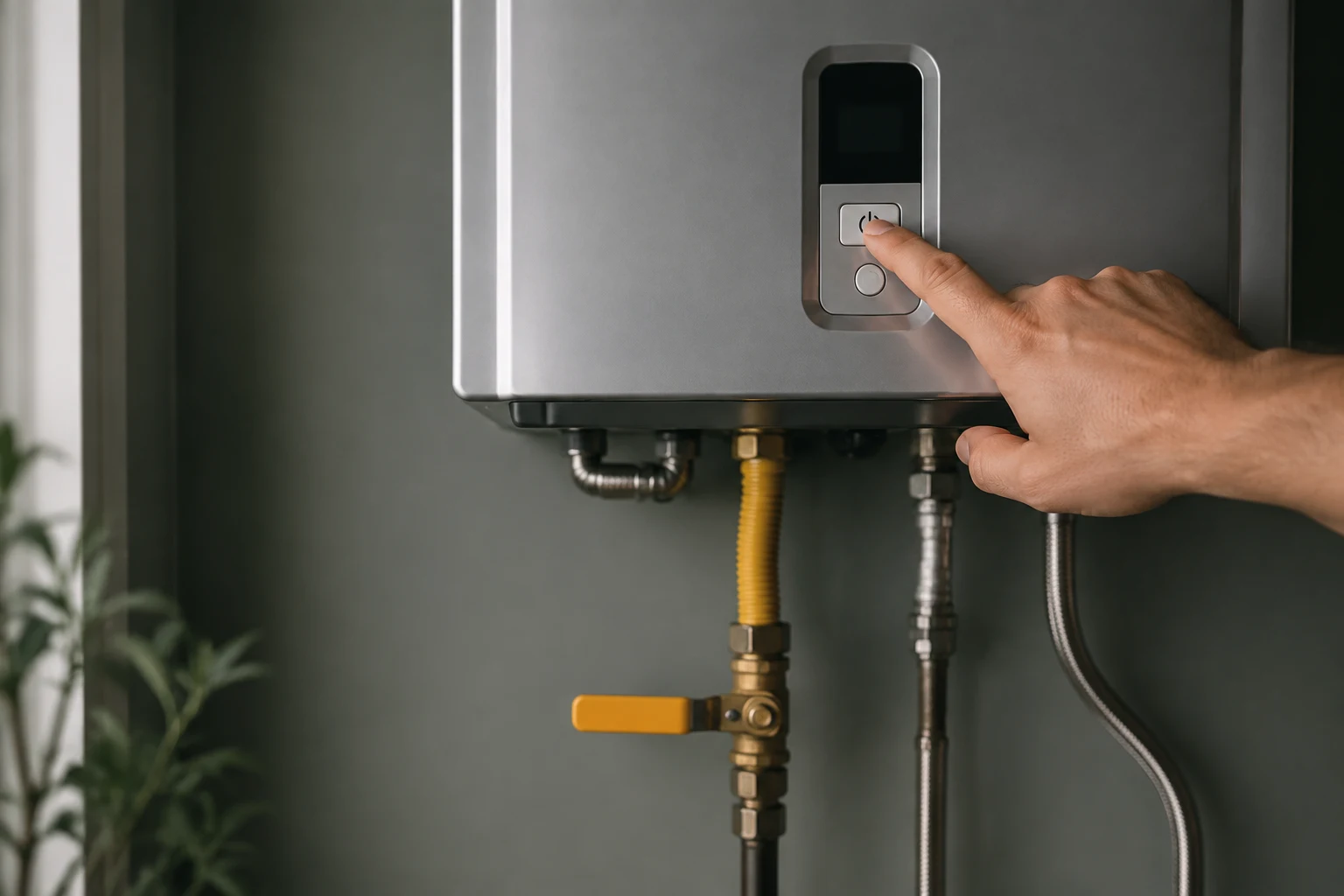
The tell for which kind you have is simple. If there is a knob with an off, pilot, and on position plus a sparker button, you have a pilot to light. If the front is a digital display with a temperature readout and an ON/OFF button, you have electronic ignition and there is nothing to light by hand, only power and gas to check and a code to clear.
When to stop resetting and call someone
One reset that sticks is a good afternoon. A code that keeps coming back after you have confirmed power, an open valve, real gas flow, and a clear vent is a unit problem, and pressing the button again will not fix a failing igniter, a dirty flame rod, a bad gas valve, or a tired control board. A burner that lights and quickly drops out, any soot or burnt smell, or water inside the cabinet all belong to a licensed tech. So does gas piping work beyond turning the inline valve. And the one that overrides everything else on this page: a smell of gas means you leave and call the utility, every time, no exceptions.
Frequently asked
How do I relight my tankless water heater if it has no pilot light?
Most gas tankless heaters built in the last fifteen years have no pilot to light. They use an electronic igniter that sparks or glows every time you open a hot tap, so there is no standing flame and no knob to hold with a match. Relighting one really means restoring ignition. Make sure the unit has power, the gas shutoff valve on the inlet pipe is fully open, and no error code is on the display. If it locked out after failing to ignite, cut power at the breaker or unplug it for about thirty seconds, turn it back on, then open a hot tap and listen for the igniter to tick and the burner to catch. If it fails again with the same code, the reset did not fix anything and you need to chase the cause, usually gas, air, or a blocked vent.
Where is the reset button on a tankless water heater?
There usually is not a dedicated red reset button like a tank heater has. On most tankless units the reset is the power itself. You either press the ON/OFF button on the front control panel to turn the unit off and back on, or you kill the power at the breaker or the plug for about thirty seconds and restore it. That clears a stored error code and releases an ignition lockout. Some models also let you press and hold a temperature or menu button to clear a code, and the exact combination is in the owner's manual for your model. Reset only clears the fault memory. If the thing that caused the lockout is still there, the code comes right back on the next ignition attempt.
Why won't my tankless water heater ignite after a gas outage?
After the gas comes back on there is almost always air in the supply line, and a burner will not light on air. Some inline shutoff valves also close automatically during an outage, or the utility left the meter turned down. Start by confirming gas is actually flowing. Light a gas stove burner. If it burns steadily, gas and pressure are back and that branch is cleared of air. Then confirm the shutoff valve at the tankless is fully open, power cycle the unit, open a hot tap, and give it two or three tries to purge the last air out of its burner. If it still will not catch after the stove proves gas is present, the unit needs a look.
What does an ignition failure code like Rinnai 11 or Navien E003 mean?
It means the control told the igniter to fire, the igniter tried, and the flame rod never confirmed a flame, so after a set number of failed tries the unit locked out. Rinnai calls it code 11, Navien uses E003, and other brands have their own number, but the meaning is the same. Common causes are no gas or low gas pressure, air trapped in the line, a shutoff valve that is closed or partly closed, a dirty flame rod, or a blocked vent starving the burner of air. The code is not the failure itself, it is the unit reporting that ignition did not happen. Fix the supply or airflow problem first, then reset to clear the code.
Do I need to relight anything on a tankless after the power goes out?
Not in the pilot sense, because there is no pilot. What happens after a power outage is that the unit loses its controls and, if it had locked out before the outage, it may still show the fault when power returns. Power comes back, the display lights up, and the next time you open a hot tap the igniter fires on its own. If it does not, or if it shows an error, cut the power for about thirty seconds and restore it to force a clean restart. One real concern with outages is freezing. The built-in freeze protection needs electricity to run, so a long outage in hard cold can let the heat exchanger freeze, and a frozen unit will not ignite until it thaws and you confirm nothing cracked.
My older tankless has a pilot. How do I light it?
A small number of older or off-grid propane tankless units use a standing pilot with a manual igniter, and those you actually light. Turn the gas control knob to pilot, press it in to send gas to the pilot, and click the piezo igniter button until the flame catches. Keep the knob pressed for about sixty to ninety seconds so the thermocouple heats up, then release it slowly. If the pilot holds, turn the knob to on. If it dies when you release the knob, wait about ten minutes and try again, and if it will not hold after a couple of tries the thermocouple is usually why. Follow the lighting label on your unit, since knob positions vary.
When should I stop and call a professional instead of resetting again?
Stop the moment you smell gas, anywhere, at any strength. That is a leave-the-house situation, not a reset. Past that, the rule is simple. One reset that fixes it is fine. A code that comes back after you have confirmed gas is on, the valve is open, and the vent is clear means the fault is inside the unit, a failing igniter, flame rod, gas valve, or control board, and clearing the lockout again just wears things out. A burner that lights then drops out, soot or a burnt smell, or water leaking inside the cabinet all belong to a licensed tech. So does gas piping work beyond the inline valve.