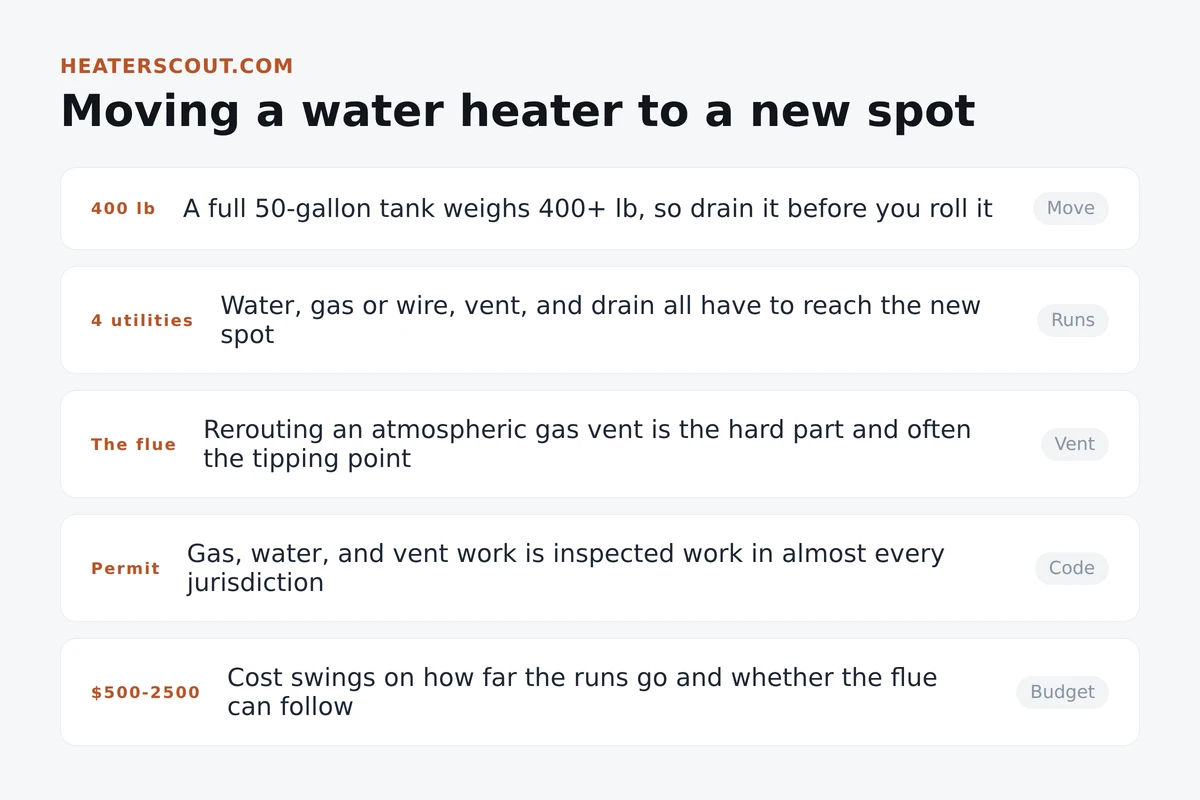
A full 50-gallon water heater weighs more than 400 pounds, which is the first reason moving one is not a Saturday project you finish before lunch. The second reason is that the tank is the easy part. Four separate utilities meet at a water heater, water in and out, gas or a heavy electrical circuit, a vent for the exhaust, and a drain for leaks and relief, and every one of them has to reach the new spot and pass inspection. On a gas unit the vent is usually what decides whether the job costs $600 or $2,400, and sometimes whether you keep the same heater at all.
Which kind of move are you actually making
Not every relocation is the same job. Sliding a tank six feet along the same wall is a different animal from carrying it to a closet across the house. Figure out which you are doing, because the vent path is what separates them.
Short move, same room
You are shifting the tank a few feet to clear space or reach a better wall, but it stays close to the existing chimney or vent. The flue connector still lines up with a bit of new pipe, the gas and water runs grow by a few feet, and the drain is nearby. This is the move that lands near the bottom of the cost range because nothing structural changes. Still permitted, still inspected, but the plumber is extending runs, not re-engineering the vent.
New room or across the space
The tank goes to a different room or the far side of the basement. Now the gas line has to be extended and possibly upsized, water lines run through framing, and a drain reach the new spot. The vent is the wild card: if the new location cannot keep the flue sloping up to the chimney, the whole plan hinges on the next option.
Switch to power-vent to avoid the chimney
When the new spot has no clean path back to the chimney, rerouting an atmospheric flue gets expensive fast. A power-vent or condensing tankless unit vents sideways out the nearest exterior wall with a fan, so it needs no chimney at all. The new heater costs more, but it can beat the price of a difficult vent reroute and reach locations an atmospheric unit never could.
Relocation options and what they really cost
The numbers below are the relocation work, not the heater itself. If you are also replacing the unit, add its price. What moves the total is distance and the vent, in that order.
| Option | Typical cost | Effort and catch |
|---|---|---|
| Short move, same room, keep atmospheric vent | $500 to $900 | Lowest. New pipe on all four runs, flue still drafts, permit and inspection. A day for a two-person crew. |
| Move to a new room, keep atmospheric vent | $1,200 to $2,500 | Extended gas line, new water and drain runs, and a vent reroute that must hold its upward slope. The slope is the risk. |
| Chimney or roof vent reroute (atmospheric) | $2,000 and up | New Type B vent, roof or masonry penetration, and framing work. Often the point where power-vent wins on price. |
| Convert to power-vent, relocate near exterior wall | $1,400 to $2,800 plus the unit | No chimney needed. Vents out a sidewall with a fan, needs an outlet and often a bigger gas line. |
| Convert to condensing tankless, relocate | $2,000 to $4,000 plus the unit | Wall-mounted, vents sidewall, frees floor space. Usually needs a 3/4 inch or larger gas line and a condensate drain. |
What each new utility run has to satisfy
Every line that meets at the tank has its own code requirements at the new spot. This is the checklist an inspector runs through, and it is why relocations cost more than they look like they should. Each run is a small job on its own.
| Water lines | New cold supply with a shutoff on the inlet, and a hot outlet tying back into the house. Longer runs mean more heat loss, so keep them short or insulated. Dielectric unions where copper meets the steel tank nipples to slow corrosion. |
| Gas line | Extended and sized for the load and the total developed length per the IFGC. Tankless and some power-vent units fire much harder than an atmospheric tank and often need 3/4 inch or larger. A new sediment trap and a shutoff at the appliance. |
| Electrical | An atmospheric gas unit needs nothing. A power-vent needs a 120V outlet for the fan. An electric tank needs a dedicated 30A 240V branch circuit sized and landed per the NEC, which is often the reason an electric relocation costs more than a gas one. |
| Vent or flue | Atmospheric: the connector must rise at least 1/4 inch per foot toward the chimney or Type B vent, within the length limits, no long flat runs. Power-vent or condensing: sealed PVC or stainless out a sidewall with clearances to windows and soffits at the termination. |
| Drain pan and drain | A pan under the tank piped to a drain or outside where a leak would harm the building, required for attics, upper floors, and interior closets. The pan drain runs by gravity, so the new spot needs somewhere downhill for it to go. |
| T&P discharge | The temperature and pressure relief line runs full-size down to within 6 inches of the floor or to a drain, with no threads on the end and no traps. It has to be replumbed to the new spot. |
| Combustion air | A gas burner needs a supply of combustion air at the new location, either enough room volume or vents to adjacent space per the fuel gas code. A tight new closet without air provisions will back-draft. |
| Seismic strapping | In seismic regions the tank gets strapped at the upper and lower thirds to framing. California requires two straps by code. The new wall has to give the straps something solid to anchor to. |
The gotchas that stall a relocation
Most relocations that go over budget or fail inspection do so for one of a handful of reasons, and they are predictable. If you are scoping the job, look hard at these before you commit to a location.
Flue slope you cannot hold
This is the number one killer of a gas relocation. Move the tank away from the chimney and the vent connector may no longer rise a quarter inch per foot the whole way, or the horizontal run gets too long to draft. Flue gas that cannot climb spills back into the room. If the new spot cannot keep the slope, you are either rerouting the chimney or switching to power-vent. Do not let anyone talk you into a flat or downhill flue.
No drain within reach
A drain pan and its drain line move by gravity, and the T&P discharge does too. If the new location has no floor drain, standpipe, or exterior wall the lines can reach downhill, you are adding a condensate pump or re-plumbing a drain, both of which add cost. Interior closets and attic spots are the usual offenders. Confirm where the water goes before you set the tank.
Undersized or too-long gas line
A gas line that was fine feeding the old tank at its old spot may not deliver enough at the new distance. Gas capacity drops as the developed length grows, so a longer run can starve the burner even without changing the appliance. Switch to a hungry tankless and the problem multiplies. If the line comes up short, the whole branch may need upsizing.
Combustion air the new spot does not have
An atmospheric or power-vent gas unit needs air to burn. A large open basement has plenty. A new sealed closet does not, and without louvered doors or air vents to adjacent rooms the burner starves and back-drafts carbon monoxide into the house. It has to be solved on paper before the unit moves.
Garage floor and clearances
Relocating into a garage brings its own rules. A gas burner has to sit at least 18 inches above the floor unless the unit is listed as flammable-vapor-ignition resistant, so gasoline vapors cannot reach the flame. The tank also needs impact protection in many jurisdictions, plus the label clearances to combustibles. New spot, new geometry to check.
Move-day and code checklist
Work this list in order. The first block is the physical move, the second is what has to be true at the new spot before an inspector signs off. If a licensed plumber is doing the connections, they own the second block, but you want to know what they are checking.
- Drain the tank fully before moving it: kill the power or gas, shut the cold inlet, open a hot tap and the T&P lever to break the vacuum, then hose the drain valve to a floor drain or outside.
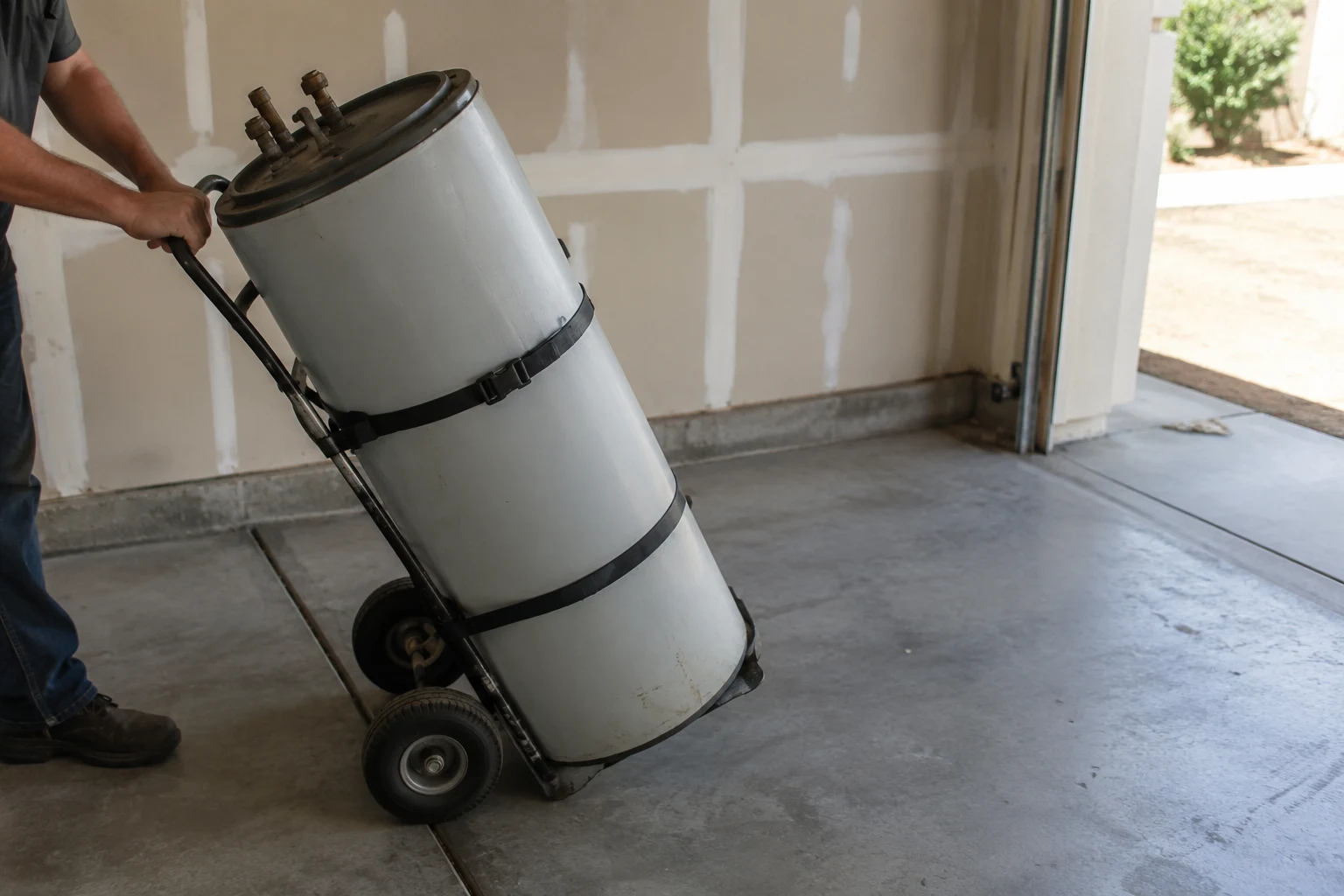
- Confirm the tank is empty and light (around 130 to 150 lb for a 50-gallon) before you tip it onto an appliance dolly. Never move it full at 400+ lb.
- Move it upright and strapped, take thresholds slowly, and protect the fittings on top from any hard tip.
- Pull the permit before the connections go in. Gas, vent, water, and electrical work is inspected work.
- New gas line sized for the load and the total length, with a sediment trap and an appliance shutoff.
- Water lines with an inlet shutoff and dielectric unions, kept short or insulated to limit heat loss.
- Vent verified: atmospheric flue sloping up at least 1/4 inch per foot with no long flat runs, or a sealed power-vent termination with proper clearances at the wall.
- Drain pan under the tank piped downhill to a drain or outside, and a T&P discharge line run to within 6 inches of the floor or a drain.
- Combustion air confirmed at the new location for any gas unit, by room volume or vents to adjacent space.
- Seismic strapping at the upper and lower thirds where required, anchored to solid framing (two straps in California).
- For a garage: burner 18 inches off the floor unless FVIR-listed, plus impact protection and label clearances.
- Refill and purge air before restoring power or gas, then let the inspector see it before you close up any walls.
When switching heaters beats moving the one you have
Here is the decision that quietly saves the most money. If the relocation forces an expensive vent reroute, price the alternative of not fighting the chimney at all. A power-vent tank or a condensing tankless unit vents horizontally out the nearest exterior wall with a fan and sealed pipe. It ignores the chimney, so the new location only has to be near an outside wall and a drain. When a chimney reroute is going to run $2,000 and up, a new power-vent unit plus a simple sidewall vent can come in under that, and you end up with a newer heater. The catch is the gas line and the outlet: hungry appliances want a bigger supply, and the fan wants power nearby. Ask for both quotes side by side and let the vent number decide.
Frequently asked
Can I move a water heater myself?
You can handle the parts that are not gas or vent work: draining the tank, rolling it to the new spot on an appliance dolly, and setting it on a stand or pan. The trouble is everything that connects to it. Extending a gas line, rerouting a flue, and running new water lines are permitted, inspected trades in almost every jurisdiction, and a botched gas or vent run kills people with carbon monoxide or fire. The honest answer for most homeowners is to do the demo and the physical move yourself, then hand the connections to a licensed plumber who pulls the permit.
How much does it cost to relocate a water heater?
Plan on $500 to $2,500 for the relocation itself, on top of the heater if you are also replacing it. The spread is almost entirely about distance and the vent. A short move within the same room, where the flue still lines up, lands near the bottom. Moving to a different room, where the plumber extends the gas line, runs new water and drain lines, and re-engineers the vent, pushes toward the top. If the move forces a switch to a power-vent or tankless unit, add the price of the new appliance. Get the quote itemized so you can see what the vent is costing you.
Why is moving the vent the hardest part?
A standard atmospheric gas water heater vents by natural draft: hot flue gas rises on its own up a metal vent connector into a chimney or a Type B vent. That draft only works if the vent keeps rising the whole way. Code requires the connector to slope upward at least a quarter inch per foot, with limited length and no long flat or downhill runs. Move the tank away from the chimney and you often cannot keep that slope. At that point flue gas can spill back into the room, which is the failure mode that produces carbon monoxide. That is why relocating an atmospheric unit often turns into a conversation about switching to a power-vent model that pushes exhaust out a side wall with a fan.
Is it cheaper to switch to a tankless or power-vent unit when relocating?
Sometimes, yes, and it is worth pricing both ways. If your only clean path for the old atmospheric flue is an expensive chimney reroute, a power-vent or tankless unit that vents horizontally out the nearest sidewall can cost less than the vent work you were avoiding. These units need no chimney, so the new location only has to be near an exterior wall and a drain for condensate. The trade is a bigger gas line in many cases (tankless units fire hard, often needing a 3/4-inch supply) and a nearby outlet for the fan. Have the plumber quote the straight relocation and the convert-and-relocate side by side.
Does relocating a water heater need a permit?
In almost every jurisdiction, yes. Water heater work touches gas, water, venting, and sometimes electrical, and those are permitted trades under the plumbing, mechanical, fuel gas, and electrical codes your city adopts (commonly the UPC or IPC, the IFGC for gas, and the NEC for wiring). A relocation is more, not less, than a straight swap because you are creating new runs, so an inspector will want to see the gas line, the vent slope and termination, the drain pan and its drain, the T&P discharge, combustion air at the new spot, and seismic strapping where required. Skipping the permit risks a failed home sale later, a voided warranty, and an uninspected gas joint over your head. The permit is cheap next to those.
How do I physically move a full water heater?
You do not move it full. A 50-gallon tank holds about 415 pounds of water alone, and the steel adds more, so a full unit is well over 400 pounds and impossible to handle safely. Drain it first: kill the power or gas, shut the cold inlet, open a hot tap and the T&P lever to break the vacuum, and hose the drain valve to a floor drain or outside. An empty 50-gallon tank weighs roughly 130 to 150 pounds, which one strong person can walk onto an appliance dolly and strap down. Move it upright, take it slow over thresholds, and never let it tip enough to bend the fittings on top.
What does the new location need to satisfy code?
Five things at minimum. Combustion air for a gas unit, so the burner does not starve and back-draft. A drain pan piped to a drain or outside, which most codes require for tanks in attics, over finished space, or in interior closets. A T&P relief line down to within a few inches of the floor or a drain. Seismic strapping at the upper and lower thirds in seismic zones (California requires two straps). And clearances to combustibles, plus 18 inches of burner elevation off a garage floor unless the unit is listed as flammable-vapor-ignition resistant. Miss one and the inspection fails.