Quick answer
Flushing a water heater means draining the tank to wash out the mineral sediment on the bottom. It takes 20 to 60 minutes plus cooldown, needs only a garden hose, and does more for the heater’s life than any other maintenance. The order matters — do it wrong on an electric tank and you can burn out an element in seconds. Here’s the safe sequence for both gas and electric.
How fast sediment stacks up on the tank floor
Left unflushed, the mineral layer keeps growing. The taller it gets, the more gas or power the heater burns and the longer it takes to reheat.
Flush every 6 to 12 months — the accent band — before the layer hardens into a crust
Sediment is the number one reason water heaters die before their time. Flushing it out is a job any homeowner can do, but the internet is full of guides that skip the two steps that actually keep you safe. This one doesn’t.
Why this one chore matters so much
Every tank collects mineral sediment on the bottom, and left alone it hardens into an insulating crust right over the burner or around the elements. That crust forces the heater to run longer to push heat through it, so you burn more gas or electricity for the same shower. ENERGY STAR figures a badly clogged tank can add 20% or more to water-heating costs. Worse, the trapped heat overworks the steel and shortens the tank’s life — caked heaters routinely fail years early. A flush is twenty minutes that pays you back in a lower bill and a heater that reaches its full eight-to-twelve-year run instead of quitting at eight.
Signs your tank is overdue
You don’t have to guess. A tank that needs flushing usually tells you:
- Popping or rumbling when it heats — water boiling under the sediment.
- Less hot water than it used to make, because the crust is eating tank volume and blocking heat.
- Temperature that swings hot to lukewarm during a shower.
- Rusty or cloudy hot water at the first draw.
- Longer reheat times after a big draw.
If it’s been more than a year, or you’ve never flushed it, assume it’s due regardless of symptoms.
What you need, and how long it takes
Tools & supplies
- Garden hose that reaches a drain or outside
- Bucket and old towels
- Flat or Phillips screwdriver (for the drain valve)
- Gloves and eye protection — the water is scalding
- Optional: wet/dry vac, transfer pump if you can’t drain by gravity
Time & difficulty
- Active work: 20–30 minutes
- Cooldown first: allow 1–2 hours
- Difficulty: beginner-friendly
- Do it yearly — twice a year on hard water
- Know where your main water shutoff is before you start
First, shut it down the right way
Gas and electric heaters start the same job differently, and this is where people make the costly mistake. Get this step right and the rest is just moving water.
Electric tank
- Switch the heater’s breaker to OFF at the panel. This is non-negotiable — the elements run on 240 volts.
- Never let power reach an element while the tank is empty. A dry element burns out in seconds, which is the classic flush disaster.
Gas tank
- Turn the gas control dial to OFF or Pilot.
- You’ll relight the pilot at the end, so note whether yours is a standing pilot or has an igniter button.
The flush, step by step
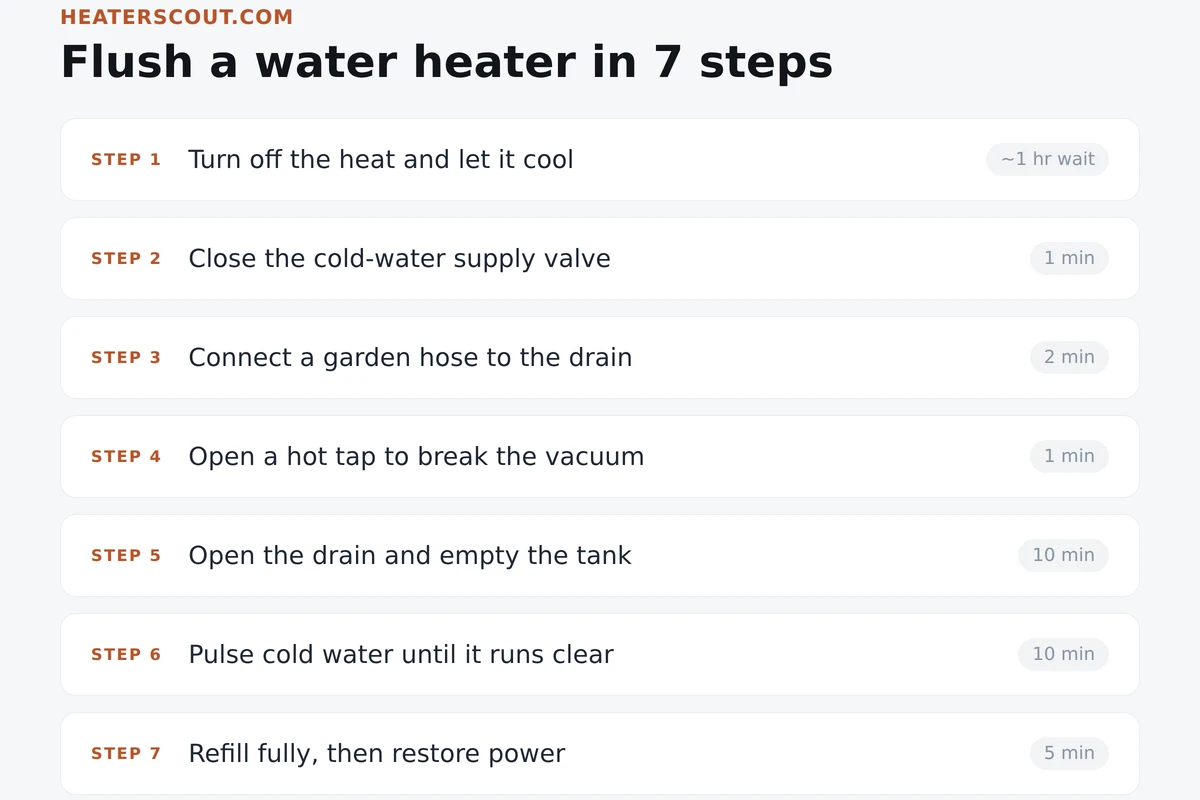
Let the tank cool
Give it an hour or two after shutting off the heat. Draining a fully hot tank means 120–140°F water through your hose — a real scald risk. Don’t skip this.
Close the cold-water supply
Find the cold inlet valve on top of the heater and shut it. This stops the tank from refilling while you drain.
Connect the hose
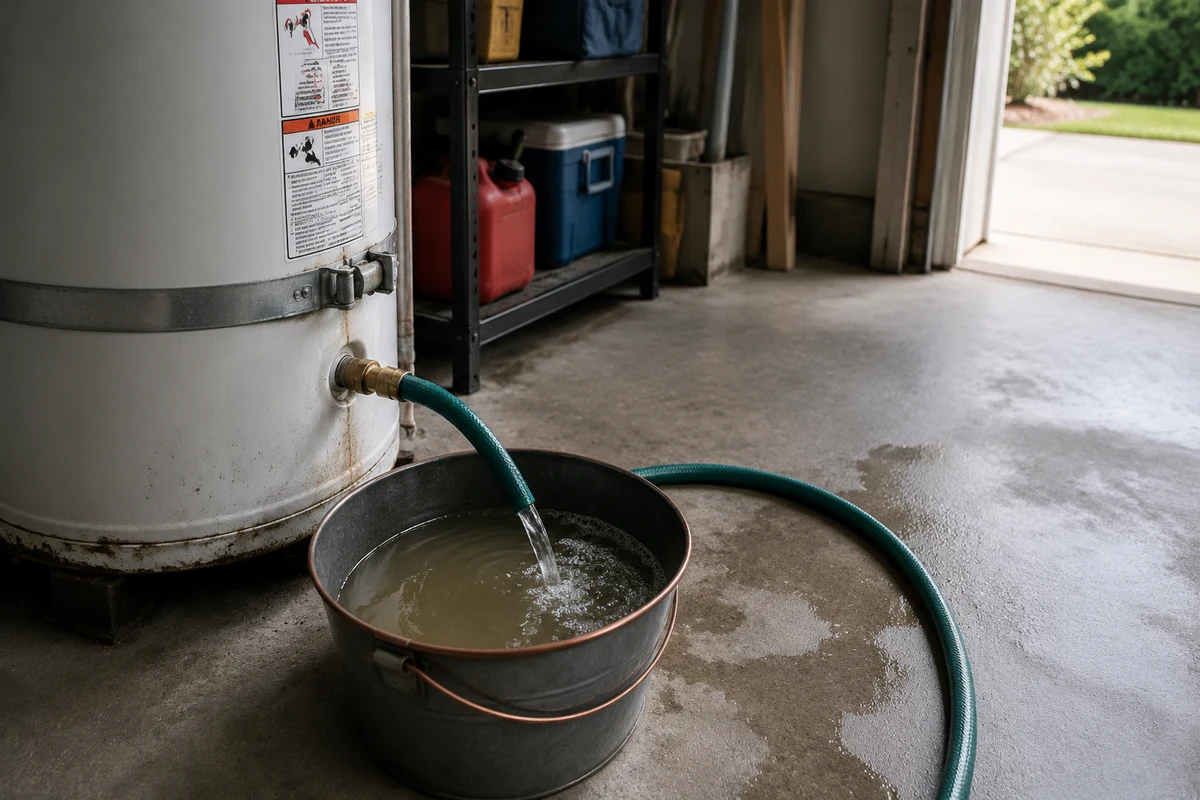
Thread a garden hose onto the drain valve at the bottom and run the other end to a floor drain, outside, or a bucket. Below the tank? You’ll need a transfer pump.
Open a hot tap to break the vacuum
Turn on a hot-water faucet somewhere in the house, or lift the T&P relief valve lever. Without this, the tank won’t drain — it’s like holding your thumb over a straw.
Open the drain valve and empty the tank
Let it run out completely. The first water may be brown and gritty; that’s the sediment you came for.
Flush until clear
With the drain still open, briefly open the cold supply in short bursts. The rush of cold water stirs up and blasts out the settled crud. Repeat until the water runs clean.
Close up and refill
Shut the drain valve, remove the hose, and close the T&P lever if you opened it. Open the cold supply and leave that hot tap running.
Purge the air, then restore power or gas
When the hot tap runs a steady stream with no sputtering, the tank is full and the air is out — give it three-plus minutes. Only now flip the breaker back on or relight the gas. Restoring the heat before the tank is completely full is what kills electric elements.
What if it won’t drain?
A trickle or nothing at all from a wide-open drain valve almost always means sediment has clogged the valve itself. Don’t force it. Try these in order:
- Back-flush it. Close the drain, open the cold supply for a few seconds to build pressure, then reopen the drain. The surge often clears the blockage.
- Poke it. With the valve open, work a stiff wire or a straightened coat hanger into the opening to break up the clog.
- Cycle the valve. Open and close it several times; the moving seat can shear off packed sediment.
- Upgrade it. If your heater has the cheap plastic drain valve, replacing it with a full-port brass ball valve makes every future flush painless. Do this while the tank is already drained.
How often should you actually flush?
There’s no universal number — it depends entirely on how hard your water is, because hardness is what deposits the mineral in the first place. A soft-water home can coast on a yearly flush, while a well-water house may need one every few months to stay ahead of the crust. Pick your situation and get a real interval.
Flush frequency finder
Not sure of your hardness? A hardware-store test strip or a call to your water utility settles it. Well water is almost always hard.
Every 6 months
Hard water lays down scale fast; twice a year keeps the burner or element clear.
When a plain flush isn’t enough
If the water clears but the tank still pops, or barely any sediment comes out of a heater you know is old, the crust has hardened past what water alone removes. That’s when you delime: drain the tank, pour in a few gallons of plain white vinegar or a commercial delimer through the anode or hot-outlet port, let it soak six to eight hours, then flush again. The mild acid dissolves the scale that flushing can’t knock loose. On electric tanks, pulling the elements to wire-brush the caked scale off them at the same time makes a real difference to how fast they reheat.
Is it ever too late to flush?
Sometimes. On a tank that’s a decade old and heavily rusted, an aggressive flush can dislodge scale that was quietly plugging pinhole leaks, and the tank starts weeping afterward. That isn’t the flush breaking the tank — it’s revealing a tank that was already failing. If yours is old, rusty, and has never been flushed, a gentle single drain is reasonable, but be ready for the result to tell you it’s replacement time.
Frequently asked
How often should I flush my water heater?
Once a year for soft to slightly hard water, every six months for hard water, and every three to four months for very hard or well water. If you don’t know your hardness, treat it as hard and flush twice a year until you test.
Can I flush a gas water heater myself?
Yes. The steps are the same as electric except you turn the gas dial to Off or Pilot instead of flipping a breaker, and you relight the pilot at the end. Everything else — cool down, drain, flush, refill, purge air — is identical.
Why won’t my water heater drain?
Sediment has clogged the drain valve. Back-flush by pressurizing with the cold supply, poke the opening with a stiff wire, and cycle the valve open and closed. If it’s a cheap plastic valve, replace it with a brass ball valve while the tank is drained.
How long does flushing take?
Twenty to sixty minutes of active work, plus one to two hours of cooldown before you start. Heavily sedimented tanks take longer because you’ll flush several times until the water runs clear.
The water won’t run clear — what now?
Keep alternating short bursts of cold supply with draining; most tanks clear after several cycles. If it stays rusty rather than just gritty, that’s tank corrosion, not loose sediment, and points toward end of life rather than a flushing problem.
Do I really have to refill before turning the power back on?
On an electric heater, absolutely. An element energized in an empty or partly empty tank overheats and burns out in seconds. Wait until a hot tap runs a steady, sputter-free stream, then restore power. Gas units are more forgiving but should also be full first.