A dial reading of 140 on a fresh water heater is not a recommendation. It is the factory hedging its bet against every possible household, and it means the tap on your kitchen sink can put a third-degree burn on a child in about the time it takes to say the word. Turning that number down to 120 takes a screwdriver, a thermometer, and an understanding of why the two numbers matter so much.
Key takeaways
- Set the tank to 120°F. It is the crossing point of scald safety, energy cost, and Legionella control.
- Electric tanks usually have two thermostats behind access panels. Both must be set to the same number, and the breaker goes off first.
- Gas tanks have one dial marked with words, not degrees. You set it, wait, and verify with a thermometer at the tap.
- Dial markings are approximate. The real number is whatever a thermometer reads at the nearest faucet after the tank recovers.
- To fight bacteria and still avoid scalds, store at 140 and fit a thermostatic mixing valve that delivers 120 at the tap.
The two dangers pulling in opposite directions
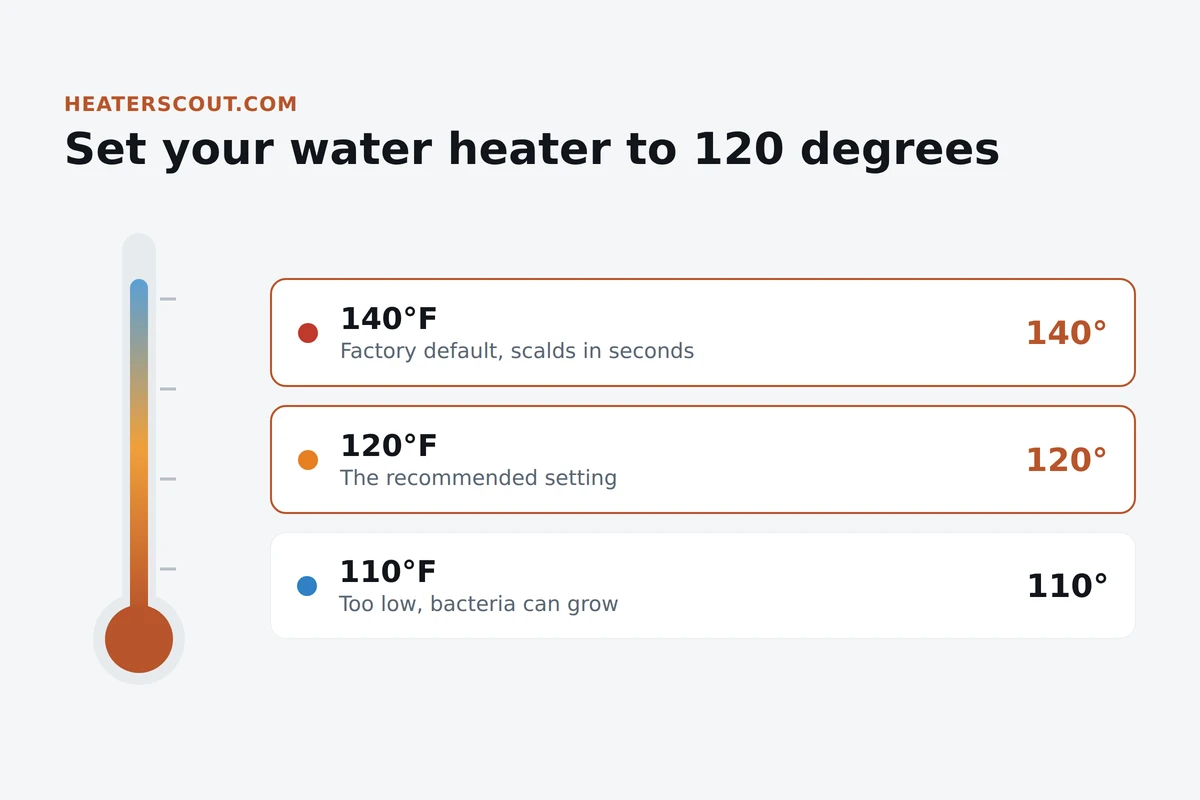
Setting a water heater is a negotiation between two hazards that live at opposite ends of the dial. Turn the temperature down far enough and the tank becomes a warm, still reservoir where Legionella bacteria can multiply. That is the organism behind Legionnaires' disease, and it thrives in water between roughly 95 and 115 degrees. Turn the temperature up to smother it and the water leaving your tap becomes hot enough to cook skin. A person who cannot pull out of the stream fast, a toddler in a tub or an older adult with slow reflexes, pays for that heat in seconds.
120 degrees is where those two curves cross for most homes. It sits above the range where bacteria bloom in a tank that gets regular use, and it sits below the range where a splash on skin turns into an emergency room visit. It is not a perfect answer to either problem. It is the setting that keeps both problems small at the same time, which is exactly what a default is supposed to do and exactly what the factory 140 fails to do. Everything else in this guide is about getting the tank to actually hold that number, because the dial and the water rarely agree.
Why the difference between 140 and 120 is measured in seconds
The gap between those two numbers does not feel like much on a dial. On skin it is the difference between a startle and a graft. At 140 degrees, water inflicts a third-degree burn on adult skin in under five seconds, and faster than that on a child's thinner skin. Drop to 130 and you buy about thirty seconds before the same injury. At 120 it takes several minutes. That is enough time for a person to notice, react, and get clear, which is the entire point. The scald data is why pediatricians and burn units push 120 in any home with kids or elderly residents, and why the small energy savings are almost beside the point. The real payoff is reaction time.
| Gas | Electric | |
|---|---|---|
| Where the control is | One gas control valve on the front, near the bottom | One or two thermostats behind access panels on the side |
| What the dial shows | Words or letters (Warm, Hot, Very Hot, Vacation), no degrees | A numbered dial, usually about 90 to 150 |
| Tool needed | None, you turn the knob by hand | A flat-blade screwdriver |
| Power first | No power to cut, but the pilot stays lit | Cut the 240V double-pole breaker before touching anything |
| Number of adjustments | One dial | Both thermostats, set to match (upper often a touch higher) |
| How you confirm | Thermometer at the tap after recovery | Thermometer at the tap after recovery |
Setting the number, step by step
The procedure splits by fuel, but the last step is identical for both: you measure the real water at a real faucet. On a gas tank you turn the single control knob toward the middle of its range, roughly where 120 should fall, since brands like Rheem, AO Smith, and Bradford White mark that spot as the line between Warm and Hot or a center notch rather than a number. On an electric tank the job is more involved and more dangerous, because the terminals behind those panels carry 240 volts. Here is the full sequence for an electric tank, which is the one people get wrong.
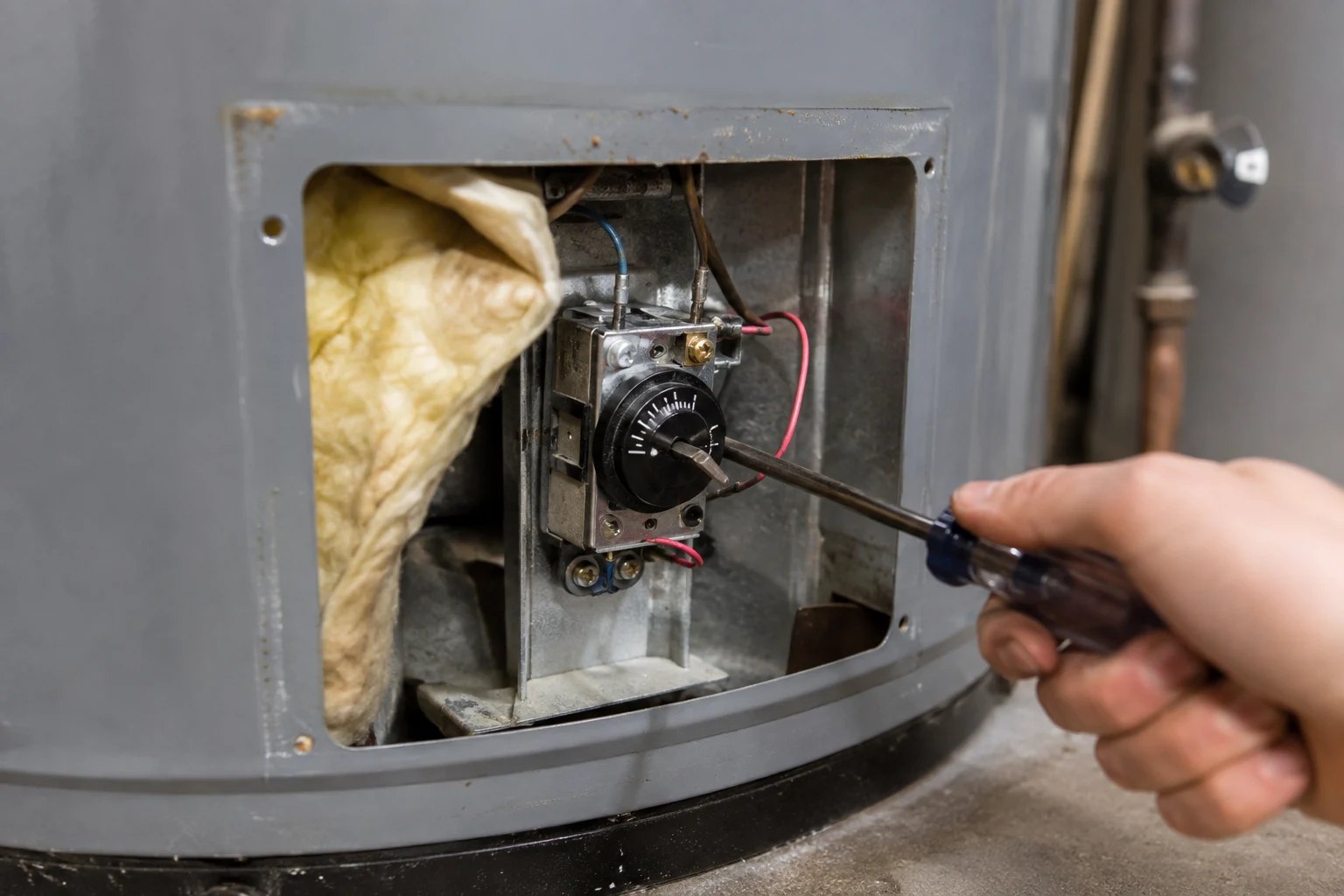
That last step is not optional busywork. A thermostat sensor reads the tank wall, not the water, so the printed number and the real output routinely disagree by four or five degrees in either direction. The dial gets you close. The thermometer tells you the truth. It also catches a subtler problem: if the tap reads far hotter than the dial suggests, a thermostat may be stuck or failing, and the water could be climbing toward scald range no matter where you set the knob.
| 110°F and below | No scald risk, but Legionella and other bacteria can multiply in a stagnant tank |
| 120°F | Scald takes several minutes; bacteria growth low for a tank in regular use; recommended setting |
| 130°F | Scald in about 30 seconds; bacteria growth largely suppressed; higher standby energy loss |
| 140°F | Third-degree burn in under 5 seconds, faster on a child; bacteria killed reliably; most energy loss and scale |
| 140°F stored, 120°F delivered | Best of both, using a thermostatic mixing valve to blend hot storage down to a safe tap temperature |
Want hot storage and a safe tap? Add a mixing valve
If your household needs hot storage to fight Legionella but also has anyone who cannot dodge a scald, do not compromise on the dial. Store the tank at 140 and install a thermostatic mixing valve on the hot outlet. It blends in cold to deliver a steady 120 at every tap while the tank stays hot enough to keep bacteria down. It is a single valve, it costs less than most people expect, and it resolves the one tradeoff the dial cannot.
Frequently asked
What temperature should my water heater be set to?
120 degrees Fahrenheit is the number the Department of Energy and most plumbers land on. It is hot enough to run a dishwasher and hold bacteria growth in check, cool enough that a slip in the shower does not scald you in seconds, and it sheds far less standby heat than the 140 many tanks ship at. If the house has a toddler or an elderly relative who cannot jump clear of a hot stream, 120 is the ceiling, not a starting point to climb above.
Why do water heaters come from the factory set to 140?
The 140 default is a one-size-fits-nobody safety margin. It covers the biggest, hardest-working household the manufacturer can imagine, including old dishwashers that never preheat, and it keeps Legionella bacteria suppressed inside the tank. The cost of that margin is real: a scald burn in under five seconds and a heater that burns extra fuel around the clock to hold water hotter than most homes ever use. Turning it down to 120 after install is one of the cheapest safety and energy moves in the house.
Do electric water heaters have one thermostat or two?
A short point-of-use electric tank has one. A standard tall residential tank has two, an upper and a lower, each hidden behind its own access panel with a slab of insulation packed in front. Both control the water temperature and both must be set to the same number. Setting only the panel you can reach is the single most common mistake, and it leaves the tank cycling against itself with the bottom half never quite matching the top.
How long after I change the setting should I measure?
Give a full tank two to three hours to reheat and settle, then read the temperature at the nearest hot tap after running it for a minute. The water already sitting in the tank has to be reheated or blended before the number stabilizes. Checking ten minutes after you turn the dial only tells you what was already in there, not where the tank will actually land.
Is 120 degrees hot enough to kill Legionella?
At 120 the risk is low for a tank that gets used regularly, but it is not zero, and the bacteria are killed reliably only above about 130. That is why some setups store the water hotter, around 140, and add a thermostatic mixing valve that blends it back to 120 at the tap. You get the disinfection of hot storage and the scald protection of cool delivery. For a normal single-family home with steady use, a clean tank at 120 is the accepted balance; a vacation home that sits stagnant for weeks is where higher storage earns its keep.
The dial says 120 but the tap feels off. Which do I trust?
Trust the thermometer at the tap, always. A thermostat sensor sits against the tank wall, not in the water, so a dial reading of 120 can put the actual output at 116 or 124. The printed markings are a starting guess. Set the dial, wait for recovery, measure the real stream at the faucet, and nudge the dial until the tap reads 120. On gas tanks the dial does not even show degrees, so the thermometer is the only honest reading you have.
Dialed it in but the water still fights you?
Lukewarm, running out fast, or swinging hot and cold usually points at a heating element, a thermostat, or a gas burner rather than the setting. Browse the electric and gas troubleshooting guides to track down the actual part.