Pull the drain valve on a heater that has run five years on hard water and what comes out first is not water. It is a gray slurry of calcium and rust, and the last cup can be nearly solid. That pile did not arrive on a schedule. It built at a rate set by your water, your household, and whether anything treats the supply before it reaches the tank. So the honest answer to how often you should flush is not a single number. It is a range that swings from once a year down to every three months, and where you land depends on measurable things you can check today.
How often should I really flush it?
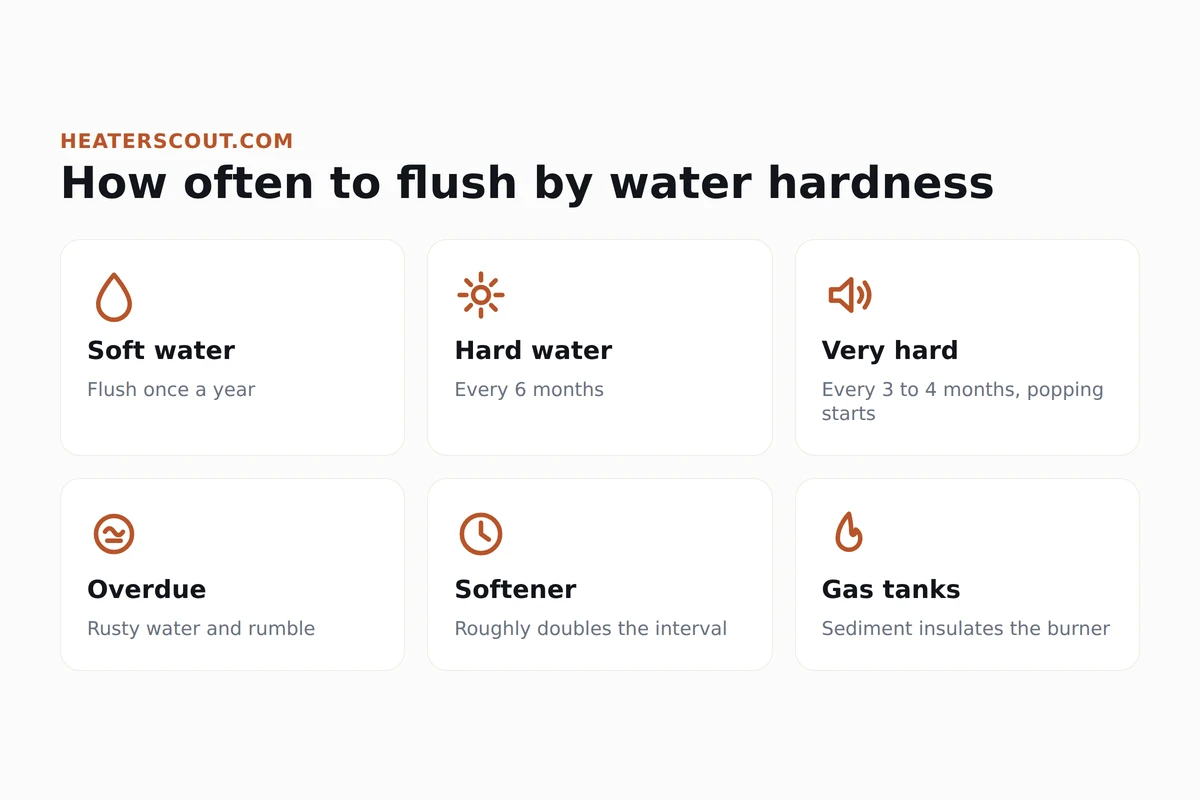
Start with your water hardness. Soft water under 3 grains per gallon means once a year. Moderate water at 3 to 7 grains means every 9 to 12 months. Hard water at 7 to 10 grains means every 6 months. Very hard water above 10 grains means every 3 to 4 months. Then adjust: a big, high-use household shortens the interval, and a whole-house softener roughly doubles it. Well water with sand or silt can push you shorter still.
Hardness is the main dial, and it is a number you can look up
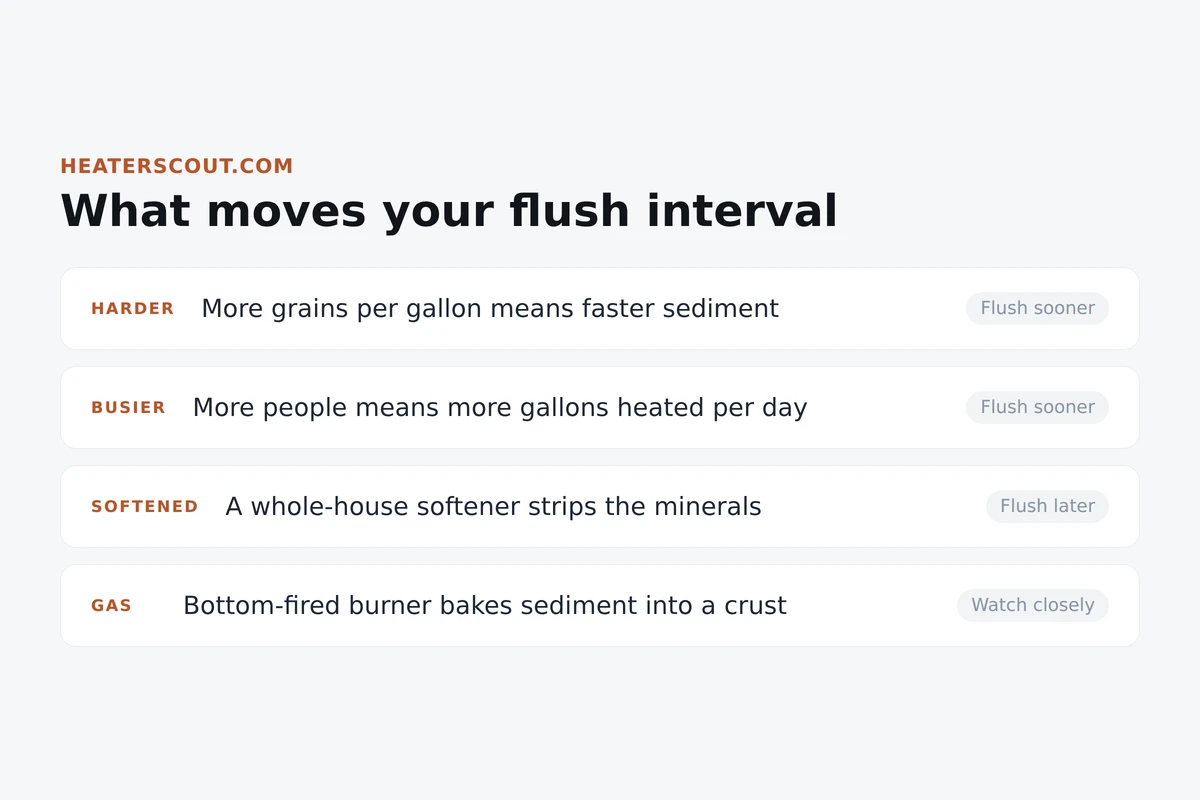
Everything about flush frequency traces back to how much dissolved mineral your water carries, and that is measured in grains per gallon. Water is called soft below 3 grains, moderately hard from 3 to 7, hard from 7 to 10, and very hard above 10. The scale matters because those minerals, mostly calcium and magnesium, drop out of solution when water is heated and settle to the bottom of the tank as sediment. More grains per gallon means more mineral falling out per gallon heated, which means the sediment layer grows faster and the tank crosses the point where it needs a flush sooner.
You do not have to guess your hardness. A municipal utility publishes it in the annual water quality report, usually in grains per gallon or in milligrams per liter. If yours reads in mg/L, divide by 17.1 to get grains. On a private well, a cheap test strip or a lab test gives you a firm number, and wells often run harder than city water on top of carrying sand and silt that city treatment removes. Once you have that one figure, the baseline interval below falls right out of it.
Read the bars as flush interval, not as severity. A longer bar is a longer stretch between flushes, so soft water earns the widest bar and a full year of grace. The bars tighten as the grains climb, and by the time you reach very hard water the tank is asking for attention three or four times a year. Well water sits at the short end even when its hardness reads moderate, because the sand and silt it carries settle on top of the mineral scale and fill the bottom faster than dissolved hardness alone would.
Two more things move the number: how many people, and whether the water is softened
Hardness sets the baseline, but two household factors slide it. The first is throughput. Sediment accumulates per gallon of water heated, so a house of five that runs the heater hard all day drops far more mineral than a couple who shower once each. Same water, same tank, but the busy household hits the flush-worthy sediment level noticeably sooner. If your home is large or high-use, treat your hardness baseline as a ceiling and flush on the short side of it.
The second is treatment. A whole-house water softener runs the incoming supply through a resin bed that trades the scale-forming calcium and magnesium for sodium. Far less mineral reaches the tank, so far less sediment settles, and the practical result is that a softener roughly doubles the interval your raw hardness would call for. A house on 10-grain water that would flush every 6 months can stretch closer to a year once a softener is in line. It does not eliminate flushing, because a trace of mineral and grit still gets through, but it changes the math enough to matter.
The signs you already waited too long
Numbers give you a schedule, but the heater gives you feedback, and it is worth knowing what an overdue tank sounds and looks like. These are the tells that the sediment layer has crossed from harmless to a working problem. If you notice any of them, do not wait for the calendar; flush now and then shorten your interval going forward.
- Popping, rumbling, or a kettle-like crackle when the burner or element runs
- Hot water runs out faster than it used to, since sludge is stealing tank volume
- Longer reheat and a creeping energy bill as the burner fights an insulating layer
- Rusty or cloudy hot water, or grit in the aerator screens on hot taps only
- The drain valve dribbles or clogs when you open it, a sign of packed sediment
- A gas tank whose bottom pings and knocks as trapped water flashes to steam
The popping deserves a word because it is the most common early warning. Sediment forms a crust on the tank bottom, water works its way underneath it, and when the burner fires that trapped water superheats and flashes to steam with a pop. Each pop is the crust flexing against the steel. It is annoying, but the real cost is the overheating happening under that crust, which stresses the glass lining and shortens the life of the tank. Rusty hot water that clears when you switch to cold points the same direction: the sediment and a spent anode are letting the steel corrode inside the tank.
Run your numbers
Set the slider to your water hardness in grains per gallon, dial in how many people live in the house, and flip the softener switch if you have one. The tool returns a recommended flush interval in months and a short note on what that schedule means for your tank. It starts from the clamp-and-adjust logic above: a baseline that falls as hardness rises, tightened for a big household and stretched for a softener.
How often should you flush?
Three inputs, one interval. A guideline, not a guarantee — check your tank for popping and rusty water too.
0–3Moderate
3–7Hard
7–10Very hard
10+
A quick flush, in brief
This article is about how often, not the full how-to, which lives in its own guide with every step and photo. But it helps to hold the shape of the job in your head when you decide whether an interval is realistic for you. Here is the short version, the reminder rather than the manual.
Old, never-flushed tanks: go easy
If your heater is eight or more years old and has never been drained, think twice before a hard flush. On an old, never-flushed tank the sediment can be the only thing plugging early corrosion pinholes on the bottom, and disturbing it sometimes starts a leak within days. On a tank that age, a gentle flush is fine, but if the water comes out as thick sludge that will not clear or the drain valve is caked shut, take it as a sign the tank is near the end and plan the replacement instead of forcing the issue.
Frequently asked
How often should I flush my water heater?
It depends on your water hardness more than anything else. On soft water under 3 grains per gallon, once a year is plenty. Moderately hard water at 3 to 7 grains wants a flush every 9 to 12 months. Hard water at 7 to 10 grains runs on a 6-month cycle, and very hard water above 10 grains needs it every 3 to 4 months. A whole-house softener roughly doubles whatever interval your raw hardness calls for. Well water carrying sand or silt can force you to flush even more often than the hardness number alone suggests.
How do I find out how hard my water is?
Check your utility's annual water quality report, which lists hardness in either grains per gallon or milligrams per liter. To convert, divide the mg/L figure by 17.1 to get grains per gallon. If you are on a private well, a $15 test strip kit or a lab test gives you a real number. As a rough field read, soft water lathers easily and leaves few spots, while hard water leaves crusty white scale on faucets and glassware. Anything over 7 grains per gallon is considered hard and should push you toward a shorter flush interval.
Does a water softener mean I never have to flush?
No, but it buys you a lot of time. A softener swaps the calcium and magnesium that form scale for sodium, so far less sediment settles in the tank. That roughly doubles the interval between flushes for a given household. You still flush, just less often, because a softener does not catch everything and a small amount of mineral and grit still makes it through. Skipping flushes entirely on softened water is a slow way to shorten the heater's life, even if the tank stays cleaner than it would on raw hard water.
Do gas and electric heaters need flushing on the same schedule?
Both benefit, but gas heaters suffer more from a given amount of sediment. A gas tank is heated by a burner underneath the steel bottom, so any sediment layer sits directly between the flame and the water and acts as insulation. That makes the burner work harder, overheats the steel, and causes the popping and rumbling you hear. An electric heater has its elements mounted partway up the tank, so a bottom sediment pile is less directly in the heat path, though sediment can still bury a lower element and burn it out. Use the same hardness-based schedule for both; just know a gas tank is less forgiving when you fall behind.
What happens if I never flush my water heater?
Sediment keeps stacking on the bottom until it changes how the heater works. You lose usable hot water volume because the sludge takes up tank space. Recovery slows down and your energy bill creeps up because the burner or element is fighting an insulating layer. You start hearing popping and rumbling as water gets trapped under the crust and flashes to steam. Eventually the extra heat stress cracks the glass lining, corrodes the steel, and kills the anode faster, which shortens the tank's life by years and can turn a routine chore into an early replacement.
Is it too late to flush an old heater that has never been drained?
Sometimes flushing a long-neglected tank does more harm than good. On a heater that is eight or more years old and has never been drained, the sediment may be the only thing plugging small pinhole corrosion spots on the tank bottom. Disturb it and the tank can start leaking within days. If the drain valve is caked shut or the water comes out as thick sludge that will not clear, that is a sign the tank is near the end of its life anyway. On a heater that age, weigh a careful flush against just planning the replacement.
How long does a flush take and can I do it myself?
A routine flush is a 30 to 60 minute job that most homeowners can handle with a garden hose and a bucket. The full step-by-step lives in our dedicated flushing guide. The short version: cut the power or set gas to pilot, shut the cold inlet, hook a hose to the drain valve, and run the tank until the water leaves clear. The only real cautions are letting the water cool first so you do not scald yourself, and not dry-firing an electric element by leaving power on with the tank empty.