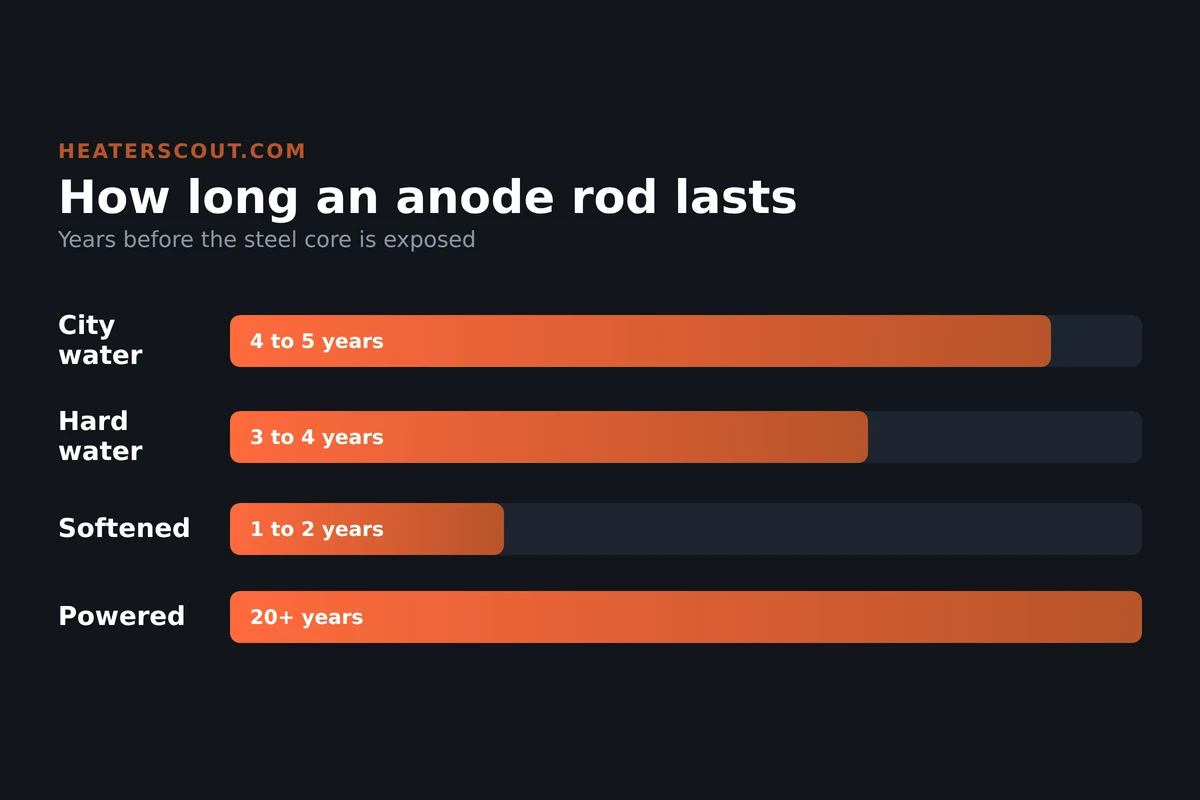
A water heater has a sacrificial anode rod screwed into the top, a bar of magnesium or aluminum whose entire job is to rust so the steel tank does not. It works by giving itself up: the reactive metal corrodes first, and while there is rod left, the tank is protected. The whole question of tank life comes down to how long that bar lasts before it is gone. On average water that is three to five years. Add a water softener and it can be one.
What actually eats the rod
The anode does not wear out on a timer. It corrodes in proportion to how hard the water pushes the galvanic reaction that protects your tank, and a handful of conditions crank that reaction up or down. Get a feel for which ones apply to your house and you can predict, within a year, when you will be shopping for a new rod. Here is how much each factor tends to move the needle in a real household.
The softener sits at the top of that list for a reason, and it catches almost everyone off guard. A softener swaps the calcium and magnesium hardness for sodium, and that dissolved salt makes the water a much better conductor of electricity. The anode does its work through a small electrical current between the reactive rod and the steel tank, so better-conducting water means a stronger current and a rod that burns through in a fraction of the time. People install a softener to protect their plumbing and their skin, never realizing they just cut the heater anode's life roughly in half. If your water is softened, assume one to two years and check accordingly.
Well water is the wild card. It ranges from gentle to brutally aggressive depending on pH, dissolved oxygen, and mineral content, so two houses on wells a mile apart can see very different rod life. Low pH, acidic water is especially hard on a rod. Municipal hard water is a milder version of the same story: more dissolved minerals nudge the corrosion along, shaving months off. Temperature and usage are the smaller levers. Running the tank at 140 degrees instead of 120 speeds the chemistry, and heavy draws keep pulling in fresh oxygenated cold water that feeds the reaction. None of those alone is dramatic, but a hot, hard-water house with four teenagers can pull a nominal five-year rod down to three.
Magnesium, aluminum, or powered: what each buys you
The rod material changes the story less than people expect, with one exception. Magnesium and aluminum are both sacrificial, meaning they get consumed, and they run through their life on a broadly similar clock. The powered rod is the one that breaks the pattern, because it is not sacrificed at all. Here is how the three stack up on the thing that decides tank life.
| Type | How it protects | Typical life | Best fit |
|---|---|---|---|
| Magnesium | Sacrifices itself; most reactive, strongest protection | 3 to 5 yr | Standard city water |
| Aluminum (Al-Zn) | Sacrifices itself; the zinc fights sulfur smell | 3 to 5 yr | Rotten-egg odor, aggressive water |
| Powered / impressed current | Plug-in current, nothing is consumed | 20+ yr | Softened water, no smell, set and forget |
Read that middle column carefully. Swapping a magnesium rod for an aluminum-zinc one does not buy you much lifespan; the zinc is there to knock out the rotten-egg sulfur smell, not to last longer. Both sacrificial rods corrode at a similar rate. The powered anode is the genuine escape hatch. Because it protects the tank with a trickle of current from a small transformer instead of by dissolving metal, there is nothing to use up, and one can outlive several sacrificial rods. On softened water, where a magnesium rod might vanish in eighteen months, a powered rod that runs twenty years is often the smarter buy over the life of the tank.
Estimate your own rod's life
Plug in your water, your softener, your setpoint, and how hard you run the heater. The estimator starts from a 4.5-year baseline on average water and adjusts for each condition, then tells you the year to pull the rod and look. It is a planning number, not a guarantee, because water chemistry varies. When in doubt, check early.
Anode rod life estimator
Rough years until the rod is spent, plus the year to inspect it. Softened water is the big mover. Not a guarantee — pull the rod and look when it says to.
—
Check on a schedule, not on a symptom
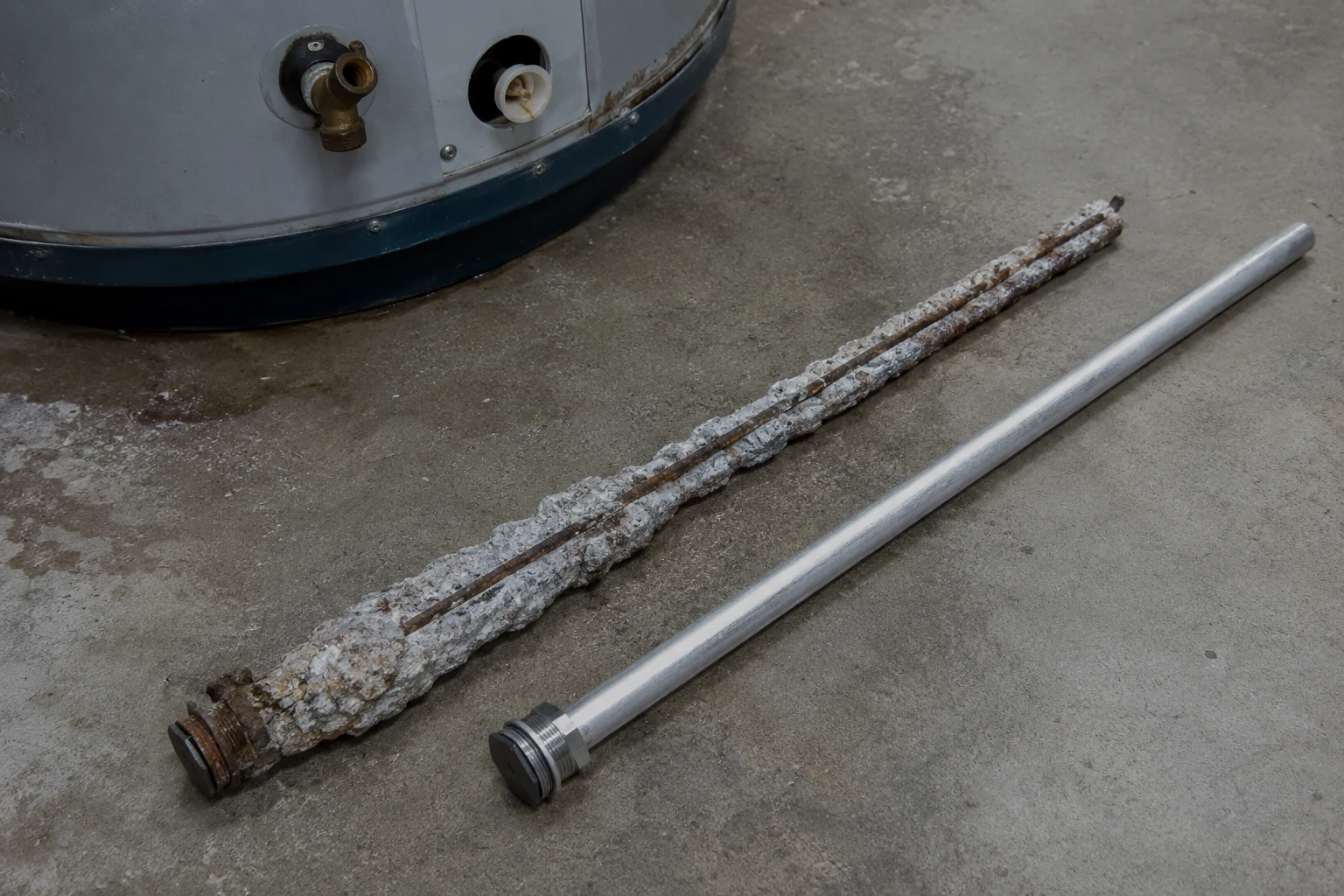
Do not wait for a symptom, because a spent anode makes no noise. Put the rod on a schedule instead. On city water, pull it at year 3 and eyeball it. On softened or well water, pull it at year 1 to 2. The check itself is one big hex bolt on top of the tank and a socket wrench. If more than half the rod is gone or the steel core shows, replace it that day. Keeping a spare rod on the shelf turns a two-week wait into a fifteen-minute job.
Match the rod to your water
The right move depends less on the brand than on what comes out of your tap. Three common situations cover most homes, and each points to a clear choice for both the rod and the checkup interval.
Standard municipal supply
A plain magnesium rod is the right default. It gives the strongest protection and lasts the full 3 to 5 years. Pull and inspect it at year 3, replace when it is half gone, and your tank will likely outlive the warranty. No reason to overthink it on ordinary treated water.
House has a salt softener
This is where a powered anode earns its price. Sacrificial rods die in 1 to 2 years on softened water, so you would be swapping them constantly. A powered rod is not consumed and runs 20-plus years, making it the set-and-forget answer for softener homes. If you stay sacrificial, check yearly.
Rotten-egg sulfur odor
Switch to an aluminum-zinc rod or a powered anode to kill the smell, which comes from bacteria reacting with the magnesium. Expect similar lifespan to magnesium from the aluminum-zinc rod, so keep the same 3-to-5-year check habit. A powered rod solves the odor and the lifespan at once.
What checking the rod actually involves
None of this matters if the rod never gets looked at, so it helps to know the job is small. The anode sits under a hex head on top of the heater, sometimes hidden under a plastic cap, and occasionally it is combined with the hot-water outlet nipple. Cut the power or set the gas to pilot, shut the cold inlet, and relieve pressure by opening a hot tap. A 1-1/16 inch socket on a breaker bar backs the rod out. Lifting it clear tells you everything: a fat, lightly pitted rod has years left, while a thin one chewed down to the wire is overdue. Clearance above the tank can be tight, and a flexible segmented rod solves that when the ceiling is low.
The thing worth internalizing is why the timing pays off. A rod caught at 60 percent consumed and replaced costs about thirty dollars and fifteen minutes. A rod ignored until it is gone hands the corrosion to the tank steel, and once the tank starts pitting from the inside there is no rod swap that reverses it. You are then on a countdown to a bottom leak and a full heater replacement, often years sooner than the tank would otherwise have failed. The anode is the cheapest insurance in the whole appliance, and it only works if the metal is still there to sacrifice.
Frequently asked
How long does a water heater anode rod last on average?
On ordinary municipal water, a standard magnesium or aluminum rod lasts about 3 to 5 years before it is eaten down to the steel core wire. Aim to pull it out and look at it around year 3, because the exact number swings a lot with your water. Once the rod is more than roughly half consumed, or you can see the bare steel core running down the middle, it has stopped protecting the tank and it is time to swap it.
Why does a water softener shorten anode rod life so much?
Softened water is the number-one reason a rod dies early. A softener trades hardness minerals for sodium, and that salt makes the water far more electrically conductive. The anode protects the tank through a galvanic reaction that runs on that conductivity, so more conductive water drives the reaction harder and burns the rod faster. On softened water a rod that would have lasted 4 or 5 years often lasts only 1 to 2. It is the single biggest surprise for people who add a softener and later find a rusted-out tank.
How do I know when my anode rod needs replacing?
Two signs. First, when more than about half the material is gone, meaning the fat rod you installed now looks thin and pitted. Second, when the steel core wire that runs down the center is exposed for six inches or more. That bare wire means the sacrificial metal around it has been used up, and from that point the tank steel itself becomes the sacrifice. Either sign is your cue to replace it. If you have never checked, and the heater is more than three years old, pull the rod and look.
What happens if I never replace the anode rod?
The rod is designed to corrode instead of your tank. It is a bar of magnesium or aluminum that dissolves so the steel does not. When it is fully consumed and nobody replaces it, the corrosion moves to the next most reactive metal in the tank, which is the steel wall itself. That is exactly how tanks rust from the inside, spring a bottom leak, and fail years before they had to. A $30 rod checked every few years is what stands between a good tank and an early replacement.
Is a powered anode rod worth it for softened or well water?
For softened water, often yes. A powered anode, also called an impressed-current anode, uses a small plug-in transformer to protect the tank electrically instead of by sacrificing metal. Because nothing gets consumed, it can run 20 years or more, so it sidesteps the fast burn-out that plagues sacrificial rods on softened water. It also does not add the sulfur smell that magnesium sometimes causes. The trade is a higher upfront cost and needing an outlet nearby, but on aggressive or softened water it usually pays for itself in tank life.
Does turning up the temperature or using more hot water wear the rod faster?
Yes, both do. A higher setpoint speeds up the corrosion chemistry inside the tank, so a heater run at 140 degrees eats its rod a little faster than one at 120. Heavy hot-water use matters too, because every gallon drawn pulls in fresh, oxygen-carrying cold water that feeds the reaction. A big family running the heater hard will go through rods quicker than a couple in the same house on the same water. Neither effect is as large as a softener, but stacked together they can pull a 4-year rod down closer to 3.
Does an aluminum-zinc rod last longer than a plain magnesium rod?
Not really. Aluminum-zinc rods exist mainly to fight the rotten-egg smell that magnesium can trigger on some water, and they corrode at a broadly similar rate, so you should not expect a dramatic lifespan gain from switching to one. Aluminum is a bit more tolerant of aggressive water than magnesium in some cases, but the honest lever for lifespan is either checking a sacrificial rod on schedule or moving to a powered anode that does not get consumed at all.