A 50-gallon tank tells you almost nothing about whether two people can shower while the dishwasher runs. What decides that is flow, measured in gallons per minute, and specifically how much flow you demand at the same instant versus how much your heater can hand out at that instant. Get the simultaneous number right and the tank size stops mattering. Get it wrong, usually by planning around summer, and the shower goes lukewarm on the coldest morning of the year.
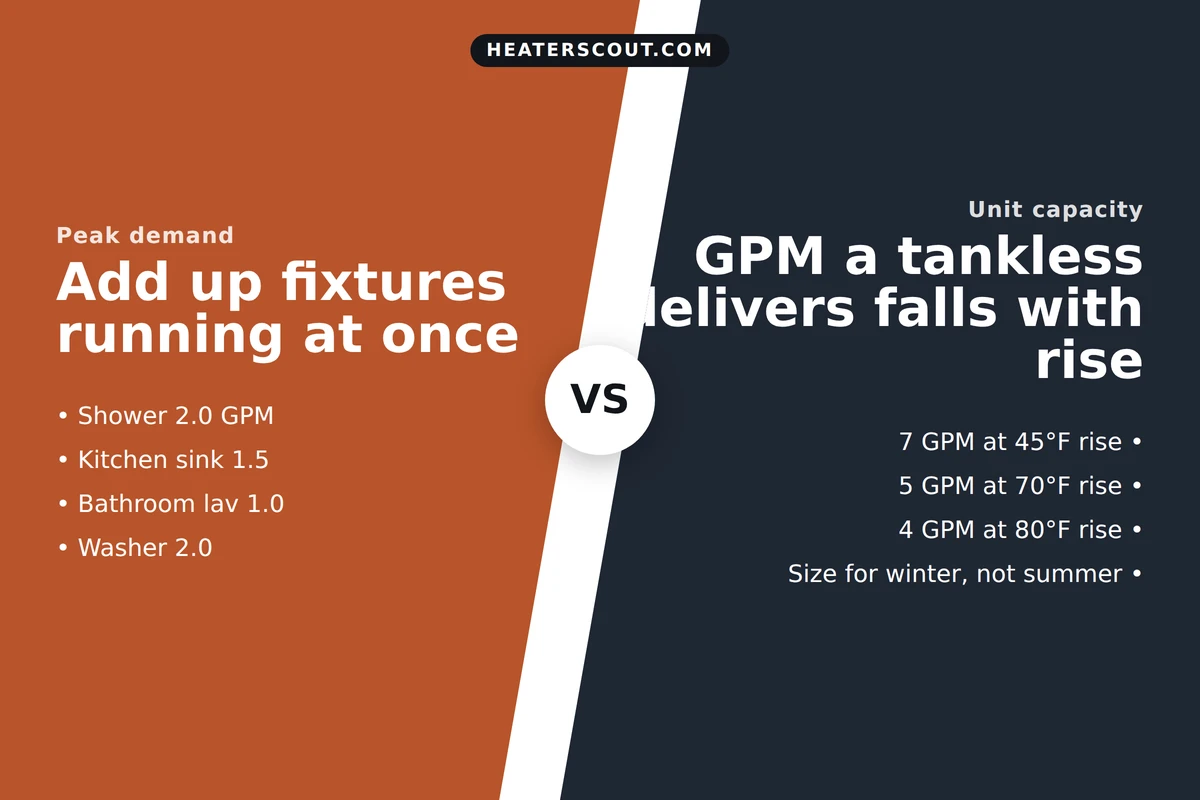
Demand is a sum of what runs at once
Peak hot water demand is not the total of every fixture in the house. It is the total of the fixtures that can plausibly run at the same moment on a bad morning. Nobody runs the shower, both bathroom sinks, the kitchen faucet, the dishwasher, and the washing machine all at once, so summing all of them oversizes badly. But two showers plus a sink is a real overlap, and that is the number to plan around.
Typical hot-side flow rates are easy to look up. A standard showerhead is 2.5 GPM, a WaterSense head 2.0. A kitchen faucet runs about 1.5, a bathroom lavatory near 1.0, a dishwasher and a clothes washer roughly 1.0 to 2.0 each on their hot fill. Pick the fixtures that overlap in your household and add their hot-side flow. A two-bathroom family often peaks around 4.5 to 5.5 GPM. A big house with teenagers can touch 7. That single number is your design demand.
Notice the bottom row. Swap two 2.5 GPM showerheads for 2.0 WaterSense heads and you shave a full gallon per minute off the peak. That gallon is often the exact margin that lets a single tankless unit keep up in winter instead of falling behind. Low-flow fixtures are not just a water bill line item, they change what heater you can get away with.
Capacity is fixed BTUs divided by the rise
A tank heater stores hot water, so it can briefly hand out more flow than its burner can reheat. A tankless heater stores nothing, so its output is pure physics: the burner's BTUs go straight into whatever flow passes through. The deliverable flow is BTU input times efficiency, divided by 500 times the temperature rise. The 500 is 8.33 pounds per gallon times 60 minutes per hour, the constant that converts BTU per hour into gallons per minute of heating.
Work an example. A large residential tankless is rated 199,000 BTU and runs about 82 percent efficient. At a 70-degree rise, deliverable GPM is 199,000 times 0.82 divided by 500 times 70, which comes out near 4.7 GPM. Drop the rise to 45 degrees, a mild climate hitting 120 from a 75-degree inlet, and the same unit delivers about 7.3 GPM. Push the rise to 80 degrees, a northern winter with a 40-degree inlet reaching a 120 setpoint, and it sinks to roughly 4.1 GPM. Nothing changed about the heater. The rise did all the work.
What you demand
- Sum of fixtures running at the same time
- Fixed by your household habits and fixture flow rates
- Falls when you install WaterSense low-flow heads
- Design around the realistic worst-case overlap
What a unit delivers
- BTU times efficiency over 500 times the rise
- Fixed BTUs, but GPM changes with the season
- Highest in summer, lowest in deep winter
- Design around the coldest inlet, not the average
The trap is right there in the two columns. Demand barely moves with the season, but capacity swings hard. A unit that looks generous against your peak in July can fall a gallon short of the same peak in January, purely because the groundwater got colder. That is the number one undersizing mistake, and it never shows up on a summer install.
| Standard showerhead | 2.5 GPM (federal max) |
| WaterSense showerhead | 2.0 GPM |
| Kitchen faucet | About 1.5 GPM |
| Bathroom lavatory | About 1.0 GPM |
| Dishwasher / clothes washer | About 1.0 to 2.0 GPM each on hot fill |
| 199k BTU tankless at 45°F rise | About 7.3 GPM (mild climate) |
| 199k BTU tankless at 70°F rise | About 4.7 GPM |
| 199k BTU tankless at 80°F rise | About 4.1 GPM (cold winter) |
Run your own numbers
Check the fixtures that could overlap on your worst morning, then set the temperature-rise slider to your coldest expected inlet. The tool adds your checked fixtures into a peak demand and computes what a single 199k BTU tankless delivers at that rise, using GPM delivered equals BTU times efficiency over 500 times the rise. If demand beats capacity, you either need a bigger unit, a second one in parallel, low-flow heads, or the honest acceptance that flow drops when everything runs at once.
Hot water GPM calculator
Check the fixtures that can run at the same time, then set your coldest expected temperature rise. Output is peak demand versus what one 199k BTU tankless delivers at that rise. Design for winter, not summer.
Peak demand
3.5 GPM
Sum of checked fixtures at once
Unit delivers
4.7 GPM
One 199k BTU tankless at this rise
—
Temperature rise
The gap between your incoming water temperature and the setpoint you deliver. If cold mains water enters at 50 degrees and you want 120 at the tap, your rise is 70 degrees. It is the denominator in every tankless GPM calculation, which is why the same heater delivers wildly different flow across the seasons. Groundwater is warmest in late summer and coldest in late winter, lagging the air temperature by weeks, so a unit sized on a spring install can still disappoint in January. Always design around the coldest inlet you will see, not a yearly average, because the average never happens on the morning everyone showers.
Where sizing goes wrong
Almost every undersized tankless traces back to one of three things. The installer sized on the summer rise, so the unit came up short the first hard winter. The household added fixtures or a bathroom after the install, pushing the real peak past the design number. Or the flow rates on paper did not match reality, usually an old 2.5-plus showerhead where the calculation assumed 2.0. Each one is a gallon or two of gap, and a gallon is enough to turn a shower tepid when a second draw opens.
The fix is boring and reliable. Design the demand around the realistic worst-case overlap, design the capacity around the coldest inlet, and leave a little headroom between them. If the two numbers land close, either step up the unit, run two in parallel, or cut demand with low-flow heads. Sizing hot water on simultaneous flow instead of tank gallons is the whole game, and the season you plan for decides whether it works.
Frequently asked
How many GPM do I need for a whole house?
Add up the fixtures that can realistically run at the same time, not every fixture you own. A common morning peak is one shower at 2.0 GPM, a kitchen sink at 1.5, and a bathroom lavatory at 1.0, which lands near 4.5 GPM. Two showers going at once plus a sink pushes you past 5.5 GPM. That simultaneous number, not the sum of everything, is what your water heater has to hit. Households run 4 to 7 GPM at peak in most homes, and low-flow fixtures pull the low end down.
Why does a tankless heater lose GPM in winter?
Because deliverable flow depends on the temperature rise, and winter groundwater is colder. A tankless unit puts out a fixed number of BTUs, and GPM equals BTU times efficiency divided by 500 times the rise. In summer your inlet might be 70 degrees, so hitting a 120 setpoint is a 50-degree rise. In January that same inlet can drop to 40 degrees, making the rise 80 degrees. The rise nearly doubled, so a unit that gave 6.5 GPM in July gives closer to 4 GPM in January. Sizing on the summer rise is the single most common undersizing mistake.
How do I calculate GPM from BTU?
Deliverable GPM equals BTU input times efficiency, divided by 500 times the temperature rise in degrees Fahrenheit. The 500 comes from 8.33 pounds per gallon of water times 60 minutes per hour. So a 199,000 BTU tankless at 82 percent efficiency, working a 70-degree rise, delivers 199,000 times 0.82 over 500 times 70, which is about 4.7 GPM. Cut the rise to 45 degrees and the same unit delivers about 7.3 GPM. Raise the rise to 80 and it drops near 4.1. The BTU stays fixed; the rise moves the answer.
What is a good GPM for a shower?
A standard showerhead flows 2.5 GPM, which is the federal maximum. A WaterSense head is capped at 2.0 GPM and most feel no weaker in practice. Older or rain-style heads can run 2.5 or higher. When you size hot water, use the head you actually have installed, because swapping two showers from 2.5 to 2.0 GPM trims a full gallon per minute off your peak demand, and that gallon might be the difference between a tankless keeping up and running short.
Can one tankless heater run two showers at once?
In a warm climate, usually yes. Two showers at 2.0 GPM each is 4 GPM, and a 199k BTU unit at a 45-degree rise delivers over 7 GPM, so it keeps up with room to spare. In a cold climate at an 80-degree winter rise, that same unit delivers about 4 GPM, so two showers leave nothing for a sink and the water may cool. This is why cold-region installs sometimes use two tankless units in parallel or a larger tank-type heater, since the winter rise is the constraint, not the summer one.
Should I size hot water by tank gallons or by GPM?
For a tank heater, first-hour delivery in gallons matters because it stores hot water and can outrun its burner for a while. For a tankless unit there is no storage, so the only number that counts is GPM at your worst-case rise. Even for a tank, the simultaneous-flow view catches problems that a gallon rating hides, like two showers running longer than the tank's recovery can sustain. Size on peak GPM and you rarely get surprised; size on tank gallons alone and you can still run cold when several fixtures overlap.
What temperature rise should I design for?
Use your coldest expected groundwater inlet, not the annual average. In the northern US and Canada, winter mains can hit 37 to 45 degrees. Delivering a 120-degree setpoint from a 40-degree inlet is an 80-degree rise. In the deep South, inlets rarely drop below 65, so a 55-degree rise is realistic. Pick the setpoint you actually keep, subtract the coldest inlet, and design the unit's GPM around that worst case. A unit sized for the summer rise looks fine on the spec sheet and disappoints every January.