A single slow blink every three seconds on a Honeywell gas control valve is the heartbeat that says the heater is fine, not a warning. The same valve, the WV8840 and its dial-style WT8840 cousin, ships under A.O. Smith, State, Reliance, Bradford White, and several Rheem rebrands, so the code you count means the same thing across a dozen brands. Trouble shows up as bursts of two, four, five, or seven quick flashes with a pause between them. This page maps every status count off the Honeywell manual, shows how to count without getting fooled, walks the dial reset most owners have never heard of, and marks where the DIY line sits.
Quick answer
On a Honeywell WV8840 or WT8840 valve, one flash every three seconds is normal (pilot held, valve healthy), and a fast strobe means the burner is firing. Faults are multi-flash bursts: 2 is low thermopile voltage, 4 is a temperature cut-out, 5 is a water-temperature-sensor failure, 7 is an electronics failure (replace the valve), and 8 is a power-off warning. There is no reset button; the knob is the reset, and a high-temp lockout on dial valves clears by rotating the dial across the 120 degree mark about six times within 30 seconds.
Normal versus a fault: read the rhythm first
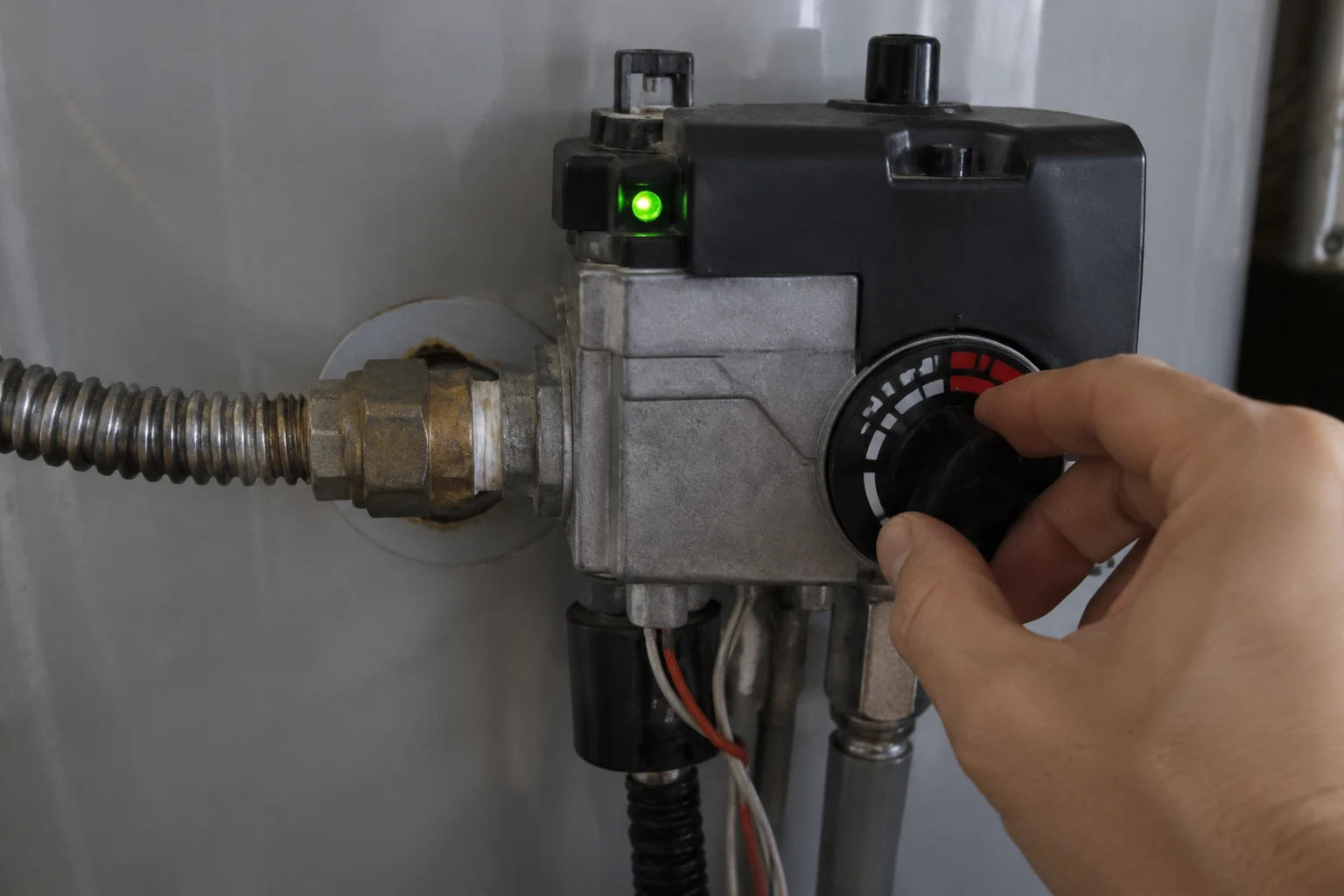
The status light lives low on the gas control valve, near the base of the tank. It has two normal states and a set of fault states, and telling them apart is the whole game. Normal idle is one flash, a long pause, one flash, a long pause, steady and unhurried, roughly one blink every three seconds with the knob in PILOT. That means the electronics are holding the pilot valve open and the main valve closed. When the tank calls for heat and the burner fires, that light changes to a faster strobe every three seconds. Also normal. A fault is different: a burst of two or more quick flashes, then a roughly three-second pause, then the identical burst again. The manual is specific about the timing, the code flashes about once per second with a three-second gap between repeats. If you keep counting and it is always one, the heater is telling you it is healthy and your no-hot-water problem is elsewhere.
Read the two lights side by side
Before you count anything, decide which mode you are in. These two look similar to a stressed homeowner at 6 a.m. but mean opposite things.
Normal (no action)
- 1 flash every 3 sec, knob in PILOT: electronics holding pilot open, main valve closed
- Fast strobe every 3 sec: call for heat, main burner running
- Solid ON that fades out: knob was turned to OFF, control shutting down (wait ~1 min)
- Steady, evenly spaced rhythm is the tell
Fault (action required)
- A burst of 2 or more quick flashes, then a pause, then the same burst
- Higher counts point deeper into the valve (thermopile up to electronics)
- Up to two different codes can show back to back, higher count first
- Write the number down before you touch the knob
The full Honeywell status-code map
This is the core of the page, pulled straight from the WT8840 status-light table (Honeywell doc 34-00013EF). Counts above one, and anything other than the plain strobe, are faults. The temperature sensing on these valves is a pair of matched NTC thermistors sealed in an immersion well, which is why a sensor problem shows as its own code and usually means a valve job.
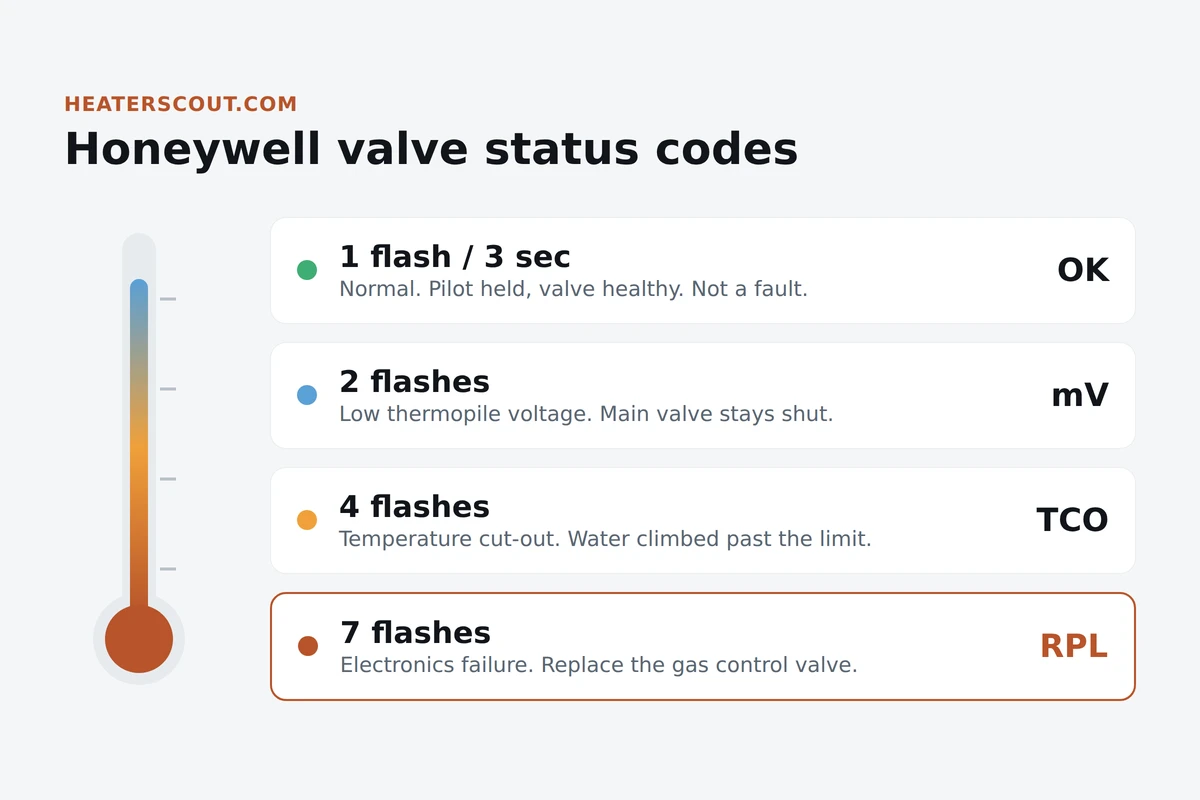
1 flash / 3 sec (PILOT): Normal. Electronics holding the pilot valve open, main valve closed. No action. Fast strobe / 3 sec: Normal. Call for heat, main valve open. 2 flashes: Low thermopile voltage, main valve not turned on. Check the thermopile, its leads, and the pilot flame. 4 flashes: Temperature cut-out (TCO) limit reached, the water got too hot. Check the valves and temperature sensor and reduce the setpoint. 5 flashes: Water-temperature-sensor failure. Check the sensor and its connection for opens, shorts, or a resistance mismatch between the two elements. 6 flashes: Tank leakage detected by the accessory module, on leak-detect models only; the control recovers when the module clears. 7 flashes: Electronics failure, replace the control module (the gas valve). 8 flashes: Power-off warning, the control does not see power decaying with the knob OFF; check the valves. Solid ON: Not an error, the control is in OFF mode; wait until the LED goes out to restart.
A word on the third-party charts you will find online: several relabel the two-flash and four-flash codes, calling two an ignition or flame failure and four simply temperature exceeded. The Honeywell manual is the authority here, and it reads two as low thermopile voltage and four as the temperature cut-out limit. If a random blog and your burner door disagree, go with the door.
How to count the flashes correctly
Miscounting is the fastest way to buy the wrong part. The flashes are quick and the pause is long, so it is easy to count a pause as a flash or lose track across cycles. The pilot has to be lit for a code to appear, so relight it first if the light is dark and give the thermopile a minute to warm. Then get a clear line of sight, kneel or use a flashlight, and watch the light itself rather than a reflection that can smear two fast flashes into one. Let one full burst-and-pause go by without counting, just to learn the rhythm. Now count only the quick flashes inside one burst, stopping at the long pause. Confirm the next burst gives the same number, because real codes repeat identically. If two different codes are stored, they play back to back with the higher count first, so give it a few cycles. Write the number down before you reset, because cycling the knob wipes it.
Key takeaways
- One flash every three seconds is normal, not an error. A fast strobe is the burner running.
- Faults are multi-flash bursts: 2 = thermopile, 4 = temperature cut-out, 5 = sensor, 7 = electronics.
- The knob is the reset. High-temp lockout on dial valves clears by crossing the 120 F mark ~6 times in 30 sec.
- Two flashes is a cheap thermopile fix. Five and seven are gas-valve replacements.
- Same WV8840/WT8840 valve ships on A.O. Smith, State, Reliance, Bradford White, and Rheem rebrands.
The verdict
Count the flashes, do not reset blind. One flash is health. Two flashes is a fifty-dollar thermopile and a Saturday job. Four flashes is a real high-temperature trip you clear once, then diagnose if it returns. Five and seven are inside the valve, which means a replacement and, for most owners, a licensed plumber. The dial reset that crosses the 120 degree mark six times is the trick that saves a service call on a one-time high-temp lockout.
The dial reset, and the flammable-vapor reset
These valves do not have a red button. The gas control knob is the reset, and knowing the exact moves saves a service call. The plain soft reset works for most codes: turn the knob to OFF, wait about a minute for the status light to go fully out, then relight the pilot per the burner-door instructions and turn the knob back to your setting. That clears a one-time fault.
Dial-style valves add a specific trick for a high-temperature lockout. After you have restored the pilot and the light is running, you have a short window, about thirty seconds, to rotate the setpoint dial back and forth across the 120 degree mark roughly six times. The control reads that deliberate motion as a reset request and drops back to the normal slow flash. It feels odd the first time, but it is the intended way to clear a TCO lockout on these dials without pulling anything apart.
Flammable-vapor models, the FVIR heaters, are different again. If the flammable-vapor sensor locks the heater out, that is not a valve fault, it is the heater telling you it smelled combustible fumes, gasoline, paint thinner, or solvent stored too close. Ventilate the space and move the source first. Then, on the common FVIR reset, turn the knob from Vacation to Very Hot twice within thirty seconds. Never bypass or jumper an FV sensor to force the burner to run through that warning.
Honeywell status light
The small diagnostic LED on a Honeywell WV8840 or WT8840 gas control valve at the base of a gas water heater. It reports the heater's state by flash count. One slow flash every three seconds with the knob in PILOT is normal, a fast strobe is the burner firing, and bursts of two or more quick flashes separated by a three-second pause are fault codes: two for low thermopile voltage, four for a temperature cut-out, five for a water-temperature-sensor failure, seven for an electronics failure, eight for a power-off warning, and six for a tank-leak signal on leak-detect models. The valve is powered by the pilot-heated thermopile and needs 350 to 850 millivolts to run. Because the same valve ships under many brands, the codes read the same on A.O. Smith, State, Reliance, Bradford White, and Rheem-rebrand heaters, though you should confirm against the chart on your own burner door.
Where the DIY line sits, and when to call a pro
Where you stop depends on the count. Two flashes is squarely homeowner work: a strong blue pilot flame should wrap the top of the thermopile, so clean the pilot, reseat the leads, and if a meter still reads low under load, swap the thermopile. The part is usually under fifty dollars and the job is a screwdriver and a wrench. Four flashes starts as homeowner work too, backing the setpoint toward 120 degrees and flushing sediment out of the tank, and only becomes a pro job if it returns on a clean tank at a sane setting, because then the sensor or the valve is failing to shut the burner off.
Five and seven flashes are the valve itself. The temperature sensor is built into the control, so a genuine sensor failure and an electronics failure both point at replacing the gas control valve. That means draining the tank, disconnecting the gas line, and swapping a part that runs roughly $150 to $300 before labor, which is where most owners bring in a licensed plumber. Before you buy anything, read the model and serial off the rating plate and check the warranty, because the gas valve is a covered part on many heaters for several years and that turns a part-plus-labor bill into labor only. A six-flash leak code is its own conversation: on a leak-detect model it means the module saw water where it should not be, and a leaking tank is not a repair, it is a replacement.
Keep sediment down with an annual flush, keep the pilot area clean, and keep gasoline and solvents away from an FVIR heater, and most of these codes never show up. When one does, the discipline is the same every time: relight, count, match the number to the chart on your own burner door, and reset once to confirm a fix rather than to paper over a safety trip.
Frequently asked
What does one flash every three seconds mean on my Honeywell water heater valve?
That is normal operation, not a fault. On the Honeywell WV8840 and WT8840 gas control valves, one slow flash every three seconds with the knob in PILOT means the electronics are holding the pilot valve open and the main valve closed, and everything is healthy. When there is a call for heat and the burner fires, that same light changes to a fast strobe every three seconds, which is also normal. People see the blinking, assume it is an error, and start resetting the heater over and over. It does nothing, because nothing is wrong. A real fault is a burst of two or more quick flashes, a roughly three-second pause, then the identical burst again. If you count exactly one flash per cycle and still have no hot water, the problem is your setpoint, gas supply, or plumbing, not a status code.
How do I read the flash code on a Honeywell gas control valve?
The status light sits low on the gas valve near the base of the tank. The pilot has to be lit for the code to show, so if it is dark, relight the pilot first and wait for the thermopile to warm up. Then watch through at least two full cycles. Count only the quick flashes inside one burst, stop at the long pause, and confirm the next burst gives the same number. Per the WT8840 manual the code flashes about once per second with a three-second gap between repeats. Two flashes is low thermopile voltage, four is a temperature cut-out, five is a water-temperature-sensor failure, seven is an electronics failure, and eight is a power-off warning. On leak-detect models a six is a tank-leak signal from the accessory module. Write the number down before you reset, because a power cycle wipes the code you were trying to read.
Can I reset the valve myself, and is there a reset button?
There is no red reset button on these gas valves the way there is on an electric heater. The gas control knob is the reset. For a soft reset, turn the knob to OFF, wait about a minute for the status light to go fully out, then relight the pilot and turn the knob back to your setting. On dial-style valves there is also a specific move to clear a high-temperature lockout: within about thirty seconds of restoring the pilot, rotate the setpoint dial back and forth across the 120 degree mark roughly six times. The control resets to the normal slow flash. On flammable-vapor (FVIR) models the sensor lockout clears differently, by turning the knob from Vacation to Very Hot twice within thirty seconds after you have ventilated the space. All of that is homeowner-safe. What is not safe is resetting a repeating high-temp or gas-valve code to force the burner back on.
What does two flashes mean and how much does the fix cost?
Two flashes is low thermopile voltage: the pilot is lit but the valve is not seeing enough millivolts to open the main valve, so the burner will not fire. The WT8840 needs its thermopile somewhere in the 350 to 850 millivolt open-circuit range to run. The usual causes are a weak or dirty pilot flame that is not wrapping the thermopile tip, a loose or corroded thermopile lead, or a thermopile that has simply worn out. Clean the pilot, reseat the leads, and if a meter still reads low under load, replace the thermopile. The part is usually under fifty dollars and it is a screwdriver-and-wrench job for most homeowners. If a plumber does it, expect a service call in the roughly $150 to $250 range depending on your area.
What does four flashes mean and is it dangerous?
Four flashes is a temperature cut-out, the manual's TCO. The valve sensed the water climbing past its high limit and shut the burner to keep the tank from overheating. It is a genuine safety trip, so it is not a code to keep resetting blind. Work the causes from cheap to expensive: a setpoint dialed too high, a heavy layer of sediment on the tank bottom trapping heat over the burner, a temperature sensor drifting high, or the valve failing to shut the burner off. Back the dial down toward 120 degrees, flush the tank, and reset once. If four flashes returns on a clean tank at a sane setting, stop resetting and get a tech, because at that point the sensor or the valve is suspect and the burner may not be shutting off when it should.
What does five or seven flashes mean, and do I have to replace the valve?
Five flashes is a water-temperature-sensor failure. On these valves the sensor is a pair of matched NTC thermistors sealed in an immersion well as part of the control, so the electronics flag an open, a short, or a mismatch between the two elements. Because the sensor is integral to the valve, a real five-flash usually ends in replacing the gas control valve. Seven flashes is an outright electronics failure, and the manual is blunt about it: replace the control module. Both are gas-valve jobs. A replacement valve runs roughly $150 to $300 for the part, plus labor, and swapping it means draining the tank and disconnecting gas, so most owners hand it to a licensed plumber. Before you buy, pull the model and serial off the rating plate and check the warranty, because the gas valve is a covered part on many heaters for several years.
Do these codes work the same on A.O. Smith, State, Reliance, and Bradford White heaters?
Largely yes. The Honeywell WV8840 and WT8840 are a common OEM valve family, and A.O. Smith, State, Reliance, Bradford White, and several Rheem-rebrand heaters ship with them. The trade sheets list these very brands as the OEM replacements. So the flash logic reads the same: one flash normal, two thermopile, four temperature cut-out, five sensor, seven electronics, eight power-off. What differs is the wording printed on the label and small behavior on the less-common codes like the six-flash leak signal, which only exists on models with the leak-detect accessory module. The safe habit is to count the flashes, then confirm the meaning against the chart on that heater's own burner door. If a generic table and the door label disagree, trust the appliance in front of you.
Why does the same flash code keep coming back after I reset?
Because a reset clears the readout, not the cause. If two flashes returns, the thermopile or pilot is genuinely weak and you have not fixed it yet. If four flashes returns, the water really is overheating, from sediment, a high setpoint, or a failing sensor or valve, and the safety is doing its job every time. If five or seven keep returning, the sensor or the electronics inside the valve are bad and no amount of resetting brings them back. A repeating high-temperature or gas-valve code is the signal to stop cycling the knob and diagnose the part. Forcing reset after reset on a safety trip is how people end up with scalding water or a valve that will not shut the burner off.