A hybrid heat pump water heater is really two heaters in one box: an efficient heat pump that sips electricity and a pair of resistance elements that heat fast and cost a fortune to run. The mode you pick decides which one does the work, and that single setting swings your yearly bill by a factor of three or four. Pick heat pump only and you might spend $150 a year. Force it into electric only and you are back to a $550 bill. The trouble is the mode names change from brand to brand, so a setting called Energy Saver on a Rheem is Hybrid on an A.O. Smith and Hybrid Standard on a Bradford White. This page lines up all of them, explains what each one actually does to your energy cost and recovery speed, and tells you when to use which.
Is a heat pump water heater and a hybrid water heater the same thing?
Yes. In the US market the terms are used interchangeably for a tank that has both a heat pump on top and electric backup elements inside. The word hybrid points at exactly that pairing. A pure heat pump water heater with no resistance backup exists but is rare in American homes, so when a store says hybrid it means the unit has the modes this page describes.
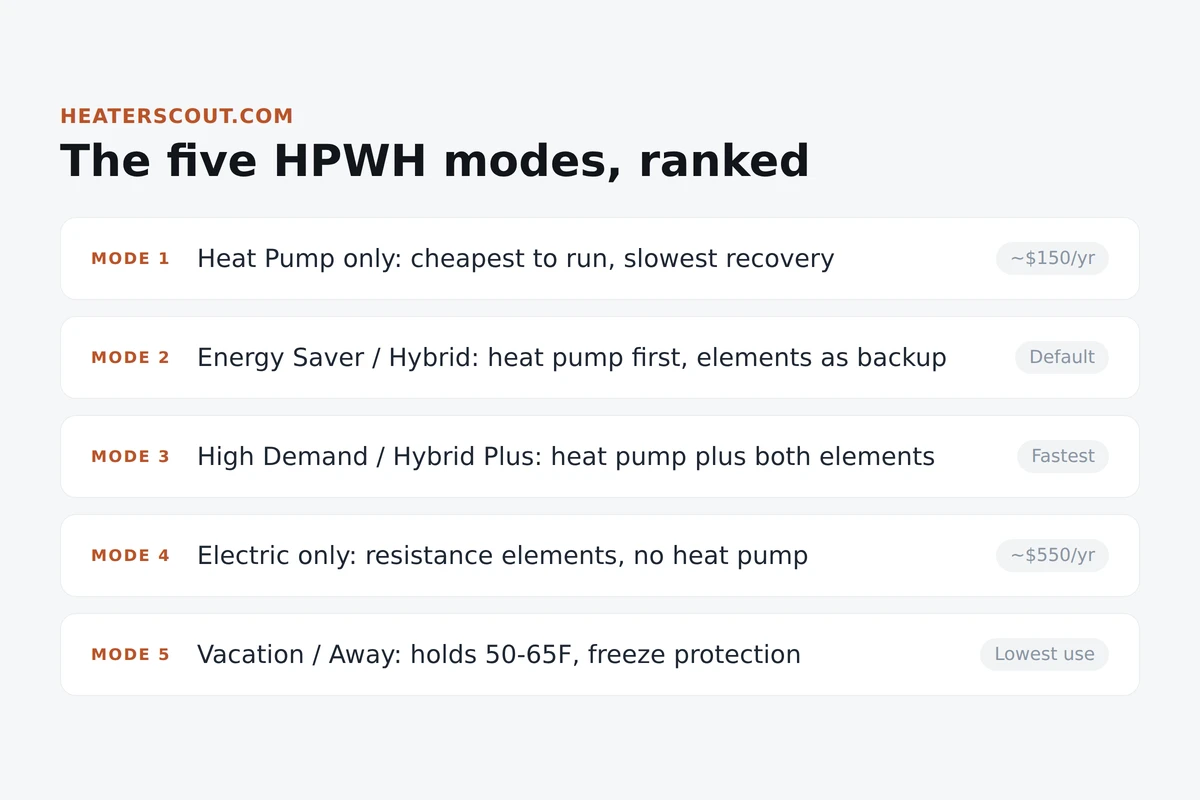
The five modes, and what each one actually does
Strip away the brand names and every hybrid heat pump water heater offers the same handful of behaviors. The heat pump is the star: it pulls warmth out of the room air and pushes it into the water, which is why it uses so little electricity. The two resistance elements are the muscle: they make heat directly, reheating a drained tank fast but drawing four to five times the power. Each mode is just a rule for when the machine is allowed to use the elements.
Heat pump only is the most efficient setting and the slowest. The compressor does all the work and the elements stay off no matter how hard you draw, so on a heavy morning the tank can run out before it catches up. Energy Saver or Hybrid is the everyday default: the heat pump handles the normal load and the elements only wake up when a spike would otherwise leave you cold. High Demand, which Bradford White calls Hybrid Plus, throws the heat pump and both elements at the tank for the fastest recovery the unit can manage. Electric only shuts the compressor off and runs like an old resistance heater, which you want only when the room is too cold for the heat pump or the compressor has failed. Vacation drops the temperature to save energy while you are gone.
Heat Pump only: cheapest, slowest
- Runs the compressor alone, elements never fire. Coefficient of performance around 3.0 to 3.5.
- Cost is the whole point: roughly $150 to $200 a year at a UEF near 3.5, versus $550-plus on resistance.
- Recovery is slow, on the order of half the speed of the elements. A big household can drain the tank faster than it refills.
- Best for light, predictable use, one or two people, or a shoulder-season squeeze on the bill.
High Demand / Hybrid Plus: fastest, priciest
- Runs the heat pump and both electric elements together. Rheem rates this the highest recovery of any ProTerra mode.
- Costs more per gallon because the elements are on, but still beats pure electric because the heat pump keeps contributing.
- Recovery jumps to the full element rate, roughly double heat pump only, so a drained tank comes back fast.
- Best for house guests, a big tub, laundry plus showers, or any day you cannot wait on the compressor.
What it costs to run each mode
The reason mode choice matters so much is the gap in efficiency between the two heat sources. The heat pump runs at a coefficient of performance around 3.0 to 3.5, meaning it delivers roughly three units of heat for every unit of electricity it draws. The resistance elements are locked at a COP of 1: every watt in becomes exactly one watt of heat, no more. That is why an Energy Star heat pump water heater in an efficient mode runs about $104 to $160 a year, and a unit at a UEF near 3.5 lands around $150 to $200, while the same tank in electric only mode behaves like the old resistance heater it replaced and can cost $550 to $720 a year. A family of four typically saves in the neighborhood of $550 a year by living in an efficient mode instead of a resistance one.
The short version
Leave a hybrid heat pump water heater in Energy Saver or Hybrid mode as your everyday setting. It captures almost all of the heat pump savings, roughly $150 a year of running cost, while keeping the electric elements in reserve so a busy morning does not end in a cold shower. Only drop to Heat Pump only if your usage is light, only bump to High Demand for a known heavy day, and only use Electric if the room is too cold for the compressor or it has failed.
There is a subtlety worth knowing. Even in Energy Saver mode the unit will occasionally fire the elements when demand outpaces the heat pump, so your bill in that mode is a little higher than pure heat pump only but not by much. In practice the difference between Energy Saver and Heat Pump only is small dollars for most homes, and the peace of mind from not running out is worth it. The big, expensive jump is Electric only, which you should treat as a temporary crutch, not a setting to live in.
Recovery rate and first-hour rating
Recovery rate is how many gallons per hour the heater can reheat, and first-hour rating (FHR) is how many gallons of hot water it can deliver in a busy first hour starting with a full tank. A Rheem ProTerra recovers around 21 gallons per hour at a 90 degree temperature rise and exceeds the federal minimum 51 GPH FHR, with a 65-gallon model rated up to about 72 gallons FHR. Heat pump only mode lowers effective recovery because the compressor is slower than the elements, which is exactly why High Demand mode exists: it restores the fast element recovery when you need it.
Rheem ProTerra vs A.O. Smith Voltex vs Bradford White AeroTherm
Here is where the naming gets confusing, because the three big US brands describe the same behaviors with different words. Rheem's ProTerra line offers five named modes. Energy Saver is the default and adjusts to demand while favoring the heat pump. Heat Pump mode runs the compressor alone for the lowest possible draw and the lowest recovery. High Demand pairs the heat pump with the elements for the highest recovery. Electric runs the elements only. Vacation drops the set point to 65 degrees and only fires the heat pump if the lower tank falls below about 50 degrees.
A.O. Smith's Voltex uses four modes. Its Efficiency or Heat Pump setting is the compressor-first mode that leans on the elements only for quick recovery after a big draw. Hybrid balances compressor and element automatically. Electric runs the elements only, which A.O. Smith recommends when limited ambient heat is available, meaning a cold install space. Vacation holds the tank at 60 degrees and adds freeze protection. A.O. Smith rates the heat pump as roughly four times as efficient as a standard element and says the unit uses up to 70 percent less electricity than a standard electric tank, with the Voltex MAX delivering about 40 percent higher first-hour ratings than similar units.
Bradford White's AeroTherm G2 splits the middle ground into two. It offers Heat Pump only for maximum efficiency, Electric only for fast recovery like a traditional element heater, Hybrid Standard as the balanced everyday mode, Hybrid Plus as a more aggressive hybrid for higher demand, and Vacation which lowers the temperature to 50 degrees when you are away. The extra Hybrid Plus tier is Bradford White's answer to Rheem's High Demand: a way to prioritize recovery without going all the way to resistance. All of these can be set from Bradford White's Wave app over Wi-Fi or Bluetooth, which is handy for flipping on vacation mode after you have already left.
Translate the names
- Cheapest, slowest: Rheem Heat Pump, A.O. Smith Efficiency/Heat Pump, Bradford White Heat Pump only.
- Everyday default: Rheem Energy Saver, A.O. Smith Hybrid, Bradford White Hybrid Standard.
- Fastest recovery: Rheem High Demand, Bradford White Hybrid Plus (A.O. Smith leans on Hybrid).
The specialty modes
- Elements only: all three call it Electric. Use it in a cold room or with a dead compressor.
- Away setting: Rheem Vacation drops to 65F, A.O. Smith to 60F, Bradford White to 50F.
- App control: Rheem EcoNet, A.O. Smith, and Bradford White Wave all let you switch modes remotely.
Which mode should you actually pick?
The honest answer for most homes is: set it to Energy Saver or Hybrid, learn where the High Demand and Vacation buttons are, and otherwise forget about it. But usage patterns differ, and the right default changes with how many people share the tank and how cold the install space runs. Here is how the choice breaks down by household.
One or two people, light use
Run Heat Pump only. Your draws are small and spaced out, so the slow recovery never catches you, and you pocket every dollar of the heat pump's efficiency. If you ever do run short, Energy Saver is one button away.
A typical family
Live in Energy Saver or Hybrid. The heat pump carries the normal load and the elements quietly back you up on the busy mornings, so you get almost all the savings without the cold-shower risk of pure heat pump mode.
Guests or a heavy day
Switch to High Demand or Hybrid Plus for the day. It runs the heat pump and both elements for the fastest recovery the tank can manage, so back to back showers and a full tub do not drain you. Switch back after.
A cold garage or a failed compressor
Use Electric only, but treat it as temporary. A heat pump starved of warm air limps, and a broken compressor leaves the elements as your only heat, so this keeps hot water flowing while you fix the real problem or wait out a cold snap.
A trip of a few days or more
Set Vacation before you leave, or flip it from the app once you are gone. The tank coasts at 50 to 65 degrees depending on brand, avoids freezing, and stops paying to keep water hot for an empty house. Switch back a few hours before you return.
One habit ties all of this together: match the mode to the day, not the season. The mistake people make is picking a mode at install and never touching it again, either leaving it in Electric because the installer set it there and never explained the difference, or forcing Heat Pump only and then blaming the unit when a houseful of guests runs it dry. The modes exist because hot water demand is not constant. Use Energy Saver as your baseline, reach for High Demand when the house is full, drop to Vacation when it is empty, and keep Electric only in your back pocket for the cold room or the dead compressor. Do that and the heater does what it was sold to do, which is deliver hot water for roughly a third of what a plain electric tank costs to run.
Frequently asked
What are the operating modes on a heat pump water heater?
A hybrid heat pump water heater carries a small set of modes that decide which heat source runs: the heat pump, the electric resistance elements, or both. On a Rheem ProTerra you get five named modes, which are Energy Saver, Heat Pump, High Demand, Electric, and Vacation. A.O. Smith's Voltex uses four, which are Efficiency or Heat Pump, Hybrid, Electric, and Vacation. Bradford White's AeroTherm G2 splits into Heat Pump only, Hybrid Standard, Hybrid Plus, Electric only, and Vacation. The wording differs but the logic is the same everywhere: heat pump only is the cheapest and slowest, an electric or high demand mode is the fastest and most expensive, and a hybrid or energy saver mode sits in the middle and runs by default. Vacation drops the temperature to save energy while you are away.
Which heat pump water heater mode is the cheapest to run?
Heat pump only mode is the cheapest, and it is not close. In that mode the unit runs the compressor and never fires the electric elements, so it moves heat from the room air instead of making heat from resistance. That gives a coefficient of performance around 3.0 to 3.5, meaning roughly three units of heat per unit of electricity. An Energy Star heat pump water heater in an efficient mode costs about $104 to $160 a year, and a unit at a UEF near 3.5 lands around $150 to $200. The same tank forced into electric only mode behaves like an old resistance heater and can cost $550 to $720 a year. The catch is recovery: heat pump only is the slowest to reheat a drained tank, so a big household can outrun it.
What is the difference between Energy Saver and High Demand mode on a Rheem ProTerra?
Energy Saver is the ProTerra's default and it leans on the heat pump for almost everything, only calling the electric elements when demand spikes past what the compressor can cover. It is tuned to keep your bill low while still avoiding a cold shower on a normal day. High Demand is the opposite priority: it runs the heat pump together with the electric elements to give the fastest recovery the unit can manage, which Rheem rates as the highest recovery of any mode while still saving some energy over a pure resistance heater. Use Energy Saver as your everyday setting and switch to High Demand for house guests, a full tub, or back to back showers when you cannot wait for the heat pump to catch up.
Should I leave my heat pump water heater in hybrid mode all the time?
For most households, yes. Hybrid or Energy Saver mode is the default for a reason: it runs the efficient heat pump for the bulk of your hot water and only wakes the electric elements when a heavy draw would otherwise leave you short. That gives you most of the savings of heat pump only mode without the risk of running out during a busy morning. Drop to heat pump only mode if your usage is light and predictable and you want to squeeze out the last of the savings. Bump up to high demand only when you know a heavy day is coming. The one time you would not leave it in hybrid is a long trip, when vacation mode saves more.
What temperature does vacation mode use on a heat pump water heater?
It depends on the brand, but every vacation mode lowers the set point so the tank is not paying to keep water hot for an empty house. A Rheem ProTerra in Vacation mode drops to a 65 degree set point and only runs the heat pump if the lower tank falls below about 50 degrees, which is enough to prevent problems without heating water nobody will use. A.O. Smith's Voltex holds 60 degrees and adds freeze protection. Bradford White's AeroTherm lowers to 50 degrees. All three are meant for trips of a few days or more, and the point is the same: keep the tank from freezing or growing stale while cutting standby energy, then return to your normal mode a few hours before you get home so the water is hot when you arrive.
Do all heat pump water heater brands use the same mode names?
No, and that trips people up. Rheem ProTerra uses Energy Saver, Heat Pump, High Demand, Electric, and Vacation. A.O. Smith Voltex uses Efficiency or Heat Pump, Hybrid, Electric, and Vacation. Bradford White AeroTherm G2 uses Heat Pump only, Hybrid Standard, Hybrid Plus, Electric only, and Vacation. Underneath, they map to the same four ideas: heat pump alone for cheapest running, a balanced hybrid or energy saver default, a high demand or hybrid plus setting that adds the elements for speed, and an electric only mode for cold spaces or a dead compressor, plus a vacation setting. When you read a guide written for one brand, translate the name to the behavior and it applies to yours.
Why is my heat pump water heater running out of hot water?
The most common cause is running heat pump only mode with a household bigger than that mode can keep up with. Heat pump only recovers slowly, on the order of half the speed of the elements, so a couple of long showers can drain the tank faster than the compressor refills it. Switch to hybrid or energy saver so the elements can help, or to high demand for the fastest recovery, and see if the problem clears. Other causes are a set point that is too low, a tank that is undersized for the home, or a cold, cramped install space that starves the heat pump of the warm air it needs. If none of that fixes it, look at a stuck element or a fault, but mode choice is the first thing to check.