A homeowner three weeks into a new hybrid water heater finds a puddle under it and assumes the tank has already failed. Usually it has not. A heat-pump water heater makes water on purpose. It heats your tank by running a refrigeration cycle and pulling heat out of the room air, and its cold coil wrings moisture out of that air the same way an air conditioner does. So it drips condensate, sometimes a trickle, sometimes over a gallon a day in a humid basement, and a standard tank never did that. The job on this page is to tell that normal condensate apart from the four things that are a real leak: a blocked condensate drain, an overflowing or cracked pan, a discharging relief valve, and an actual tank or fitting failure.
Condensate
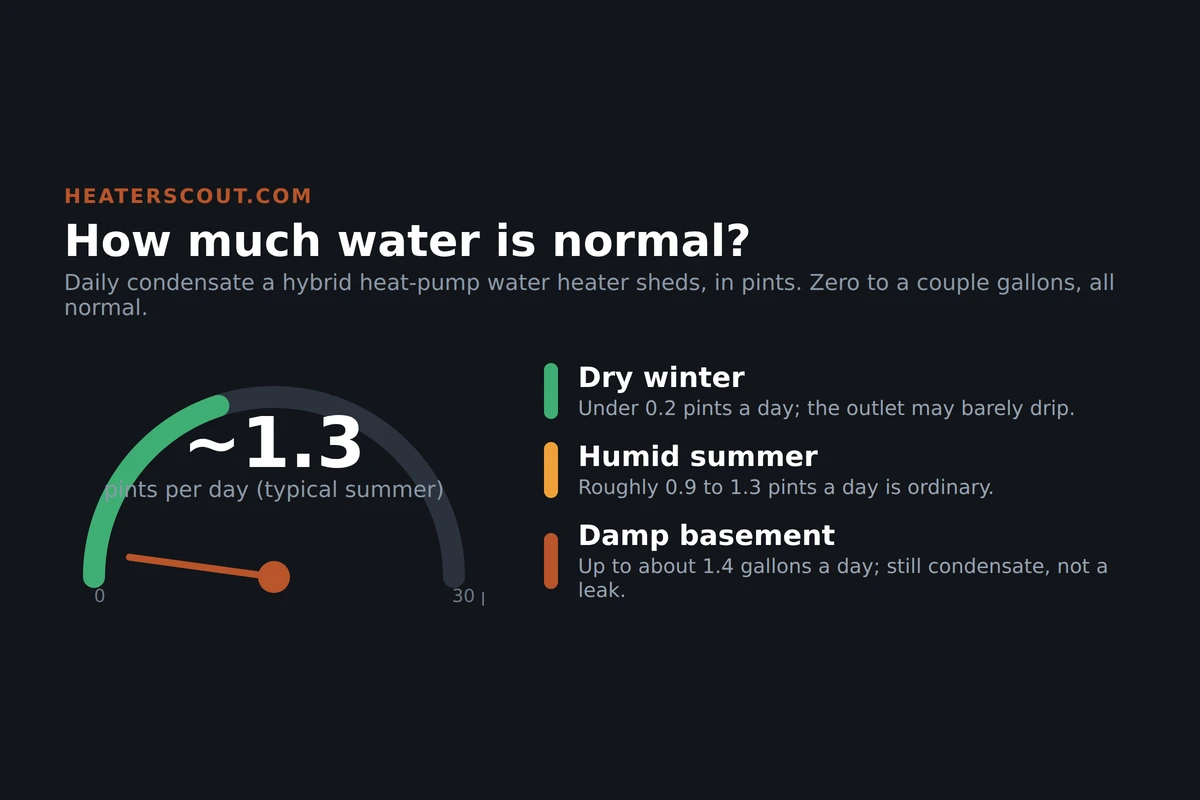
The water a hybrid heat-pump water heater pulls out of the surrounding air while it heats your tank. The unit runs a refrigeration cycle and its evaporator coil runs cold, so room-air moisture condenses on it and drips off through a condensate outlet, usually a half or three quarter inch fitting, into a drain line and a backup drain pan. The amount tracks humidity, not the tank: monitored units run under a fifth of a pint a day in dry winter and roughly nine tenths to one and a third pints a day in summer, and a damp basement can push a unit to about a gallon and a half a day. It is clean water from the air, not a tank leak, and it is roughly neutral, so it does not need the acid neutralizer a gas condensing unit's condensate does.
Which of the four is it? Ranked by how often it happens
Before you touch anything, figure out which category the water falls into, because the fixes are completely different. Clean water near the pan on a humid day is almost always condensate that either drained fine or backed up. Water tied to a fitting or the tank body is the real leak. The bars below rank the sources roughly by how often they turn out to be the culprit on a hybrid unit.
Start here: is the water even a leak?
The fastest way to settle this is to dry the whole unit, note the weather, and watch where water comes back first. Condensate returns at the condensate outlet, the drain line, or the pan, it is clean and slow, and it rises in summer and falls in dry weather. A real leak returns at a fitting or the tank body and does not care what the humidity is doing. Run down this list before you call anyone.
- The water is clean and clear, not rusty, and shows up near the drain pan or the end of the drain line. That reads as condensate.
- Volume rises in humid weather and nearly stops in a dry winter stretch. That confirms condensate, since it comes from the air.
- Water is running from a threaded fitting, the drain valve, or a nipple. That is a fitting leak, not condensate.
- The relief valve discharge pipe is wet or dripping. That is the T&P valve, a pressure or temperature issue, not condensate.
- The tank bottom or a seam is wet and stays wet regardless of humidity. That points at a failed tank.
If the relief valve is dripping, do not ignore it
The temperature and pressure relief valve is a safety device, not a nuisance. It opens if the tank reaches about 150 psi or roughly 210 degrees, and in normal operation it should never discharge. If yours drips, that is a real pressure or temperature signal, most often thermal expansion in a closed system that needs an expansion tank, and it is not the same as condensate. Never cap, plug, or valve the discharge pipe, and never assume the drip is harmless.
Fixing a blocked condensate line, the usual real problem
When the water really is condensate but it is ending up on the floor instead of the drain, the line failed, not the tank. This is the single most common service issue on hybrids. Rheem ProTerra units flag it as fault A108, Condensate Blocked, and A.O. Smith Voltex units post a condensate management code for the same thing. Both mean the water cannot get through the line, the trap, the pump, or the drain, so the pan fills and a leak sensor can shut the unit down. Work the line end to end.
Ruling in a pan problem or a real tank leak
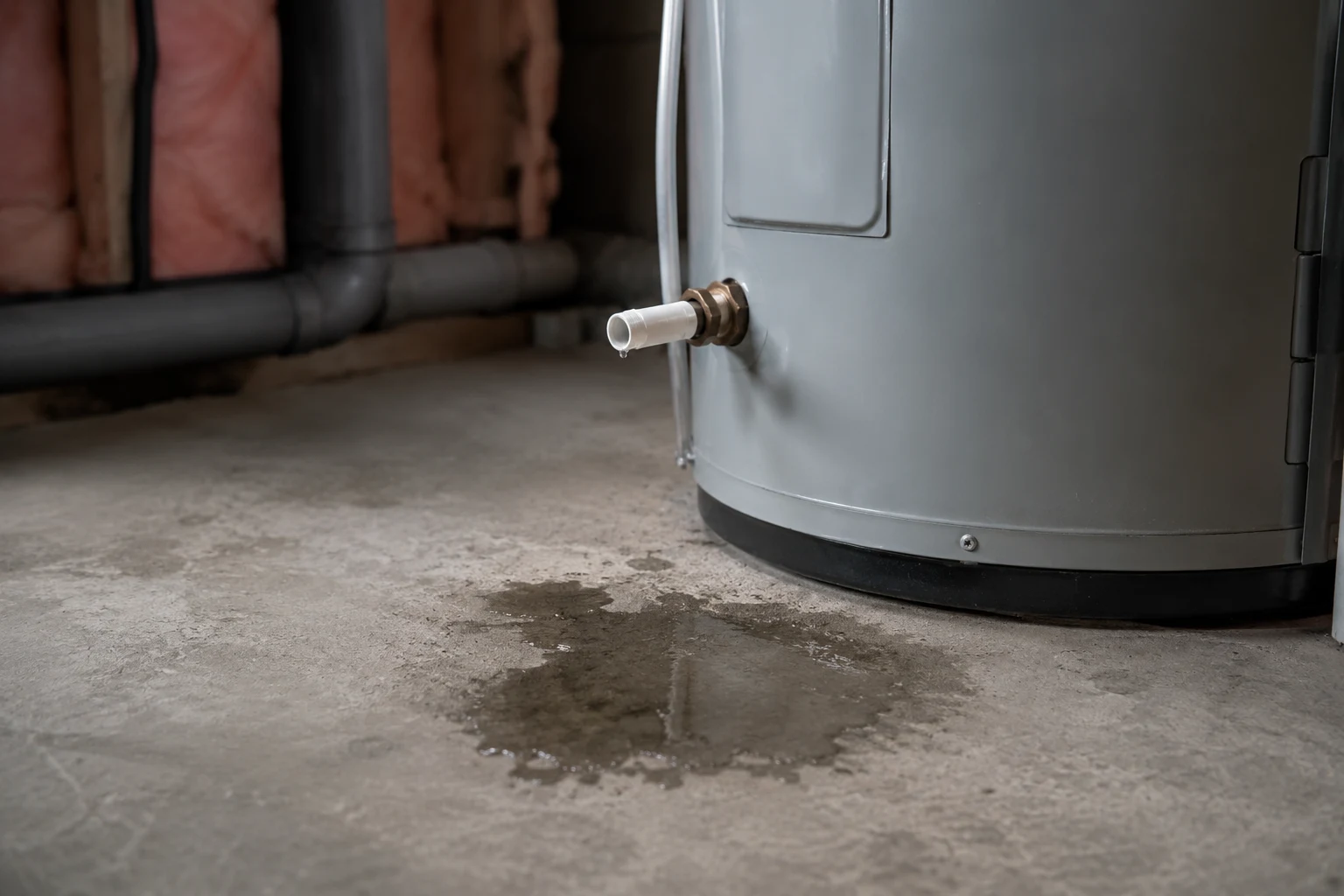
If the line is clear and the pump runs but water still shows up, the pan or the tank is next. The pan is easy to overlook: it catches condensate overflow as well as any tank drip, so a cracked plastic pan or a plugged pan drain spills onto the floor even when the tank is perfectly sound. A genuine tank leak is the last suspect on a newer unit, and it is the one that ends in replacement. Work these in order.
Check the pan and its drain
Code wants a pan at least an inch and a half deep drained by a three quarter inch waste pipe. Inspect the plastic for hairline cracks, confirm the pan drain is open and falls to an approved point, and clear it if it is plugged. A wet pan with a clear condensate line usually means the pan drain, not the tank.
Trace fittings you can fix
Water at the cold or hot water nipples, the drain valve, or the relief valve threads is a connection, not the tank. Dry each one, watch which reappears, and tighten or replace the offending fitting. These are the leaks worth chasing because they are cheap.
Confirm a failed tank
Water seeping from the tank bottom or a rusted seam, steady and unrelated to the weather, is a failed inner tank. That is not repairable. Note the model and serial off the rating label, check the warranty, and plan a replacement rather than pouring money into a chase.
Match the symptom to the season
Dry the unit completely and watch it through a humid stretch while the heat pump runs. If it stays dry, you were chasing condensate all along. If water returns at a fitting or the tank regardless of humidity, you have your real leak.
The habit that saves the most grief is simple: dry everything, note the weather, and let the unit run before you spend a dollar. A hybrid heat-pump water heater is designed to make water, and the volume swings with the season, so a puddle in July that vanishes in a dry January was condensate the whole time. Match the water to its source, condensate to the outlet and pan, the relief valve to pressure and temperature, and a real leak to a fitting or the tank, and each one routes to a different fix instead of a panicked call about a tank that never failed.
Frequently asked
Is my heat-pump water heater leaking or is that normal condensate?
Most of the time it is condensate, and that surprises people because a standard electric or gas tank makes essentially none. A hybrid heat-pump water heater runs a refrigeration cycle to heat your water, so its cold evaporator coil pulls moisture out of the room air and drips it off, exactly the way a cold soda can sweats. Field measurements put a typical unit under a fifth of a pint a day in dry winter air, around nine tenths to one and a third pints a day in summer, and one very humid basement filled a ten-gallon bucket a week, close to a gallon and a half a day. All of that is normal. The tell is where the water is and whether it is clean and slow. Condensate shows up as a small clear trickle at the condensate outlet, in the drain pan, or at the end of the drain line, and it tracks the weather and how hard the heat pump is running. A real leak tends to be faster, tied to a fitting or the tank body, and does not stop when the humidity drops.
Why is water pooling under my hybrid heat-pump water heater?
Walk it from the most likely to the least. First is condensate that is not draining: the condensate line sagged, clogged with biofilm, or froze, or the condensate pump quit, so water backs up and spills out of the drain pan. Second is the drain pan itself, a cracked plastic pan or a plugged pan drain that overflows even when the tank is fine. Third is the temperature and pressure relief valve discharging down its pipe, which points at pressure or temperature, not the heater weeping. Last, and least common on a newer unit, is an actual tank or fitting leak. Touch the water and trace it uphill to its highest wet point. Clear water from the pan area usually means condensate. Water clearly running from a threaded fitting, the cold or hot nipple, or the tank seam is the real thing.
How much condensate should a heat-pump water heater produce?
It depends almost entirely on how humid the air around it is, because the water comes out of that air, not the tank. Monitored units have run under two tenths of a pint a day in dry winter conditions and roughly nine tenths to one and a third pints a day in summer. In a genuinely damp basement the numbers climb: one owner reported filling a ten-gallon bucket a week, about a gallon and a half a day. So anywhere from a few drips to a couple of gallons a day is within normal, and the volume rises in summer and falls in winter. If your unit makes almost nothing in January and steadily more in July, that is the heat pump working as a modest dehumidifier, not a fault.
What does a condensate blocked or condensate error code mean?
It means the water the unit made has nowhere to go. On a Rheem ProTerra the code is A108, Condensate Blocked, and it fires when condensate cannot drain through the line, the trap, the pump, or the drain connection. A.O. Smith Voltex units post a condensate-management code for the same family of problems. The causes are a clogged or sagging drain line, a dirty or dry trap, a kinked hose, a frozen outdoor termination, or a failed condensate pump. The fix is to inspect the line end to end, clear the clog with a flexible brush or a wet vacuum, flush the run with a mild vinegar and water mix, confirm the pump runs and its float moves freely, and make sure the whole line falls downhill to the drain. The pan filling and tripping a leak sensor is the safety doing its job, not the tank leaking.
My heat-pump water heater's T&P valve is dripping. Is that condensate?
No. The temperature and pressure relief valve is a separate thing from condensate, and its drip is a real signal you should not ignore. That valve opens to protect the tank if pressure reaches about 150 psi or the water hits about 210 degrees, and in normal operation it should not discharge at all. The most common reason it weeps is thermal expansion in a closed plumbing system: as the water heats and expands it has nowhere to go, pressure spikes, and the valve relieves. The fix there is a properly sized and charged expansion tank and a check of house pressure, not a new valve. A valve that streams or will not reseat can be failed or reacting to genuinely high temperature or pressure, which is a safety issue. Never cap or plug the discharge pipe; it has to stay open and end within a few inches of the floor or a drain.
How do I fix a clogged heat-pump water heater condensate line?
Start at the condensate outlet and disconnect the tubing to look for standing water or a soft green or black slime, which is the usual biofilm clog. Clear the pipe with a flexible brush, a length of wire, or a wet vacuum pulling from the far end, then flush the run with a mix of white vinegar and warm water until it drains clear. If there is a condensate pump, open the reservoir, clean it with the same vinegar solution, confirm the float travels freely, and check the discharge tube and check valve. Then fix why it clogged: give the whole line continuous downhill slope so nothing pools, support the tubing every few feet so it cannot sag, and keep any trap holding a seal so the fan cannot pull air back and dry it out. Bradford White notes the drain should sit no higher than thirty-six inches above the floor, close to the unit, so keep the run short with minimal turns.
Does a heat-pump water heater need a drain pan, and how big?
Yes in most installs, and it earns its keep here because the heater makes water even when it is healthy. Residential code calls for a pan at least an inch and a half deep, drained by an indirect waste pipe of at least three quarters of an inch, wherever a leak or overflow could damage the building, which covers attics, spaces over finished rooms, and most utility closets. On a hybrid the pan catches condensate overflow as well as any tank leak, so a cracked plastic pan or a plugged pan drain will let water onto the floor even when the tank is sound. Check the pan for hairline cracks, make sure its drain is open and runs downhill to an approved point, and remember that a wet pan on a heat pump usually means the condensate path failed, not the tank.
When is it actually the tank leaking and not condensate?
When the water traces back to the tank body or a plumbing fitting rather than the condensate outlet or pan, and when it does not track the weather. Dry off the whole unit, then watch where water returns first. Water at the cold or hot water nipples, the drain valve, or the T&P valve threads points at a fitting you can often tighten or replace. Water that seeps from the bottom of the tank or from a rusty seam, steady and unrelated to how humid the room is, is a failed tank, and a failed tank is not repairable. Condensate, by contrast, is clean, comes from the outlet or pan, rises in summer, and slows or stops in dry weather. If you can dry the unit and it stays dry through a humid stretch while the heat pump runs, you were chasing condensate.
Frequently asked
Is my heat-pump water heater leaking or is that normal condensate?
Most of the time it is condensate, and that surprises people because a standard electric or gas tank makes essentially none. A hybrid heat-pump water heater runs a refrigeration cycle to heat your water, so its cold evaporator coil pulls moisture out of the room air and drips it off, exactly the way a cold soda can sweats. Field measurements put a typical unit under a fifth of a pint a day in dry winter air, around nine tenths to one and a third pints a day in summer, and one very humid basement filled a ten-gallon bucket a week, close to a gallon and a half a day. All of that is normal. The tell is where the water is and whether it is clean and slow. Condensate shows up as a small clear trickle at the condensate outlet, in the drain pan, or at the end of the drain line, and it tracks the weather and how hard the heat pump is running. A real leak tends to be faster, tied to a fitting or the tank body, and does not stop when the humidity drops.
Why is water pooling under my hybrid heat-pump water heater?
Walk it from the most likely to the least. First is condensate that is not draining: the condensate line sagged, clogged with biofilm, or froze, or the condensate pump quit, so water backs up and spills out of the drain pan. Second is the drain pan itself, a cracked plastic pan or a plugged pan drain that overflows even when the tank is fine. Third is the temperature and pressure relief valve discharging down its pipe, which points at pressure or temperature, not the heater weeping. Last, and least common on a newer unit, is an actual tank or fitting leak. Touch the water and trace it uphill to its highest wet point. Clear water from the pan area usually means condensate. Water clearly running from a threaded fitting, the cold or hot nipple, or the tank seam is the real thing.
How much condensate should a heat-pump water heater produce?
It depends almost entirely on how humid the air around it is, because the water comes out of that air, not the tank. Monitored units have run under two tenths of a pint a day in dry winter conditions and roughly nine tenths to one and a third pints a day in summer. In a genuinely damp basement the numbers climb: one owner reported filling a ten-gallon bucket a week, about a gallon and a half a day. So anywhere from a few drips to a couple of gallons a day is within normal, and the volume rises in summer and falls in winter. If your unit makes almost nothing in January and steadily more in July, that is the heat pump working as a modest dehumidifier, not a fault.
What does a condensate blocked or condensate error code mean?
It means the water the unit made has nowhere to go. On a Rheem ProTerra the code is A108, Condensate Blocked, and it fires when condensate cannot drain through the line, the trap, the pump, or the drain connection. A.O. Smith Voltex units post a condensate-management code for the same family of problems. The causes are a clogged or sagging drain line, a dirty or dry trap, a kinked hose, a frozen outdoor termination, or a failed condensate pump. The fix is to inspect the line end to end, clear the clog with a flexible brush or a wet vacuum, flush the run with a mild vinegar and water mix, confirm the pump runs and its float moves freely, and make sure the whole line falls downhill to the drain. The pan filling and tripping a leak sensor is the safety doing its job, not the tank leaking.
My heat-pump water heater's T&P valve is dripping. Is that condensate?
No. The temperature and pressure relief valve is a separate thing from condensate, and its drip is a real signal you should not ignore. That valve opens to protect the tank if pressure reaches about 150 psi or the water hits about 210 degrees, and in normal operation it should not discharge at all. The most common reason it weeps is thermal expansion in a closed plumbing system: as the water heats and expands it has nowhere to go, pressure spikes, and the valve relieves. The fix there is a properly sized and charged expansion tank and a check of house pressure, not a new valve. A valve that streams or will not reseat can be failed or reacting to genuinely high temperature or pressure, which is a safety issue. Never cap or plug the discharge pipe; it has to stay open and end within a few inches of the floor or a drain.
How do I fix a clogged heat-pump water heater condensate line?
Start at the condensate outlet and disconnect the tubing to look for standing water or a soft green or black slime, which is the usual biofilm clog. Clear the pipe with a flexible brush, a length of wire, or a wet vacuum pulling from the far end, then flush the run with a mix of white vinegar and warm water until it drains clear. If there is a condensate pump, open the reservoir, clean it with the same vinegar solution, confirm the float travels freely, and check the discharge tube and check valve. Then fix why it clogged: give the whole line continuous downhill slope so nothing pools, support the tubing every few feet so it cannot sag, and keep any trap holding a seal so the fan cannot pull air back and dry it out. Bradford White notes the drain should sit no higher than thirty-six inches above the floor, close to the unit, so keep the run short with minimal turns.
Does a heat-pump water heater need a drain pan, and how big?
Yes in most installs, and it earns its keep here because the heater makes water even when it is healthy. Residential code calls for a pan at least an inch and a half deep, drained by an indirect waste pipe of at least three quarters of an inch, wherever a leak or overflow could damage the building, which covers attics, spaces over finished rooms, and most utility closets. On a hybrid the pan catches condensate overflow as well as any tank leak, so a cracked plastic pan or a plugged pan drain will let water onto the floor even when the tank is sound. Check the pan for hairline cracks, make sure its drain is open and runs downhill to an approved point, and remember that a wet pan on a heat pump usually means the condensate path failed, not the tank.
When is it actually the tank leaking and not condensate?
When the water traces back to the tank body or a plumbing fitting rather than the condensate outlet or pan, and when it does not track the weather. Dry off the whole unit, then watch where water returns first. Water at the cold or hot water nipples, the drain valve, or the T&P valve threads points at a fitting you can often tighten or replace. Water that seeps from the bottom of the tank or from a rusty seam, steady and unrelated to how humid the room is, is a failed tank, and a failed tank is not repairable. Condensate, by contrast, is clean, comes from the outlet or pan, rises in summer, and slows or stops in dry weather. If you can dry the unit and it stays dry through a humid stretch while the heat pump runs, you were chasing condensate.