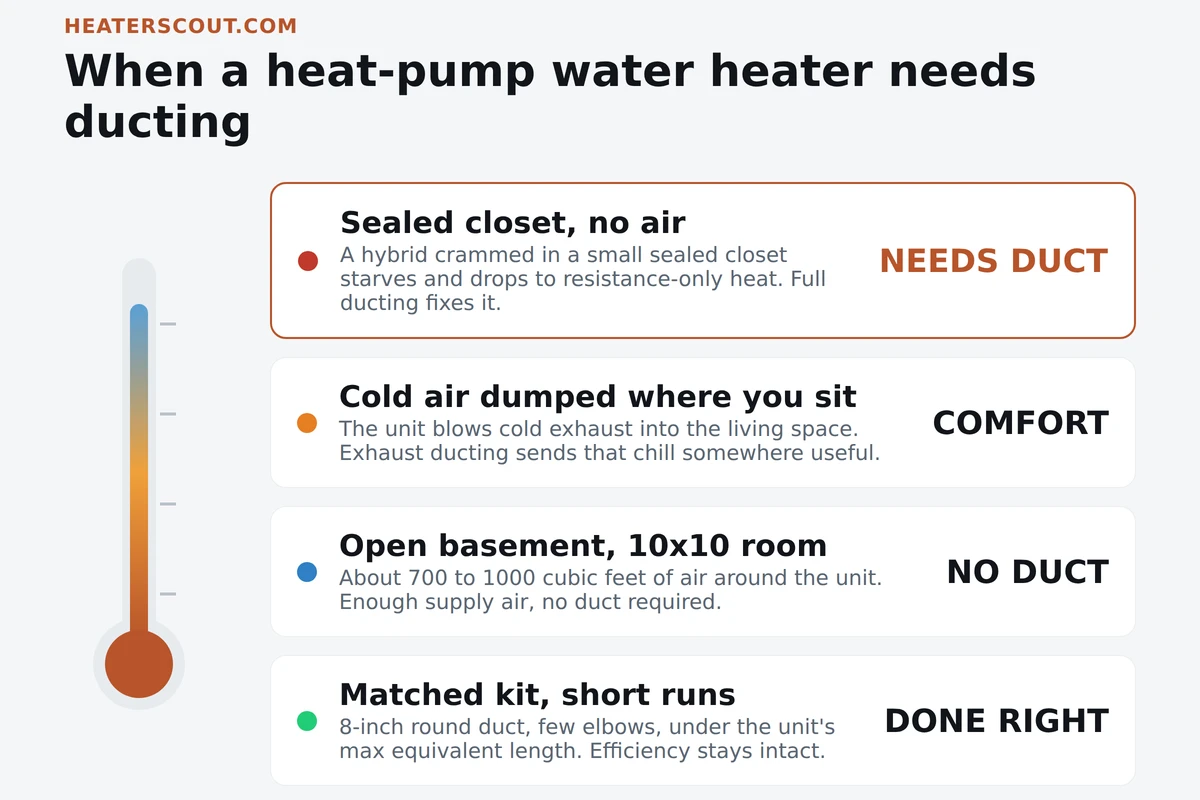
A heat-pump water heater needs about 700 to 1000 cubic feet of air around it, roughly a 10 by 10 foot room with an 8 foot ceiling, because it does not make heat so much as move it. It pulls warmth out of the surrounding air, uses that to heat your water, and blows the leftover air back out cold. That single fact drives every ducting decision. If the unit has that much air and the cold exhaust lands somewhere harmless, you need no ducting at all. If the space is too small, sealed, or the cold air chills a room you use, a ducting kit routes the unit's intake, its exhaust, or both through ductwork so the appliance stops fighting its own installation. This page covers when you actually need one, the three ways to configure it, and the mistakes that turn a duct kit into a source of lost efficiency and dripping water.
You probably need ducting
- The unit has to live in a small sealed closet or tight mechanical room with far less than 700 to 1000 cubic feet of air.
- The cold exhaust blows into a room you actually use, so the heater is air-conditioning a space you want warm in winter.
- There is a warmer, larger space nearby you would rather borrow intake air from than the cramped room the unit sits in.
You probably do not
- The unit sits in an open basement or a large utility room with plenty of air and no comfort complaints about the cold discharge.
- A louvered door into a bigger adjacent room already supplies the airflow the manufacturer asks for.
- You are in a climate where the cool exhaust is a welcome bonus half the year and harmless the rest.
Why the unit is so hungry for air
A resistance electric water heater turns a kilowatt of power into a kilowatt of heat and does not care what the room is doing. A heat-pump water heater is a different animal. It runs a small refrigeration cycle, the same idea as an air conditioner working in reverse, and it harvests heat out of the air in the room to push into the water. That is why it is two to three times more efficient. It is also why it is picky about its surroundings. The air it draws in comes out several degrees colder, and if the room is too small the unit ends up re-breathing its own chilled exhaust, the intake temperature spirals down, efficiency falls, and eventually the controller gives up on the compressor and fires the electric resistance elements to keep up. At that point you own an expensive standard water heater.
The 700 to 1000 cubic foot figure, about a 10 by 10 room with an 8 foot ceiling, is the manufacturer's way of saying the reservoir of air has to be big enough that the unit never chills its own supply into that losing loop. Some spec sheets phrase it as a minimum floor area, others as a louvered free-area number for a closet door. However it is written, the point is identical: give the compressor a large volume of air to work against. When you physically cannot, ducting is how you fake a bigger room by piping air in from one and out to another.
The three ways to duct, and when each one fits
There are exactly three configurations, and each answers a different complaint. Getting the right one is mostly a matter of naming the problem out loud.
Intake-only and exhaust-only
- Intake-only: the unit draws its supply air through a duct from a warmer, larger space nearby. Use it when the room is small but a better air source sits close by.
- Exhaust-only: the cold discharge is ducted out of the room, so it stops chilling the space the heater lives in. Use it when air volume is fine but the cold breeze is a nuisance.
- Both leave one side open to the room, so the room still has to supply or absorb the other half of the airflow.
Full ducting
- Both intake and exhaust run through ductwork, so the unit no longer depends on the room's air at all.
- This is the only configuration that lets you seal a heat-pump water heater into a tight closet or small mechanical room.
- It is also the most demanding on equivalent length, since you are adding duct on both sides. Keep both runs short or the static pressure adds up fast.
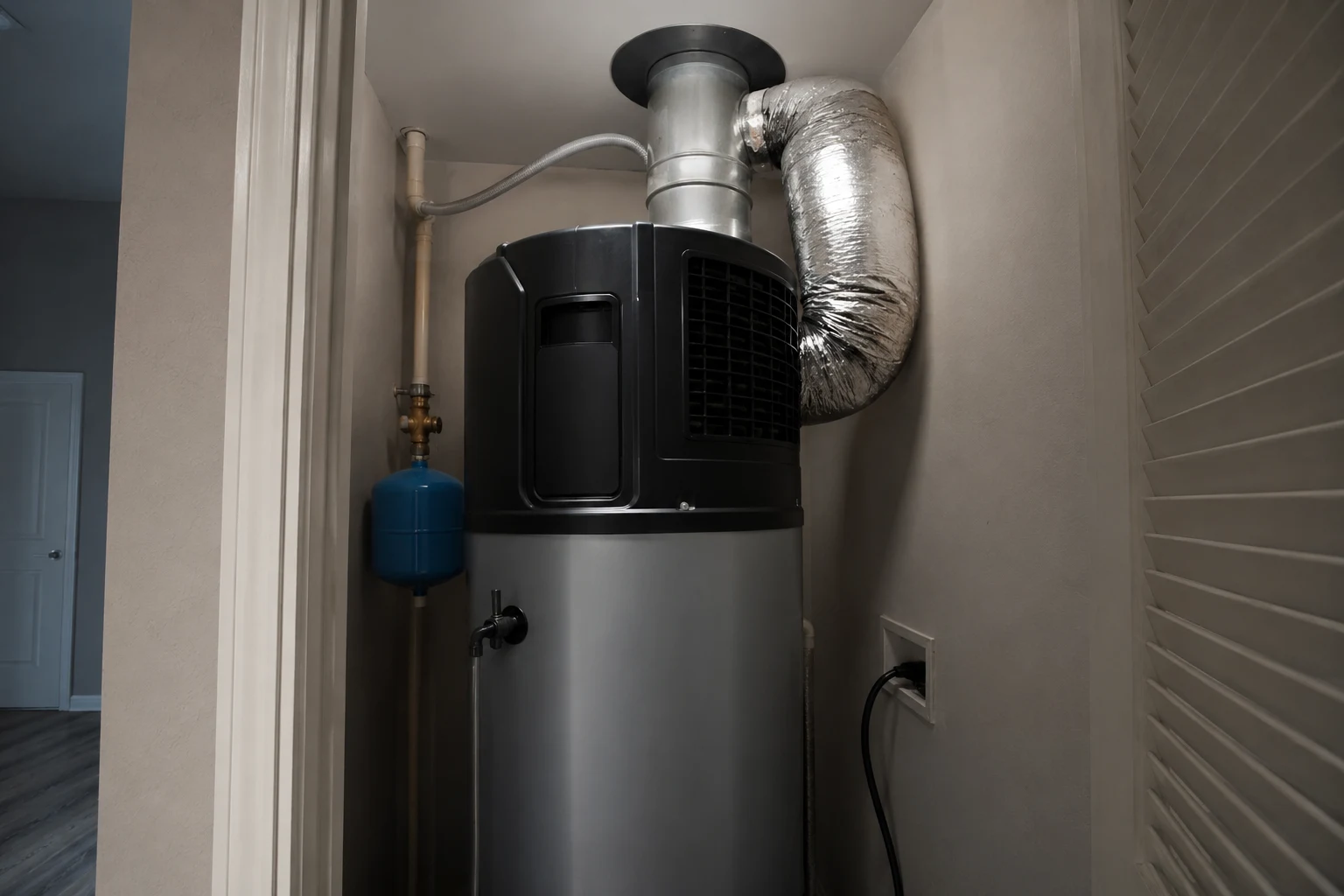
A common real-world case: a hybrid tucked into a laundry closet off a hallway. Left open, it works but throws cold air into the hall and the noise annoys everyone walking by. Exhaust ducting alone can carry that cold discharge into an adjacent garage or up and out, solving the comfort complaint without touching the intake. Contrast that with a unit going into a genuinely sealed mechanical closet with a solid door and no louver: that one has no choice but full ducting, because with the door shut there is simply not enough air in the closet for the compressor to work, and without intake ducting it would run its resistance elements all winter.
Equivalent duct length is the number that matters
People fixate on duct diameter and skip the spec that actually decides whether the install works. Every duct-capable unit publishes a maximum equivalent duct length, and it is usually somewhere around 10 to 25 equivalent feet total depending on the model. Equivalent length is straight footage plus a penalty for every fitting, because bends and transitions resist airflow far more than their physical length suggests. A single 90-degree elbow can count as several feet of straight duct all by itself. So a run that looks like 12 physical feet but has three elbows in it might land at 25 or more equivalent feet once you add the penalties, and that can blow right past the limit.
Why care so much about a number on a chart? Because static pressure is unforgiving. Push the equivalent length past the maximum and the fan cannot move the design airflow anymore. Less air across the evaporator means less heat harvested, which means lower capacity and lower efficiency, and in the worst case the unit leans on resistance heat to make up the difference. The whole point of the heat pump quietly erodes. This is why the guidance is always the same: keep runs short and straight, use the fewest elbows you can, favor smooth rigid duct over crushable flex, and do the equivalent-length math before you cut anything.
Condensation, pests, and the other quiet failures
Airflow gets all the attention, but the exhaust duct has a second problem: it carries cold, often damp air through warmer space. That is a recipe for condensation on the outside of the duct, and uninsulated cold duct running above a finished ceiling or over stored belongings will sweat and drip on whatever sits below. The fix is simple and non-negotiable: insulate the exhaust duct along its whole run through warm areas. This is separate from the condensate the unit itself produces at its drain; the duct sweat is outside moisture the ducting invites, and it is easy to forget until a water stain shows up.
- Confirm the unit is duct-capable: intake and exhaust collars on top plus a matched kit listed for your model. If either is missing, do not duct it.
- Match the configuration to the problem: intake-only for air supply, exhaust-only for cold-air comfort, full ducting to seal it in a closet.
- Use 8-inch round duct and the manufacturer's adapter kit, not a generic connection that leaks and adds resistance.
- Add up straight feet plus elbow penalties and stay under the unit's maximum equivalent duct length, usually about 10 to 25 feet.
- Insulate the cold exhaust duct so it does not sweat and drip inside warm space.
- Screen any outdoor termination against insects and rodents, and check the run for any crush, closed damper, or clog that would restrict airflow.
- In cold climates, prefer ducting warm interior air over cold outdoor air so the unit does not fall back to resistance heat all winter.
Outdoor terminations bring their own hazard. An open duct to the outside is an invitation, and insects, wasps, and small rodents will find their way in and either nest or die in the run, restricting airflow either way. A simple screen at the termination stops it. And there is the seasonal trap of pulling outdoor air in the first place. Bringing in cold winter air feels efficient but it hands the heat pump almost nothing to work with, so its efficiency drops and many units switch to resistance backup to keep up with demand. In most climates the better call is to duct warm interior air to the intake and accept that the unit gently cools a room you are willing to cool, rather than importing 30 degree air that defeats the compressor.
Quick answer
You need a ducting kit when a heat-pump water heater cannot get the roughly 700 to 1000 cubic feet of air it wants, or when its cold exhaust chills a space you use. Pick intake-only to borrow air, exhaust-only to send the cold air away, or full ducting to seal the unit into a tight closet. Use the manufacturer's matched 8-inch kit, keep the total equivalent duct length under the model's limit (often about 10 to 25 feet, with elbows counting as several feet each), insulate the cold exhaust so it does not drip, and screen any outdoor opening.
Equivalent duct length
The real airflow resistance of a duct run, expressed as the length of straight duct that would resist air the same amount. You add up the straight footage plus a penalty for each fitting, since a single 90-degree elbow can count as several feet. Heat-pump water heaters publish a maximum equivalent length, often around 10 to 25 feet, and staying under it is what keeps airflow, capacity, and efficiency where the manufacturer designed them.
Put together, the whole decision is less complicated than the accessory catalog makes it look. Ask whether the space gives the unit enough air and whether the cold exhaust lands somewhere harmless. If both are yes, skip the kit. If not, name the single problem, pick the matching configuration, confirm your model is duct-capable, and then respect the equivalent-length limit while you insulate the cold side and screen the outside. Do that and the ducting disappears into the background, which is exactly what a good install should do: let the heat pump breathe and stay a heat pump instead of quietly becoming a resistance heater in a box.
Frequently asked
Do I need a ducting kit for a heat-pump water heater?
Only if the space cannot supply enough air on its own, or the cold exhaust lands somewhere you do not want it. A heat-pump water heater pulls heat out of the surrounding air and blows that air back out cold, so it wants a lot of room to breathe, on the order of 700 to 1000 cubic feet, roughly a 10 by 10 foot room with an 8 foot ceiling. Sit one in an open basement or a large utility room and it will run happily with no ducting at all. Seal it into a small closet, tuck it in a tight mechanical room, or put it somewhere the cold exhaust chills a space you use, and that is when a ducting kit earns its keep. The kit does not make the unit heat water faster. It solves an air problem: not enough of it, or cold air in the wrong spot.
How much air does a heat-pump water heater need?
Manufacturers generally call for about 700 to 1000 cubic feet of air around the unit, which works out to a space of roughly 10 by 10 feet with an 8 foot ceiling, sometimes stated as a minimum floor area or a louvered-door free-area figure. That number exists because the compressor is moving heat, not making it. It cools the air it draws in by several degrees and needs a large enough reservoir of air so it does not chill its own supply into a losing loop. Starve it of air and two things happen: efficiency falls as the intake air gets colder, and many units give up and switch to their electric resistance elements, which erases the reason you bought a heat pump. If your install spot is smaller than that, you either louver the door into a bigger room or you duct.
What are the three ducting configurations?
Intake-only, exhaust-only, and full ducting. Intake-only pulls the unit's supply air from another space through a duct, useful when the unit sits in a small room but there is a warmer, larger space nearby to borrow air from. Exhaust-only takes the cold discharge and sends it somewhere you want it or out of the way, so it stops chilling the room the heater lives in. Full ducting connects both the intake and the exhaust, which is the only configuration that lets you seal the unit into a tight closet, because it no longer depends on the closet air at all. It draws from one duct and dumps to another. Which one you need comes down to the single problem you are solving: too little air, cold air in the wrong place, or both.
What size duct does a heat-pump water heater use?
Most heat-pump water heaters that support ducting use 8-inch round duct, and the top of the unit has either knockouts or factory collars sized for it. The manufacturer sells a matched adapter or ducting kit for that specific model rather than expecting you to improvise a connection. The critical spec is not the diameter by itself but the maximum equivalent duct length the unit allows, often somewhere in the range of about 10 to 25 equivalent feet total. Equivalent means elbows count for far more than their physical length: a single 90-degree elbow can add the equivalent of several feet of straight run. Add up your straight footage plus the elbow penalties and stay under the published limit, because going over raises static pressure, cuts airflow, and drags down both heating capacity and efficiency.
Should I duct outdoor air into a heat-pump water heater in winter?
Usually no. It is tempting, because outdoor intake in summer feels like free cooling and fresh air, but in winter that cold outdoor air is exactly what a heat pump struggles with. Pull in 30 degree air and the unit has very little heat to extract, its efficiency craters, and many models respond by kicking over to electric resistance backup, which costs you the savings the heat pump was supposed to deliver. In most climates ducting warm interior air to the intake is the better move for efficiency, even if it means the unit gently cools a room you are willing to cool. If you do bring in outdoor air, plan for the seasonal penalty and make sure the termination is screened against pests and does not let freezing air pool at the unit.
What can go wrong with a badly installed ducting kit?
The two big failures are choked airflow and dripping condensation. Choked airflow comes from long runs and too many elbows that push the equivalent length past the unit's limit, which raises static pressure and quietly steals capacity and efficiency until the heater leans on resistance heat to keep up. Condensation is the sneaky one: the exhaust duct carries cold, often damp air, and if it runs through warm space uninsulated it sweats on the outside and drips onto whatever is below. Insulate the exhaust duct to stop that. Two more: unscreened outdoor terminations invite insects and rodents into the duct, and any restriction, a crushed flex section, a closed damper, a clogged screen, starves the unit. Keep runs short and straight, insulate the cold duct, screen the outside, and never pinch the airflow.
Does every heat-pump water heater support ducting?
No, and this is the first thing to confirm before you buy a kit. A duct-capable unit has knockouts or collars molded into the top shroud for the intake and exhaust, and the manufacturer lists a matched ducting or duct-adapter kit for that model along with a maximum equivalent duct length in the install manual. If your model has none of that, it is not meant to be ducted and forcing it voids the arrangement. Check the spec sheet or the top of the unit for the collars, then check that a kit exists for your exact model number. If both are true, you can duct. If not, your fix is a bigger room or a louvered door instead.
Will a ducting kit make my heat-pump water heater quieter?
It can, indirectly. The compressor and fan noise is not loud, but in a small room off a living space it is noticeable, and the cold breeze it throws is its own kind of nuisance. Full ducting lets you seal the unit into a closet or mechanical room away from where you live, and exhaust ducting carries the cold discharge, and some of the fan noise with it, out of the occupied space. You are not silencing the unit so much as relocating its output. Just remember the tradeoff: every foot of duct and every elbow adds static pressure, so the quiet you buy with ducting has to stay inside the unit's equivalent-length budget or you trade noise for lost efficiency.