A heat-pump water heater's evaporator coil can drop well below the temperature of the room air it sits in, and when that air is cool and humid, moisture freezes onto the coil the same way it does inside a refrigerator. So the unit runs a periodic defrost cycle to melt that frost off. The compressor pauses for a few minutes, the fan behavior changes, and you might hear a short noise or catch a trickle from the condensate drain, and then heat-pump mode picks right back up. That is designed behavior, not a breakdown. The question worth answering is where the line sits between a normal defrost cycle you should ignore and a frosting problem that is quietly costing you hot water and money. This page draws that line, then walks the handful of checks that tell the two apart.
Brief cycle, warm room
The unit pauses the compressor for a few minutes, the fan sound shifts, the condensate line trickles, and then it goes back to making hot water. In a basement or utility room that stays above 40F, this is the machine doing exactly what it was built to do.
Cold or tight space
The heater lives in a small, sealed closet or an unheated garage. Frost builds faster than a warm room, and in near-freezing air the unit may drop the compressor and heat on resistance. Not broken, but you are losing the efficiency you paid for.
Iced solid, weak recovery
The coil is a block of ice rather than lightly frosted, defrost runs almost back to back, hot water is slow to recover, or the display shows an alert. That is a fault: start with airflow, then room conditions, then the sealed system.
Why the coil frosts in the first place
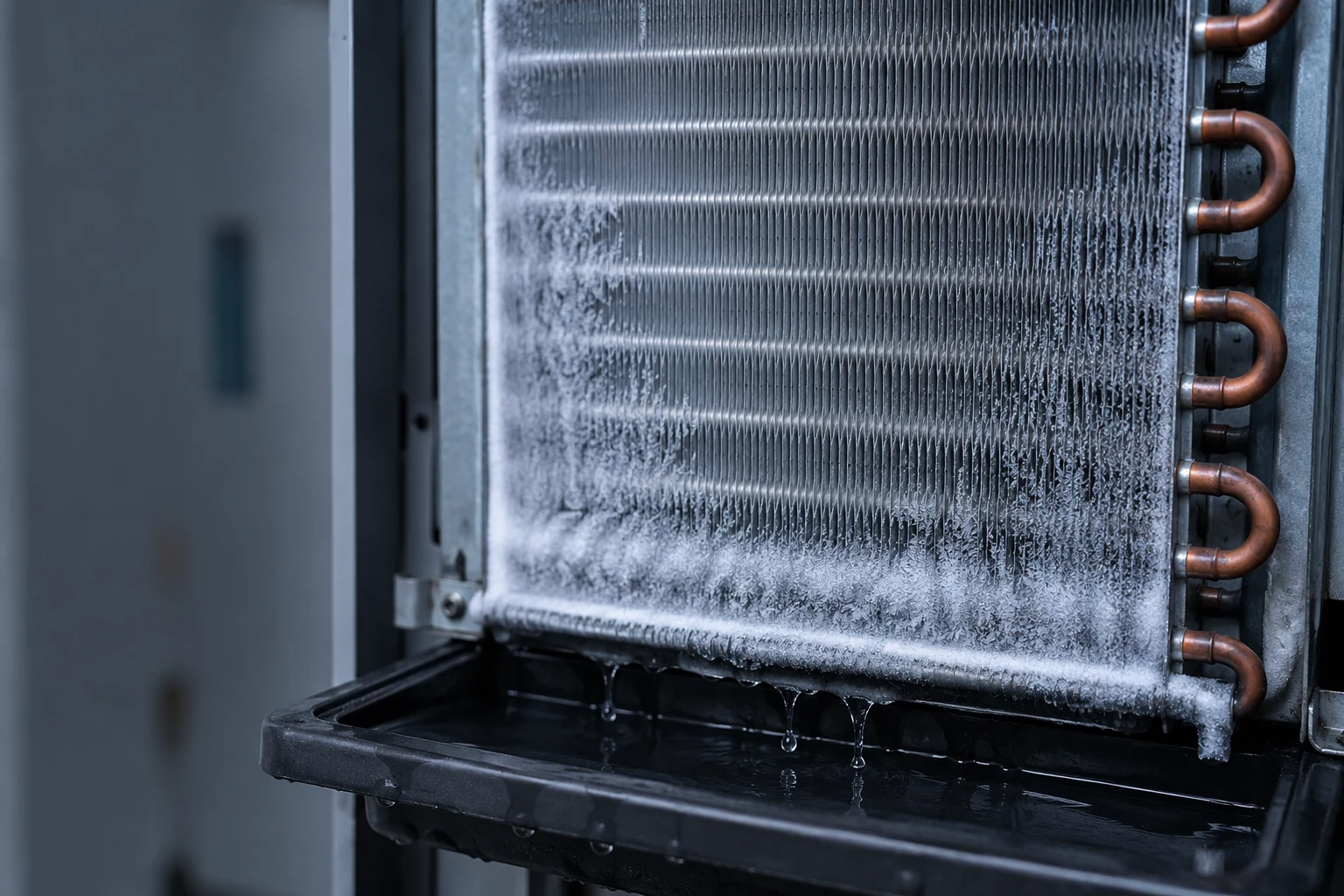
A hybrid water heater does not make heat, it moves it. The evaporator coil on top of the tank pulls warmth out of the room air and hands it to the water, and to do that the coil has to run colder than the air around it. When that air carries moisture, and cool basement air usually does, some of that moisture condenses on the cold fins and freezes. A thin skin of frost is not a defect. It is the unavoidable side effect of a cold surface sitting in humid air, which is why every heat pump, from a mini-split to a refrigerator, has a defrost strategy built in.
Left alone, that frost would keep building until it bridged the gaps between the fins and choked off airflow, and the coil would starve. So the control board runs a defrost cycle on a schedule or when a sensor says frost has built up. It pauses the compressor, warms the coil back above freezing, and the frost melts and runs off down the condensate drain. A few minutes later the compressor restarts and heat-pump mode resumes. You may never notice it unless you are standing next to the unit when the sound changes.
| Why frost forms | Cold evaporator coil pulls heat from cool, humid room air; moisture freezes on the fins |
| What defrost does | Pauses the compressor and warms the coil so frost melts and drains, then heat-pump mode resumes |
| Cycle length | A few minutes, roughly 2 to 10, depending on model and frost buildup |
| What you may notice | Sound change, fan behavior shift, brief noise, a trickle from the condensate drain |
| Efficient ambient range | About 37F to 95-145F; below ~37-40F many units drop the compressor for electric backup |
| Air volume it wants | Roughly 700 to 1000 cu ft of space, or ducting to a larger area |
Where normal ends and a problem begins
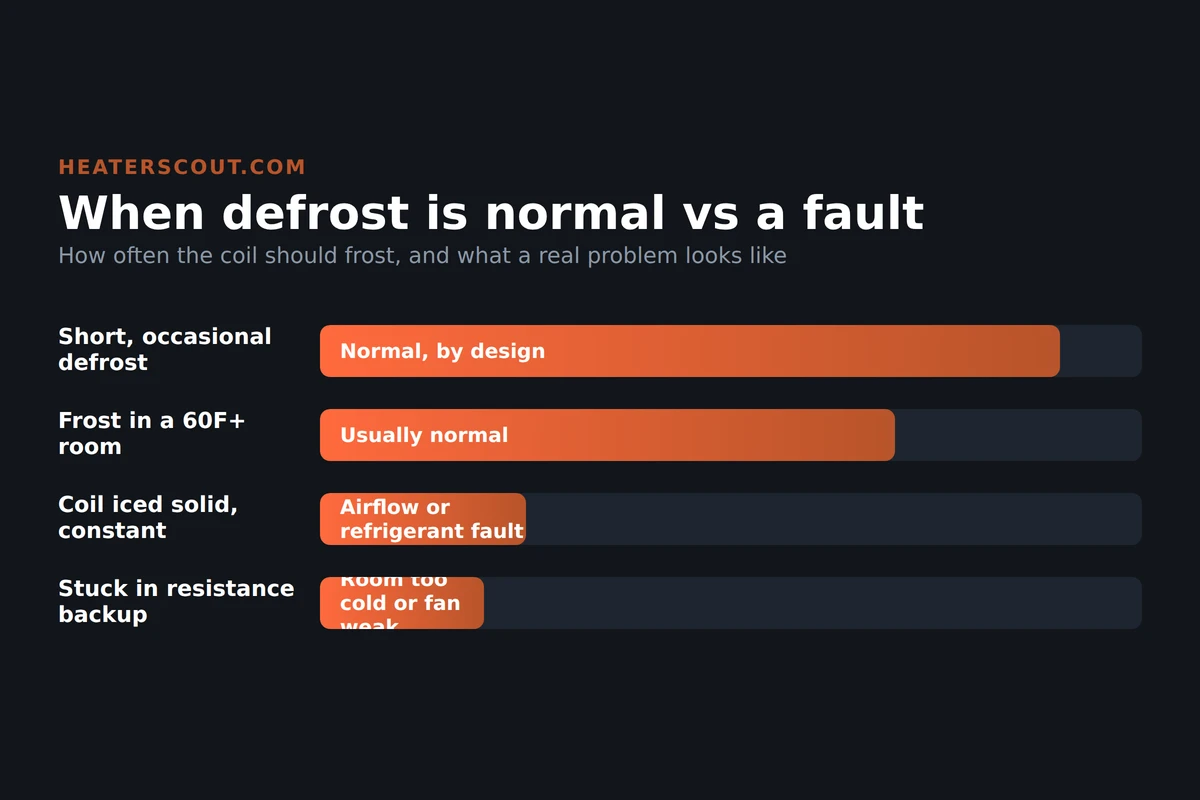
The tell is duration versus heating. A healthy unit defrosts briefly and occasionally, and between cycles it clearly makes hot water in heat-pump mode. The frost is light and the coil looks dusted, not encased. A problem unit looks different in ways you can see and hear: the coil is packed into a solid block of ice, defrost runs almost constantly so the machine spends more time thawing than heating, hot water recovery drags, the unit sits in electric-resistance backup even when the room is warm, or the display throws an error or alert code. Any one of those is your cue to stop and diagnose.
Room temperature is the piece people miss. Below about 37 to 40F, many heat pump water heaters deliberately stop using the compressor and heat with resistance elements instead. So if your unit lives in an unheated garage that dips below freezing, you should not see heavy frosting, since the compressor is not running, but you also will not get the efficiency you paid for. The unit is behaving correctly for the conditions. The fix is a warmer location, or accepting the resistance-heating cost in winter.
Normal defrost is short and occasional. A fault is a coil packed in ice, a unit stuck on resistance backup, or long run times with weak recovery.
The six things that turn frost into a fault
When frosting crosses from cosmetic to crippling, the cause is almost always one of a short list. Work them roughly in this order, cheapest and most likely first.
What to actually do about it
Start with the free checks, because most frosting complaints are airflow, not a dead compressor. Clean or replace the air filter. Inspect and gently clean the evaporator coil fins. Confirm the room is within the operating temperature range and is not a damp, sealed box, and that the unit has enough air volume or ducting to breathe. Check that the condensate drain is clear and sloped. Those four checks resolve the large majority of frosting problems and cost nothing but time.
My heat pump water heater keeps running on resistance backup. Is it broken?
Not necessarily. If the room is below about 37 to 40F, the unit is supposed to drop the compressor and heat with resistance, so a cold garage or basement in winter explains it. Check the room temperature first. If the room is warm and it still refuses to use the compressor, then look at the mode setting, a clogged filter, or a fan or refrigerant fault, and call a technician if the airflow checks come up clean.
Can I just turn defrost off to stop the noise?
No, and you would not want to. Defrost is what keeps the coil from icing into a useless block. Disable it, if the control even lets you, and the unit will frost over and lose the ability to make hot water efficiently. The brief noise is the cost of a coil that stays clear. If the noise is constant rather than brief, that is a symptom to chase, not a setting to mute.
If the airflow is clean, the room is in range with enough air, the drain is clear, and the coil still ices or the unit still hides in resistance mode, that is where the DIY line ends. Heavy frosting with good airflow points at low refrigerant charge or a weak fan motor, and both need a technician. Have your model and serial ready off the rating label, note how long defrost runs and how often, and mention any error code on the display. Those details let the tech head straight for the sealed system or the fan.
The short version: a heat pump water heater is supposed to frost lightly and defrost briefly, and a short cycle with a trickle at the drain is the machine working, not failing. Treat a coil packed in ice, a near-constant defrost, or a unit stuck on resistance in a warm room as the real problem, and chase it in order, filter, coil, room, drain, then refrigerant and fan. Most of the time the fix is a clean filter and a room that gives the unit enough warm air to breathe.
Frequently asked
Is defrost mode normal on a heat pump water heater?
Yes. A heat-pump (hybrid) water heater makes hot water by pulling heat out of the surrounding air, and the coil that grabs that heat, the evaporator, runs cold enough that moisture can freeze onto its fins. A thin layer of frost is expected when the room air is cool and humid. To keep the frost from building into a block of ice that blocks airflow, the unit runs a short defrost cycle: it pauses the compressor, changes the fan behavior, and warms the coil so the frost melts and drains away. That cycle lasts a few minutes and then heat-pump mode resumes. It is designed behavior, not a malfunction, the same way a refrigerator or a mini-split runs defrost. What is not normal is a coil packed solid with ice, defrost running back to back with no real heating between, or the unit giving up on the compressor and heating only with its electric backup elements.
How long does a heat pump water heater defrost cycle last?
A few minutes, typically two to ten depending on the model and how much frost built up. During that window the compressor usually pauses, so you may hear the sound change, and the fan may keep running or briefly stop. You might hear a short gurgle and see a trickle from the condensate drain as the melted frost runs off. Then the compressor restarts and the unit goes back to pulling heat from the air. If a single defrost drags on far longer, or the machine spends more time defrosting than heating, that points at a problem with airflow, room conditions, or the sealed refrigerant system, not a normal cycle.
Why is my heat pump water heater icing up or frozen solid?
Light frost is normal, but a coil frozen into a solid block means the defrost cycle cannot keep up, and that almost always traces to airflow or the room. Start with the air filter: a clogged filter starves the coil of warm air, so it runs colder and frosts faster. Next, check the evaporator coil fins for dust and lint. Then look at the room: if it is very cold, very humid, or too small and sealed to feed the unit enough air, often 700 to 1000 cubic feet, the coil will ice up no matter how clean it is. If the filter and coil are clean and the room is in range and it still ices, you are likely looking at low refrigerant charge or a weak fan motor, both of which need a technician.
At what temperature does a heat pump water heater stop working?
Most hybrid units are happy roughly between 37F and 95 to 145F ambient. Inside that band the compressor runs efficiently and you get the energy savings that make a heat pump worth buying. Below about 37 to 40F many units stop using the compressor entirely and switch to their electric resistance backup elements. That is a deliberate design choice, not a breakdown, since the compressor is not efficient in near-freezing air. So a unit in a space that drops below freezing will not frost heavily, because the compressor is not running, but it also will not save you energy. For heat-pump savings year round, put it somewhere that stays above 40F, like a conditioned basement or a mechanical room.
How do I know if my heat pump water heater defrost is a problem, not normal?
Compare duration and frequency against the heating you actually get. Normal defrost is short and occasional, a few minutes here and there, and between cycles the unit clearly makes hot water in heat-pump mode. A problem looks different: the coil is packed in ice rather than lightly frosted, defrost runs almost constantly, run times stretch long with weak recovery, the unit sits in electric-resistance backup even though the room is warm, or the display shows an error or alert code. Any of those means stop and diagnose. Begin with the filter and coil, confirm the room temperature and air volume are in range, and check that the condensate drain is clear. If clean airflow and a good room still leave you with a frozen coil or a machine stuck on resistance, call a technician.
Should I hear noise or see water during defrost?
A little of both is normal. When the compressor pauses and the coil warms, the melting frost runs off into the condensate drain, so a brief trickle or gurgle from the drain line during or just after defrost is expected. You may also hear the sound shift as the compressor stops and the fan changes, and sometimes a short hiss as pressures equalize. None of that is a fault on its own. What should worry you is water pooling on the floor rather than draining, which points at a clogged or disconnected condensate line, or a loud grinding or rattling that keeps up outside the brief transition, which points at the fan or compressor. Keep the condensate drain clear and sloped so the meltwater leaves the unit.