A hybrid heat pump water heater that is quietly running on its electric elements will still make hot water, so a lot of owners do not notice anything is wrong until the power bill climbs or the fan on top never seems to spin. The compressor is the efficient half of the machine, the part that pulls heat out of the room air instead of burning kilowatts through resistance coils. When it refuses to run, the tank falls back on those coils and your four-times-more-efficient heater turns into a plain electric one. The good news: most of the reasons a compressor sits silent are ordinary and free to fix. Cold air, the wrong mode, a dirty filter, a tripped condensate switch, or a recent outage account for the large majority. This page walks each cause in the order worth checking, using the actual cutoff temperatures and mode names from Rheem, A. O. Smith, and Bradford White.
Quick answer
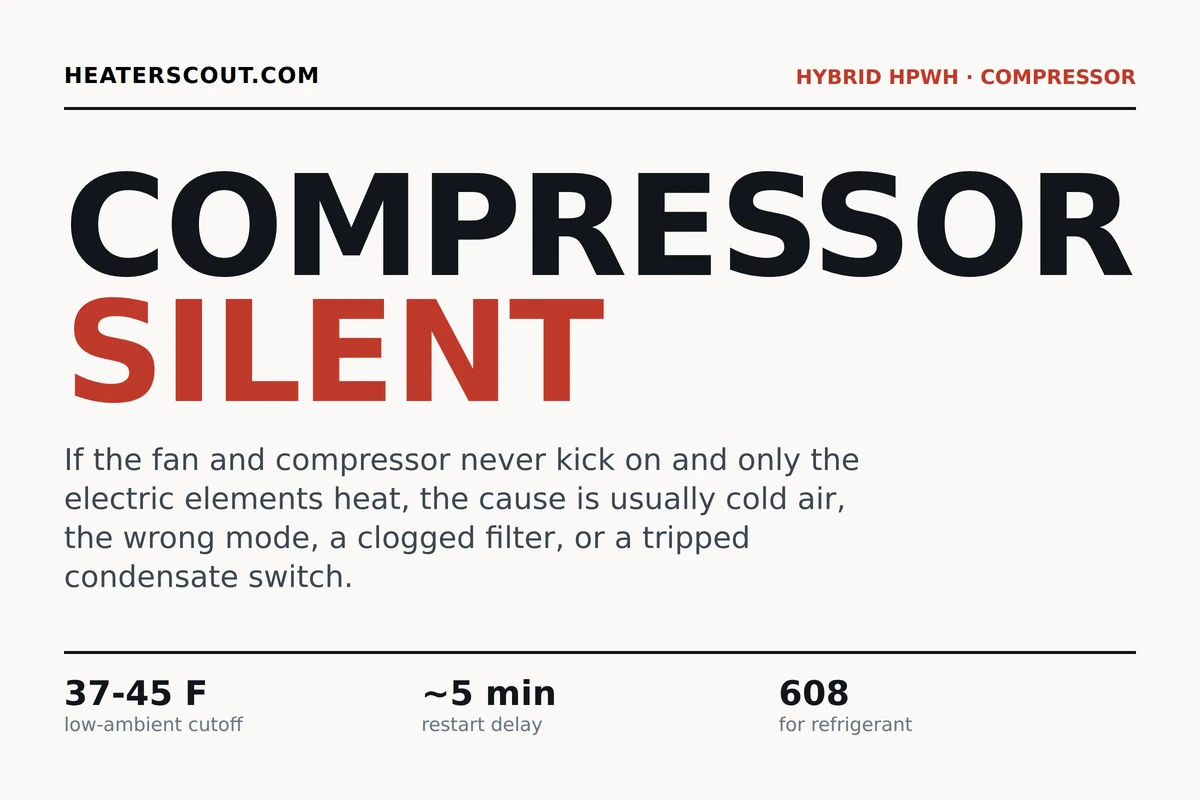
If the compressor never runs and only the electric elements heat, work top to bottom: confirm the room is warm enough for the compressor (Rheem needs above 37 F, A. O. Smith Voltex 45 F to 109 F, Bradford White AeroTherm below 120 F and above 35 F), then check the mode is not set to Electric or Vacation, clean the air filter, clear the condensate drain, and give it five to ten minutes if the power just cycled. A compressor that is genuinely failed or low on refrigerant almost always throws a fault code, and refrigerant work is EPA 608 licensed only.
Start with the two free causes: cold air and the wrong mode
Before you touch a filter or a drain, rule out the two things that fix themselves for nothing. The first is ambient temperature. A heat pump water heater harvests heat from the air around it, so when that air gets too cold there is not enough heat to move and the control deliberately parks the compressor and runs the elements instead. This is not a malfunction. It is written into every manual, and the exact cutoff differs by brand.
The brand cutoff temperatures, in plain numbers
These are the air temperatures around the unit, measured where the heat pump draws its intake, not the outdoor temperature and not the water temperature. A garage that reads 42 F on the thermostat by the door can be several degrees colder near the floor where the intake sits, which is why a unit can drop to elements even when the wall says it should be fine.
Now the mode. Every hybrid ships with a menu of operating modes, and two of them intentionally shut the compressor off. If someone bumped the unit into Electric to power through a cold snap, or the installer left it there and never switched back, the compressor will stay silent no matter how warm the room is. Rheem hybrids carry five modes: Energy Saver, which is the default and the one most homes want, plus Heat Pump, High Demand, Electric, and Vacation. Electric mode runs the elements only. High Demand fires the elements alongside the heat pump, so you may hear the compressor there but the elements are doing most of the work. A. O. Smith Voltex gives you Hybrid, Heat Pump, Electric, and Vacation. Bradford White AeroTherm adds a hybrid-plus tier. The fix is the same across all three: switch back to Energy Saver, Hybrid, or Heat Pump and watch for the compressor to start after any restart delay.
The 72-hour Rheem quirk
A Rheem left in Electric mode auto-reverts to the default Energy Saver mode after 72 hours, so it does not sit on the expensive elements indefinitely. If your compressor came back to life on its own after a few days, it likely just timed out of Electric mode rather than fixing itself.
Clean the air filter and let the coil breathe
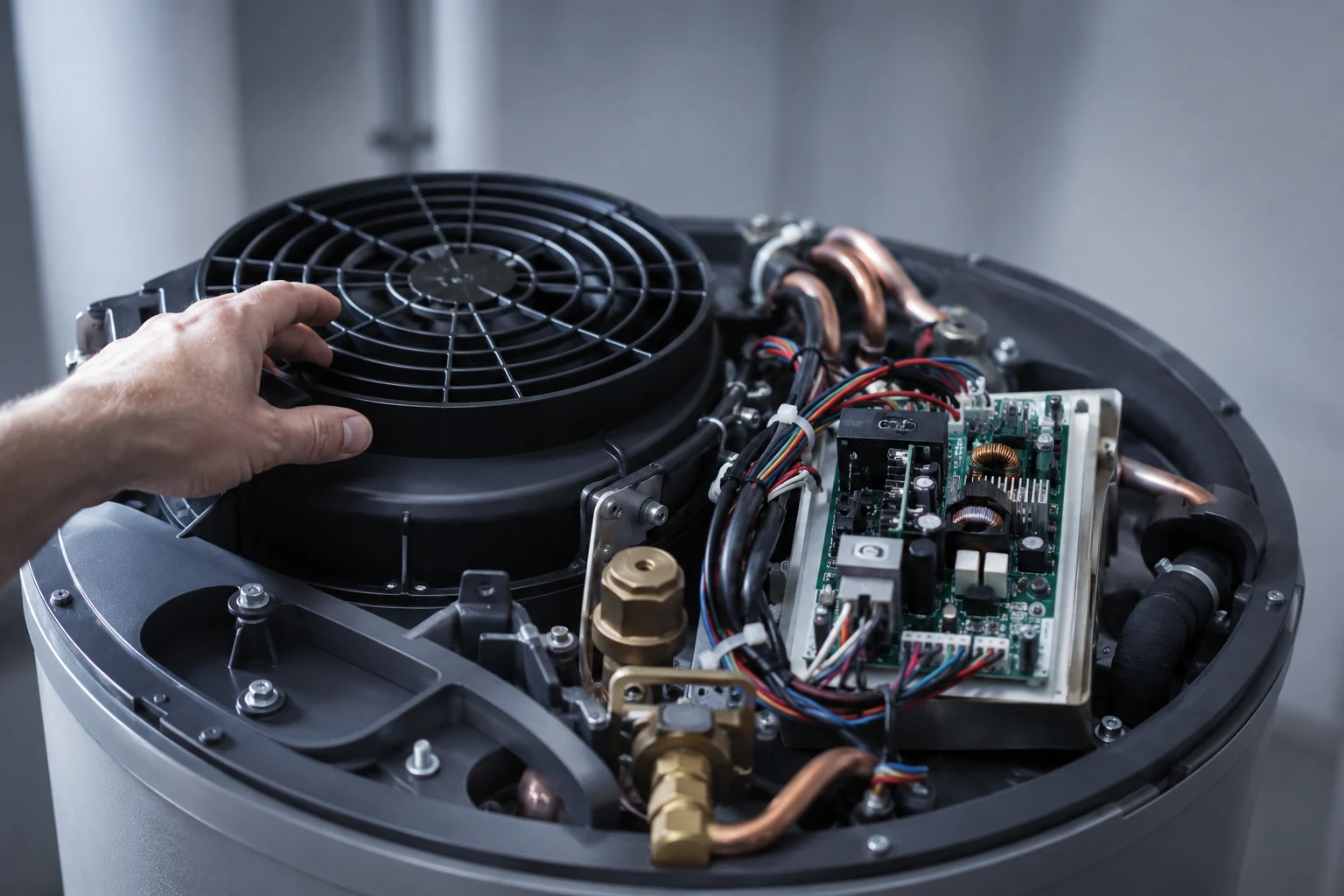
If the room is warm and the mode is right and the compressor still will not run, the next suspect is airflow. The heat pump pulls room air across an evaporator coil to pull heat out of it, and that air has to move freely. A filter packed with dust, lint, and pet hair starves the coil, and choked airflow makes the coil run cold and the whole system underperform. On many units a blocked filter or iced evaporator trips a protection limit that parks the compressor and falls back to the elements. Rheem tells owners to check the filter monthly and clean it quarterly, or sooner if it looks dirty, and that interval exists precisely because a neglected filter is one of the most common reasons these units stop running the heat pump.
- Room air is above the brand cutoff (Rheem 37 F, Voltex 45 F, AeroTherm 35 F) and below the high limit.
- Mode is set to Energy Saver, Hybrid, or Heat Pump, not Electric or Vacation.
- Air filter is clean and dry, and the evaporator fins are free of dust and lint.
- Condensate drain line is clear, the pan is empty, and the tube is not kinked or clogged.
- It has been more than five to ten minutes since the last power cycle or outage.
- The display shows no compressor, sensor, or refrigerant fault code.
The condensate switch, the outage delay, and the sealed system
Three causes remain, and they run from easy to expert. The condensate overflow switch is the sneaky one. Because the heat pump dehumidifies the air it processes, it drips condensate, sometimes a gallon or more a day, out a tube to a floor drain or condensate pump. A float or overflow safety switch watches that path, and if the line clogs or the pump quits, the switch trips to keep water off your floor. Depending on how the model is wired, that trip can disable just the compressor or shut down the entire thermostat. So a unit that stopped running the compressor, especially with a damp pan or a puddle underneath, is often reporting a blocked drain. Clear the line, empty the pan, confirm the tube runs downhill without kinks, and the switch resets.
The outage delay trips people up because it looks like a dead compressor. Heat pump compressors carry anti-short-cycle protection, a timer that holds the compressor off for roughly five minutes after a power loss or the end of a cycle. When a compressor stops, high-side pressure needs time to bleed down, and restarting against that trapped head pressure can stall or overheat the motor, so the control waits it out. After an outage, give the unit ten to fifteen minutes before you conclude anything is wrong. A cut of power at the breaker for a full minute and back on is also a legitimate reset that clears a one-time fault, but respect the same delay afterward.
Cold room or wrong mode
Warm the space, move the unit off a freezing floor, or switch out of Electric and Vacation. No parts, no cost, and the compressor returns once the room is in range and the mode is right.
Dirty filter or blocked drain
Rinse the air filter, vacuum the evaporator fins, and clear the condensate line and pan. Reset the condensate switch by removing the water it was tripping on. Homeowner work with a shop vac.
Refrigerant or board fault
A compressor fault code, a hissing leak, or a compressor that will not run after every free check is a sealed-system or control-board issue. Refrigerant work is EPA 608 licensed only.
That last category is the real repair, and it is where the do-it-yourself line stops hard. If the compressor still refuses to run after you have confirmed a warm room, the right mode, a clean filter, a clear drain, and a full restart delay, and the panel is showing a compressor or refrigerant fault, the problem is inside the sealed system or the control board. Low refrigerant means a leak, and a leak has to be found and repaired by a technician. Under EPA Section 608 of the Clean Air Act, only a certified tech may connect gauges, recover or add refrigerant, or open the refrigerant circuit, and the R134a in these units is a regulated refrigerant. There is no legal or safe homeowner shortcut for a charge problem.
Refrigerant is 608-licensed work
Never try to add refrigerant, connect gauges, or open the sealed system yourself. That work is regulated under EPA Section 608 and requires a certified technician. A low charge always means a leak that must be found and repaired, not just topped off.
Reading the panel before you spend money
The single most useful habit with any hybrid is to read the display before you decide the compressor is dead. A genuinely failed compressor, a bad sensor, or a low charge almost always posts a fault code rather than sitting quietly, and a silent compressor with no code on the screen usually points right back at the free causes: the room is cold, the mode is wrong, or a protection limit tripped. Rheem units surface these through the EcoNet app and the on-unit display, A. O. Smith through its panel and app, and Bradford White through the ICON System. Note the exact code and your model and serial off the rating plate before you call, because the code tells the technician whether they are chasing a sensor, the board, or the sealed system, and that decides the bill.
Put together, the path is short. Confirm the air is warm enough for your brand, using 37 F for Rheem, 45 F for a Voltex, 35 F for an AeroTherm. Confirm the mode is not Electric or Vacation. Clean the filter and evaporator. Clear the condensate drain. Wait out the restart delay. Only after all five of those does a silent compressor become a service call, and even then the code on the panel usually tells you which way the money is going before the tech arrives.
Frequently asked
Why is my heat pump water heater only using the electric elements?
A hybrid tank leans on its electric backup elements whenever the heat pump cannot or should not run, and there are a handful of ordinary reasons. The most common is that the room is too cold. Rheem heat pumps are not meant to run below 37 F, an A. O. Smith Voltex needs ambient air between 45 F and 109 F, and a Bradford White AeroTherm G2 switches to electric-only below 35 F or above 120 F. If the space is inside that band, check the mode: Electric or High-Demand modes deliberately favor the elements. After that comes a clogged air filter choking airflow, a tripped condensate overflow switch, a recent power outage holding the compressor off for a few minutes, or a genuine sealed-system fault like low refrigerant. Rule out the free causes, cold air and wrong mode, before you assume the compressor died.
What temperature is too cold for a heat pump water heater compressor?
It depends on the brand, and the numbers are printed in each manual. Rheem states the heat pump should not operate below 37 F and recommends Electric mode below that point. A. O. Smith Voltex specifies the ambient air must stay above 45 F and below 109 F for the compressor to run, otherwise the elements take over. Bradford White AeroTherm G2 automatically drops to electric-only below 35 F or above 120 F. Those are the air temperatures around the unit, not the outdoor temperature, so a garage that reads 40 F on the wall can easily be colder near the floor where the intake sits. If your heater is in an unconditioned garage or a cold basement in winter, the compressor staying off is the control doing exactly what the manufacturer designed, not a failure.
How do I know if my heat pump water heater is in the wrong mode?
Look at the top control panel or the app. Rheem hybrids have five modes: Energy Saver, which is the default and the one you usually want, plus Heat Pump, High Demand, Electric, and Vacation. Electric mode shuts the compressor off entirely and runs on the elements, and High Demand mode fires the elements alongside the heat pump for fast recovery. A. O. Smith Voltex offers Hybrid, Heat Pump, Electric, and Vacation. If someone bumped the unit into Electric to get through a cold snap, or the installer left it there, the compressor will never run until you switch back to Energy Saver, Hybrid, or Heat Pump. One quirk worth knowing: a Rheem left in Electric mode auto-reverts to Energy Saver after 72 hours, so a compressor that mysteriously came back to life on its own may just have timed out of Electric mode.
Can a dirty air filter stop the compressor from running?
Yes, and it is one of the easiest things to fix. The heat pump pulls room air across an evaporator coil to harvest heat, and a filter caked with dust and lint starves that airflow. Choked airflow makes the coil run cold, drops efficiency, and on many units trips a protection limit that parks the compressor and falls back to the elements. Rheem tells owners to check the filter monthly and clean it quarterly, or sooner if it looks dirty. Pop the filter, rinse or vacuum it, let it dry, and reinstall. While you are in there, look at the evaporator fins: if they are packed with fuzz the compressor will keep tripping until the coil can breathe. A five-minute filter cleaning fixes more no-compressor complaints than any part.
My heat pump water heater compressor won't start after a power outage. Is it broken?
Probably not. Heat pump compressors have anti-short-cycle protection, a built-in delay that holds the compressor off for roughly five minutes after power is lost or a cycle ends. When a compressor stops, high-side pressure needs time to bleed down, and starting against that trapped head pressure can stall or damage the motor. So after an outage the control waits out its timer before the compressor fires. Give it ten to fifteen minutes. If the fan and compressor still refuse to start well after that, then check the mode, the filter, and the condensate switch, and look for a fault code on the display. A compressor that is truly dead usually throws an error code rather than sitting silently, so read the panel before you panic.
What is a condensate overflow switch and why would it stop my compressor?
Because the heat pump dehumidifies the air it pulls in, it produces condensate, sometimes a gallon or more a day, that drains out a tube to a floor drain or condensate pump. A small float or overflow safety switch watches that drain. If the line clogs, the pump fails, or water backs up, the switch trips to stop the unit from flooding your floor. Depending on how your model is wired, that tripped switch can disable just the compressor or shut down the whole thermostat. So a heater that suddenly stopped running the compressor, especially one with a damp pan or a puddle nearby, is often telling you the condensate path is blocked. Clear the drain line, empty the pan, confirm the tube is not kinked, and the switch resets.
Do I need a licensed technician to fix a heat pump water heater compressor?
For the sealed refrigerant system, yes. Anything that involves connecting gauges, adding or recovering refrigerant, or opening the refrigerant circuit is regulated under EPA Section 608 of the Clean Air Act, and the refrigerant in these units, usually R134a, is covered. Only an EPA 608 certified technician may legally do that work. What you can and should do yourself first is the non-sealed side: confirm the mode, warm up a cold room or move the unit, clean the air filter and evaporator, clear the condensate drain, wait out the restart delay, and reset power at the breaker. If the compressor still will not run after all of that and the display shows a compressor or refrigerant fault, that is when you call a pro, because a low charge means a leak that a certified tech has to find and repair.