A hybrid heat pump water heater is a fantastic machine in the right spot and an expensive electric tank in the wrong one. The difference comes down to two numbers on the spec sheet that buyers routinely skip: the ambient temperature range the compressor is allowed to run in, and the volume of air the unit needs around it. Get either one wrong, drop it in a sealed cold closet, and the heat pump you paid extra for spends the winter switched off while the resistance elements do the work. This page lays out the operating temperature windows for the major brands, the room air volume each one needs, when and why the unit falls back to resistance, and the ducting options that fix a room that is too small or too cold.
The operating temperature window, brand by brand
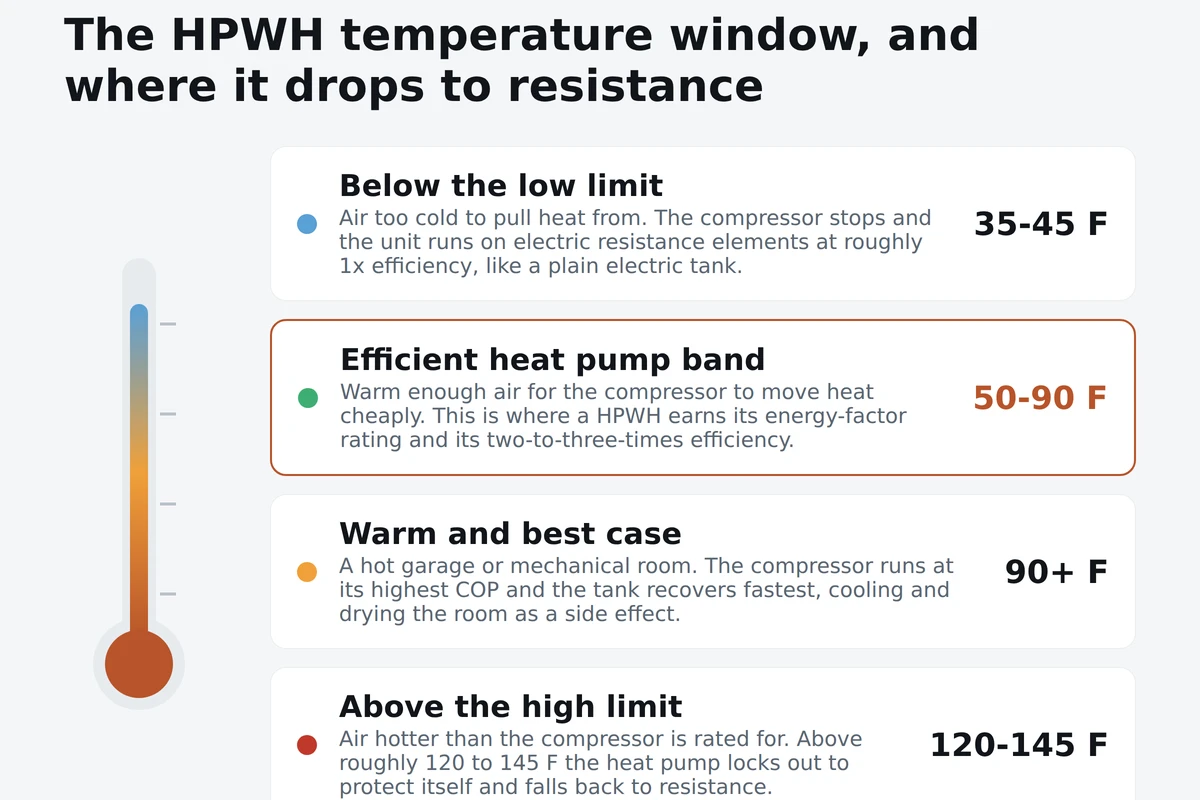
Every hybrid has a band of ambient air temperatures inside which the compressor is allowed to run. Outside that band the unit does not shut off and leave you with cold showers. It quietly switches to the electric resistance elements and keeps making hot water, just at the efficiency of a plain electric tank. The bands differ enough between brands that the same cold garage can be fine for one unit and a resistance-mode trap for another. These figures come straight off the manufacturer spec sheets and install manuals.
| Rheem ProTerra / Performance Platinum | 37 F to 145 F (Northern Climate Spec Tier 4, widest range) |
| A.O. Smith Voltex Hybrid | above 45 F and below 120 F |
| Bradford White AeroTherm RE | 35 F to 120 F |
| GE Profile GeoSpring | 700 cu ft rule; falls to resistance when air is too cold |
| Below the low limit | compressor off, electric resistance elements heat the water |
| Above the high limit | heat pump locks out to protect the refrigerant circuit |
Read your own model's plate and spec sheet rather than trusting a generic 'about 40 to 90 degrees' rule of thumb. The high end matters less for most homes, since few utility rooms ever hit 120 F, but the low end decides how many weeks of the year your heat pump actually runs. A Rheem rated down to 37 F will keep harvesting heat in a garage that would have pushed an A.O. Smith, which stops at 45 F, onto its elements weeks earlier.
Efficiency does not fall off a cliff, it slides
The temperature cutoff is a hard line, but the efficiency loss well above that line is gradual and just as important to your bill. A heat pump moves heat rather than making it, and the colder the air, the less heat is in it to move. So as the room cools, the compressor runs longer for the same tank and the coefficient of performance, the ratio of heat delivered to electricity used, drops. The bars below sketch the trend that field studies from NREL and others have measured. They are directional, not a guarantee for your exact unit, but the shape is consistent across brands.
Two things stand out. First, efficiency starts easing off well before the cutoff, around 68 F, so a 'cold but above the limit' room still costs you real money compared to a warm one. Second, the moment the unit crosses into resistance mode, its COP collapses to 1.0, the same as the cheapest electric tank. That is why a HPWH in a space that spends months below 50 F can disappoint: on paper it is a heat pump, but in practice it runs like a resistance heater through the cold season.
The closet trap
Do not seal a heat pump water heater into a small furnace closet with no louvers or ducting. The compressor will chill the trapped air within minutes, lose the heat it needs to run efficiently, and drop onto resistance elements. The room air volume rule exists precisely to prevent this, and ignoring it is the most common way a new HPWH underperforms its rating.
Why space and air volume matter
Minimum room air volume
The volume of unrestricted air a heat pump water heater needs around it so the compressor has enough heat to harvest without chilling the room into resistance mode. The common manufacturer figure is about 700 cubic feet, roughly a 10 by 10 foot room with an 8 foot ceiling. A.O. Smith states 700 cubic feet as a minimum, Rheem recommends 700 but allows down to about 450 cubic feet at reduced efficiency, and GE uses the same 700 cubic foot guideline. Below that, you need louvers into a larger space or a ducting kit.
The number comes from a simple physical fact: the unit is a heat scavenger. Over a heating cycle it pulls a meaningful amount of thermal energy out of the surrounding air and dumps cooler, drier air back out. In a big basement, that air is a rounding error against the room. In a tight closet, the unit cools its own supply, the air temperature sags below the compressor's happy zone, and efficiency craters. Manufacturers also want clearance for the air filter and for service. A.O. Smith calls for 6 inches of clearance to reach the filter and recommends about 3 feet on the sides and back for future service access. Bradford White specifies louvered doors with at least 240 square inches of open area when the unit sits in an enclosed space.
Ducting: the fix for a room that is too small or too cold
When the room fails the air volume test or runs too cold in winter, ducting is the standard answer. Most current hybrids, including Rheem's ProTerra, A.O. Smith's Voltex, and GE's GeoSpring with its PH10VK kit, are duct-ready. You can duct the exhaust, the intake, or both, and each option solves a different problem. Ducting the exhaust sends the cool, dry discharge air somewhere useful or out of a living space instead of chilling the room. Ducting the intake lets a unit in a cold garage pull warmer air from an adjacent conditioned space, keeping the compressor above its cutoff longer. Full dual-path ducting, intake and exhaust both, lets you install in a small mechanical closet that could never meet the 700 cubic foot rule on its own.
Ducting is not free performance. Every elbow and foot of duct adds airflow resistance, and the fan has to overcome it, so manufacturers cap total duct length and the number of bends. Follow the kit instructions for maximum equivalent length. And if you duct through an unconditioned space in a cold climate, insulate the duct so you are not just importing cold air by another path. Done right, ducting turns a marginal location into a working one. Done carelessly, it starves the fan and you are back to resistance mode.
The side effects: cool air, noise, and condensate
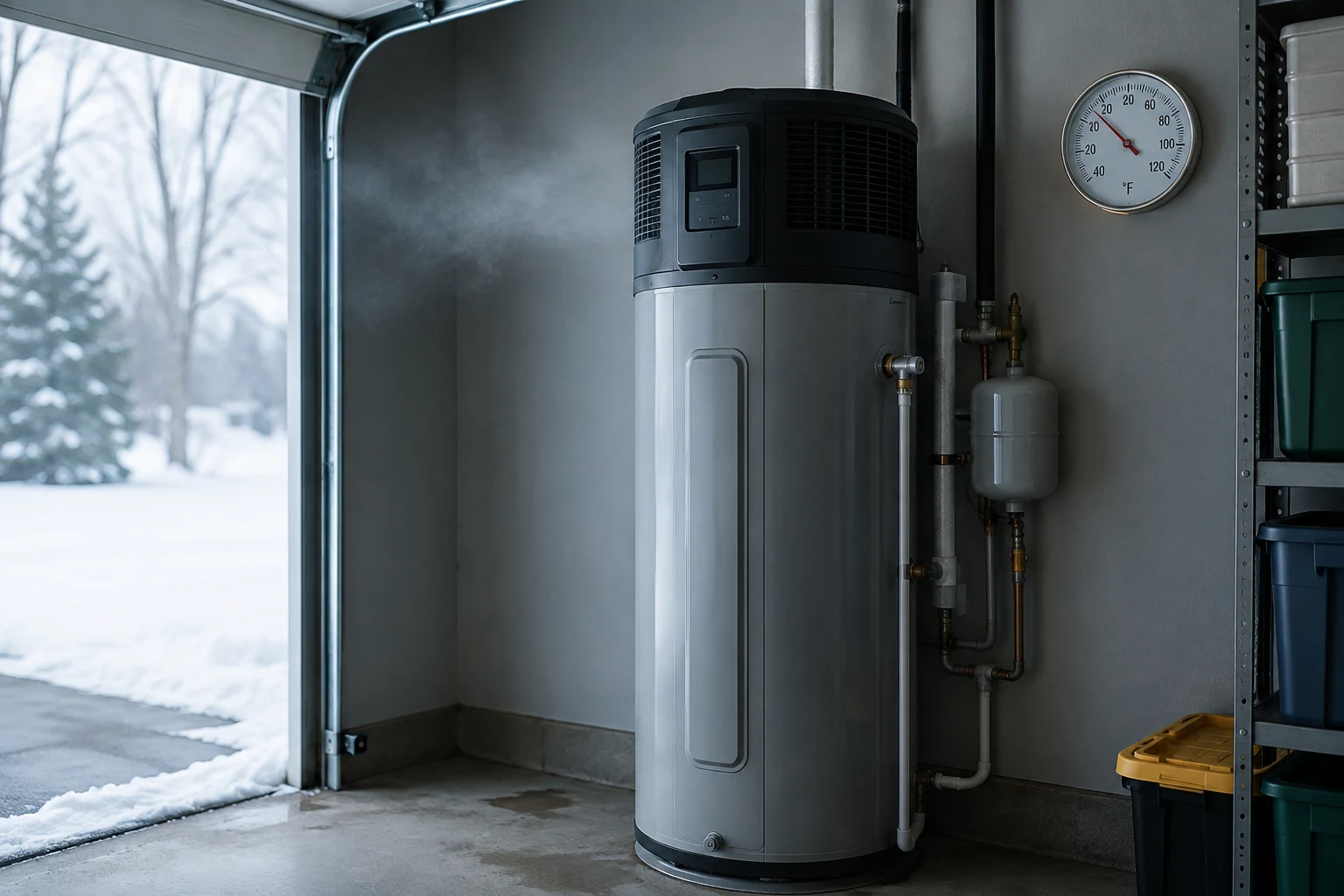
Three practical consequences follow from how a HPWH works, and all three steer where you should put one. The unit blows cool, dry air, so it slightly heats-loads any conditioned space it sits in during winter, effectively borrowing heat your furnace paid for. It hums and whirs at roughly 45 to 50 decibels at three feet, a low compressor note plus fan whir that carries through thin walls more than the raw number implies, which is why a closet sharing a wall with a bedroom is a poor choice. And it dehumidifies as it runs, condensing several gallons of water a day out of humid air, so it needs a gravity condensate drain or a small condensate pump. None of these is a defect. They are the reason garages, unconditioned basements, and dedicated utility rooms are the classic homes for a hybrid.
Will a heat pump water heater still make hot water when it is freezing outside?
Yes. Below its compressor cutoff the unit keeps heating with its electric resistance elements, so you do not run out of hot water in a cold snap. You just lose the efficiency for those hours or days. That is exactly the safety net the hybrid design provides: heat pump when it can, resistance when it must.
Is a cold basement better or worse than a warm one for a HPWH?
Warmer is more efficient, but a cool basement that stays above the low cutoff, say in the 55 to 65 F range year round, is a fine spot with plenty of air volume. The problem case is a space that swings below the compressor's low limit for weeks, which forces resistance backup and erases the savings. Stable and above the cutoff beats warm but cramped.
Frequently asked
What ambient temperature does a heat pump water heater need to work?
Each brand publishes a heat pump operating range, and the spread between them is wider than most buyers expect. Rheem's ProTerra and Performance Platinum hybrids are rated for heat pump operation from about 37 F to 145 F, which is the widest window on the market and the reason Rheem carries the Northern Climate Spec Tier 4 label. A.O. Smith's Voltex asks for air above 45 F and below 120 F. Bradford White's AeroTherm is designed for 35 F to 120 F. Below the low end of its own range, every one of these units stops running the compressor and heats with plain electric resistance elements instead, so it keeps making hot water but at ordinary electric-tank efficiency. Above the high end, usually 120 to 145 F depending on brand, the heat pump also locks out to protect the refrigerant circuit. The takeaway is simple: read the range on the spec sheet for your exact model, because a cold garage that is fine for a Rheem may push an A.O. Smith into resistance mode all winter.
How much space does a heat pump water heater need?
The compressor pulls heat out of the surrounding air, so it needs a reservoir of air to draw from. The common manufacturer figure is about 700 cubic feet of unrestricted air around the unit, which is roughly a 10 by 10 foot room with an 8 foot ceiling. A.O. Smith's Voltex manual states 700 cubic feet as the minimum. Rheem publishes 700 cubic feet as the recommendation but notes the unit will run in rooms down to about 450 cubic feet at reduced efficiency and output. GE's GeoSpring uses the same 700 cubic foot guideline. If your mechanical closet is smaller than that, you have two outs: fit a louvered door that opens the closet to a larger adjacent space, or add a ducting kit that pipes intake and exhaust air to and from elsewhere in the house. Squeeze one into a sealed closet with no air path and it will chill that small pocket of air within minutes, then run on resistance because there is no heat left to harvest.
Can I put a heat pump water heater in an unheated garage?
You can, but the answer depends on your climate and the brand's low-temperature cutoff. In a mild climate where the garage rarely drops below 50 F, a HPWH in the garage is close to ideal: plenty of air volume and moderate temperatures. In a cold-winter garage that spends months below 40 F, the story changes. Field studies found unconditioned spaces that sat under 50 F for much of the year drove excessive electric-resistance backup, erasing most of the savings. A Bradford White rated to 35 F will keep the compressor running a little longer into the cold than an A.O. Smith that stops at 45 F, and a Rheem rated to 37 F sits in between. Below each unit's limit you are simply running an expensive electric tank. If your garage gets genuinely cold, either duct the intake from a warmer space or accept that the heat pump will nap through the coldest weeks.
Why does my heat pump water heater run on electric resistance instead of the heat pump?
A hybrid has both a heat pump and a pair of electric resistance elements, and the control board picks between them. It falls back to resistance for a few normal reasons. The most common is cold air: once the room drops below the compressor's low limit, roughly 35 to 45 F depending on brand, the board shuts the compressor off and heats with the elements to avoid running the refrigerant circuit in conditions it is not rated for. It will also lean on resistance when you draw a large volume of hot water fast and the slower heat pump cannot keep up, or when you have selected a high-demand or electric mode in the settings. If your unit runs on resistance all the time and the room is warm and well above the low limit, that points at a fault, a stuck mode setting, or a heat pump that is not engaging, not normal behavior.
Does a heat pump water heater make the room cold?
Yes, and that is not a defect, it is how the machine works. A HPWH extracts heat from the air and moves it into the water, so it blows cooler, drier air back into the room. In a large basement this is often welcome in summer and unnoticed in winter. In a small closet it is a problem, because the unit quickly chills the trapped air and then loses efficiency. The cooling side effect is exactly why the space and airflow rules exist. In a heated living space, the water heater is effectively stealing heat your furnace paid for, which is one reason garages, unconditioned basements, and utility rooms are the preferred spots. The unit also dehumidifies as it runs, pulling several gallons of condensate a day out of humid air, so it needs a condensate drain or a small condensate pump.
How loud is a heat pump water heater?
Louder than a plain tank, because it has a compressor and a fan, but not loud like an old fridge in a quiet kitchen. Current models land in the mid 40s to low 50s of decibels measured at three feet. A.O. Smith rates its quieter Voltex build around 45 dB, and Rheem's newer ProTerra units are cited from the low 40s up to about 49 dB, with a quiet mode that slows the fan during set overnight hours. For reference, 45 dB is about the level of a quiet library or light rain. The sound is a low compressor hum plus fan whir, so it carries through thin walls into a bedroom more than the raw number suggests. That, plus the cool exhaust air and the condensate, is why most owners are happiest with the unit in a garage, basement, or dedicated utility room rather than a closet next to a bedroom.
What happens to efficiency as the air gets colder?
The colder the air, the less heat there is in it to harvest, so the compressor works longer for the same tank of hot water and the coefficient of performance, or COP, falls. In warm air a good HPWH runs a COP around 3 to 4, meaning three to four units of heat delivered for every unit of electricity. Field measurements in unconditioned basements showed COPs sliding to the 1.5 to 2.6 range as those spaces cooled, and efficiency starts easing off once the air drops below about 68 F. By the time the room is near 50 F you are getting far less than the sticker efficiency, and once you cross the low-temperature cutoff the unit is running on resistance elements at a COP of 1, no better than a plain electric tank. So the ambient temperature is not a footnote. It is the single biggest lever on what a heat pump water heater actually costs you to run.