A heat-pump water heater turns one unit of electricity into three or four units of heat, while a gas tankless turns a unit of gas into a little under one unit of heat and an electric tankless into almost exactly one. That single spread, a UEF near 3.5 against a UEF near 0.9, drives most of the cost story. But efficiency is not the whole decision. One heater stores a tank of hot water and reheats it slowly, the other stores nothing and heats on demand but caps how many taps you can run at once. This page lines them up on running cost, hot-water delivery, what each needs to install, upfront price, and how long they last, so you can match the heater to your house instead of the marketing.
Heat pump (hybrid)
- Electric. A compressor pulls heat from the room air into a 50 to 80 gallon tank.
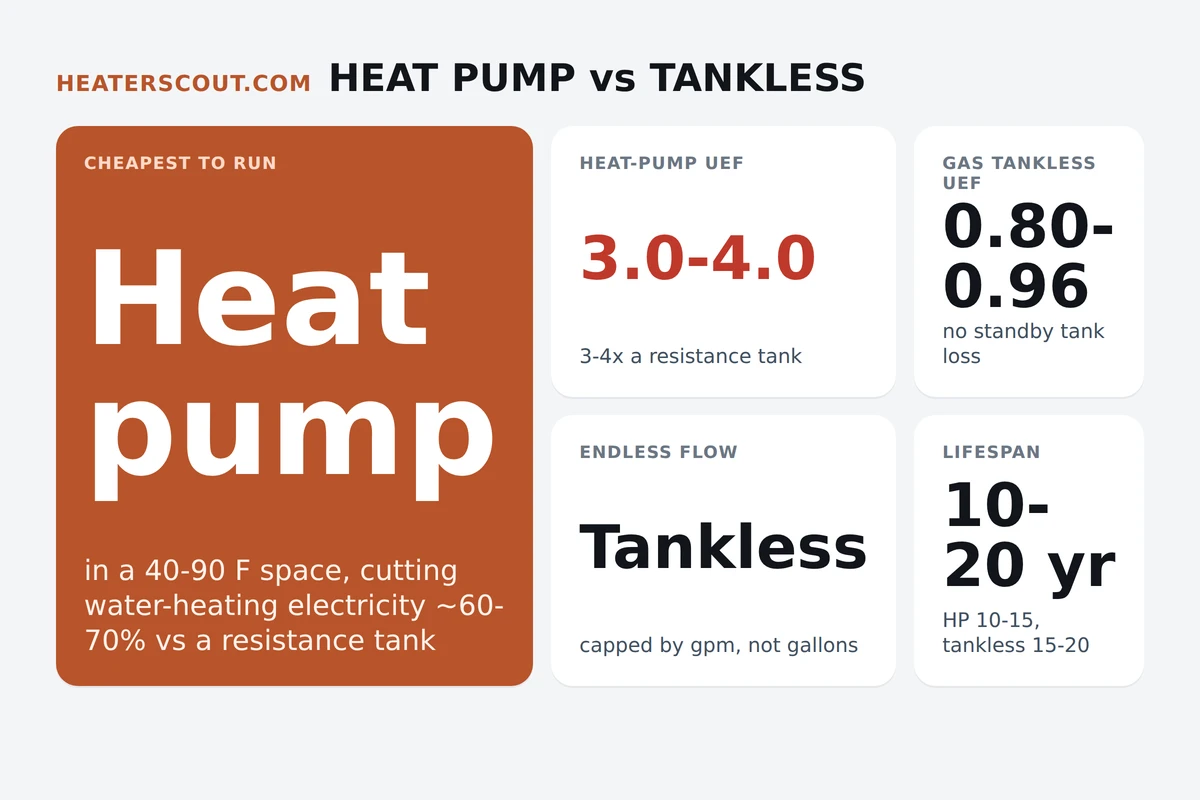
- UEF about 3.0 to 4.0, roughly 3 to 4 times a standard electric resistance tank.
- Cheapest to run in a 40 to 90 F space. Can cut water-heating electricity by 60 to 70 percent.
- Needs 700 to 1000 cubic feet of air or a duct kit, dumps cold exhaust, hums like a window AC.
- Tank buffer, but slow recovery after heavy use. About 10 to 15 years.
Tankless (gas or electric)
- Heats on demand, no stored tank and no standby heat loss.
- Gas UEF about 0.80 to 0.96. Electric UEF near 0.99 but about a 100 to 150 amp draw.
- Endless flow if sized right, but output is capped by gpm at your temperature rise.
- Gas needs a sized gas line plus venting. Electric needs a large service.
- About 15 to 20 years with regular descaling.
Running cost: where the heat pump pulls ahead
The efficiency gap is the headline. A heat pump does not make heat, it moves heat, so its UEF lands around 3.5 while a gas tankless sits near 0.9 and an electric tankless near 0.99. In practice that means a heat pump in a decent space can cut the electricity you spend heating water by 60 to 70 percent compared with a plain electric resistance tank. If your alternative is resistance electric, the heat pump is not a close call on the monthly bill. The comparison tightens against gas. A gas tankless burns cheap fuel in many parts of the country, so its operating cost tracks local gas prices, and where gas is inexpensive the two can end up in the same neighborhood. The bar chart below shows the rough spread in operating cost, keyed to efficiency rather than to any one utility rate.
Read those bars as relative operating cost, not exact dollars, since your gas and electric rates set the real numbers. The pattern holds across most of the country: a heat pump in a warm enough room is the cheapest to run, a gas tankless is competitive where gas is cheap, and anything using electric resistance heat, tank or tankless, sits at the top of the bill. The one thing that flips the heat pump result is a cold install space, because a heat pump in a 35 degree garage in January runs on its resistance backup and turns into an expensive electric tank.
Quick answer
A heat-pump (hybrid) water heater is usually the cheapest to run and the smart pick when your install space stays between 40 and 90 F, because its UEF of 3.0 to 4.0 cuts water-heating electricity by 60 to 70 percent versus a resistance tank. A tankless wins when you want endless flow, have limited floor space, and either have cheap gas (gas tankless) or a small point-of-use need. Choose the heat pump for lowest operating cost in a garage or basement; choose a gas tankless for never running out and a long service life where gas is affordable.
Location decides the heat pump
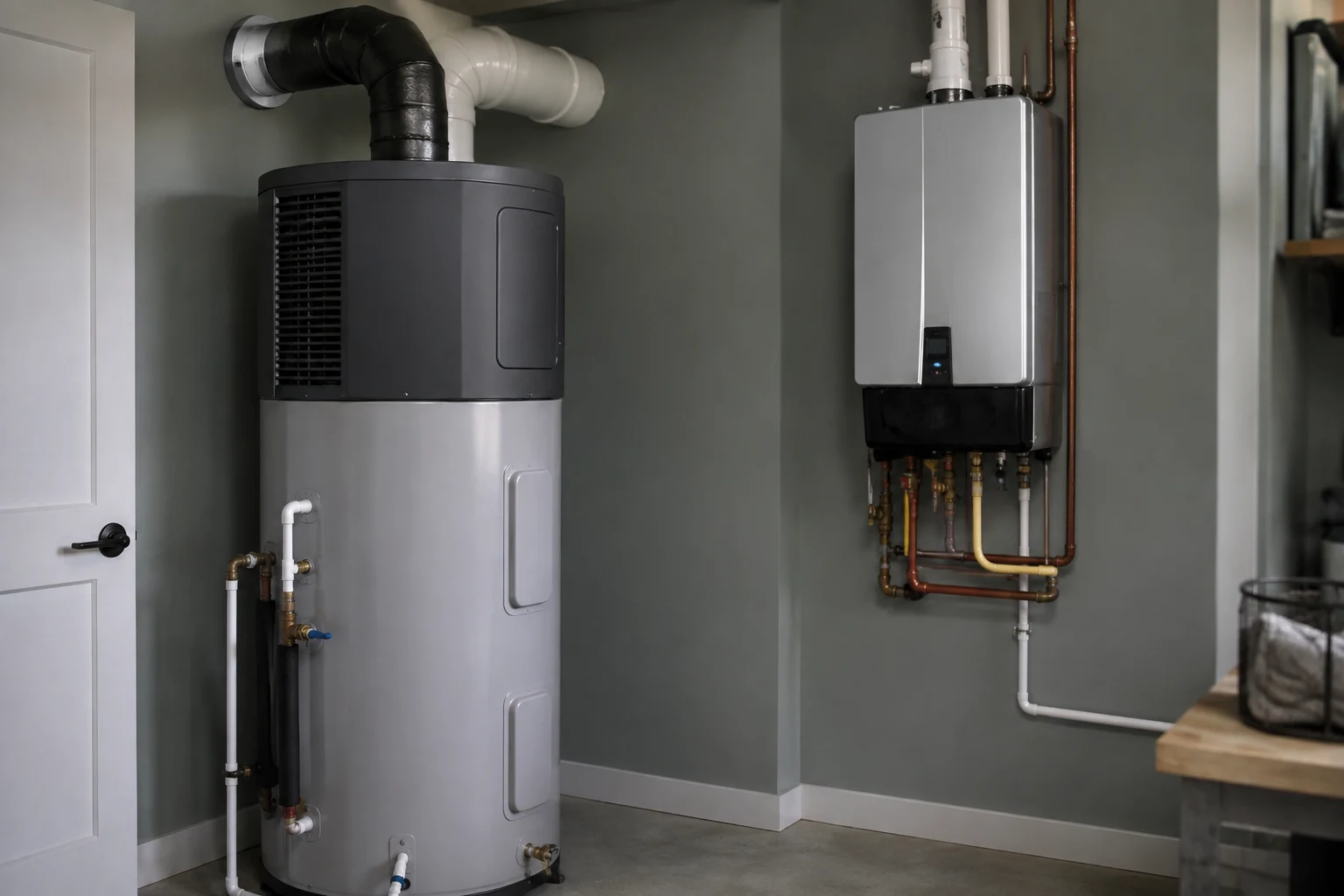
A heat pump in a small, cold, or closed-off closet is the most common way this choice goes wrong. It needs roughly 700 to 1000 cubic feet of air or a duct kit, and it dumps cold exhaust into the room. Put one in a tight utility closet and it starves for air, cools the room it sits in, and leans on resistance backup, which erases the savings you bought it for. Measure the space before you buy.
Hot water delivery: buffer versus endless
These two heaters fail differently under load, and that difference matters more than the spec sheet. A heat pump has a tank, so it hands you a full buffer of hot water and a strong, steady flow until that buffer runs low. Its weakness is recovery: the compressor reheats gently, so after several long showers back to back you can drain the tank and then wait while it slowly catches up. A tankless has no tank and cannot run out in that way, because it heats water as it flows. Its weakness is simultaneous demand. A tankless can only raise so many gallons per minute to your target temperature at once, and a cold winter inlet lowers that ceiling. Run two showers and a dishwasher on an undersized unit and the water turns lukewarm.
So the right question is not which one gives more hot water, but how your household actually uses it. A big family with staggered showers and the occasional deep tub is well served by a large heat pump tank. A household that hates the idea of ever running out, or one that runs a few fixtures at once and can size the unit for it, leans tankless. Neither is universally better. The heat pump trades a slow refill for a large reserve; the tankless trades a flow cap for a bottomless supply.
UEF (Uniform Energy Factor)
The federal efficiency rating for water heaters. It is heat delivered divided by energy consumed over a standard day of use, so a higher number means less energy wasted. A UEF above 1.0 looks impossible until you remember a heat pump moves existing heat instead of creating it, which is how a hybrid reaches 3.0 to 4.0. Combustion and resistance heaters can never exceed 1.0, which is why a gas tankless tops out near 0.96 and an electric tankless near 0.99. Compare heaters by UEF, not by the older Energy Factor, and compare within fuel type since a low-UEF gas unit can still cost less to run than a high-UEF electric one where gas is cheap.
Install, upfront price, and lifespan
The sticker price is only part of the install cost, and the two heaters spend money in different places. A heat-pump hybrid unit runs about $1,500 to $3,000. Its install is usually straightforward if the space is right, since it drops into the same plumbing footprint as a tank heater and needs only air and a condensate drain. A gas tankless unit runs about $1,000 to $2,000, but the install often costs as much as the box, because you may need a larger gas line and new venting. An electric whole-house tankless can look cheap until you price the 100 to 150 amp electrical capacity it demands, which pushes many homes into a panel or service upgrade. State and utility rebates may still favor the heat pump, which can close the upfront gap further, but the federal 25C tax credit that offered up to $2,000 on a heat-pump water heater ended after 2025, so do not count on it. Programs change often enough that you should confirm current local rebates before you count on any of it.
On lifespan, the tankless has the edge. A gas tankless commonly lasts 15 to 20 years with regular descaling, because its main wear part, the heat exchanger, can be flushed clean. A heat-pump hybrid usually lasts 10 to 15 years, since it carries both a corrodible tank and a compressor that can fail. Factor that into the math: the tankless costs more to install but may run longer, while the heat pump costs less to install and far less to run but may need replacing a few years sooner. Maintenance moves both numbers. Skip descaling in hard water and a tankless dies early; run a heat pump in a cold space on constant resistance backup and its compressor works harder than it should.
How to pick for your house
Start with the room. If you have a garage, an unfinished basement, or any space that stays between 40 and 90 degrees with 700 or more cubic feet of air, a heat pump is usually the lowest total cost of ownership, especially if your only other electric option is resistance. If your install spot is a small, cold, or closed closet, cross the heat pump off unless you can duct it. Next, look at gas. If you already have a sized gas line and cheap gas, a gas tankless gives you endless hot water and a long life at a running cost that stays competitive. If you have no gas line, compare the heat pump against an electric tankless and the heat pump almost always wins, because the electric tankless runs at resistance efficiency and demands a huge service. Finally, weigh how your family draws hot water: a large reserve with slow refill, or a bottomless supply with a flow cap. Match the heater to that pattern and the rest of the decision falls into place.
Frequently asked
Is a heat pump water heater cheaper than tankless?
To run, usually yes, if you put it in the right space. A heat-pump (hybrid) water heater has a UEF of about 3.0 to 4.0, meaning it delivers three to four units of heat for every unit of electricity it draws, because it moves heat out of the surrounding air instead of making heat from scratch. That can cut your water-heating electricity by roughly 60 to 70 percent versus a standard electric resistance tank. A gas tankless runs on gas at a UEF around 0.80 to 0.96, so its running cost tracks the price of gas in your area. Where gas is cheap, a gas tankless can be close on operating cost. Where you would otherwise heat water with electric resistance, the heat pump almost always wins on the monthly bill. The catch is the heat pump needs a warm enough space, because in a cold room it falls back to resistance heat and loses that advantage.
Does a heat pump water heater run out of hot water faster than tankless?
It can, and this is the trade most people miss. A heat pump has a tank, usually 50 to 80 gallons, so you get a buffer of stored hot water like any tank heater. But its recovery is slow: the compressor reheats the tank gently, so after a run of long showers or a big bath you may drain the buffer and wait. A tankless never stores water and never runs out in that sense, since it heats on demand. What limits a tankless is flow: it can only raise so many gallons per minute to your target temperature at once. Run two showers plus a dishwasher and a small tankless will drop the temperature. So the heat pump can run out but delivers a strong steady flow until it does, while the tankless never runs out but caps how many fixtures you can run at the same time.
What are the downsides of a heat pump water heater?
Three things. First, air. The compressor needs roughly 700 to 1000 cubic feet of air around it or a duct kit, and it dumps cold exhaust air into the room, which is great in a hot garage and unwelcome in a finished basement you are trying to keep warm. Second, temperature. It wants a space between about 40 and 90 degrees Fahrenheit. In a cold space it switches to electric resistance backup, and at that point you are paying resistance rates and the efficiency argument is gone. Third, noise and recovery. The compressor and fan make a low hum, somewhere near a window air conditioner, and recovery after heavy use is slower than a gas heater. None of these are dealbreakers in the right room, but they explain why location decides whether a heat pump is brilliant or disappointing.
What are the downsides of a tankless water heater?
Mostly install and flow limits. A gas tankless needs a gas line sized for its high burner input and its own venting, which often means new stainless or PVC vent runs and sometimes a larger gas pipe, so the install cost can exceed the unit price. An electric whole-house tankless needs a very large electrical service, commonly about 100 to 150 amps of dedicated capacity, which many older panels simply cannot give without a service upgrade. On the water side, output is capped by gallons per minute at your required temperature rise, and a cold winter inlet cuts that output, so a unit that felt endless in summer struggles in January. Tankless heaters also need periodic descaling in hard-water areas to protect the heat exchanger.
Which lasts longer, a heat pump or a tankless water heater?
Tankless, on paper. A gas tankless commonly lasts 15 to 20 years when it is descaled on schedule, because the heat exchanger is the main wear part and it can be flushed. A heat-pump hybrid usually runs 10 to 15 years, since it carries both a tank that can corrode and a compressor that can fail, so it has more moving parts to age. Neither number is guaranteed. A tankless that never gets descaled in hard water can scale up and fail early, and a heat pump run in a cold space, cycling into resistance backup, works harder than one in an ideal room. Maintenance, water quality, and location move these ranges more than the badge on the front.
Should I choose a heat pump or a tankless if I have no gas line?
With no gas line, the honest comparison is heat pump versus electric tankless, and the heat pump usually wins. An electric whole-house tankless draws about 100 to 150 amps, which forces most homes into a panel or service upgrade that can cost more than the heater. It also runs at a UEF near 0.99, so it is close to one unit of heat per unit of electricity, while the heat pump delivers three to four. Unless your space is too cold or too cramped for a heat pump, going electric-resistance-on-demand is the expensive way to make hot water. The one case for electric tankless is a small point-of-use need, like a remote bathroom, where sizing and amperage stay small.