A homeowner with a GE Marathon and a cold shower does what everyone does with a modern water heater: gets down on the floor with a flashlight and starts looking for a blinking status light or an error code. On a Marathon there is nothing to find. This heater is electric, it has no gas valve, and it never blinks a code at you. What it has instead is a red reset button, two heating elements, and two thermostats, and every no-hot-water or runs-out-fast problem traces back to one of those parts. Once you stop looking for a code that does not exist, a Marathon is a simple heater to sort out.
No flash codes here
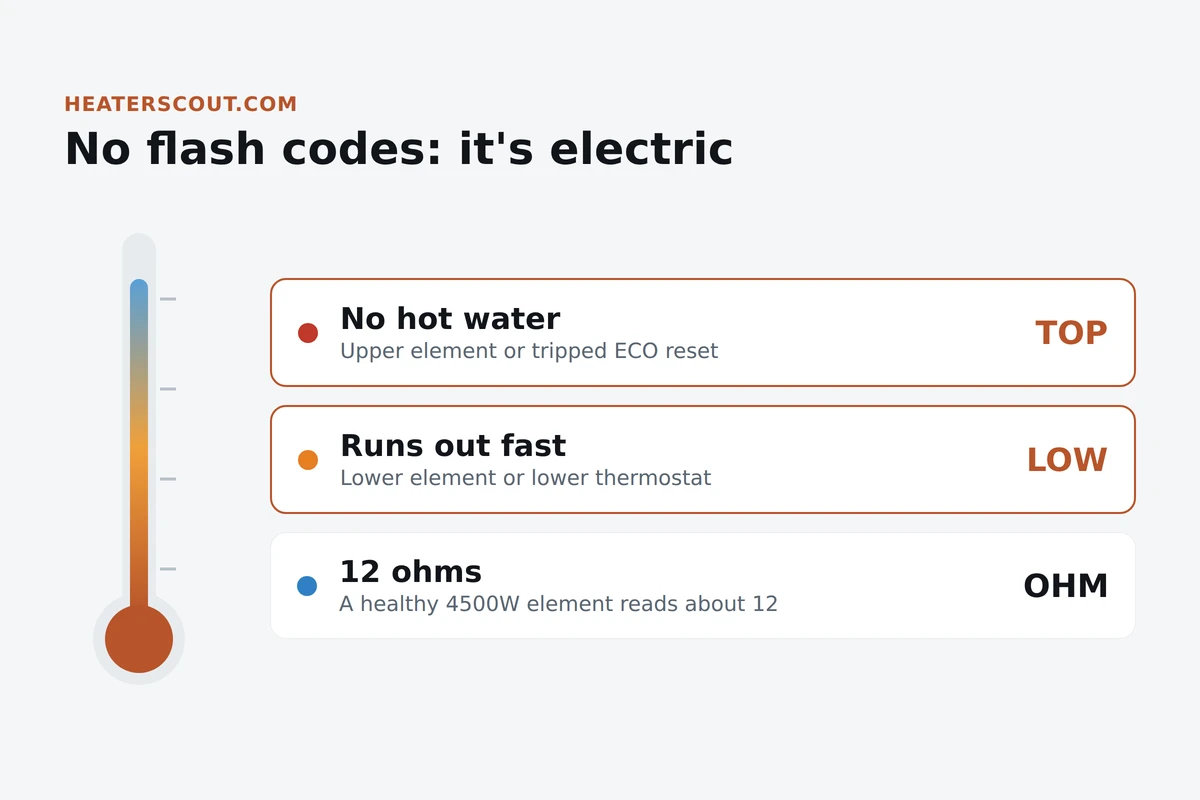
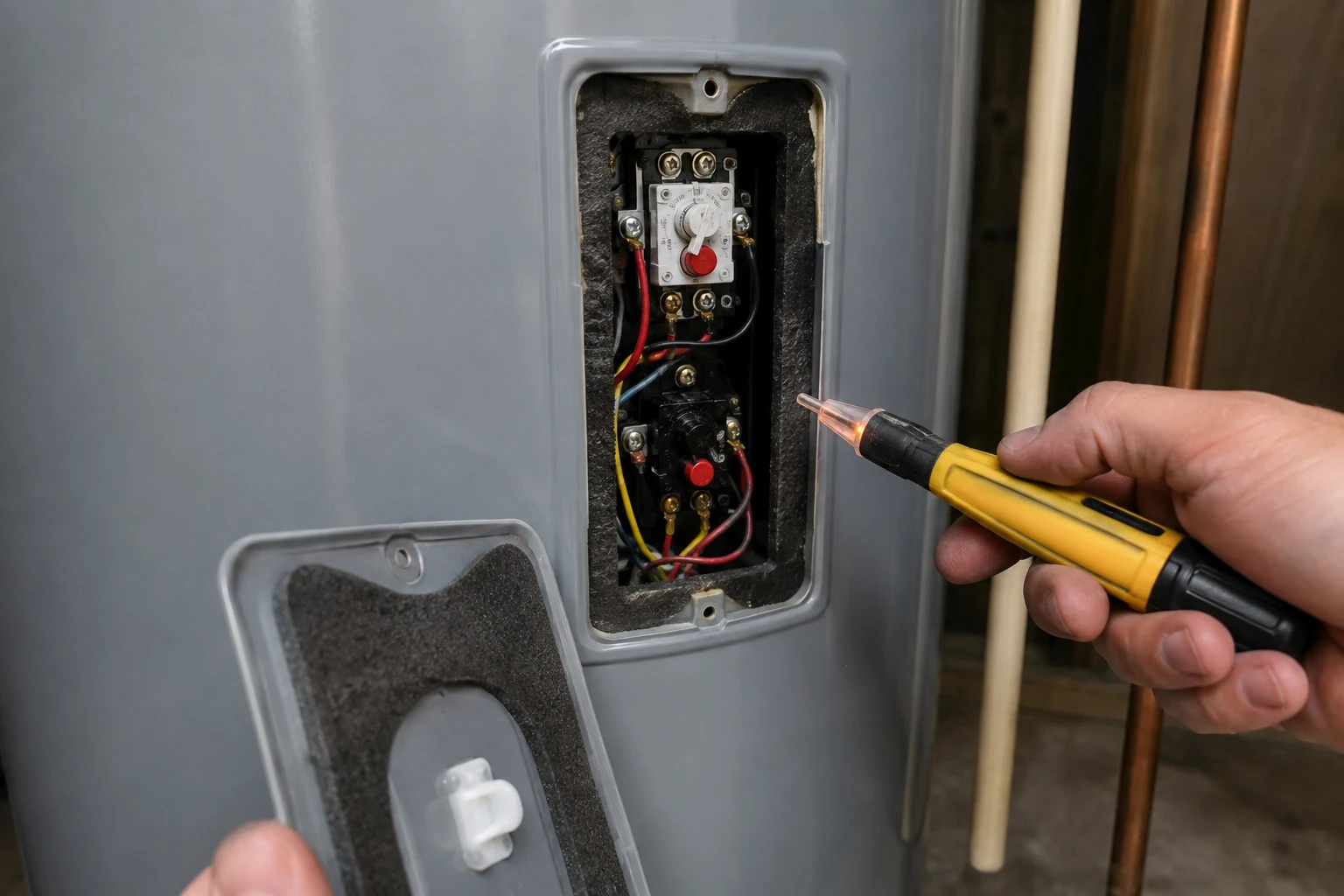
This is an electric water heater, not a gas one. There is no gas control valve, no status light, and no flash codes to count. Do not go looking for them. You troubleshoot a Marathon by checking the breaker, pressing the red ECO reset button behind the upper access panel, and testing the two screw-in elements and their thermostats with a multimeter. Every fix on this page is a part you can measure.
Why a Marathon is a different animal
Most troubleshooting guides assume a steel tank with a sacrificial anode rod and, if it is gas, a control valve that blinks codes. The Marathon breaks both assumptions. Its tank is a seamless blow-molded polybutene plastic shell, not welded steel, so it physically cannot rust or corrode. That is why it needs no anode rod: no steel to protect means nothing to sacrifice. It is also why the tank carries a limited lifetime residential warranty, since the corrosion failure that ends most steel heaters after eight or ten years cannot happen here. The tank is lightweight, wrapped in about R-24 of foam, and holds heat so well its standby loss is among the lowest of any tank.
The second broken assumption is the flash code. Because it is electric, there is no gas valve and no diagnostic light. Everything that heats the water is hardware you can put a meter on: two screw-in elements on 240 volts, upper and lower; two thermostats that tell those elements when to fire; and one high-limit switch with a red reset button that cuts power if the water climbs past its safe ceiling. That is the whole cast, and every heating complaint on a Marathon comes down to one of them.
No hot water versus runs out fast
These two complaints sound alike and point at opposite ends of the tank. No hot water at all usually means the top of the tank never heated. That is the upper element's job, and it fires first, so a burned-out upper element, a dead upper thermostat, or a tripped ECO all leave you cold. Check the breaker, press the red ECO reset, and if you are still cold, ohm the upper element. One of those three is almost always it.
Runs out fast is the other pattern: a couple of warm minutes, then cold that stays cold. That is a dead lower element or a stuck lower thermostat. The upper element keeps the top hot enough for the brief warm burst, but with the lower one out, the bottom two-thirds never heats, so you drain the warm layer and hit cold. A crossed dip tube or heavy sediment can mimic it, though the plastic tank resists sediment better than steel, so start with the lower element and thermostat.
How to ohm an element
Testing an element is the most useful skill on this heater and takes a five-dollar multimeter. Kill the 240-volt breaker and confirm the terminals are dead with a tester first, every time. Pull the two wires off the element, set the meter to ohms, and touch one probe to each terminal. A 4500-watt, 240-volt element reads about 12 to 13 ohms; a 5500-watt element reads a bit lower, around 10 to 11 ohms. An infinite or open reading means the coil has burned through and the element is dead. Then touch one probe to a terminal and the other to bare metal on the tank; a good element reads open there, but any reading near zero means it is shorted to ground and has to go. These are standard screw-in units, so a confirmed bad element is a cheap fix.
When the reset keeps tripping
Here is the trap. You press the red ECO reset, the water heats, and a day later you are cold again, so you press it again. Do not fall into that loop. The high-limit cuts power when the water gets dangerously hot, and a reset that trips right back means the water really is overheating: a thermostat is stuck closed and holding an element on, or an element is shorted and heating without control. Both are real faults, and both will keep tripping the ECO no matter how often you push the button.
So when an ECO trips and stays clear after one reset, treat it as a one-time event. When it trips again, stop resetting, kill the breaker, and test the thermostats and elements. A thermostat that reads closed when the water is already hot is stuck and needs replacing; an element shorted to ground needs replacing. Both are standard Marathon parts, so the fix is straightforward once you find which one is holding the element on.
A leaking Marathon is usually a fitting, not the tank
Water on the floor around most heaters is a death sentence, the sign the steel tank has rusted through. On a Marathon it almost never means that, because the plastic tank cannot rust and carries a lifetime warranty precisely because it does not fail that way. So before you price a new heater, trace the leak. The usual suspects are the drain valve, the temperature-and-pressure relief valve and its discharge pipe, the inlet and outlet fittings up top, and the gaskets behind the two elements. A weeping element gasket runs down the tank and pools at the base exactly like a tank leak, but it is a cheap gasket, not a dead heater.
Snug the fittings, watch the T&P valve for a day since it can pass water when the tank over-pressurizes, and pull an element to check its gasket if water is coming from an access panel. Nine times out of ten one of those is the source. The lifetime tank warranty is real, so only if you have ruled out every fitting and the leak is coming from the tank body itself do you pull the model and serial off the rating label and start a claim.
| Tank warranty | Limited lifetime, residential |
| Parts warranty | Typically 6 years (elements, thermostats, high-limit) |
| Tank material | Seamless blow-molded polybutene plastic |
| Anode rod | None required, the tank cannot rust or corrode |
| Insulation | About R-24 foam, very low standby heat loss |
| Voltage | 240V, standard double-pole breaker |
| Typical element | 4500W screw-in (upper and lower), reads about 12 ohms |
| Capacities | Roughly 30, 40, 50, 66, 85, and 105 gallons |
| Reset | Red ECO button on the high-limit, behind the upper access panel |
Frequently asked
Does the GE Marathon have error codes?
No. The Marathon is an electric water heater, so it has no gas control valve and no status light blinking a flash code at you. If you are down on the floor hunting for a little diagnostic LED, you will not find one, because that light lives on gas heaters. You diagnose a Marathon the way you diagnose any electric tank: you check the 240-volt breaker, press the red ECO reset button behind the upper access panel, and ohm the two screw-in heating elements with the power off. The fault is always a part you can test, not a code you have to decode.
Why do I have no hot water on my Marathon?
Cold water at every tap usually means power is not reaching the elements. Start at the electrical panel and confirm the double-pole 240-volt breaker is on and has not tripped. If power is good, the high-limit safety, called the ECO, has likely tripped. Behind the upper access panel is a red reset button on the high-limit; press it once. If that restores heat, watch it. A failed upper thermostat or a burned-out upper element will also leave you completely cold, since the upper element is what heats the top of the tank first. Ohm both elements with the power off to find the dead one.
Where is the reset button on a GE Marathon?
It is the red button on the high-limit switch, sitting behind the upper access panel on the side of the tank. Kill the 240-volt breaker first, then remove the upper cover plate and fold back the foam insulation and the plastic safety shield. The high-limit is the small block mounted above the upper thermostat, and the red button is its reset. Press it firmly and you should feel a slight click. That resets a one-time over-temperature trip. If the button will not stay in or trips again within minutes, stop pressing it, because a repeating trip is a real fault, not a glitch.
Why does my Marathon run out of hot water fast?
A short, lukewarm shower almost always points at the lower element or the lower thermostat. In a tall electric tank the upper element heats the top of the tank and the lower element heats the rest, so when the lower one dies you still get a little hot water from the top, then it turns cold fast. Kill the breaker and ohm the lower element; an open reading means it is burned out. A stuck or drifting lower thermostat does the same thing by never firing the element. Sediment can shorten recovery too, though the Marathon's plastic tank resists buildup better than a steel one.
How do I test the elements on a Marathon?
Shut off the 240-volt breaker and confirm the terminals are dead with a voltage tester before anything else. Remove the access panels, fold back the insulation, and pull the wires off one element. Set a multimeter to ohms and touch the two element terminals. A 4500-watt element reads about 12 to 13 ohms and a 5500-watt element reads about 10 to 11 ohms. An infinite or open reading means the element is burned out and needs replacing. Then touch one meter lead to a terminal and the other to the tank or bracket; any reading near zero means the element is shorted to ground and also needs to go.
Does a Marathon water heater need an anode rod?
No, and that is one of the whole points of the design. A standard steel tank has a sacrificial anode rod that slowly corrodes so the tank does not, and that rod has to be checked and replaced over the years. The Marathon tank is seamless blow-molded polybutene plastic, so it cannot rust or corrode in the first place. With nothing to protect against corrosion, there is no anode rod to inspect, replace, or worry about. That is also why the tank carries a lifetime residential warranty, since the failure mode that kills most steel heaters simply does not exist here.
Is the Marathon tank really warrantied for life?
Yes, the tank carries a limited lifetime warranty for residential use, which is unusual and comes straight from the plastic tank that cannot rust. The parts, meaning the elements, thermostats, and high-limit, typically carry a shorter warranty, often around six years. So if a Marathon is leaking, do not assume the tank has failed, because it almost never does. Check the drain valve, the T&P relief valve, the inlet and outlet fittings, and especially the element gaskets first. A weeping element gasket looks like a tank leak but is a cheap fix. Have the model and serial from the rating label ready when you call about coverage.