Quick answer
A gas water heater with no hot water almost always broke somewhere on one flame-proving safety chain: pilot → thermocouple → gas valve → burner. A pro doesn’t guess — they walk that chain in order. Pilot won’t light? Check gas. Pilot lights but dies? Thermocouple. Pilot holds but the burner won’t fire? Gas valve or burner. Follow the same order and you’ll land on the real cause instead of buying random parts.
No heat: causes by how common
Longer bar = more likely. Work top down.Check this: relight it, control to OFF, wait 5 min, then PILOT. A relight costs $0.
Check this: pilot lights but dies on release. Healthy output is 25-30 mV; clean the tip, then swap the cheap part.
Check this: manual shutoff open, other gas appliances work, propane tank not empty.
Check this: pilot holds but burner never fires. The gas control valve is a licensed-tech job.
Check this: FVIR vapor-sensor lockout or a blinking status-light fault code.
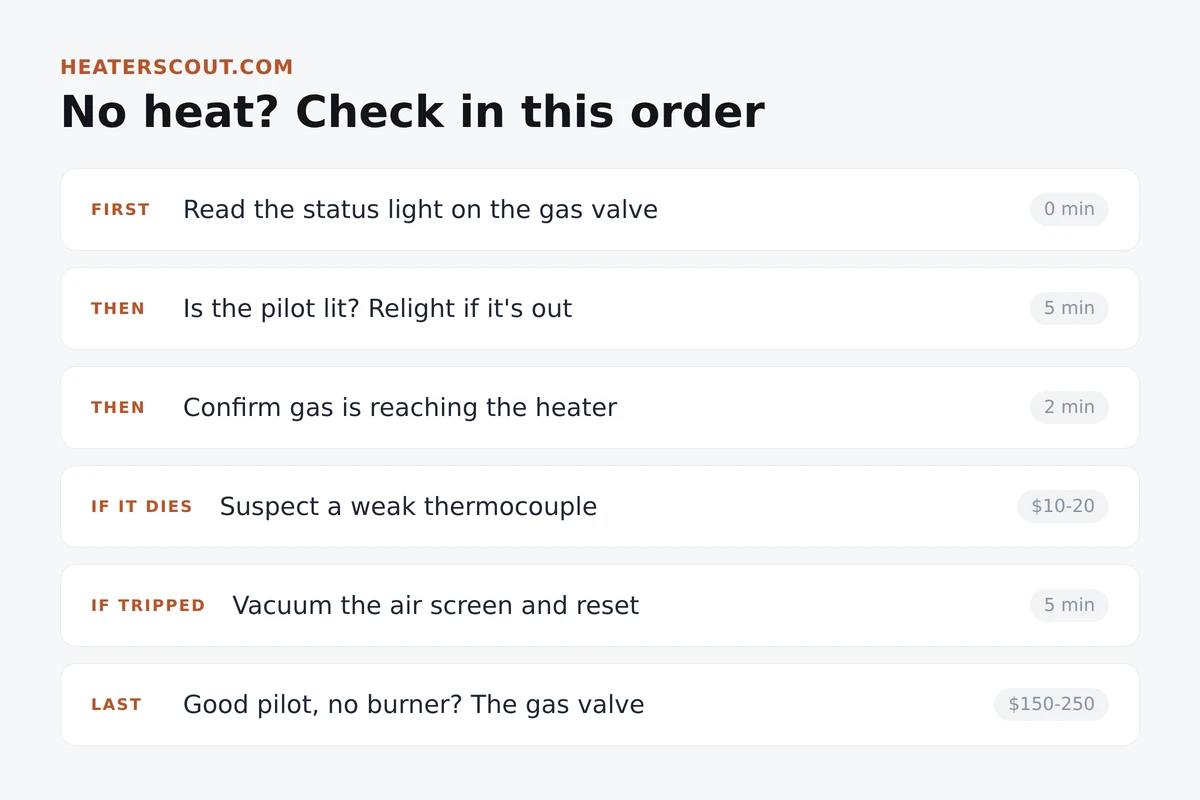
Before you call anyone, you can get remarkably far by testing one thing at a time in the right sequence. The trick is not to skip steps — a dead thermocouple and a failed gas valve look identical until you’ve ruled out the pilot.
Walk the diagnosis
Answer each question with what your heater actually does. The wizard steps down the same chain a technician follows and lands on the likely part.
Gas heater no-heat walkthrough
Set the gas control to PILOT to start. If you smell gas at any point, stop and leave.
Why the order matters
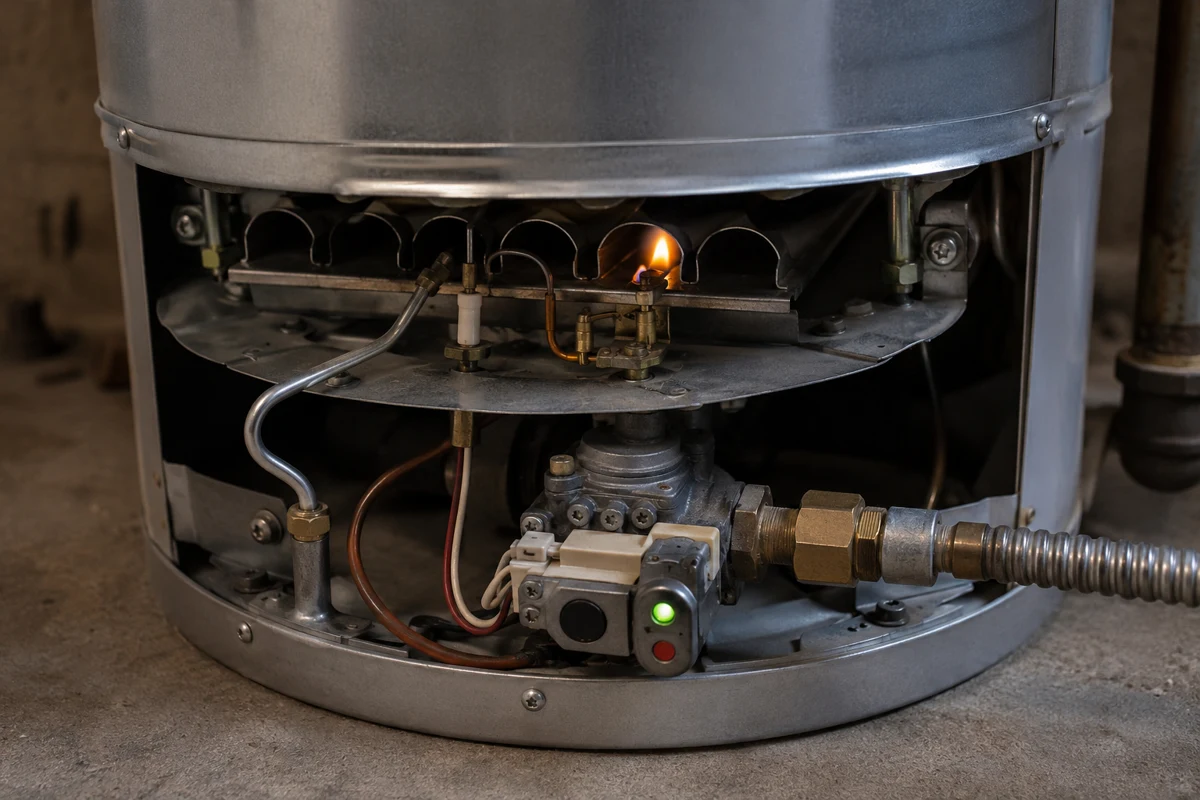
The whole system is built around proving there’s a flame before gas is allowed to flow. That’s the thermocouple’s job: its tip sits in the pilot flame, the heat generates a small millivolt signal — roughly 20 to 30 millivolts — and that signal energizes a solenoid inside the gas valve that holds it open. Blow out the pilot and the thermocouple cools, the voltage collapses, and a spring snaps the valve shut, cutting gas to both the pilot and the burner. That’s why a pilot that won’t stay lit points straight at the thermocouple, and why you can’t judge the gas valve until the pilot side checks out.
Step one: the pilot and gas supply
If the pilot won’t light at all, don’t assume the worst part. Confirm the boring things first: the manual gas shutoff is open (its handle runs in line with the pipe when open), your other gas appliances still work, and — on propane — the tank isn’t empty. If gas is clearly present and the pilot still won’t catch, the pilot tube or orifice may be clogged or the igniter weak. When you relight, follow the sequence on the tank: control to OFF, wait five minutes for any gas to clear, set to PILOT, hold the button while igniting, and keep holding for 30 to 60 seconds so the thermocouple heats before you release.
Step two: the thermocouple, the usual villain
By far the most common no-heat cause is a pilot that lights and then dies the moment you let go of the button. Nine times out of ten that’s the thermocouple: the tip is sooted over, has drifted out of the flame, or has simply worn out after years of heat cycling. Start gentle — clean the tip with fine sandpaper or steel wool and make sure it sits right in the pilot flame. If the pilot still won’t hold after that, replace it. Thermocouples are inexpensive and swap out directly.
One modern wrinkle: newer heaters are FVIR (flammable-vapor-ignition-resistant) and carry a sensor that locks out the pilot if it detects vapors from gasoline, solvents, or paint stored nearby. A status light usually blinks a code — a steady slow flash is normal, a burst pattern signals a fault. If a real vapor event tripped it, manufacturers generally want the sensor replaced, not just reset.
Step three: burner, gas valve, and “warm not hot”
If the pilot holds steady but the main burner never fires on a call for heat, you’ve reached the gas control valve or the burner itself. A clogged burner orifice shows up as a weak or yellow flame instead of a crisp blue one; the gas control valve, which meters gas to the burner in response to the thermostat, is a licensed-tech replacement rather than a driveway job.
And there’s a different complaint hiding in here. If the burner does light and run but the water is only ever lukewarm, that isn’t an ignition problem at all — it’s heat output. The thermostat may be set too low (120°F is the usual target), a cracked dip tube may be dumping cold water straight into the hot outlet, or sediment may be insulating the burner from the water above it. Those are the “warm not hot” causes, and they’re a separate chase from “no heat at all.”
Sediment and the slow decline
Not every gas heater fails all at once. Often the complaint starts as “it takes forever” or “it never gets as hot as it used to,” and the culprit is sediment. Minerals settle to the bottom of the tank — right above the burner — and bake into a crust that insulates the water from the flame. The burner fires, the tank bottom overheats, and you often hear popping or rumbling as trapped water flashes to steam under the layer. Left alone, that crust slows recovery, wastes gas, and shortens the tank’s life. An annual flush clears it, and if your heater is rumbling and lagging rather than dead, this is worth checking before you condemn any part.
Testing a thermocouple instead of guessing
If you want to confirm a thermocouple before spending, you can measure it. With the pilot lit, a healthy thermocouple puts out roughly 20 to 30 millivolts across its output. A multimeter on the millivolt scale, probes on the thermocouple connection, tells the story: a reading well below that range, or zero, means the unit isn’t generating enough signal to hold the valve open and it’s done. It’s a five-minute check that saves you from replacing a good part — and from the more common mistake of jumping straight to condemning the expensive gas valve.
One field note worth knowing: a thermocouple that reads fine cold but fails once hot can still be the culprit, because the solenoid needs that full signal continuously. If cleaning helps for a day and then the pilot starts dropping again, stop nursing it and replace it.
What to fix yourself and what to hand off
| Part / cause | DIY? | Notes |
|---|---|---|
| Relighting the pilot | Yes | Follow the tank’s printed sequence |
| Cleaning the pilot / thermocouple tip | Yes | Fine sandpaper, reposition in flame |
| Thermocouple replacement | Usually | Cheap part, direct swap, gas off |
| Clearing a clogged burner | Sometimes | Comfort with the burner assembly |
| Gas control valve | No | Licensed technician only |
| FVIR sensor after a vapor event | No | Replace per manufacturer, not reset |
The through-line: the cheap, common failures — pilot and thermocouple — are within reach of a careful homeowner, while anything that meters gas or proves flame electronically belongs to a pro. Knowing which is which before you start keeps you from either overpaying for a $12 fix or over-reaching on a gas valve you shouldn’t touch.
If you ever smell gas, don’t touch switches or relight anything — leave the building and call the gas company from outside. After a failed lighting attempt, wait five minutes before trying again so gas can clear; repeated quick relights let it accumulate. And leave gas-control-valve replacement to a licensed professional.
Frequently asked
Why is my gas water heater not making hot water?
It almost always failed on the flame-proving chain: pilot, thermocouple, gas valve, burner. Walk it in order. If the pilot won’t light, check that the gas is on. If it lights but dies when you release the button, it’s the thermocouple. If the pilot holds but the burner won’t fire, it’s the gas valve or a clogged burner.
Why won’t my pilot light stay lit?
The classic cause is a bad thermocouple. It has to heat in the pilot flame to prove the flame and hold the gas valve open; if it’s dirty, bent out of the flame, or worn out, the valve closes and the pilot dies on release. Clean and reposition the tip first, then replace it if it still drops. Hold the pilot button a full 30 to 60 seconds when lighting.
Can I replace a thermocouple myself?
Many homeowners do — it’s a cheap part and a direct swap. Shut off the gas, let things cool, and follow the tank’s procedure. If you’re not comfortable working around the gas connections, or if a new thermocouple doesn’t fix it, bring in a pro rather than moving on to the gas valve yourself.
The pilot is on but the burner won’t light — what now?
That points past the pilot to the gas control valve or the burner. A clogged burner orifice gives a weak or yellow flame; the gas valve meters gas to the burner and, when it fails, the burner never fires despite a call for heat. The gas valve is a licensed-technician replacement, not a DIY part.
My gas water heater makes warm water but not hot — is that the same problem?
No. If the burner lights and runs, ignition is fine and you have a heat-output problem instead. Check the thermostat setting (aim for 120°F), suspect a broken dip tube mixing cold into the hot outlet, or sediment insulating the burner. Those are different fixes from a no-heat, won’t-ignite failure.
What should I do if I smell gas near the heater?
Leave immediately and don’t operate any switches, lights, or the heater controls — a spark near leaking gas is dangerous. Call your gas utility or company from outside or a neighbor’s. Don’t keep trying to relight a heater that smells of gas, and don’t return until the utility says it’s safe.