The tankless aisle looks like one product with two power cords, but gas and electric tankless water heaters solve the hot-water problem in genuinely different ways, and picking the wrong one shows up either in a cold shower or in a surprise line item on the install quote. The real fork is not brand or price. It is how much hot water your house needs at once, how cold your incoming water gets in January, and what your home's gas line and electrical panel can actually feed. Get those three straight and the choice mostly makes itself.
Gas gives you more hot water and asks for more plumbing. Electric gives you a simpler box and asks for a much bigger electrical service. Your house, not the brochure, decides which trade is cheaper.
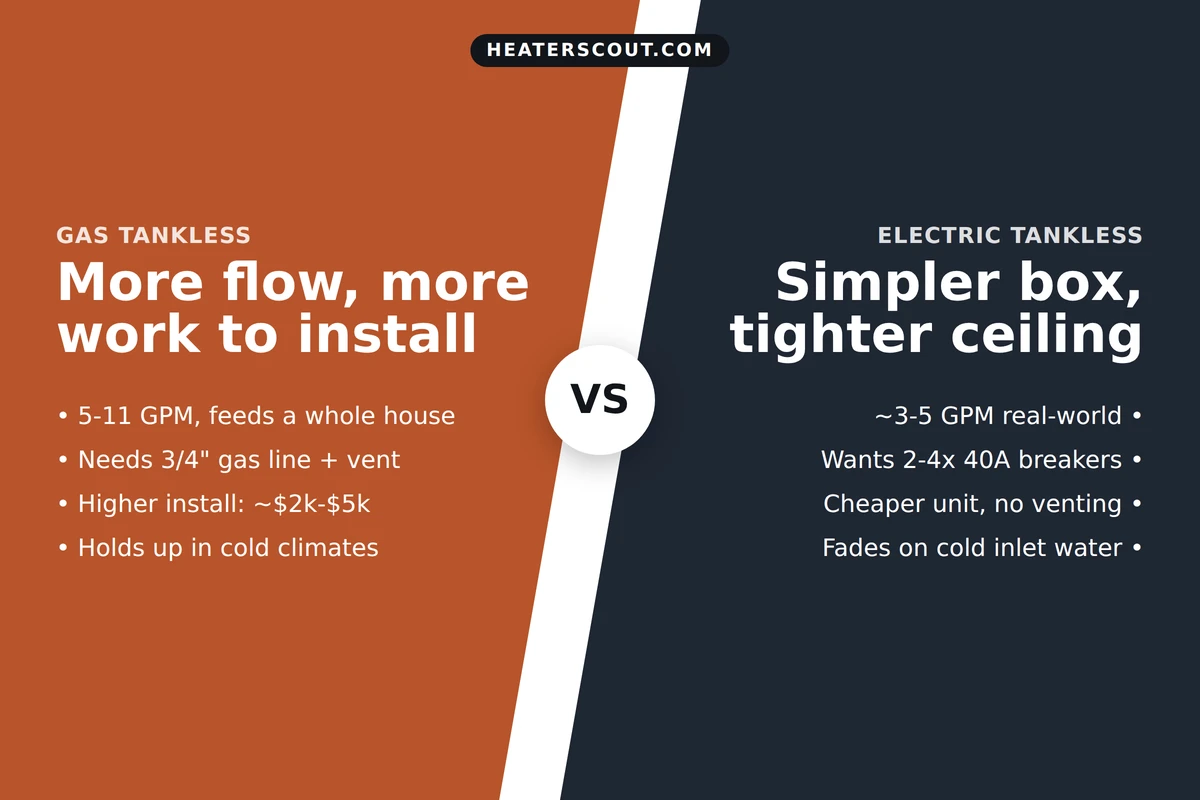
Flow rate: how much hot water each can actually make
This is the number that decides comfort, and it is where gas and electric part ways. A gas tankless burns a big slug of energy on demand and realistically delivers in the 5 to 11 gallons-per-minute range, which is enough to run a shower and the kitchen sink at the same time without either going cold. A whole-home electric unit is a different animal. Its ceiling is set by how much electrical current it can safely pull, and even the largest models top out around 8 GPM under ideal, warm-water conditions. In everyday use, most whole-home electric units live in the 3 to 5 GPM range, and less than that in winter.
Why the gap? Gas can throw a huge amount of heat at the water almost instantly, so simultaneous demand is a matter of burner size. Electric is throttled by physics and by your panel: every gallon of extra flow at a given temperature rise takes more kilowatts, and the panel only has so many to give. That is why a family with two full bathrooms running at once almost always wants gas, and why electric shines in a one-bathroom home, an apartment, or a point-of-use install at a single fixture.
Climate and incoming water: the caveat that changes every number
Every GPM figure comes with an asterisk, and it is temperature rise. A tankless heats water as it passes through, so its output is governed by how far it has to lift the temperature, meaning the difference between your incoming water and the target at the tap. Manufacturers rate their units at a gentle 35-degree rise, about 77-degree inlet water warmed to 112. A home in coastal California or the Gulf South might actually see something close to that. A home in Minnesota or Maine does not.
Run the arithmetic for a cold climate and the rated numbers collapse. If groundwater arrives at 40 to 50 degrees and you want 120, that is a 70 to 80-degree rise. A unit advertised at 8 GPM at a 35-degree rise may deliver only about 4.5 GPM at a 77-degree rise, and an 11 GPM rating can fall to around 5 GPM. Gas takes the hit but has burner headroom to spare; a condensing gas unit can still push 3.5 to 5.5 GPM in 45 to 52-degree winter groundwater. Electric has no such reserve, so whole-home electric units often sag to 1.5 to 2.5 GPM in the same conditions. In cold country, gas is frequently the only practical whole-home tankless. Size for your local January water, not the spec sheet.
Electrical and gas requirements: what the install actually demands
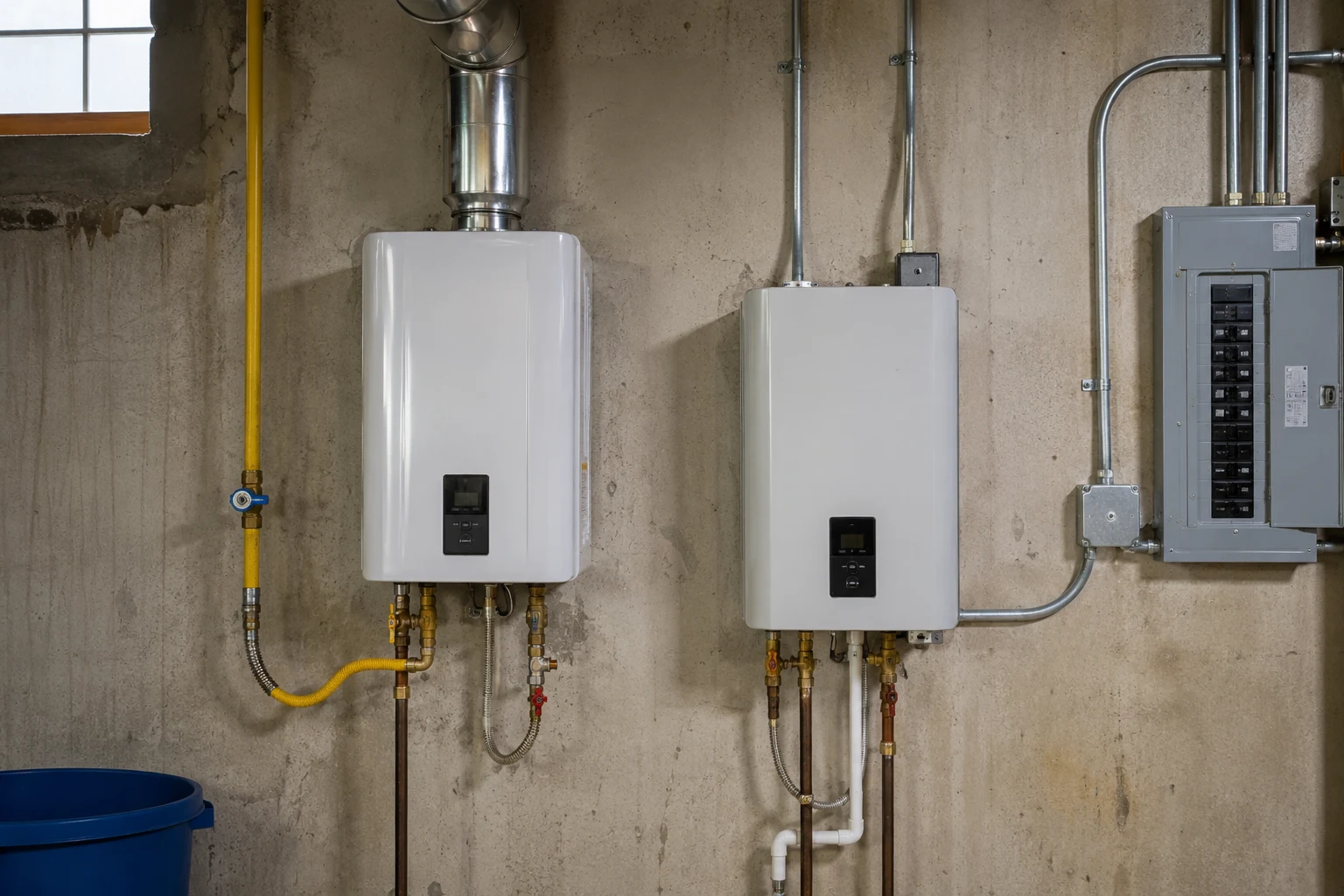
Here is where the two fuels ask for completely different things from your house. A whole-home electric tankless is one of the largest loads you can hang on a residential panel. Manufacturers typically call for two to four separate 240-volt double-pole 40-amp circuits, wired in 8 AWG copper. An 18 kW unit commonly needs two of those breakers; a 27 kW unit pulls around 112 amps and needs three; the biggest units use four. A single 24 kW model draws roughly 100 amps, which is 40 to 50 percent of a standard 200-amp panel on its own. Most whole-home electric installs assume a 200-amp service as a floor, and a home on a 100 or 150-amp panel usually needs a service upgrade before anything else happens.
Gas asks for plumbing and venting instead of amperage. A residential gas tankless can draw up to around 199,000 BTU per hour, roughly 232 cubic feet of gas per hour, and generally needs at least a 3/4-inch gas supply line, stepping to 1 inch on longer runs, sized to keep the pressure drop at or under half an inch of water column at full fire. Homes plumbed with a 1/2-inch line for an old tank heater usually need that line upsized. Then there is the flue: a high-efficiency condensing unit is a Category IV appliance running under positive pressure and producing acidic condensate, so it vents through listed stainless or PVC and needs a condensate drain, while non-condensing units use stainless Category III venting. Both fuels, in other words, come with a real installation project attached.
Install cost and operating cost: the sticker lies a little
On paper, electric wins the install. A straight electric tankless runs roughly 1,200 to 3,500 dollars installed, skipping the gas line and venting that push gas jobs to about 2,000 to 5,000 dollars. But the unit itself is only 30 to 50 percent of the total on either fuel, and the electric sticker quietly assumes your panel can feed it. When a whole-home electric unit forces a subpanel or a full 200-amp service upgrade, that upgrade can cost more than the entire gas installation, and the cheaper-install story flips. The comparison that matters is your specific house, with its existing panel and gas line, against what each option demands.
Operating cost is its own puzzle, and the efficiency rating alone will mislead you. Electric tankless units post very high Uniform Energy Factors, around 0.90 to 0.99, because there is no flue loss. Condensing gas runs about 0.87 to 0.97 and non-condensing gas around 0.80 to 0.86. Yet UEF only says how much of the energy reaches the water, not what that energy costs. You have to multiply by your local rate. At roughly 15 cents per kilowatt-hour and 1.20 dollars per therm the two land in the same ballpark per gallon; below about 10 cents per kilowatt-hour electric pulls ahead; and across most of the country, where gas is cheap per BTU, a gas tankless costs less to run despite the lower efficiency figure.
The short version
If you have natural gas at the house, a busy multi-bathroom household, or cold winter groundwater, buy gas and budget for a 3/4-inch line and proper venting. If you are heating a small or warm-climate home, a single bathroom, or a point-of-use spot, and your panel has room, electric is the cleaner, cheaper, venting-free choice. The moment a whole-home electric unit needs a service upgrade, gas is usually the better value.
Temperature rise
The difference between your incoming (groundwater) temperature and the hot-water temperature you want at the tap. It is the real driver of a tankless heater's usable flow rate. Units are rated at a 35-degree rise, but if 50-degree water comes in and you want 120, that is a 70-degree rise, and the same heater delivers far less water. Always size a tankless for your local winter rise, not the advertised GPM.
Busy household with gas at the meter
Two or more bathrooms that can run at once, a big soaking tub, or a whole family cycling through morning showers. Gas gives you the 5-to-11 GPM headroom to serve simultaneous fixtures without going cold, and the gas line and venting are a one-time install cost.
Cold-climate home
Northern groundwater in the 40s means a 70-to-80-degree temperature rise in winter, which guts electric output. Gas keeps a usable flow rate when it counts, so in cold country it is often the only practical whole-home tankless.
Small or warm-climate home with panel room
A one-bathroom house, condo, or apartment in a mild climate, on a 200-amp panel with spare capacity. Electric skips the gas line and venting, installs cheaper, and its lower flow ceiling is plenty when demand and temperature rise are both modest.
Point-of-use at a single fixture
A garage sink, a far-off bathroom, or a workshop where running gas is impractical and you only need one fixture's worth of hot water. A small electric unit on a single 240-volt circuit is the simple, no-venting answer.
Frequently asked
Is a gas or electric tankless water heater better for a whole house?
For a full-size US home with two or more bathrooms that might run hot water at the same time, gas is usually the better fit, and it is not close in cold climates. A gas tankless burns a large amount of energy on demand and realistically delivers somewhere in the 5 to 11 gallons-per-minute range, enough to run a shower and a kitchen tap together. A whole-home electric unit is capped by how much current your panel can hand it. Under ideal warm-inlet conditions the big electric models are rated up to about 8 GPM, but in real winter water they commonly land around 2 to 5 GPM. Electric earns its keep in warm-climate homes, small households, apartments, and point-of-use spots like a single bathroom or a garage sink. If you have gas at the house and a busy household, gas is the safer sizing bet.
How many amps and breakers does a whole-house electric tankless need?
More than most people expect. A whole-house electric tankless is a serious electrical load, and the manufacturer typically calls for two to four separate 240-volt double-pole 40-amp circuits, not one. An 18 kW unit commonly needs two 40-amp double-pole breakers; a 27 kW unit pulls around 112 amps and needs three; the largest units use as many as four 40-amp breakers. A 24 kW model draws roughly 100 amps, which is 40 to 50 percent of a standard 200-amp home panel all by itself. That is why most whole-home electric installs assume a 200-amp panel as a minimum, and a full or undersized panel means a subpanel or a service upgrade before the heater ever turns on. Each 40-amp 240-volt circuit is wired in 8 AWG copper per the NEC. Have a licensed electrician confirm your panel has the room and the service.
What size gas line and venting does a gas tankless require?
A residential gas tankless is a high-BTU appliance, often up to around 199,000 BTU per hour, which is far more than a tank heater draws. A unit that size pulls roughly 232 cubic feet of gas per hour and generally needs at least a 3/4-inch gas supply line, stepping up to 1 inch on longer runs, sized so the pressure drop stays at or under 0.5 inches of water column at full fire. Plenty of older homes were plumbed with a 1/2-inch line for a tank heater, and that line usually has to be upsized. Venting depends on the unit. A high-efficiency condensing model is a Category IV appliance, meaning it runs under positive flue pressure and makes acidic condensate, so it vents through listed stainless steel or PVC and needs a condensate drain. Non-condensing units use stainless Category III venting. Both are code-driven jobs for a licensed installer.
Why does cold weather cut a tankless water heater's GPM?
Because a tankless heats water as it flows, its real capacity is set by temperature rise, the gap between the incoming water temperature and the temperature you want at the tap. Manufacturers rate GPM at a friendly 35-degree rise, roughly 77-degree inlet water heated to 112. Northern homes never see that. If groundwater comes in at 40 to 50 degrees and you want 120, that is a 70 to 80-degree rise, and the same hardware puts out far less water. A unit advertised at 8 GPM at a 35-degree rise might manage only about 4.5 GPM at a 77-degree rise; an 11 GPM rating can fall to around 5 GPM. This hits electric hardest because it cannot burn extra fuel to make up the difference, so cold-climate whole-home electric units often drop to 1.5 to 2.5 GPM in winter. Size for your local winter groundwater, not the number on the box.
Which is cheaper to run, gas or electric tankless?
It depends on your local energy prices, and the efficiency rating alone will not tell you. Electric tankless units post very high Uniform Energy Factors, roughly 0.90 to 0.99, because there is no flue and no combustion loss. Condensing gas units run about 0.87 to 0.97, and older non-condensing gas around 0.80 to 0.86. But UEF measures how much of the energy reaches the water, not what that energy costs. Electricity and natural gas are priced per different units, so you have to multiply efficiency by your actual rate. At roughly 15 cents per kilowatt-hour and 1.20 dollars per therm, gas and electric land in the same ballpark per gallon of hot water. Below about 10 cents per kilowatt-hour, electric wins. In much of the country where gas is cheap per BTU, a gas tankless costs less to run despite the slightly lower efficiency number.
Is electric tankless really cheaper to install than gas?
On the sticker, yes. In the driveway, often not. A straight electric tankless swap runs roughly 1,200 to 3,500 dollars installed, and it skips the gas line and the venting that push gas jobs to around 2,000 to 5,000 dollars. That looks like an easy win. The catch is the panel. A whole-home electric unit that needs three or four 40-amp circuits frequently forces a subpanel or a full 200-amp service upgrade, and that upgrade alone can cost more than the entire gas installation. The heater itself is only about 30 to 50 percent of the total on either fuel; the electrical or gas work is the rest. So the honest comparison is not unit versus unit, it is your house with its existing panel and gas line versus what each option demands. Price the panel work before you call electric the cheaper install.
Can I put a whole-house electric tankless on a 100-amp or 150-amp panel?
Usually not without a service upgrade. A 24 kW whole-home electric tankless draws about 100 amps on its own, which would consume the entire capacity of a 100-amp panel and leave nothing for the rest of the house. Even a 150-amp panel is tight once you add air conditioning, an electric range, and a dryer. Most whole-home electric tankless installs assume at least a 200-amp service, and homes with 100 or 150-amp panels typically need a service upgrade first. If a panel upgrade is off the table, a gas tankless or one or two point-of-use electric units sized for a single fixture are more realistic paths than trying to force a whole-home electric unit onto a small service.
Do I need propane or natural gas for a gas tankless?
Either works, but the unit has to match the fuel and the two are not interchangeable without a conversion kit. Natural gas is piped in from the utility and is the common choice in cities and suburbs with gas service. Propane comes from an on-site tank and is what rural homes without a gas main use, and it carries more energy per cubic foot, so the orifices and gas-valve settings differ. Buy the unit configured for your fuel, or install the manufacturer's approved conversion kit, and confirm your gas line and regulator are sized for the unit's full BTU demand. Mixing fuels or eyeballing the conversion is a combustion-safety problem, so this is licensed-installer territory.