You are standing next to the water heater and you hear it: a click. Maybe a single tick when the burner lights, maybe a faster tick-tick-tick that will not settle down, maybe a soft ticking a minute into the heating cycle that fades away on its own. On a gas tank the clicking almost always comes from the gas control valve, that boxy device screwed into the side near the floor with the temperature dial and the pilot knob. The good news is that most clicking is the heater working exactly as designed. The trick is knowing which click is the valve talking normally and which one is it asking for help.
A click is the valve talking. The only question worth answering is whether it is talking normally or telling you a flame-safety part is about to quit.
Does this apply to a tankless or a power-vent gas heater?
Partly. The thermal-expansion tick and the idea of a solenoid clicking when it opens carry over, but tankless units and electronic-ignition power-vent tanks use igniters, control boards, and blowers that click and buzz on their own schedule, and they read faults through a display code rather than a pilot and a thermopile. This page is about standard atmospheric-vent gas storage tanks with a standing pilot and a Honeywell or Robertshaw style gas control valve. If yours has a digital display or a blower that spins up, use its error code and manual.
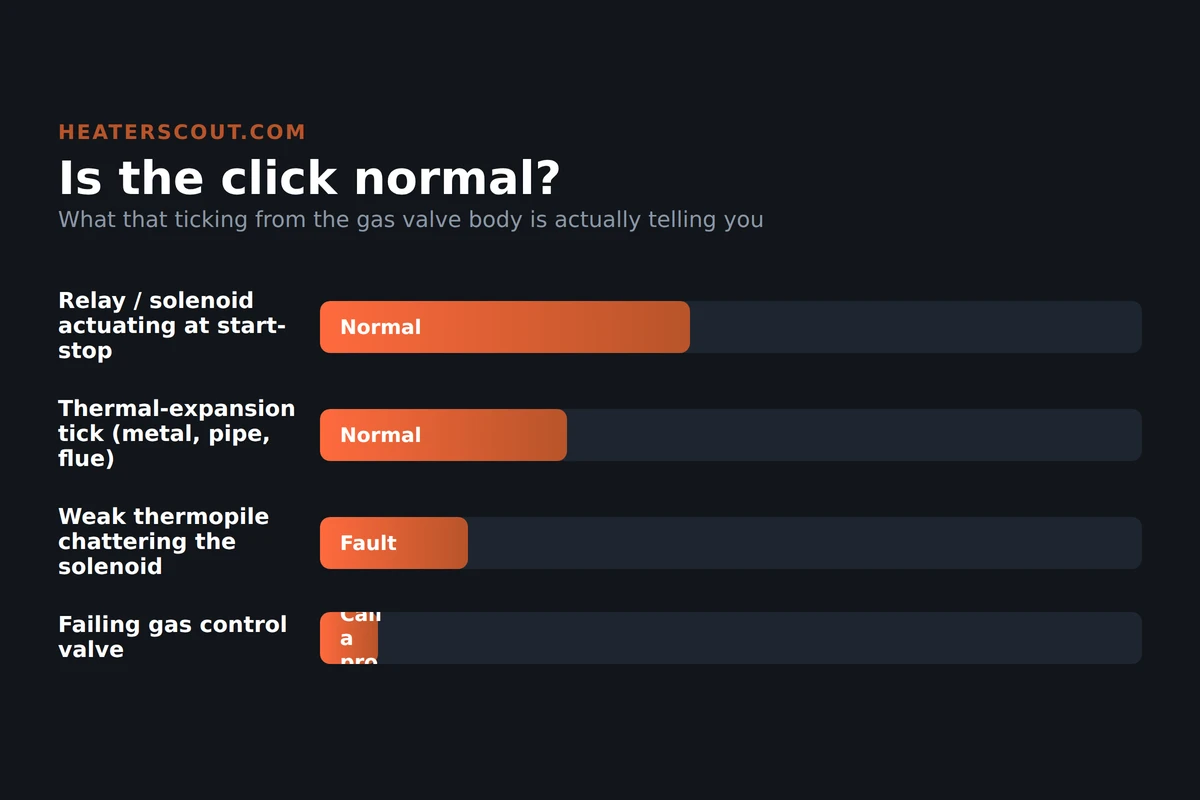
What the click actually is
Inside that gas control valve is a small solenoid, an electromagnet that physically opens the passage letting gas reach the main burner. When the tank cools below your set point, the valve's control tells that solenoid to pull in, gas flows, and the pilot lights the burner. You hear that as a click. When the water comes up to temperature, the solenoid releases and the gas shuts off, and you hear a second click. One click on, one click off, a handful of times a day, matched to when the burner is running. That is normal, and it is the same relay-style click a furnace or any gas appliance makes when it calls for heat.
The second normal noise is not the valve at all, it just sounds like it is. When the burner fires, the flue pipe up the center of the tank and the metal of the tank itself heat up quickly, and cold supply pipe carrying incoming water expands as the hot water hits it. Metal strapped tight against a stud or threaded through a snug hole ticks and taps as it slides. This thermal-expansion tick usually starts a minute or two into the burn and eases off as everything settles at temperature. It is harmless. If it annoys you, loosen an over-tight strap, add a plastic spacer where a pipe rubs framing, or drop the temperature a notch so the metal expands more gently.
So far, nothing wrong. The clicking that means something is the clicking that does not fit those two patterns: fast, repeating, stuttering, or happening when the burner should be quiet, and usually paired with the burner not staying lit.
Time the click against the burner
Watch the burner or the pilot window. A single click right as the flame lights and another as it goes out is the solenoid actuating, and that is normal. Clicking that has no relationship to the burner cycle, or that repeats several times a second, is the pattern to chase.
Count the rhythm: single versus rapid
One clean click on, one clean click off is healthy. A stutter, a tick-tick-tick, or a chatter is the solenoid grabbing and dropping repeatedly, which points at the voltage holding it open being too weak.
Check the pilot flame
Look at the pilot through the sight glass. It should be a steady blue flame wrapping firmly around the tip of the sensor. A small, lazy, yellow, or flickering pilot starves the thermopile and is a top cause of chatter. A dirty pilot orifice is a common and cheap culprit.
Watch what the burner does
Does the burner light and then die a few seconds after you release the pilot knob? Does the water go lukewarm? Clicking plus a burner that will not hold is the classic weak-thermopile signature, not a coincidence of two separate problems.
Have the thermopile measured
This is the meter test that settles it. A tech puts a multimeter across the thermopile leads. Healthy is roughly 650 to 850 millivolts open-circuit; below about 400 millivolts means the thermopile is too weak to hold the solenoid and gets replaced. This is the step that tells you whether it is a cheap part or the valve.
Working the problem in order
The reason order matters here is money and safety. The thermopile and a dirty pilot are cheap, common, and the usual answer. The gas control valve is expensive and rarely the real cause. People who replace the valve first, before measuring the thermopile, often spend a lot to fix nothing. Work it in this sequence.
| Single click at burner start, single at stop | Solenoid/relay actuating normally as the valve opens and closes the gas. This is the heater working. |
| Soft ticking a minute into heating, fades out | Thermal expansion of the flue, tank metal, and supply pipe. Harmless; loosen a strap or lower temp if it annoys you. |
| Rapid chatter or stutter from the valve body | Solenoid grabbing and dropping, usually a weak thermopile or dirty pilot starving it. Clean pilot, measure millivolts. |
| Clicking plus pilot drops when knob released | Thermopile too weak to hold the solenoid, or a dirty/misaligned pilot. Test the thermopile; replace if below ~400 mV. |
| Clicking plus water going lukewarm / cold | Burner not staying lit, almost always the thermopile flame-safety circuit. Diagnose the thermopile, do not ignore it. |
| Erratic click with a clean pilot and healthy mV | Gas control valve failing internally. Whole-valve replacement by a licensed tech, matched to the model. |
| Any clicking paired with a gas smell | Stop. Leave the house, call the gas utility. Not a noise to diagnose. |
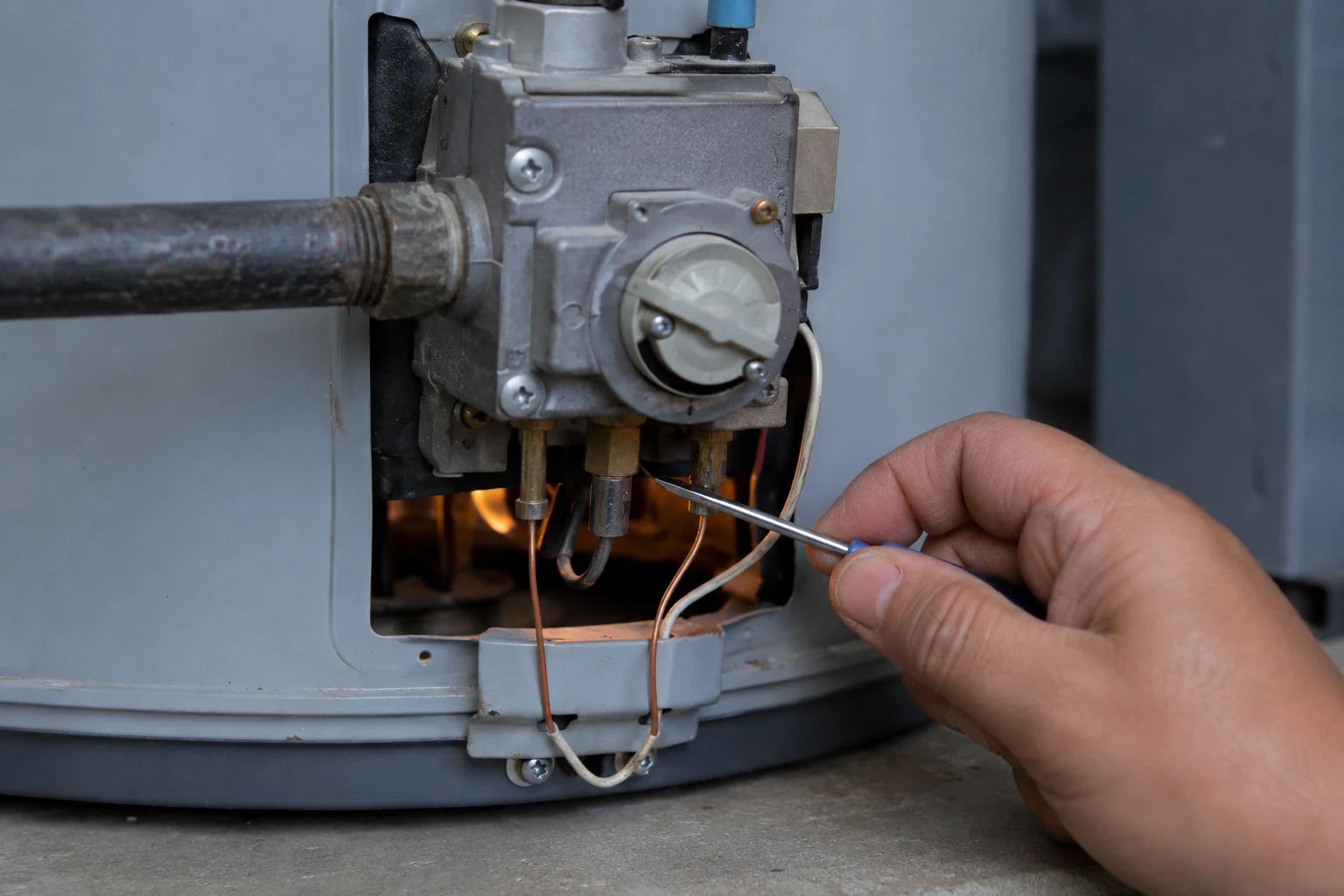
Where the homeowner line is
A lot of this is yours to check. Timing the click against the burner, looking at the pilot flame, listening for whether the water still gets hot, and loosening a pipe strap to kill a thermal tick are all reasonable homeowner work. Reading the label on the front of your specific heater and its model manual is always fair game, and on gas equipment it is the tie-breaker over any generic chart.
The line worth respecting is anything involving live gas and the flame-safety circuit. Measuring thermopile millivolts, swapping the thermopile, and above all replacing the gas control valve are jobs where a licensed plumber or gas tech earns the call, because the failure mode is a burner that will not stay lit or gas where it should not be. And the one hard stop, no matter what the clicking sounds like, is a smell of gas. That is not a diagnosis you make with your ear. Leave, call the utility, and let them clear it before anyone chases a click.
Frequently asked
Is it normal for a gas water heater's control valve to click?
A single, quiet click from the valve body when the burner kicks on, and another when it shuts off, is completely normal. That is the control valve's internal solenoid or relay actuating, opening the main gas line to the burner when the tank calls for heat and closing it when the water is up to temperature. You will usually hear it a handful of times a day, spaced out, matching when the burner lights. The clicks that matter are the ones that break that pattern. Rapid clicking, a click that repeats several times a second, a click that keeps happening when the burner is not running, or a click paired with the pilot dropping out is a different story. Steady, occasional, one-and-done clicking that lines up with the burner cycling is the heater doing its job.
Why does my water heater tick when it heats up?
That ticking is almost always thermal expansion, and it is one of the most common harmless noises a tank makes. When the burner fires, the flue and the metal of the tank heat up fast, and hot water moving into cold supply pipe makes the copper expand. Metal that is strapped tight to a stud or run through a snug hole in the framing taps and ticks as it slides against whatever it touches. It tends to start a minute or two after the burner lights and fade as everything reaches temperature. If it bugs you, the cures are simple: loosen an over-tight pipe strap, slip a plastic spacer where the pipe rubs, or turn the tank temperature down a notch so the metal expands more slowly. In a closed plumbing system a thermal expansion tank on the cold inlet takes the pressure spike out too. None of this is a gas problem, so if the tick is your only symptom you are fine to leave it or quiet it at your leisure.
What does rapid clicking from the gas valve mean?
Rapid or erratic clicking coming from the valve body, several clicks a second or a stutter instead of a clean single click, points at the solenoid inside the valve struggling to stay open. The most common reason on a standing-pilot heater is a weak thermopile. The thermopile is the sensor that turns pilot-flame heat into the small voltage that holds the main gas solenoid open. When that voltage sags right around the point where the solenoid can barely hold, the solenoid drops out and re-grabs over and over, and you hear that as chatter or rapid clicking. A dirty or misaligned pilot flame starves the thermopile the same way. Less often the valve itself is failing internally. Rapid clicking is not a noise to live with, because it usually comes with the burner not staying lit and the water going cold, and the underlying issue is a flame-safety component. Get the thermopile tested before you replace anything.
Can a bad thermopile cause a clicking noise?
Yes, and it is the single most common cause of fault-type clicking on a standing-pilot gas water heater. The thermopile sits in the pilot flame and generates roughly 400 to 800 millivolts, which is what holds the main gas valve solenoid open so the burner can run. A healthy thermopile tests around 650 to 850 millivolts with no load on it. As it ages, gets sooty, or sits in a weak pilot flame, that output drops. The solenoid needs somewhere around 250 millivolts just to hold, so once the thermopile sags toward that floor the solenoid can no longer hold steadily. It pulls in, the voltage dips under load, it drops out, the voltage recovers, it pulls in again, and that cycle is the clicking or chattering you hear. A tech confirms it in a couple of minutes with a multimeter across the thermopile leads. If it reads below about 400 millivolts open-circuit, the thermopile is done and gets replaced. Clean the pilot first, because a dirty pilot can starve a perfectly good thermopile.
Should I be worried about a clicking gas water heater?
It depends entirely on the pattern, and one thing is a hard line. If you smell gas at any point, a rotten-egg or sulfur smell near the heater, stop. Do not flip a switch, do not relight anything, leave the house and call your gas utility from outside. That is not a clicking problem anymore. Setting gas smell aside, a slow, occasional click that matches the burner turning on and off is normal and nothing to worry about. A tick during heat-up is thermal expansion and is also fine. What earns a call is clicking that is rapid, constant, or getting louder, especially when it comes with the water going lukewarm, the burner not staying lit, or the pilot dropping out. That combination says a flame-safety part like the thermopile is failing, and while a burn-out thermopile is a routine repair, diagnosing it on live gas equipment is worth handing to someone with a meter and the right part. When you are not sure which kind of click you have, treat the safety cutout as if it is real and get it looked at.
Do I need to replace the whole gas control valve if it clicks?
Usually not. On a standing-pilot heater the clicking almost always traces back to the thermopile or a dirty pilot, both of which are far cheaper and easier than the valve. The right order is to clean the pilot assembly and check the pilot flame first, then have the thermopile voltage measured, and only after both of those check out do you suspect the valve body itself. A gas control valve does fail, and when it does the fix is a full valve replacement, not a repair of the internals, because the solenoid and the thermostat are sealed inside a device that sits on live gas. But replacing the valve first, before ruling out the thermopile, is a common and expensive mistake. Get the millivolts measured. If the thermopile reads healthy, the pilot is clean and steady, and the valve still clicks erratically or will not hold the burner, then the valve is the suspect and a licensed tech should handle the swap. Confirm the exact replacement valve against your model's label, since Honeywell and Robertshaw valves are not interchangeable.