Your electric water heater trips the GFCI the second it calls for heat, and resetting it buys you maybe an hour before it goes again. That is not the same failure as a plain breaker that trips on load. A GFCI is watching for current sneaking off to ground, and it acts on an imbalance of just 5 milliamperes. Something in that tank is leaking a whisper of current, and the fix starts with finding where.
Trips onLeakage to ground
imbalance to ground
- Compares hot and neutral; opens when about 5 mA escapes to ground, roughly 1/1000th of an element's normal draw
- Protects people from shock, not the wiring from heat
- Nuisance-trips on moisture in the box or under an element gasket
Trips onOverload or short
too many amps, too long
- An amp counter; opens only when current climbs past its rating and holds
- Protects the wire from overheating, not you from a leak
- Fires on two elements at once, a dead short, or a seized part
Quick answer
A GFCI trips because current is leaking to ground somewhere between the breaker and the tank. On an electric water heater the two heavy hitters are moisture bridging a live terminal to the grounded tank and a heating element with a hairline crack letting water touch the live coil. Kill the power, dry out the junction box, and ohm each element from its terminal to the tank shell. A reading below a few hundred kilohms means the element is leaking and needs to come out.
GFCI trip is not a breaker trip
People use the words loosely, so start here. A standard circuit breaker is an amp counter. It trips when the current through it climbs past its rating, say 30 amps, and holds there long enough to overheat. Two elements firing at once, a shorted wire, a seized part pulling locked-rotor current: that is overload territory, and that is the story in the reset-keeps-tripping guide.
A GFCI does something else entirely. It compares the current going out on the hot leg to the current coming back on the neutral. On a healthy circuit those match to the milliamp. When they do not, current is escaping the intended loop, which almost always means it found a path to ground, through the tank, through the water, or through a person. The instant that leak passes 5 mA, the GFCI opens. It does not care about total amps. A heater can be drawing well under its rated load and still trip a GFCI, because the trigger is the leak, not the size.
Why does a water heater sit on a GFCI at all when most have run on plain breakers for decades? Newer code sections have pushed ground-fault protection onto more 240V appliance circuits, and any heater installed in a garage, basement, or crawlspace where water and bare concrete meet is a prime candidate. So the protection is doing exactly its job when it trips. The nuisance is real, but the device is honest: there is a leak, and these are the usual sources, ranked by how often they turn out to be the culprit.
What is actually leaking: causes by likelihood
Ranked by how often each one is the real cause on an electric tank. Bar width is rough frequency. Tap a row for the test that confirms or clears it.
-
Moisture in the junction box or under the element gaskettest thisVery common
Test: kill power at the breaker. Pull the top wiring cover and the element access panels. Look for water beads, rust streaks, or white mineral film bridging two terminals, and feel the insulation for damp. Dry everything with a rag and a hair dryer on low, reseal a weeping element gasket, then reset. If it holds through several heat cycles, moisture was the path. A green or corroded ground screw is a giveaway.
-
Heating element with a hairline crack leaking to groundtest thisVery common
Test: power off. Disconnect one wire from each element. Set a multimeter to its highest ohms range and read from an element terminal to the bare tank metal or the ground screw. A good element reads open, effectively infinite. Any real reading, especially under a few hundred kilohms, means the sheath has a crack and water is touching the live coil. That element leaks to ground and has to be replaced. The lower element fails this way most, since it sits in the sediment.
-
Long wire run or shared neutral causing nuisance tripstest thisSometimes
Test: long cable runs build up tiny capacitive leakage that can nudge a sensitive GFCI over the edge even with no real fault. So can a neutral accidentally shared with another circuit downstream. Confirm the heater neutral and ground are separate and land only on their own terminals. If the tank, elements, and box all test clean and it still trips, have an electrician check the run length and look for a bootleg or shared neutral.
-
Failed GFCI breaker or worn devicetest thisLess common
Test: GFCIs wear out and can start tripping on nothing, or refuse to reset at all. Treat this as the last suspect, not the first, because a bad device is far rarer than a real leak. Confirm the tank, elements, wiring, and box are all clean first. Only then swap in a known-good GFCI breaker of the same rating. If a fresh device holds and everything else tested fine, the old one was worn.
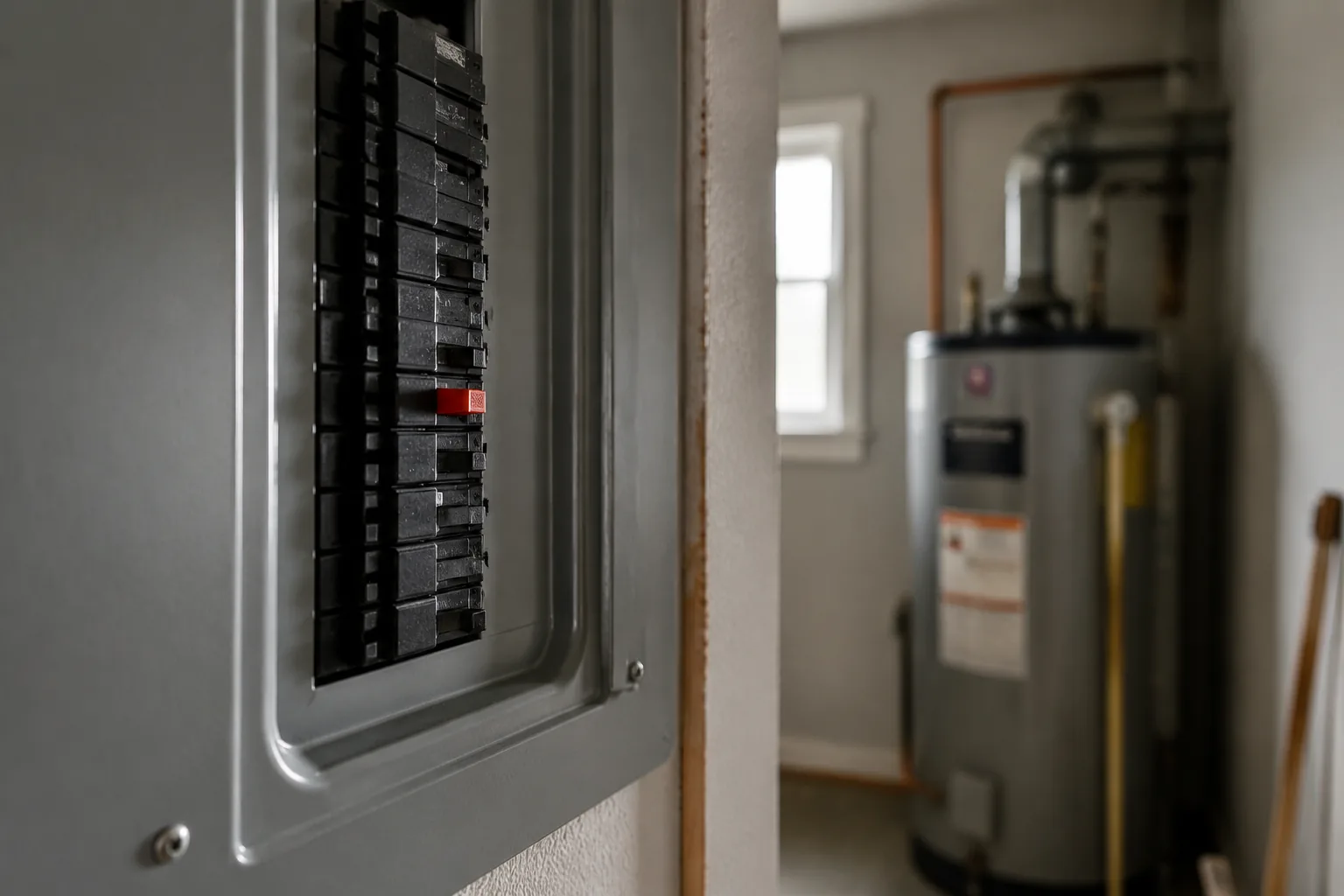
Moisture: the leak most people miss
Water and electricity make a ground fault the easy way. It does not take a puddle. A film of damp mineral residue laid across two terminals inside the top wiring box gives current a low-resistance detour straight to the grounded tank shell, and 5 mA is a tiny amount of current to lose that way. The GFCI reads the imbalance and opens.
Where does the water come from? A weeping gasket under a heating element is the classic source. The element screws or bolts into the tank through a rubber or fiber gasket, and once that gasket ages or the element loosens, a slow seep runs down the element flange and pools around the terminals right where the live connections sit. Condensation is the other one, common on a heater in an unconditioned garage or a damp crawlspace, where warm tank surfaces sweat and drip into the junction box below. Even a roof or plumbing leak overhead that finds the top of the tank will do it.
The test is blunt and it is free. Cut the power, open the top cover and both element panels, and look. Water beads, rust trails, white crusty film across terminals, a corroded green ground screw: any of these is your answer. Dry it all thoroughly, a hair dryer on low speeds this up, reseat or replace a leaking gasket, and reset the GFCI. Watch it through a few full heat cycles. If it holds, you were chasing water, not a dead part. If it trips again dry, move to the elements.
The cracked element: current straight to the tank
A heating element is a coil of resistance wire sealed inside a metal sheath. Water surrounds the sheath but never touches the coil, that is the whole design. Heat cycling expands and contracts the metal thousands of times, and sediment packed around the lower element makes it run hotter than it should. Over time a hairline crack opens in the sheath. Water seeps in, reaches the live coil, and now current has a direct road to the grounded tank. On a plain breaker that might trip only on a hard short. On a GFCI it trips at the first 5 mA of leak, which is why a marginal element that limped along for months finally starts kicking the GFCI.
Testing for it is a five-minute job with a multimeter. Power off, always confirm dead. Pull one lead from each element so you are reading the element alone. Set the meter to its highest resistance range. Put one probe on an element terminal and the other on bare tank metal or the ground screw. A healthy element shows open, no path. Any reading at all, and certainly anything below a few hundred kilohms, means the sheath is cracked and leaking to ground. That element is done. While you are there, read across the two element terminals too: a normal 4500W element reads somewhere around 12 to 13 ohms, and open there means the element burned out separately. The lower element takes this hit far more often than the upper, because it lives buried in the sediment layer at the bottom of the tank.
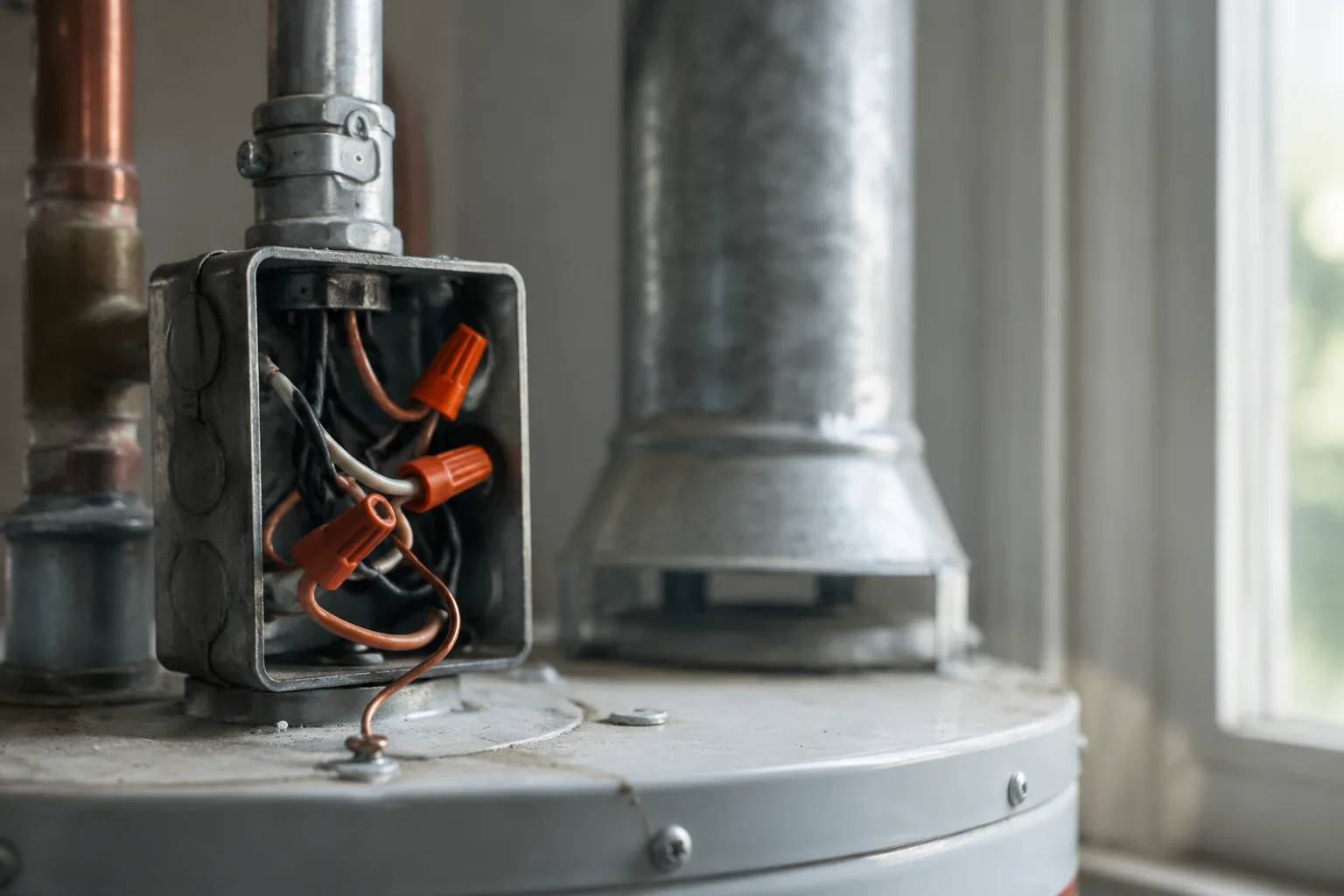
When the tank tests clean but it still trips
Sometimes the box is dry, both elements read open to ground, and the thing still trips. Two culprits are left, and both are less common than the first two.
The first is a nuisance trip from the wiring itself. Every long cable run has a little natural capacitance, and a GFCI protecting a heater at the far end of a long home run can see enough tiny leakage across that distance to trip even with no real fault present. A neutral that got shared or crossed with another circuit downstream does the same thing, because now return current splits and the GFCI sees an imbalance that is not a ground fault at all. Confirm the heater neutral and ground each land only on their own terminals and nowhere else. If they do and it still trips, the run length or a bootleg neutral is an electrician's call.
The second is the GFCI device itself. They do wear out, and a tired one can trip on nothing or refuse to reset. It happens, but it is the rarest of the four, so it goes last. Chasing a "bad breaker" before you have checked the tank is how people replace a perfectly good GFCI and still have the problem an hour later. Only after the box, both elements, and the wiring all check clean does swapping in a fresh GFCI breaker of the same amperage make sense. If the new one holds, the old one was worn. If it trips again, the fault is still in the tank and you missed it, usually a lower element that reads marginal rather than dead open.
The order that actually saves time
Work it in the order the bars suggest, cheapest and most likely first. Power off, then look and smell for moisture in the box and under the element gaskets, because water is the single most common cause and costs nothing to check. Dry, reseal, retest. Still tripping dry? Ohm each element to the tank and pull the one that reads a leak. Elements clean too? Now look at the neutral and the run. Only when all of that is genuinely clean do you touch the GFCI itself. Skipping to the last step first is the mistake that turns a one-hour fix into a weekend and a wasted part.
240V water heater circuits are dangerous even with the breaker off if you have not confirmed it. Test for dead voltage before touching a terminal. If a GFCI trips again the instant you reset it with the tank powered, stop resetting and diagnose with the power off. A GFCI that will not hold is telling you there is a live leak to ground, which on a wet tank is exactly the shock hazard it exists to stop.
Frequently asked
Why does my electric water heater keep tripping the GFCI?
A GFCI trips when current leaks to ground, and it acts on an imbalance of just 5 milliamperes. On an electric tank the two most common sources are moisture bridging a live terminal to the grounded tank inside the junction box or under an element gasket, and a heating element with a hairline crack in its sheath letting water reach the live coil. Kill the power, dry and inspect the box, then ohm each element to the tank shell to find the leak.
What is the difference between a GFCI trip and a regular breaker trip?
A regular breaker trips on overload, meaning too many amps flowing through it for too long. A GFCI trips on a ground fault, meaning current is leaking out of the circuit to ground even at a tiny level, about 5 milliamperes. They are different faults. A heater can draw well under its rated amps and still trip a GFCI because the trigger is the leak to ground, not the total current.
How do I test a water heater element for a ground fault?
Turn off the breaker and confirm the wires are dead. Disconnect one lead from the element so you read it alone. Set a multimeter to its highest ohms range, put one probe on an element terminal and the other on bare tank metal or the ground screw. A good element reads open, effectively infinite. Any real reading, especially below a few hundred kilohms, means the sheath is cracked and leaking to ground, so the element needs replacing.
Can moisture cause a water heater to trip a GFCI?
Yes, and it is the most common cause. It does not take a puddle. A film of damp mineral residue across two terminals in the junction box, a weeping gasket under a heating element, or condensation on a tank in a damp garage all give current a path to the grounded tank shell. Since a GFCI trips at only 5 milliamperes of leak, even a little moisture is enough. Dry the box, reseal any weeping gasket, and retest.
Can a long wire run make a GFCI trip for no reason?
It can. Long cable runs carry a small amount of natural capacitive leakage, and a GFCI at the far end of a long home run can see enough of it to trip even without a real fault. A shared or crossed neutral does the same by splitting return current so the device reads an imbalance. Confirm the tank, elements, and box are all clean first, since these nuisance causes are less common than a real leak, then have an electrician check the run and neutral.
Should I replace the GFCI breaker if my water heater keeps tripping it?
Only as the last step, not the first. A worn GFCI can trip on nothing, but that is far rarer than a real leak in the tank. Check moisture in the box, ohm both elements to the tank, and verify the neutral and ground before you suspect the device. If everything else tests clean, swap in a known-good GFCI breaker of the same rating. If a fresh one holds, the old one was worn out; if it still trips, the fault is still in the tank.