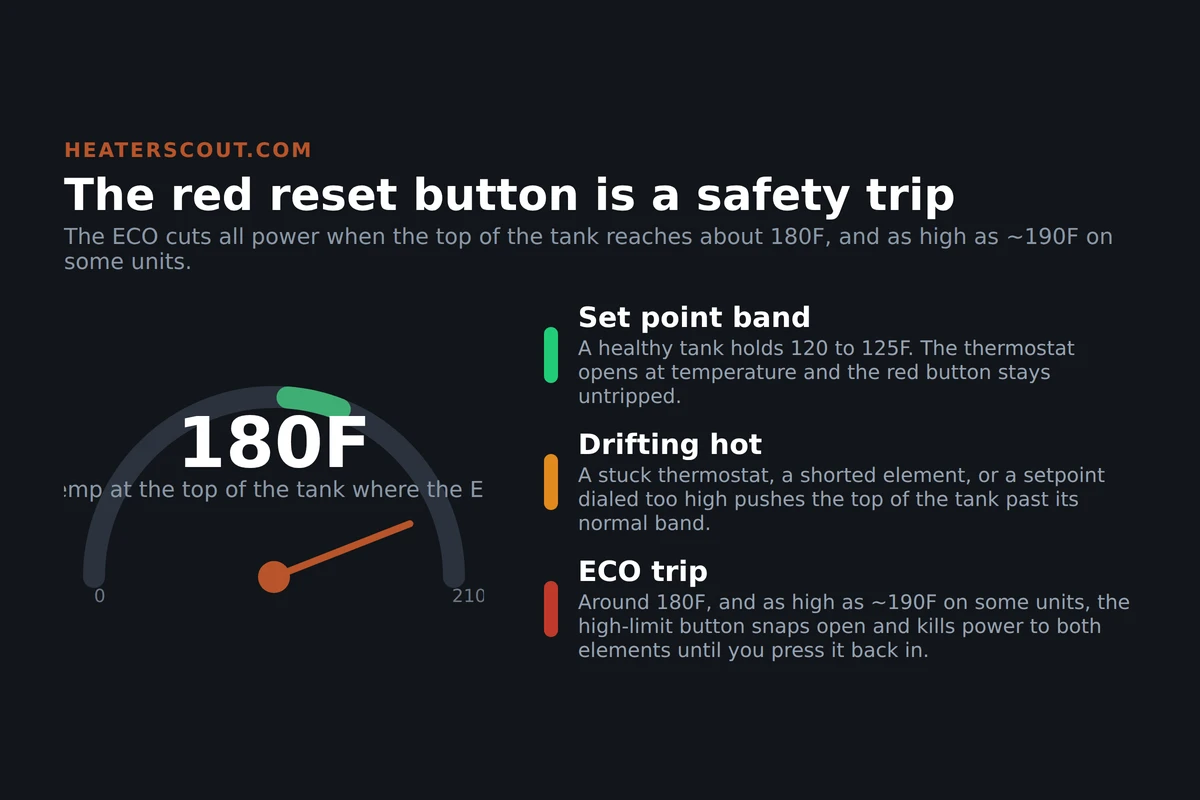
The red button behind the top panel of an electric water heater trips at about 180 degrees, and as high as roughly 190 on some units, and that number is the whole story. It is not a thermostat and it is not a control you set. It is the high-limit switch, the ECO or Energy Cut Off, and its only job is to kill all power to both elements the instant the water at the top of the tank climbs into scald-and-damage territory. When it trips you lose hot water completely. Pressing it back in takes thirty seconds. Figuring out why it tripped is the part that actually matters, because a button that trips twice is pointing at a failed part, not a fluke.
The verdict
The red reset button is the high-limit safety switch on the upper thermostat, not a normal control. It cuts all power when the top of the tank reaches about 180F, and as high as ~190F on some units. Reset it exactly once: kill the breaker, pull the top panel, fold back the insulation and cover, press until it clicks. If it trips again, stop resetting and find the cause, usually a stuck thermostat, a shorted element, or a loose thermostat that is not reading the tank. Your everyday target is 120 to 125F, nowhere near the trip point.
Is the reset button the same as the thermostat?
No. The button is a separate safety switch built into the upper thermostat assembly. The thermostat is the control that cycles the element to hold your setpoint. The red button, the ECO, only acts when that control has already failed and let the water run too hot. They live in the same part but do opposite jobs: one manages temperature, the other slams the door when temperature management breaks.
What the red button actually is
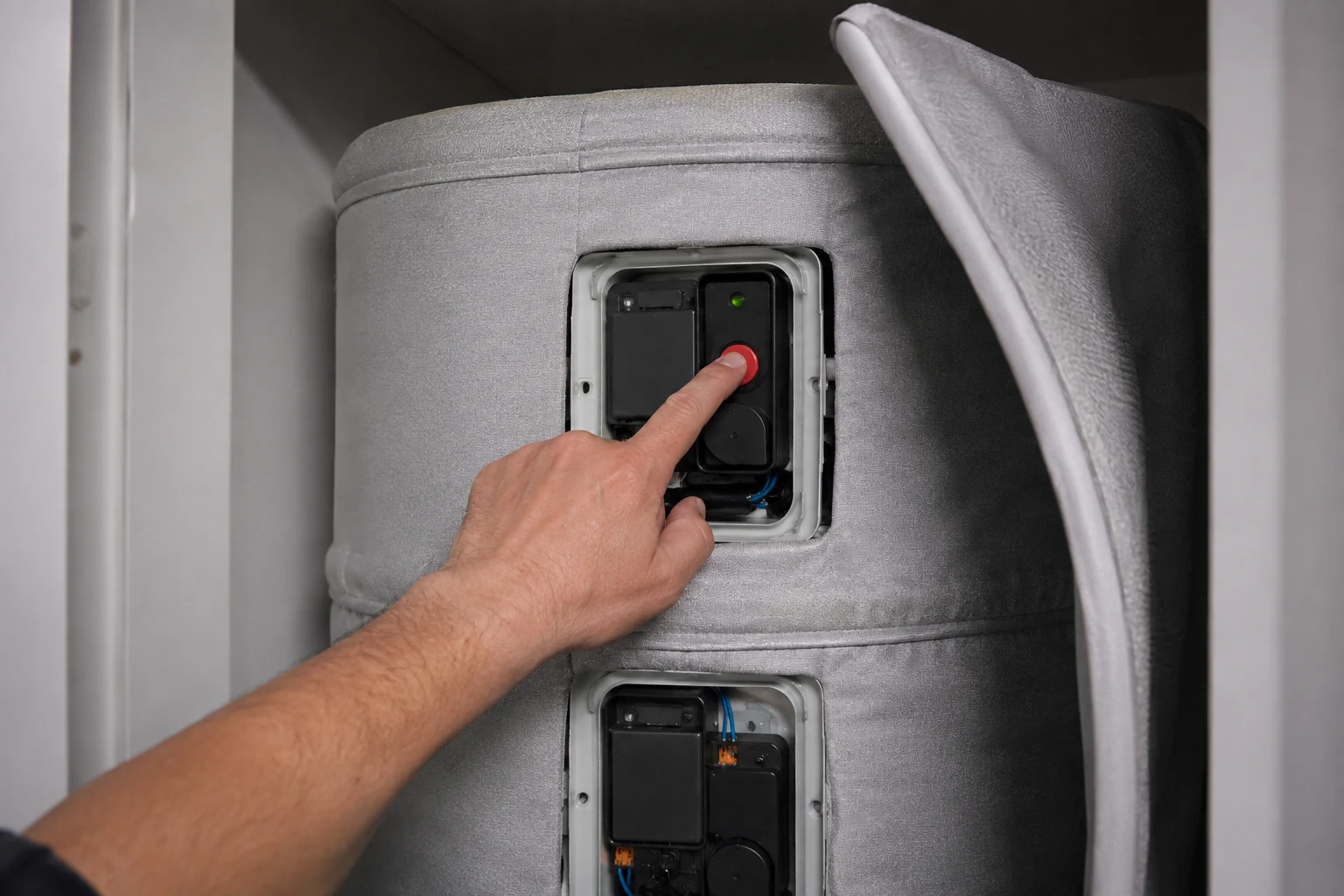
Every electric water heater has one high-limit switch, and it lives on the upper thermostat behind the top access panel. Peel back the fiberglass insulation and lift the plastic safety cover and you see it: a thermostat body with a small red button in the center. That button is wired ahead of both heating elements, so when it opens it removes power from the entire heater, not just the top element. The reason it sits up top is simple physics. Hot water rises, so the hottest water in the tank is at the top, and the safety that watches for an overheat needs to sit where the danger shows up first.
It is a mechanical snap switch tuned to a fixed temperature. It does nothing at all during normal operation, no matter how many times the elements cycle. It only moves when the water at the top of the tank reaches about 180 degrees, and as high as roughly 190 on some units, a temperature you would never choose on purpose. At that point a bimetal disc inside snaps and breaks the circuit. That single event is what people call the reset button tripping, and it is the tank telling you a control that was supposed to shut an element off did not.
How to reset it, step by step
Do this once. If it trips again, move to diagnostics rather than pressing the button a second and third time. Treat the whole job as live-electrical work until you have proven the power is off with a meter.
Reset once, then diagnose
The red button is the last safety device between a runaway element and a tank of scalding water. Reset it one time to see if it holds. If it trips again within hours, do not keep pressing it in. Cut the breaker and diagnose the thermostat and elements, because a repeated trip means a part has failed and the button is the only thing catching it.
Why it tripped, in order of likelihood
A high-limit trip is a symptom. The button only opens when something else let the water run too hot, so the real work is finding that something. These are the usual causes, and they are worth ruling out roughly in this order because the first two are both common and cheap to fix.
- Thermostat stuck closed: the control has welded or jammed in the on position, so it never stops calling for heat and the element runs until the ECO catches it.
- Element shorted to ground: a failed element stays energized no matter what the thermostat does, heating continuously until the top of the tank hits the limit.
- Thermostat not touching the tank wall: a loose mounting bracket lets the thermostat read cold air instead of tank temperature, so it holds the element on while the water quietly overheats.
- Setpoint dialed too high: a thermostat set near the top of its range can push the water close enough to the limit that normal cycling trips the ECO.
- Loose or arcing wire: a poor connection at a terminal generates its own heat, or a one-time surge or an aging ECO trips once and then behaves.
Diagnostics after a reset
If the button held, good. If it tripped again, or you want to know why it tripped the first time, this is the sequence. Every step below assumes the breaker is off and you have confirmed no voltage at the terminals with a meter. These tanks superheat when a control fails, which is the entire reason the ECO exists, so never probe live terminals to save time.
Check the setpoint
Look at both thermostat dials. They should be at 120 to 125 degrees, not cranked to HOT or the top of the scale. If someone turned them up, that alone can trip the limit. Dial them back before you condemn any parts.
Ohm out the elements
With power off and the wires off one terminal, put a multimeter across the element terminals. Resistance depends on the element's stamped wattage: R equals 240 squared divided by watts, so a common 4500-watt element reads about 12 to 13 ohms. Compute the expected value from your element's rating rather than assuming a fixed band. Zero or infinite means the element is dead. Then check from each terminal to the tank or the element base: any continuity to ground means the element has shorted and is heating uncontrolled. Replace a shorted element.
Test the thermostat
Confirm the thermostat is sitting tight against the tank wall, not hanging loose in its bracket. Then verify it opens and closes at temperature: it should pass power when the water is cool and cut it as the water reaches the setpoint. A thermostat that never opens is stuck closed and will trip the ECO again.
Decide the fix by how fast it came back
If the button tripped again within hours, do not keep resetting. Replace the upper thermostat, which carries the ECO, and inspect or replace the element that tested bad. A single trip after a surge, with everything else testing normal, can be a one-time event worth watching rather than an immediate parts swap.
Where the homeowner line sits
Pressing the reset button, checking the setpoint, and ohming an element are fair game for a careful owner who respects the 240 volts involved and confirms the power is dead first. Swapping a thermostat or an element is a common repair too, both are inexpensive bolt-in parts. The line is your comfort with line-voltage work and your willingness to verify no voltage every single time before reaching into that panel. If the button trips again right after you have replaced the thermostat and the element, or you find scorched wiring or a melted terminal, stop and bring in a licensed electrician or plumber, because something is driving heat that the obvious parts swap did not fix. The red button will keep catching it, but it was never meant to be the permanent solution.
One more thing about gas heaters
If your water heater burns gas, none of this applies to a red electrical button, because it does not have one. Gas tanks manage temperature through a gas control valve and a thermocouple or thermopile, and their over-temperature protection lives inside that valve. The confusion usually comes from furnaces and other appliances that do have reset buttons, or from someone giving electric-heater advice to a gas owner. On a gas unit, if the burner will not stay lit or you suspect an overheat, you are looking at the pilot, the thermocouple, and the gas valve, not an electric high-limit switch behind an access panel.
Frequently asked
Where is the reset button on an electric water heater?
It is the red button on the upper thermostat, hidden behind the top access panel on the side of the tank. Pop the metal panel off, fold back the fiberglass insulation, and lift the plastic safety cover, and you will see the thermostat with a small square or rectangular red button in the middle. That button is the high-limit switch, also called the ECO or Energy Cut Off. There is only one, and it sits on the upper thermostat even though the tank has two elements, because the upper unit senses the hottest water at the top of the tank. If your heater has just one access panel it is a single-element model, and the reset button is on that lone thermostat. Do not go looking for a second reset near the lower element, because there is not one.
Why does my electric water heater reset button keep tripping?
Because something is driving the water at the top of the tank up to about 180 degrees, and as high as roughly 190 on some units, and the button is doing exactly what it is built to do. The most common cause is a thermostat that has failed stuck closed, so it keeps calling for heat and the element never shuts off. Close behind is a heating element that has shorted to ground and stays energized regardless of the thermostat. A thermostat that has come loose from the tank wall reads cold, holds the element on, and cooks the water while thinking it is still heating. A setpoint dialed near the top of the range can trip it on its own, and so can a loose or arcing wire generating heat at a terminal. A single trip after a power surge can be a one-time event, but a button that trips again within hours is telling you a part has failed.
Is it safe to keep resetting the button on my water heater?
Resetting it once to see if it holds is reasonable. Resetting it over and over is not. The red button is the last safety device between a runaway element and a tank full of scalding, expanding water. Every time it trips it is reporting that the water reached a temperature its designers considered dangerous. If you keep pressing it back in without finding out why, you are overriding the one thing standing between you and a genuine scald hazard or, in a worst case, a tank pushed past its pressure limits. Press it once. If it trips again, stop, cut the breaker, and diagnose the thermostat and elements before you touch that button a third time. The button is not the problem. It is the messenger.
Does a gas water heater have a reset button like this?
No. The red electrical high-limit button is an electric-water-heater part. A gas water heater controls temperature through a gas control valve and a thermocouple or thermopile, and its over-temperature protection is built into that valve rather than a separate red button you press. People sometimes confuse the electric ECO with the reset on a furnace or the pilot controls on a gas heater, but they are different systems. If you have a gas tank and someone tells you to press the reset button on the thermostat, they are describing the wrong appliance. On a gas unit you are working with the gas valve, the pilot, and the thermocouple, not an electric high-limit switch.
What temperature does the water heater high-limit trip at?
About 180 degrees Fahrenheit at the top of the tank, and as high as roughly 190 degrees on some units. That is well above any setting you would ever use for household hot water. A normal, safe setpoint is 120 to 125 degrees, which is hot enough to be useful and low enough to limit scald risk and slow mineral scaling. The ECO is not a control that holds the water near that number. It is a hard ceiling that does nothing until the water climbs to around 180, at which point it snaps open and cuts all power. If your water is coming out near scalding but the button has not tripped, you have a setpoint or thermostat problem below the ECO threshold, and you should turn the dial down and check the thermostat before the water ever gets high enough to trip the limit.
How do I know if the reset button is actually tripped?
When you press a tripped button it clicks, sometimes with a firm snap, and power is restored. If you press the button and feel nothing, no travel and no click, it was not tripped, and your no-hot-water problem is somewhere else, usually a dead element, a bad thermostat, or a tripped breaker at the panel. That distinction matters, because homeowners often mash the button, feel nothing, and assume it is broken. A button with no click simply was not open. Before you decide the ECO itself failed, confirm the breaker is on, both elements ohm out, and the thermostats are passing power. A genuinely failed ECO that will not reset does happen, but it is far less common than a dead element being mistaken for a stuck button.
Can I replace just the thermostat, or do I need a whole new unit?
You can almost always replace just the thermostat, and often it is the right call. The upper thermostat with its integrated ECO is a single inexpensive part, and it swaps out with a screwdriver once the power is off and confirmed dead with a meter. If the button keeps tripping and the thermostat tests bad or is not sitting tight against the tank wall, replace it. If an element has shorted to ground, replace the element too, because a shorted element will trip a brand-new thermostat's ECO just as fast as it tripped the old one. What you rarely need is a whole new water heater over a tripping reset button. The tank itself is fine; it is the cheap controls and elements bolted to it that fail, and those are all serviceable parts.