The red button behind your water heater's upper access panel is not a convenience feature, it is the ECO, an energy cut-off that yanks power off the whole tank when the water crosses roughly 180 degrees. When it trips once, something let the water get too hot. When it trips again an hour after you reset it, the heater is telling you a part has failed and is still failing. The instinct is to keep pressing the button. The right move is to cut the breaker, get a multimeter, and find out which of five things is cooking your water past the safety limit.
Which owner are you right now
Before the theory, figure out where you sit, because it changes how urgent this is and whether you should pick up a screwdriver or a phone.
Popped once, held after reset
A single trip after a power blip or a hot day, and the button clicked back in and stayed, is often nothing. Note the date, back your setpoint to 120 F, and move on. If it never returns, it was a one-time event, not a failing part.
Trips again within hours
This is the real case. A button that pops again the same day means an element, thermostat, or wiring fault is still driving the water hot. Stop resetting and start testing. This whole page is written for you.
Reset AND breaker both trip
When the house breaker or GFCI drops at the same time as the ECO, suspect a grounded heating element first. That is an electrical fault, not just a heat problem, and it needs the ohms-to-ground test before you touch the reset again.
Burning smell or discolored wires
If you smell hot plastic, hear buzzing, or see browned insulation or melted terminals at the thermostat, do not reset. Leave the breaker off and get a licensed electrician or plumber. A loose, arcing connection is a fire risk, full stop.
The verdict
The red button is the high-limit ECO on the upper thermostat, and it trips because the water actually got too hot. Reset it once, with the breaker off, to rule out a fluke. If it trips again, the odds run: a thermostat stuck ON, then a grounded or shorted element, then a loose connection, then real overheating from a high setpoint or sediment, and last the ECO itself. A multimeter settles which. Parts are cheap, element around 15 to 25 dollars, thermostat around 15 to 25 dollars, but a grounded element or burned wiring is a safety fault, so know when to hand it to a pro.
What the ECO actually is
Electric tank heaters run on 240 volts and usually have two elements, upper and lower, each with its own thermostat. The upper thermostat is special: molded into the same body is the high-limit switch, the ECO, with that red button on its face. The lower pair is just a thermostat and an element. The ECO watches the top of the tank, where the hottest water collects, and if that water reaches somewhere around 170 to 190 degrees, commonly cited near 180, it opens and cuts power to everything. It is a manual-reset, one-shot device: once it trips, nothing runs until you press the button in, which is why a tripped ECO shows up as a tank of cold water, not just lukewarm.
ECO (energy cut-off / high-limit switch)
A manual-reset thermal safety built into the upper thermostat of an electric water heater. It opens the 240-volt feed to both elements when tank water near the top exceeds roughly 180 degrees Fahrenheit, protecting against scalding and tank overpressure. The red button on its face resets it. It is a one-shot: after a trip, nothing heats until the button is pressed, and if it keeps tripping, the water is genuinely reaching that limit because a thermostat, element, or connection has failed.
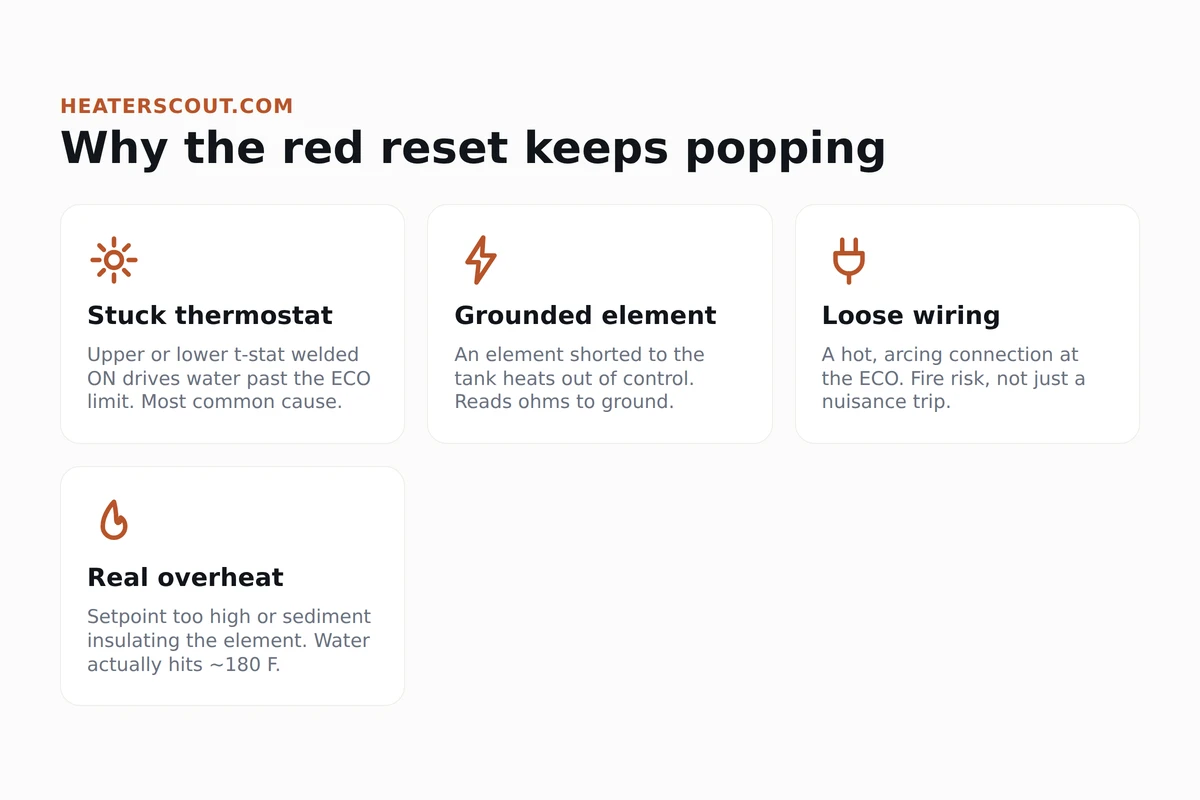
The five causes, in the order to chase them
The point of an ordered list is to stop you replacing the expensive-feeling part first. The ECO itself is the last suspect, not the first, because a good ECO tripping means it is doing its job against a real fault upstream.
| Cause | What is happening | How you confirm it | Fix / who |
|---|---|---|---|
| Thermostat stuck ON | Upper or lower t-stat contacts welded closed, element never shuts off | Continuity stays closed on an already-hot tank; lower stuck-on stacks heat up top | Replace the thermostat, DIY-friendly |
| Grounded / shorted element | Element coil touches its sheath or the tank, uncontrolled heating | Ohms terminal-to-tank reads anything but infinite; often trips breaker too | Replace the element, DIY-friendly |
| Loose / burned wiring | A high-resistance connection heats and arcs at the ECO | Discolored insulation, melted terminals, buzzing, burnt smell | Repair connection, lean toward a pro |
| Real overheating | Setpoint too high, or sediment insulating the lower element | Dial reads above 120 F, or tank is full of scale and slow to recover | Lower dial to 120 F, flush tank, DIY |
| Failed ECO / thermostat | The high-limit itself trips at too low a temperature | Everything else tests good and it still trips | Replace upper thermostat + ECO unit, DIY |
Notice that a stuck thermostat and a grounded element are both squarely homeowner-repairable, and both are cheap. The two cases that push toward a pro are loose or burned wiring, because that is where fires start, and any situation where you are not confident working next to 240-volt terminals. There is no shame in the phone call. There is real risk in guessing with the power on.
A good ECO tripping is the safety working. Chase the thing making the water hot, not the switch that noticed.electric tank service order
Reset it once, the safe way
You reset the ECO exactly once, to distinguish a fluke from a failure. The single most important step is the first one, and people skip it constantly.
Two trips is the limit
If the reset button trips a second time, do not press it a third. Repeated tripping means a shorted element, welded thermostat contacts, or arcing wiring is still dumping heat into the tank, and every one of those can start a fire or scald someone. Leave the breaker off until you have tested the parts.
Testing with a multimeter
A 20-dollar multimeter turns this from guessing into knowing. Two tests do most of the work: the element resistance test and the element ground test. Do both with the breaker off and the wires disconnected, and confirm the terminals are dead with a non-contact voltage tester before you touch metal.
For the resistance test, set the meter to ohms and put one probe on each of the two element terminal screws. A healthy 4500-watt, 240-volt element reads roughly 10 to 16 ohms; a 3500-watt one reads a little higher. Anything in the 10 to 30 ohm band is generally a live element. Zero ohms means the coil is shorted internally. No reading, infinite ohms, means the element is burned open. For the ground test, keep one probe on a terminal and touch the other to bare tank metal or the mounting flange. A good element reads infinite here. Any resistance to ground means the element is shorted to the tank, the fault that trips your ECO and often your breaker together. Do both elements.
For the thermostats, you are checking whether the contacts open and close with temperature. On a hot tank a healthy thermostat that reached setpoint shows open contacts, then closes them as the water cools. A thermostat that reads closed on an already-hot tank, or never opens, is stuck, and that is what lets the water run to the high limit. The lower thermostat stuck ON is the textbook cause: heat stacks toward the top and the upper ECO pops. Since the upper thermostat and the ECO share one body, a bad upper thermostat means replacing that combined upper unit.
Do I have to drain the tank to test or replace parts?
To test, no. The thermostats and the element terminals are dry, behind the access panels, so you can meter everything with the tank full. To replace an element, yes, you drain the tank below that element and pull it out, since the element threads into the water. To replace a thermostat, no draining needed, it clips to the outside of the tank against a bracket. So test first with the tank full, and only drain if the meter says an element is the bad part.
Which part to replace, and what it costs
Once the meter has named the culprit, the fix is a specific, cheap part. Match voltage and wattage exactly when you buy an element. A 4500-watt element on a 4500-watt heater; never step up to a higher wattage, because the existing breaker and wiring were sized for the original draw and a bigger element can overload them.
| Screw-in heating element | About $13 to $25. 4500 W / 240 V units run ~$13 to $18. Match watts and volts exactly. |
| Upper thermostat with ECO | About $15 to $25 for the combined upper unit. This is the part with the red button. |
| Lower thermostat | About $15 to $20. Separate from the ECO, controls only the lower element. |
| Element wrench + gasket | A few dollars. You need the 1-1/2 inch socket to unthread a screw-in element. |
| Multimeter | About $15 to $30 for a basic one. Pays for itself the first time it saves a wrong part. |
| Pro repair, parts + labor | Roughly $150 to $350 depending on region and how many parts are swapped. |
| Replace vs repair | Repair almost always wins unless the tank leaks or the heater is past ~10 to 12 years. |
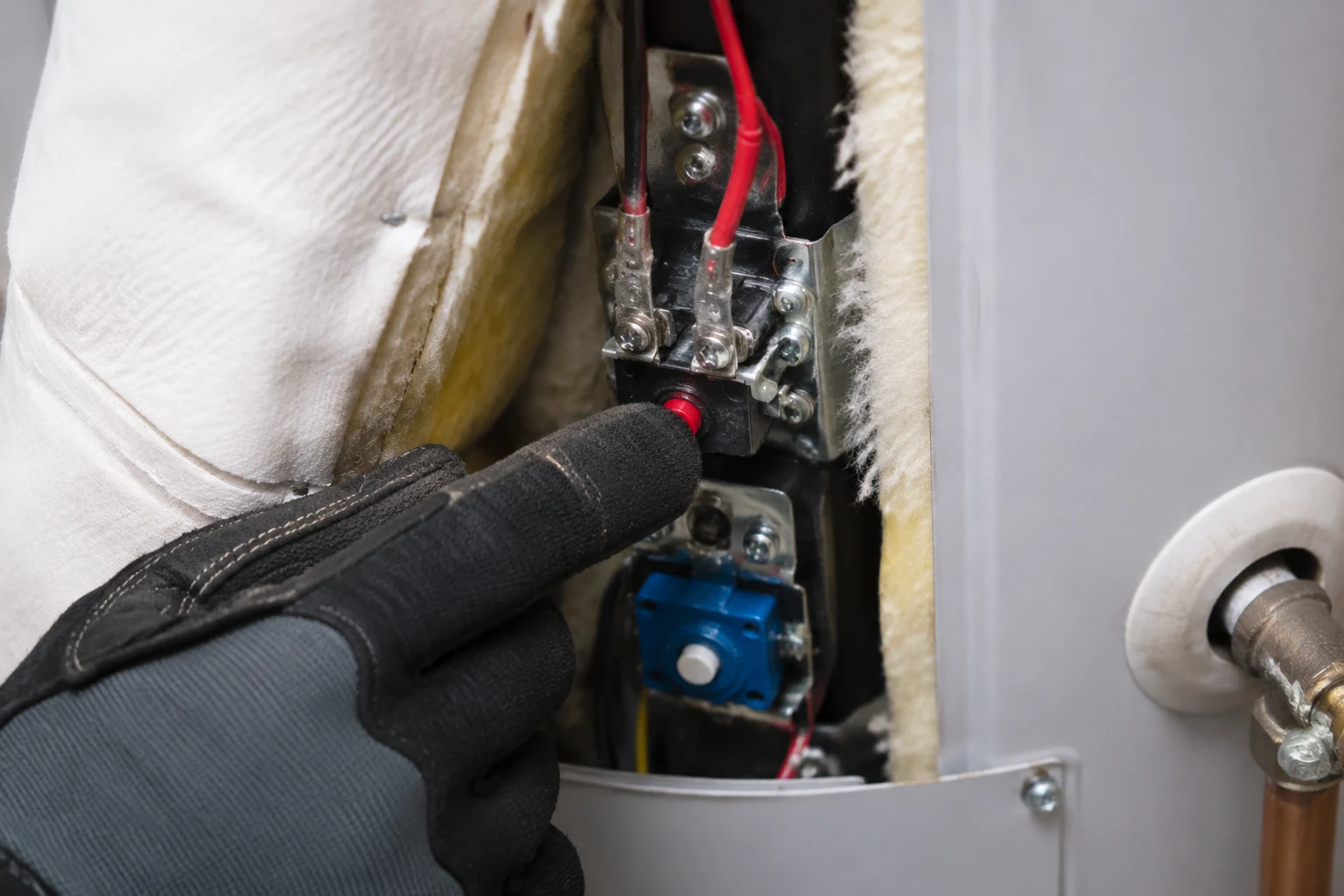
Draw the DIY line by fault, not by pride. Swapping a thermostat or an element is genuine homeowner work: breaker off, a screwdriver, an element wrench, a multimeter, and an hour or two. Repairing burned or arcing wiring, or diagnosing a fault you cannot pin down with the meter, is where a licensed plumber or electrician earns the 150 to 350 dollars, and where the fire risk justifies it. If you ever open the panel and find melted terminals or a scorched thermostat, close it back up and make the call.
Keeping it from coming back
Two habits prevent most repeat trips. Keep the setpoint at 120 degrees: it is safe against scalding, efficient, and it gives the ECO plenty of margin below its limit, so a small thermostat drift does not immediately pop the high limit. And flush the tank once a year to clear sediment, which otherwise insulates the lower element and forces it to overshoot. If you have had one part fail, the others are the same age, so test all four while you are in there. A heater that trips once and never again after a 120-degree reset was probably a fluke. One that keeps tripping has a bad part, and now you know how to find it with a meter instead of a guess.
Frequently asked
Why does my electric water heater reset button keep tripping?
That red button is the ECO, the high-limit cutoff built into the upper thermostat, and it opens when tank water climbs past roughly 180 degrees. Something is letting the water get that hot, or the safety itself failed. In rough order of likelihood: a thermostat stuck in the ON position that will not shut its element off, a heating element shorted or grounded to the tank, a loose or burned wiring connection generating heat at the switch, real overheating from a high setpoint or a sediment-buried element, and last the ECO or thermostat itself tripping at too low a temperature. The button popping again within minutes is the tell that the fault is real, not a fluke.
Is it safe to just keep pressing the reset button?
No. Reset it once, after cutting power at the breaker, to see whether it was a single event. If it holds and you have hot water, fine. If it trips again within minutes or hours, stop. That switch is the last line between a working heater and a scalding-hot tank, and forcing it back in defeats the safety without fixing the cause. Repeated tripping usually means a shorted element or welded thermostat contacts are still dumping heat into the water, and both can arc and start a fire. Once it will not stay after two presses, the next step is testing, not another press.
How do I reset the button the right way?
Turn off the 240-volt breaker feeding the heater first, always, because you will have your hands next to live line terminals. Pull the upper access panel, fold back the insulation, and pop off the plastic safety cover over the thermostat. The red ECO button sits just above the temperature dial. Press it firmly until you feel or hear a small click. Reassemble the cover, insulation, and panel, then switch the breaker back on. Give it 20 to 30 minutes and check for hot water. If the button was already pushed in and did not click, it had not tripped, and your no-hot-water problem is elsewhere, most likely a dead element or open thermostat rather than the high limit.
How do I test the heating elements with a multimeter?
Kill the breaker and confirm the terminals are dead with a non-contact voltage tester first. Loosen the two screws and pull the wires off the element. Set the meter to ohms. Across the two terminals a healthy 4500-watt, 240-volt element reads about 10 to 16 ohms; anywhere in 10 to 30 ohms is generally alive. Zero ohms is a dead short inside the element. No reading means it is burned open. Then the ground test: one probe on a terminal, the other on bare tank metal. That should read infinite. Any resistance to ground means the element is shorted to the tank, exactly what trips your ECO, and it gets replaced.
How do I know if the thermostat is the problem?
A thermostat trips the ECO in one specific way: its contacts weld shut, it never turns its element off, and the water heats until the high limit saves you. The classic version is the lower thermostat stuck ON, which stacks heat in the top of the tank and pops the upper ECO. Test it for continuity with the meter: a good thermostat opens its contacts once the water reaches setpoint and closes them again as it cools. One that reads closed on an already-hot tank, or never opens, is stuck and needs replacing. Because the upper thermostat and the ECO are one combined part, a failed upper thermostat means replacing that whole unit.
How much does it cost to fix a water heater that keeps tripping the reset?
The parts are cheap. A screw-in heating element runs about 13 to 25 dollars, and an upper thermostat with the integral ECO is roughly 15 to 25 dollars. Replacing both an element and the thermostat yourself is often under 50 dollars in parts plus a couple of hours. If you bring in a plumber or electrician, expect roughly 150 to 350 dollars for parts and labor depending on your area and which parts they swap. The math only tips toward a whole new heater when the tank itself is leaking or the unit is past 10 to 12 years old, because at that age you are chasing one worn part after another.
Can a grounded heating element trip both the reset button and the breaker?
Yes, and that pairing is a strong clue. When an element shorts to the tank sheath, it creates an uncontrolled electrical path that both heats the water abnormally fast, tripping the ECO, and can draw enough fault current to trip the circuit breaker or a GFCI. So if you are resetting the red button and the house breaker at the same time, suspect a grounded element first. The ohms-to-ground test settles it: any continuity between an element terminal and bare tank metal confirms the short. Replace that element and the double-tripping usually stops.
Will flushing the tank stop the reset button from tripping?
Sometimes, if the real cause is sediment. Mineral scale settling on the bottom over the lower element acts like a blanket, trapping heat so the element overshoots and the water locally overheats enough to eventually trip the high limit. Draining and flushing the tank clears that. But flushing does nothing for a welded thermostat, a grounded element, or a loose connection, which are the more common reasons the ECO pops. So flush as part of prevention and as a fix when overheating is the diagnosis, not as a blind first move when the button is tripping every few hours.