A standard electric water heater has two heating elements and two thermostats stacked inside the tank, and they never run at the same time. That single design fact explains almost every case of water that comes out warm but never truly hot. The upper element heats the top of the tank first, and the top is exactly the water that feeds your hot outlet. So when the top half of the system quits, the lower element keeps the rest of the tank lukewarm, and you get a steady stream that is warm from the first draw and never climbs. This page walks the split between upper and lower faults, the crossover and dip tube traps that mimic a dead element, and the multimeter tests that tell you exactly which part to replace before you spend a dollar.
Warm but never hot is the fingerprint of the upper element or upper thermostat, because the top of the tank is the water that leaves it.heaterscout diagnostic rule
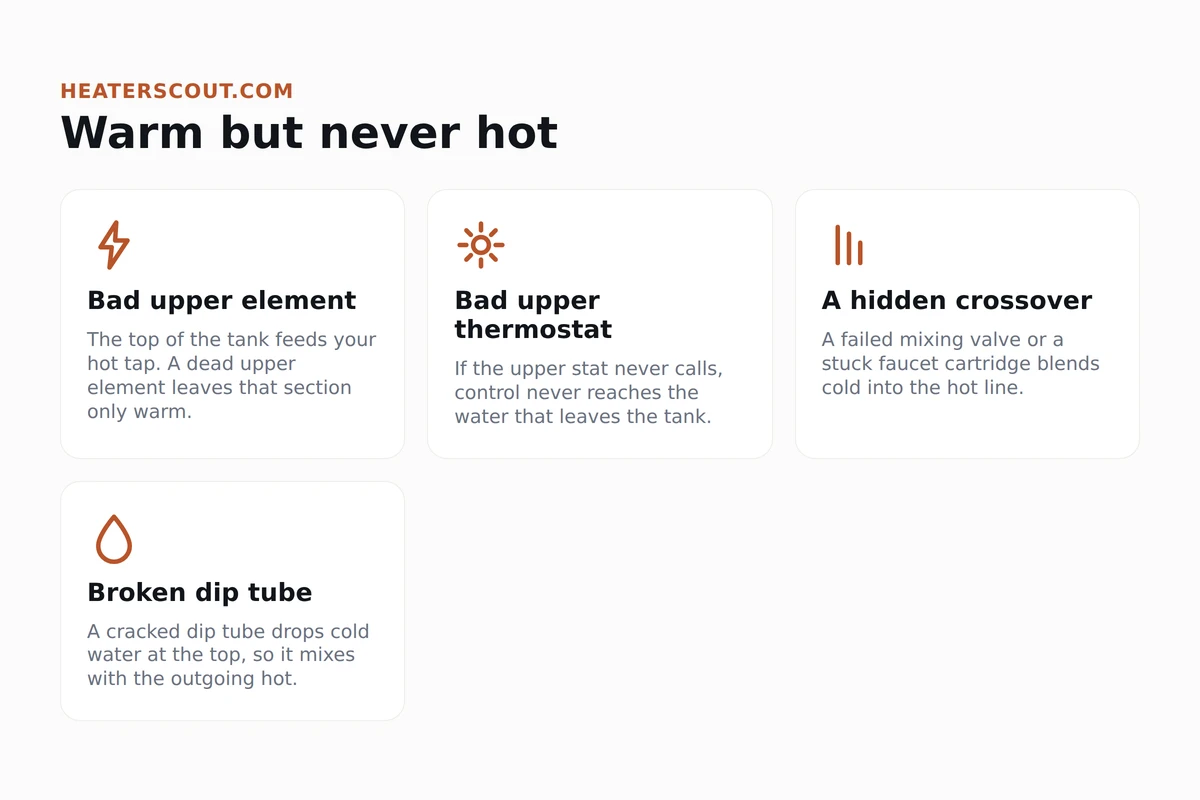
Upper element or upper thermostat
Water is warm from the very first draw and never improves. The top of the tank feeds the outlet, so a dead upper side gives steady lukewarm water. Test the upper element and stat first.
Lower element
Water starts genuinely hot and runs out fast, sometimes in a few minutes. The lower element heats the tank volume, so its failure cuts how much hot water you get, not the peak temperature.
Crossover or dip tube
Both elements test fine but water stays warm. Cold is blending into the hot line through a mixing valve, a stuck faucet, or a cracked dip tube. Isolate the tank and test before buying parts.
How a two-element electric tank actually works
Inside a standard electric water heater are two 240-volt elements, an upper and a lower, each paired with its own thermostat. The important part is that they alternate. They are wired so that only one draws power at a time, never both together. When you fire up the heater or open a hot tap, the upper thermostat gets first priority: it runs the upper element until the top of the tank hits temperature. Only then does control pass down to the lower thermostat, which runs the lower element to heat the rest of the tank.
That order is the whole story. The hot outlet pipe draws from the very top of the tank, so the water that leaves your heater is the water the upper element is responsible for. If the upper element or its thermostat fails, the top section never reaches full temperature. The lower element can still warm the bulk of the tank, but that heat sits below the outlet and mixes on the way out, so what reaches your tap is warm and steady rather than hot. Flip it around and the picture changes: a dead lower element leaves a properly hot top that drains fast, because only the small top section is fully heated.
| Water is warm, never hot | Upper element or upper thermostat (top feeds the outlet) |
| Hot at first, runs out fast | Lower element (heats the tank volume) |
| Warm even with good elements | Crossover or a broken dip tube blending cold in |
| Element resistance, healthy | From stamped wattage: R = 240 squared / watts, about 12 to 13 ohms for a 4500W element |
| Element resistance, burned out | Open or infinite (no continuity) |
| Element resistance, shorted | Near zero, or continuity to the bare tank |
| Correct thermostat setpoint | 120 to 125 F on both thermostats, matched |
Diagnose it in order
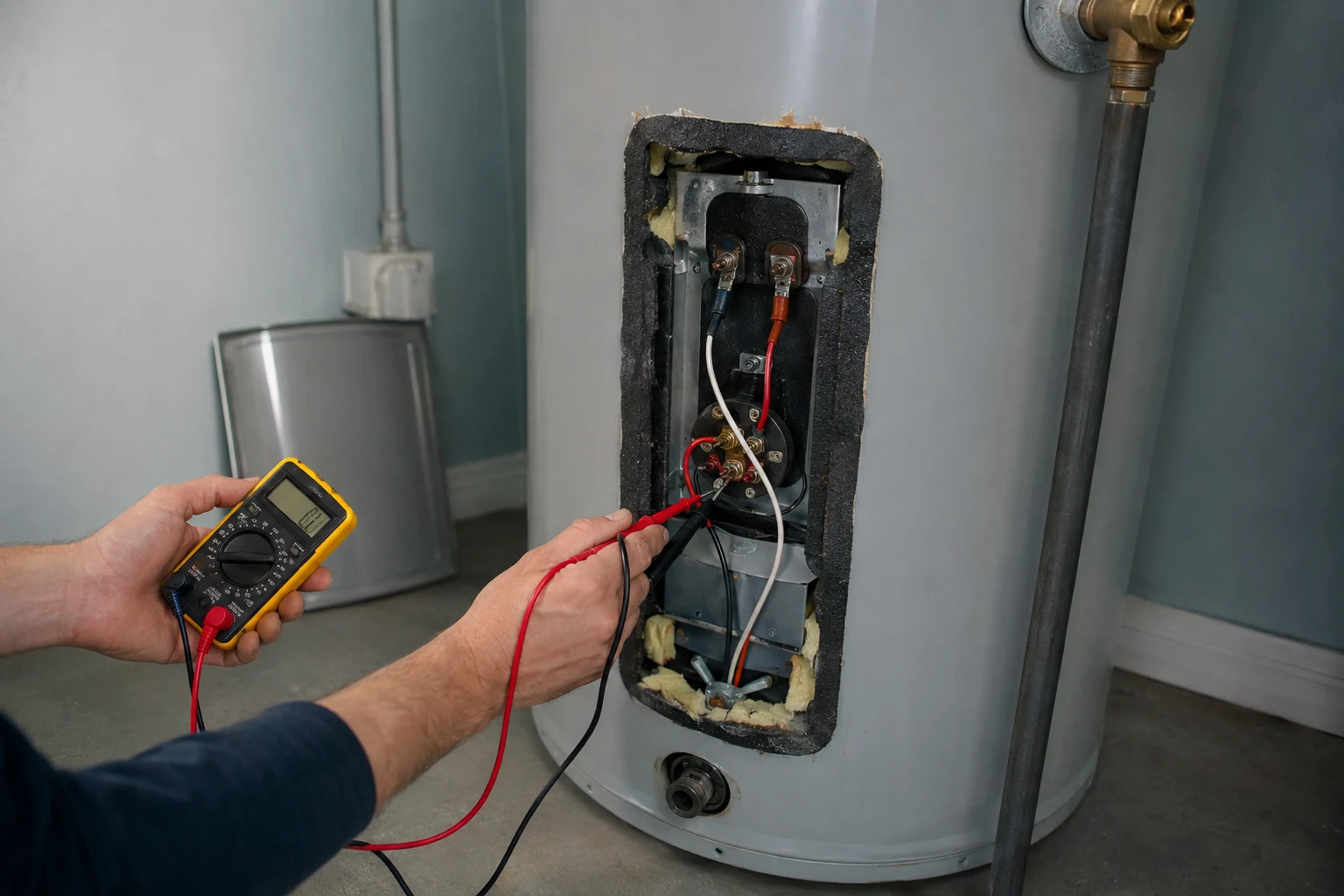
Work the cheap and free checks before you pull anything apart. The goal is to isolate whether the tank itself is failing to heat the top, or whether the tank heats fine and cold is leaking into the hot line somewhere in the house. These steps go from safest and simplest to the meter tests that name the part.
Quick answer
Warm but never hot on an electric tank almost always means the upper element or upper thermostat has failed, because the top of the tank feeds the hot outlet. Kill the breaker, confirm no voltage, press the red reset, and ohm the upper element: compute the expected resistance from the element's stamped wattage (R = 240 squared / watts, about 12 to 13 ohms for a 4500-watt element), while open or infinite means it is burned out. First, though, rule out a crossover by shutting the cold supply to the heater and opening a hot tap, because cold blending into the hot line mimics a dead element and wastes the price of a part.
Fix it and keep it fixed
Once the meter names the part, the repair is straightforward. A failed element gets drained down below its level, unscrewed with an element wrench or the right socket, and replaced with a matching wattage and voltage unit, with a fresh gasket. A bad thermostat unclips from its bracket and swaps in minutes, but make sure the replacement seats flat and snug against the tank so it reads temperature correctly. If your testing pointed at a crossover, the fix is the mixing valve, faucet cartridge, or check valve that was letting cold in, not anything in the tank at all.
Two habits keep the problem from coming back. Flush the tank to clear sediment, because a bed of scale on the tank bottom insulates the lower element and shortens its life, and buildup is a common reason elements burn out early. And rule out the crossover and dip tube before you buy parts, so you are not chasing a lukewarm symptom with a new element that was never the problem. A cracked dip tube dropping cold at the top produces the same warm water a dead upper element does, and no amount of new elements will fix it. Diagnose the real cause, then replace exactly the part the tests point to.
- Both thermostats set to the same value, 120 to 125 F.
- Crossover ruled out: cold supply off, hot tap runs dry within a minute.
- Breaker off and terminals confirmed dead with the meter before touching anything.
- Red high-limit reset pressed on the upper thermostat.
- Upper element ohmed: expected resistance from stamped wattage (R = 240 squared / watts, about 12 to 13 ohms for a 4500W element), open means burned out.
- Element checked for a short to the bare tank (any continuity there is a fail).
- Thermostat reseated flat and snug against the tank wall.
- Sediment flushed, and the dip tube considered if cold enters high in the tank.
Frequently asked
Why is my electric water heater warm but never hot?
The classic cause is a failed upper heating element or upper thermostat. A standard electric tank has two 240-volt elements stacked inside it, an upper and a lower, each with its own thermostat, and they take turns instead of running at the same time. The upper element heats the top third of the tank first, and that top section is exactly what feeds the hot outlet pipe. When the upper element burns out or the upper thermostat stops calling for heat, the lower element can still warm the rest of the tank, so you get water that is lukewarm but never climbs to a real hot temperature. That is the difference that matters: warm and steady points up top, while hot water that runs out fast points at the lower element. Before you buy a part, rule out a thermostat set too low, a broken dip tube, and a plumbing crossover, because all three can mimic the same lukewarm symptom without a single failed element.
Is it the upper or lower element when water is only warm?
Only-warm water points at the upper, and runs-out-fast points at the lower. Think about where each element sits and what it feeds. The upper element and its thermostat control the top of the tank, and the top is where the hot outlet draws from, so if the upper side is dead the water leaving the tank never gets fully hot no matter how long you wait. The lower element heats the bottom two thirds, which is the volume, the amount of hot water you get before it turns cold. So a lower failure gives you a normal hot start that quickly goes cold, sometimes after just a few minutes, while an upper failure gives you a steady stream that is warm from the very first draw and never improves. Match your symptom to that split before you open the tank, and you will usually know which half to test first.
How do I test a water heater element with a multimeter?
Kill the breaker first, then confirm with the meter that no voltage is present at the terminals before you touch anything. Remove both access panels, fold back the insulation and the plastic safety covers, and press the red high-limit reset button on the upper thermostat while you are in there. To test an element, set the meter to ohms and put one probe on each of the element's two terminals. Resistance depends on the element's stamped wattage: R equals 240 squared divided by watts, so a common 4500-watt element reads about 12 to 13 ohms. Compute the expected value from your element's rating rather than assuming a fixed band. An open or infinite reading means the element is burned out, and a reading near zero means it is shorted. Then check for a grounded element: put one probe on an element terminal and the other on the bare metal tank or the mounting bolt. Any continuity there means the element is shorted to the tank and needs replacing. You can also set the meter to 240 volts AC and confirm power is actually reaching the thermostat when the breaker is on, which tells you the fault is downstream.
What is a crossover and how do I test for it?
A crossover is cold water sneaking into your hot line, and it will make every fix you try feel useless. It happens when a failed mixing valve, a stuck single-handle faucet cartridge, or a recirculation loop check valve lets cold water blend into the hot side of the plumbing. The result is lukewarm water at the tap even though the tank itself is heating fine. Here is the test. Turn off the cold water supply valve going into the water heater, then open a hot tap somewhere in the house. If the tank is isolated and there is genuinely no cold getting in, that hot tap should run dry within a minute or so. If water keeps flowing steadily out of the hot tap with the cold supply to the heater shut off, cold is entering the hot line somewhere else, and you have a crossover. Chase the mixing valve, faucet cartridges, and any recirculation check valve before you spend money on elements or thermostats.
What temperature should my water heater be set to?
Around 120 to 125 degrees Fahrenheit is the standard target. That setting scalds slowly enough to be safe for a household while still being hot enough for showers and dishes and hot enough to discourage bacteria in the tank. If your water is only warm, check the dial on both thermostats before assuming a part failed, because a thermostat that was bumped down toward its low end, or set inconsistently between the upper and lower, can leave you with lukewarm water and nothing actually broken. Both thermostats should be set to the same temperature. If you dial them up and the water still will not get past warm, then you move on to testing the elements and thermostats for a real fault.
Can a broken dip tube cause only warm water?
Yes, and it is one of the sneakier causes. The dip tube is the plastic pipe that carries incoming cold water down to the bottom of the tank, so the cold enters low and the hot rises to the top where the outlet draws it off. When the dip tube cracks or breaks near the top, the incoming cold water dumps in high up instead of at the bottom, right where the hot outlet is pulling from. That cold immediately mixes with the hot on its way out, and every tap in the house delivers water that is only warm. The tell is that a dip tube failure often gets worse when you draw water fast, and you may see small bits of plastic in your faucet aerators or shower head. It is a cheap part, but replacing it means draining the tank and pulling the cold inlet nipple, so it is worth confirming before you dig in.
How much does it cost to fix an electric water heater that only gets warm?
The parts are cheap, and how far you go depends on the cause. A heating element usually runs about 15 to 40 dollars, and a thermostat is in the same neighborhood, both homeowner jobs with an element wrench and a screwdriver. A plumber to diagnose and swap an element or thermostat is roughly 150 to 350 dollars. A crossover fix depends on the culprit, from a cheap faucet cartridge to a mixing valve. The most expensive mistake is buying an element you did not need because you skipped the crossover test, so isolate the tank and confirm the fault first.