A 4500-watt heating element energized in an empty tank can burn open in under five seconds. That is the whole problem with dry firing in one number. An electric water heater element is a resistance coil built to work only while it is submerged, because the water around it is what carries the heat away. Strip that water off, from an empty tank, an air pocket over the upper element, or a level that dropped, and the coil has nowhere to dump its heat. It glows, blisters, and fails almost instantly. Newer A.O. Smith and electronic control heaters now watch for this and throw a dry-fire lockout to save the part. Simpler heaters do not, and there the lockout is just a dead element.
Water is not a bystander in an electric water heater, it is the coolant. Take it away and a healthy element destroys itself in seconds.Why dry firing is so fast
The verdict
Dry fire is an element powered while sitting in air instead of water; it burns open in seconds. The usual cause is turning power on before the tank is full and the air is bled. Newer A.O. Smith units detect it and lock the element out with a dry-fire alert; simple heaters just kill the element. To clear it: fill the tank and bleed all air first, then power-cycle the breaker for five minutes and press the red high-limit reset if it popped. If the element already burned open, test it with a meter and replace it. Fill and bleed before every power-on and this never happens.
What dry firing actually does to the element
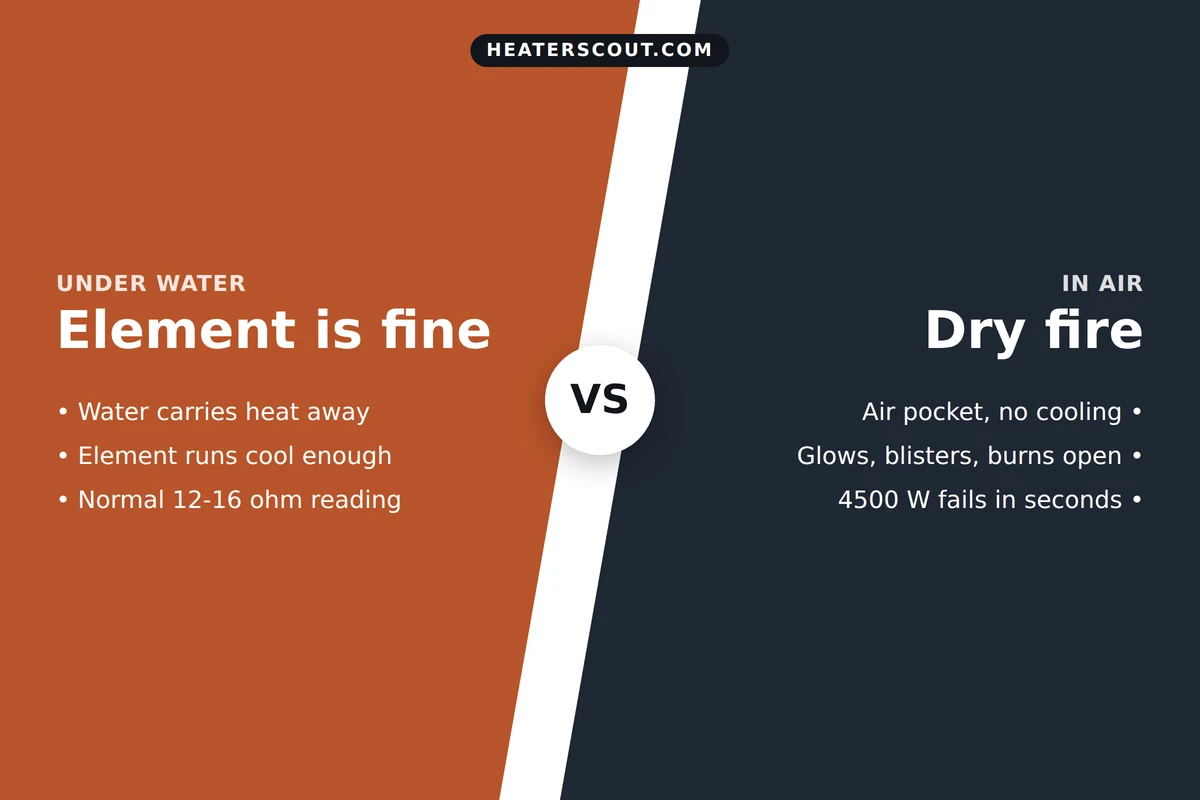
Inside the tank, the element is a folded resistance coil sheathed in metal. When it is underwater, the water in contact with the sheath pulls heat away as fast as the coil makes it, so the metal stays in a range it can live in for years. That heat transfer is the only thing keeping the sheath temperature sane. Air is a terrible conductor by comparison. An element sitting in an air pocket makes the same wattage of heat with almost nothing to carry it off, so the sheath temperature runs away in seconds. The metal glows, the insulation inside breaks down, and the coil either shorts or, far more often, burns open. Higher wattage fails faster because it is making more heat per square inch. This is why a dry fire is not a gradual wear-out. It is closer to blowing a fuse: near instant, and usually terminal for that element.
The numbers behind a dry fire
A few figures explain why this failure is so unforgiving and why filling first is not optional. The time-to-failure is short enough that there is no reaction window, and the healthy resistance is low enough that an open reading on your meter is unmistakable.
Quick answer
Dry fire means the element was powered while sitting in air, not water, so it overheated and burned open in seconds. To recover: confirm the tank is completely full and bleed the air by running a hot tap until the stream is steady with no sputter. Then power-cycle the breaker for about five minutes to clear a dry-fire lockout, and press the red high-limit reset button behind the upper panel if it tripped. If the element already burned open, it reads infinite resistance on a meter and must be replaced. Never restore power to an unfilled tank; that is the mistake that causes dry fire in the first place.
Why it happens, most common first
Almost every dry fire traces back to power reaching the element before water covers it. The order below is roughly how often each shows up. The first one is the overwhelming favorite.
The classic cause is turning the breaker on while the tank is still filling. Someone opens the cold supply, hears water rushing in, and flips power without confirming the tank is truly full. The upper element sits high in the tank, and a tank that is 90 percent full still leaves an air pocket at the top right where that upper element lives. Second is a trapped air pocket even after the tank seems full, because air did not get purged out the top. Third is a level that dropped, a slow leak or a partial drain, and then the heater got re-energized against a half-empty tank. Fourth, and slower, is heavy sediment that buries the lower element and insulates it from the water, so it overheats even though the tank is full. That last one is a cousin of dry fire more than a true one, but it kills elements the same way.
Homeowner can handle
- Fill the tank and bleed all the air at a hot tap
- Power-cycle the breaker for 5 minutes to clear the alert
- Press the red high-limit reset button if it popped
- Meter-test the element and swap a screw-in element
- Upgrade to a dry-fire-resistant low-watt-density element
Call a pro
- Dry-fire alert returns on a confirmed-full tank (bad board)
- You are not comfortable around 240-volt wiring
- Electronic control board was damaged by the dry fire
- Repeated element failures with no clear cause
- Any doubt after the zero-volt meter check
How the smart controls detect and lock out
On a heater with an electronic control, most notably A.O. Smith heat-pump and higher-end electric models, a dry-fire detection algorithm runs in the background. The logic is simple: if an element is energized and the control is not seeing the water temperature climb the way it should, it concludes there is no water on that element absorbing the heat. Rather than let the part cook, it cuts the element and posts a dry-fire alert on the display, then locks that element out. That lockout is protecting a good element, or telling you a bad one already failed. The key thing to understand is what the control cannot do: it cannot put water on the element for you. So a dry-fire alert is always a two-part message. Something is dry, and you need to fix that before you clear the code, or the moment you re-energize you are back where you started.
A plain dual-thermostat electric water heater, the common kind with no circuit board, has none of this. There is nothing watching for a dry element and no alert to post. On those heaters the only protection is passive and after-the-fact: the element burns open, and the high-limit ECO switch may trip and pop its red reset button. So when people say their basic heater locked out on a dry fire, what they actually have is a dead element and a tripped reset. That distinction matters, because on a simple heater there is no smart safety net, which makes the fill-and-bleed habit the entire defense.
Clearing the lockout, in order
The sequence matters more than any single step. Confirm water, then clear the code, never the other way around. Start by making sure the tank is genuinely full. Open a hot tap somewhere in the house and let it run. At first you will get sputtering and air; keep it open until the flow settles into a steady, quiet stream with no spitting. That steady stream is your proof the tank is full and the upper element is under water. If you want to be thorough, gently lift the temperature and pressure relief valve lever on top of the tank for a couple of seconds to purge any air trapped at the very top, then let it snap shut.
With the tank confirmed full, clear the control. On an A.O. Smith or other electronic unit, switch the breaker off, wait about five minutes, then switch it back on. That power-cycle resets the board and clears the dry-fire detection. If a high-limit reset button tripped, and it often does alongside a dry fire, open the upper access panel, fold the insulation and plastic safety cover out of the way, and press the red ECO reset button until you feel it click. Restore power and give the heater 20 to 30 minutes to start making hot water. If the dry-fire alert or the tripped high-limit comes right back on a tank you know is full, stop resetting. At that point the element is burned open or the control is damaged, and the fix is a test, not another reset.
Testing and replacing a burned element
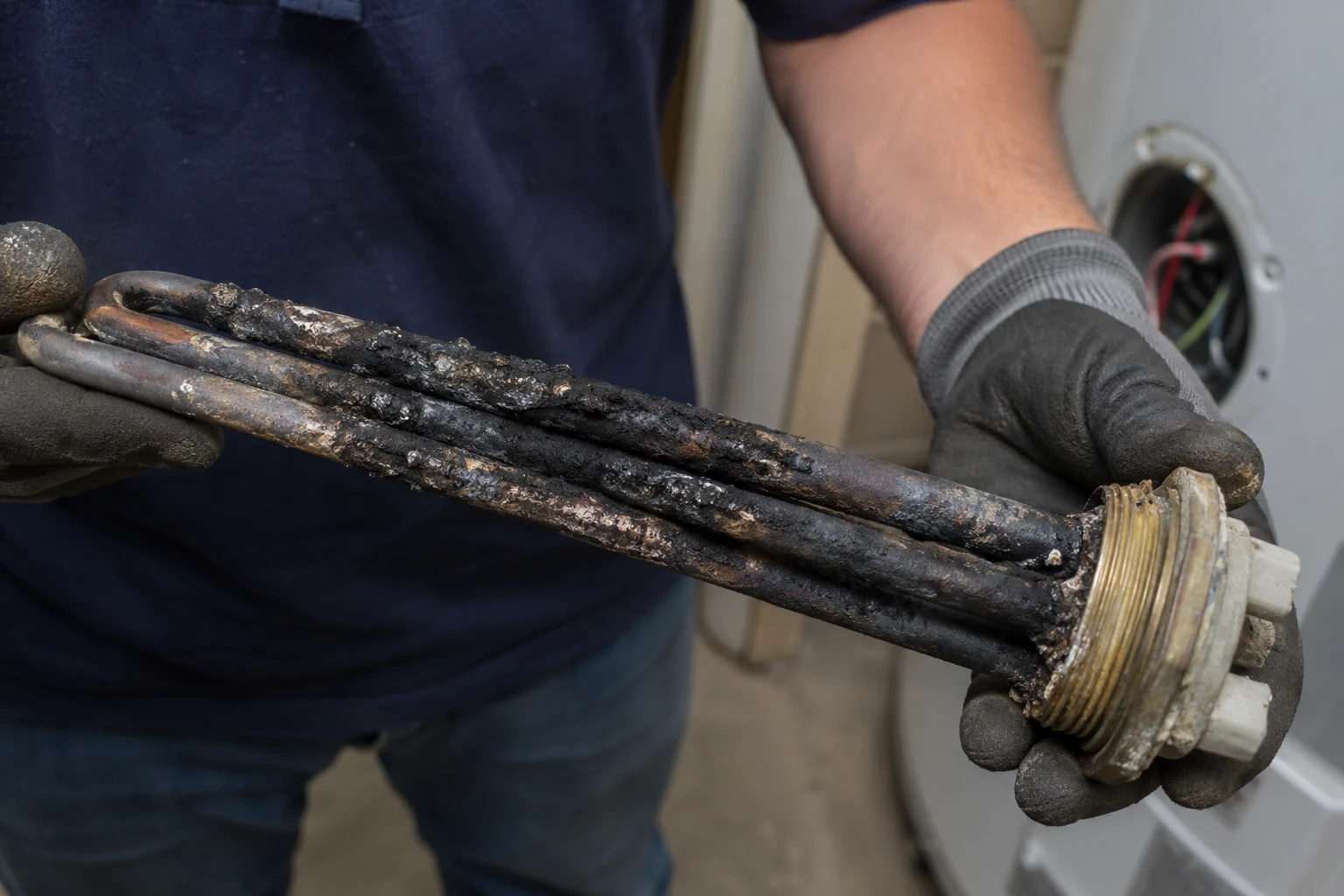
If resetting will not hold, test the element. Turn the breaker off, pull the access panel, and verify zero volts across the element terminals with your meter before you touch anything. Disconnect the two element wires. Set the meter to ohms and probe the two element terminals. A healthy 240-volt, 4500-watt element reads roughly 10 to 16 ohms, around 12.8 nominal. If you get OL or infinity, the element is open, burned through, dead. That is the signature failure of a dry fire. Next, check for a short to ground: put one probe on a terminal and the other on the bare metal of the tank. You want infinity there; any real reading means the element is shorted to the case and has to go.
To replace it, drain the tank below the element, unscrew the old one with an element wrench, and thread in the new one with a fresh gasket. Match the voltage and the wattage exactly, a 240-volt 4500-watt heater takes a 240-volt 4500-watt element. This is the moment to consider a dry-fire-resistant, low-watt-density element as the replacement. It spreads the same wattage over more surface area so the metal runs cooler, and while it will not survive a sustained dry fire, it forgives the brief moments in air that instantly kill a standard high-density element. It runs about 30 to 105 dollars versus 15 to 40 for a plain one, cheap insurance on a part you are already replacing. Refill and bleed before you restore power.
Preventing the next one
There is exactly one rule that prevents dry fire, and it costs nothing: fill the tank and bleed the air before the breaker ever goes back on. Every time. After any drain, any element swap, any new install, open a hot tap upstairs and run it until the stream is steady with no air or sputter, crack the T and P valve for a second to purge the top, and only then energize. That single habit closes off the most common cause. Beyond that, flush sediment out of the tank once a year so the lower element never gets buried, and never re-energize a heater you suspect has leaked or partly drained until you have confirmed it is full. Do those, and the fastest failure mode an electric water heater has simply never gets its chance.
Frequently asked
What is a dry fire on an electric water heater?
A dry fire is what happens when a heating element is energized while it is sitting in air instead of water. The element is a resistance coil that only survives because the water around it constantly pulls heat away. Take the water away, from an empty tank, a trapped air pocket over the upper element, or a level that dropped, and the element has nothing to dump its heat into. It glows red, blisters, and burns open, and it does this fast. A 4500-watt element can open in under five seconds dry. So a dry fire is not a slow decline, it is a near-instant kill. Newer A.O. Smith and some electronic-control heaters watch for it: if an element is powered but the water temperature is not climbing the way it should, the control figures there is no water on the element and locks that element out, posting a dry-fire alert instead of letting the part cook itself.
What causes a water heater to dry fire?
The number-one cause is turning the power on before the tank is completely full and the air is bled out. It is the classic install and DIY mistake: someone opens the cold supply, hears water running in, and flips the breaker without confirming the tank is truly full. The upper element sits high in the tank, so even a modest air pocket at the top leaves it uncovered while the tank looks like it is filling. Other causes are a level that dropped from a leak or a partial drain that then got re-energized, and heavy sediment that buries or insulates the lower element so it overheats even with water in the tank. Every one of these comes down to the same thing: an element making heat with nothing there to carry the heat away.
How do I clear a dry fire lockout on an A.O. Smith water heater?
First and non-negotiable: confirm the tank is actually full of water and the air is bled before you clear anything. Open a hot tap somewhere in the house and let it run until you get a steady, sputter-free stream with no spitting or air. That proves the tank is full and the upper element is submerged. Only then clear the alert. On a controlled A.O. Smith unit, cut power at the breaker for about five minutes, then restore it; that power-cycle resets the control board and clears the dry-fire detection. If a high-limit reset button popped, open the upper access panel, fold back the insulation, and press the red button until it clicks. If the alert comes right back after a confirmed-full tank and a clean reset, the element or the control is damaged and needs testing, not another reset.
Can I reset it myself or do I need a plumber?
Clearing the lockout is homeowner-level work: fill and bleed the tank, cycle the breaker for five minutes, press the red high-limit reset if it tripped. No special tools. Testing and replacing a burned element is also a common DIY job if you are comfortable killing the breaker, verifying zero volts with a meter, draining the tank, and swapping a screw-in element. Where people bring in a pro is when the dry-fire alert keeps returning on a confirmed-full tank, which points at a damaged control board rather than a simple element, or when they are not comfortable around 240-volt wiring. There is real voltage here, so if the meter step makes you uneasy, that is the honest line to call a plumber or electrician.
How do I know if the element is actually burned out?
Kill the breaker, confirm zero volts with a meter, then disconnect the two wires from the element and touch your multimeter probes to the two element terminals on ohms. A healthy 240-volt, 4500-watt element reads roughly 10 to 16 ohms, around 12.8 is nominal. A reading of OL or infinity means the element is open, burned through, and dead. A reading near zero means it is shorted. Then do the short-to-ground check: one probe on a terminal, the other on the bare metal tank body. Anything other than infinity there means the element is shorted to the case and is dangerous, replace it. A dry-fired element almost always reads open, because burning open in air is exactly how it failed.
How much does it cost to fix a dry-fired water heater?
The part is cheap. A standard screw-in element runs about 15 to 40 dollars at a home center. A dry-fire-resistant, low-watt-density element, the upgrade that resists this exact failure, runs roughly 30 to 105 dollars depending on brand and wattage; a Rheem Marathon 4500-watt sits around 61 dollars. If you replace it yourself you also want a fresh gasket, which usually comes with the element. A plumber doing the whole job, drain, swap, refill, typically charges about 200 to 350 dollars including labor. The expensive scenario is when the dry fire also damaged an electronic control board, since a replacement board can cost more than a plain element and sometimes more than the labor to install it.
Will a dry-fire-resistant element prevent this?
It helps, it does not make you immune. Dry-fire-resistant elements use a low watt density design, the same wattage spread over more surface area, so the metal runs cooler and can survive brief moments in air that would instantly kill a standard high-density element. They buy you seconds and forgiveness, which is real. But sustained dry firing will still destroy one eventually, and they do nothing to fix the underlying mistake of powering an unfilled tank. Think of them as a seatbelt, not a reason to skip filling and bleeding. The habit that actually prevents dry fire is filling the tank and purging the air every single time before the breaker goes back on.
Do all electric water heaters have dry-fire lockout?
No. Software dry-fire detection lives on newer units with an electronic control, most notably A.O. Smith heat-pump and higher-end electric models that run a detection algorithm and can post a dry-fire alert. A plain, common dual-thermostat electric water heater with no circuit board has no such feature. On those, there is nothing watching for a dry element; the only protection is the element burning open and the high-limit ECO switch tripping after the fact. So on a basic heater the lockout you experience is not a smart alert, it is a dead element and a popped reset button. That is exactly why the fill-and-bleed habit matters more on simple heaters, because they will not save you from the mistake.