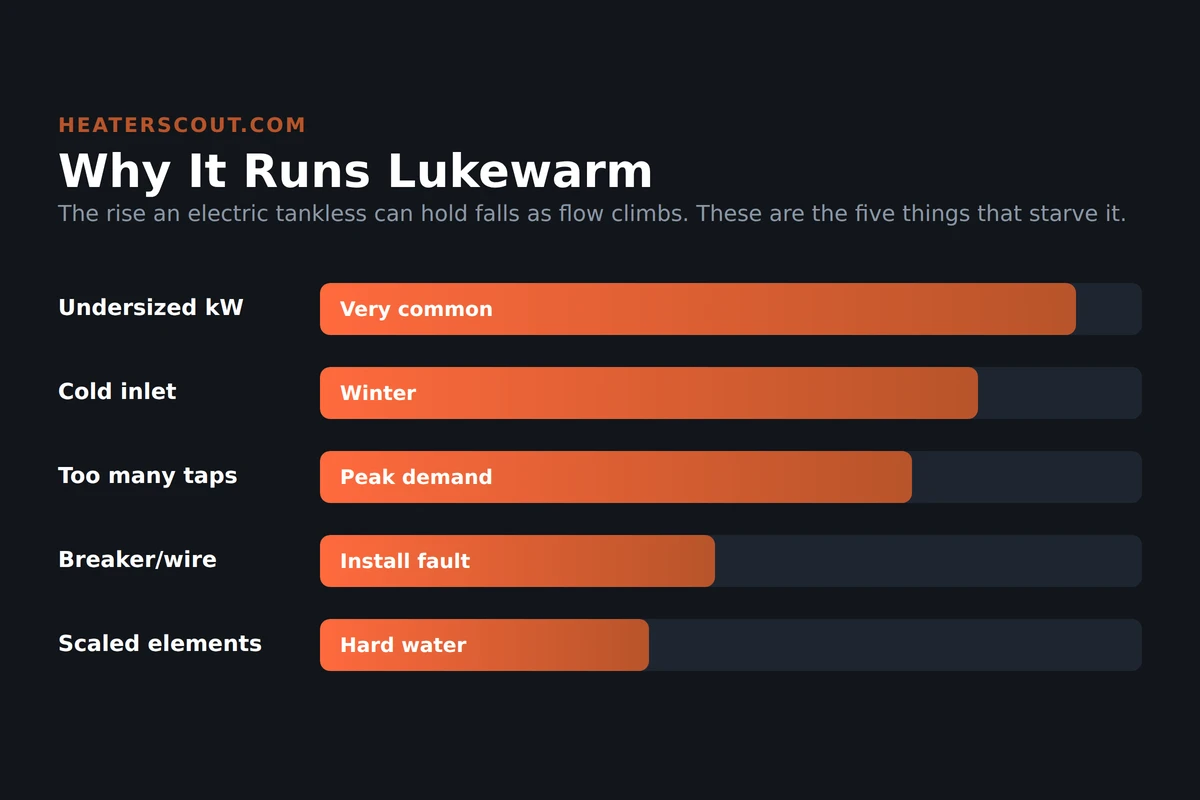
An electric tankless water heater has no tank to fall back on, so the temperature it delivers is decided in real time by one thing: how much power it can pour into the water versus how fast that water is moving. When it runs lukewarm, the heater is almost never broken. It has hit the wall between its fixed kilowatts and the load you are asking it to carry, and that load spikes in winter when incoming groundwater is coldest. This page works the actual sizing math, then walks the five reasons an electric tankless comes up short: undersized power, cold inlet, too much simultaneous flow, a breaker or wire that cannot feed it, and scale on the elements.
240 volts, three circuits, real current
An electric tankless heater draws 100 amps or more at 240 volts on the larger units, split across several double-pole circuits. Do not open the wiring compartment or reset element breakers blind. Every step past the front control panel is licensed-electrician work.
The one equation that explains all of it
Everything about a lukewarm electric tankless traces back to a single relationship, so it is worth carrying it in your head. To heat water you need power, and the power scales with both how much water you move and how far you have to lift its temperature. In the units printed on the heater's label, it works out to this: the kilowatts you need equal the gallons per minute times the temperature rise in Fahrenheit, divided by about 6.83. The rise is simply your target temperature minus the temperature of the water coming in from the ground.
That 6.83 is not arbitrary. Heating water takes 500 BTU per hour for every gallon-per-minute per degree Fahrenheit, and there are 3,412 BTU in a kilowatt-hour, so 500 divided by 3,412 is about 146.5. Turn it around and one kilowatt buys you 6.83 GPM-degrees. Rearranged, the flow a unit can actually serve is its kilowatts times 6.83 divided by the rise you need. So a 24-kilowatt heater needing a 70-degree rise can hold only about 2.3 gallons a minute at full temperature. Ask for more flow than that and the water leaves cooler, full stop.
Cause 1: the unit is undersized for your winter rise
This is the most common reason by a wide margin, and it usually hides until the first cold snap. A homeowner sizes a heater on a mild inlet, or takes the flashy GPM number off the box, and the unit performs beautifully through summer. The box rating is almost always quoted at a small rise, something like 3.75 gallons a minute at a 35-degree rise. That is a real number, but it describes a warm-inlet, low-rise world you do not live in during January.
Run the winter case instead. Say your target is 120 degrees and your coldest inlet is 45 degrees, a 75-degree rise. A 24-kilowatt unit can serve 24 times 6.83 divided by 75, which is about 2.2 gallons a minute at full temperature. That is barely one strong shower and nothing else. Bump to a 36-kilowatt unit and you get about 3.3 gallons a minute at that same rise. The fix here is not a repair; it is buying the right size, or accepting that one electric tankless cannot carry the whole house on cold water and splitting the load.
Cause 2: cold incoming groundwater
The rise is half the equation, and the inlet temperature drives the rise. Incoming groundwater in the United States runs from roughly 37 degrees in the northern states in winter to 77 degrees in the deep south in summer. Minneapolis sits near 37 in the coldest months; Pittsburgh near 42; Tampa stays a mild 65 to 70 in winter and can actually warm to 80-plus in late summer as shallow pipes bake in the sun. That spread is enormous for a tankless.
Watch what it does to the same heater. A 27-kilowatt unit on a 70-degree summer inlet needs only a 50-degree rise to hit 120, so it can push about 3.7 gallons a minute. Come January, the same target on 37-degree water is an 83-degree rise, and the unit drops to about 2.2 gallons a minute. Nothing changed in the hardware. The heater that carried two fixtures in July can barely carry one in January. If your tankless goes lukewarm only in cold weather, this is why, and it means the unit was sized to summer rather than winter.
Same heater, summer inlet
A 27 kW unit on 70-degree water making 120 needs a 50-degree rise, so it holds roughly 3.7 GPM at full temperature. Two fixtures feel fine.
Same heater, winter inlet
The same unit on 37-degree water needs an 83-degree rise for the same 120 setpoint, and flow at full temperature falls to about 2.2 GPM. One shower is now the limit.
What that means for sizing
Always size on the winter inlet for your region. A heater sized to the summer number will always disappoint in the season you most want hot water.

Cause 3: too many fixtures open at once
Flow adds up, and the unit sizes itself against the total, not the individual tap. A single shower pulls 1.8 to 2.5 gallons a minute. Add a kitchen faucet at 1.5 and you are drawing close to 4 gallons a minute through a heater that looked strong at 2. The available rise falls in direct proportion to that combined flow, so the more you open, the cooler everything gets.
Put numbers on it. A 24-kilowatt unit at 2 gallons a minute holds an 82-degree rise, plenty for a hot shower on moderate inlet. Open a second fixture to reach 4 gallons a minute and that rise halves to about 41 degrees. On 50-degree winter water that is 91-degree output, which is lukewarm and dropping. The heater is behaving exactly as designed; you simply asked for more than its kilowatts can serve. The answers are to stagger hot-water use, size the unit for your true simultaneous peak, or add a small point-of-use heater at a distant fixture so it stops loading the main unit.
Cause 4: an undersized breaker or wire
A large electric tankless is not a single-circuit appliance, and a wiring shortcut at install will make a correctly sized unit act underpowered. A 24-kilowatt heater draws about 100 amps at 240 volts, a 27-kilowatt unit about 112, and a 36-kilowatt unit about 150. No single residential breaker carries that, so the elements are split across two or three double-pole breakers, each on its own wire run, commonly 8-gauge copper feeding a roughly 40-amp element bank.
If an installer landed only some of those circuits, undersized a breaker, or one leg has since tripped, the unit energizes a fraction of its elements and performs like a much smaller heater. The symptom is identical to being undersized: strong at a trickle, lukewarm at real flow. Two tells point here rather than at sizing. One, the unit was hot at first and faded, suggesting a tripped or loose circuit. Two, a big unit never met its rating out of the box, suggesting it was wired short from day one. Either way, this is not a homeowner reset. Have a licensed electrician confirm every element circuit is live, correctly breakered, and wired to the manufacturer's table.
When the panel is the problem
If a large tankless only ever powers part of its elements, the fix is at the panel, not the heater. Resetting a breaker that keeps tripping without finding why is how you end up with a melted lug. This is the one cause on this list that is squarely an electrician's job.
Cause 5: scale on the heating elements
Tankless heaters get sold as maintenance-free because there is no tank to drain, but the elements still sit in whatever water your house has. In hard water, calcium and magnesium bake onto the elements and the narrow internal passages as a concrete-hard crust. That crust does two bad things: it insulates the element so less heat reaches the water, and it narrows the flow path so the unit restricts and can trip its own overheat protection. The result is a heater that slowly, over a year or two, stops making the heat it used to.
The tell for scale is the timeline. A unit that was clearly hot enough at install and gradually cooled, in an area with hard water, is a descaling candidate. Flush it with a descaling pump and a food-grade solution through the service valves, then hold a schedule of every one to two years. If the heat comes back after a flush, add a water softener so the scale does not simply rebuild. But keep the diagnosis honest: if the unit was never hot enough from the first day, scale is not your problem and no amount of flushing will add kilowatts. That is a sizing conversation.
Quick answer
An electric tankless runs lukewarm when the temperature rise you are asking for, at the flow you are drawing, needs more kilowatts than the unit has. The rise is your target minus the incoming water temperature, and it spikes in winter when groundwater is coldest. Work the math: kilowatts equal gallons per minute times the rise in Fahrenheit divided by 6.83. If the number exceeds your unit's rating, the heater is undersized for that moment, and it will either cut flow or drop temperature. Confirm the unit is getting full power across all its element circuits, descale it if hard water has crusted the elements, and stagger fixtures or size up if the load genuinely exceeds the kilowatts.
Frequently asked
Why is my electric tankless water heater not getting hot enough?
Almost always it is running out of power for the job you are asking of it. An electric tankless heater does not store hot water; it heats it on the fly, and the temperature it can add depends on how fast the water moves through it. The math is fixed: kilowatts needed equals gallons per minute times the temperature rise in Fahrenheit, divided by about 6.83. If your incoming water is 45 degrees and you want 120 at the tap, that is a 75-degree rise. Push 4 gallons a minute through and you need roughly 44 kilowatts, which is more than any residential unit makes. The heater does the only thing it can: it either cuts the flow to protect the setpoint or lets the temperature sag. Cold winter groundwater, too many fixtures open at once, an undersized unit, scale on the elements, or a breaker and wire that cannot feed full power all push you into that same corner.
What temperature rise can an electric tankless water heater actually deliver?
It depends entirely on flow, because the kilowatts are fixed and the rise is what gives. Take the unit's rated kilowatts, multiply by 6.83, and divide by the gallons per minute you are drawing to get the rise it can hold at that flow. A 24-kilowatt unit at 2 gallons per minute can lift water about 82 degrees. Open a second fixture and pull 4 gallons per minute through the same unit, and that rise halves to roughly 41 degrees. That is the whole trap. On paper a heater looks strong at low flow, then falls apart the moment you draw real volume. Size on your worst case: the coldest winter inlet and the most flow you actually run at once.
Does cold incoming water make my tankless run cooler?
Directly, and more than most people expect. Groundwater in the northern United States drops to around 37 degrees in winter, while southern states sit at 65 to 77. A unit that comfortably makes a 50-degree rise handles a 70-degree summer inlet with room to spare, then chokes in January when the same 120-degree setpoint suddenly needs an 83-degree rise on 37-degree water. Nothing broke. The heater is doing the same work; the load just grew. This is why a tankless that was fine all summer starts delivering lukewarm showers the first cold week. Size for the winter inlet in your region, not the annual average, and definitely not the summer number a salesperson quoted.
Can a wrong breaker or wire size make a tankless heater weak?
Yes, and it is a common install fault. A large electric tankless does not run on one circuit. A 24-kilowatt unit draws about 100 amps at 240 volts, a 27-kilowatt unit about 112, and a 36-kilowatt unit about 150, so the elements are split across two or three double-pole breakers with their own wire runs, often 8 gauge copper per roughly 40-amp element. If an installer wired only some of those circuits, undersized the breakers, or one leg tripped, the unit powers a fraction of its elements and behaves like a much smaller heater. It will feel underpowered exactly the way an undersized unit does. If a big tankless was strong at install and faded, or never met spec, have an electrician confirm every element circuit is live and correctly sized.
Will descaling fix an electric tankless that lost heat?
It helps when hard water is the cause, and it is worth ruling in or out. Even without a storage tank, calcium and magnesium bake onto the heating elements and the internal passages. That scale is an insulating crust: it slows heat transfer from element to water and narrows the flow path, so the unit both heats less efficiently and can trip on its own overheat protection. A heater that gradually cooled over a year or two in a hard-water area is a prime descaling candidate. Flush it with a descaling pump and food-grade solution, and set a schedule of every one to two years going forward. If descaling brings the heat back, install a softener so it does not creep back. If the unit was never hot enough from day one, scale is not your problem; sizing is.
Why does the water go cold when I run two fixtures at once?
Because the two flows add, and the unit sizes itself against the total. A shower might pull 2 gallons a minute and a kitchen tap another 1.5, so the heater now sees 3.5 gallons per minute instead of 2. The available rise falls in proportion. A 24-kilowatt unit that held a solid 82-degree rise on the shower alone drops to about a 47-degree rise across 3.5 gallons a minute, and on cold inlet that is the difference between a hot shower and a lukewarm one. This is normal physics, not a fault. Either stagger your hot-water use, install a unit sized for simultaneous demand, or add a second point-of-use heater for the far fixture.
How many GPM should an electric tankless deliver for a whole house?
For a whole house you are usually planning around 5 to 10 gallons per minute of simultaneous hot-water demand, though most homes rarely peak at the top of that. A single shower runs 1.8 to 2.5 gallons a minute, and stacking a shower plus a sink or a second shower is where the total climbs. The catch is that gallons per minute is only half the spec; it means nothing without the rise it is measured at. A unit rated for 8 gallons per minute at a 35-degree rise is a very different heater than 8 gallons per minute at a 70-degree rise. Match the flow you need to the rise your coldest month demands, and only then compare units.